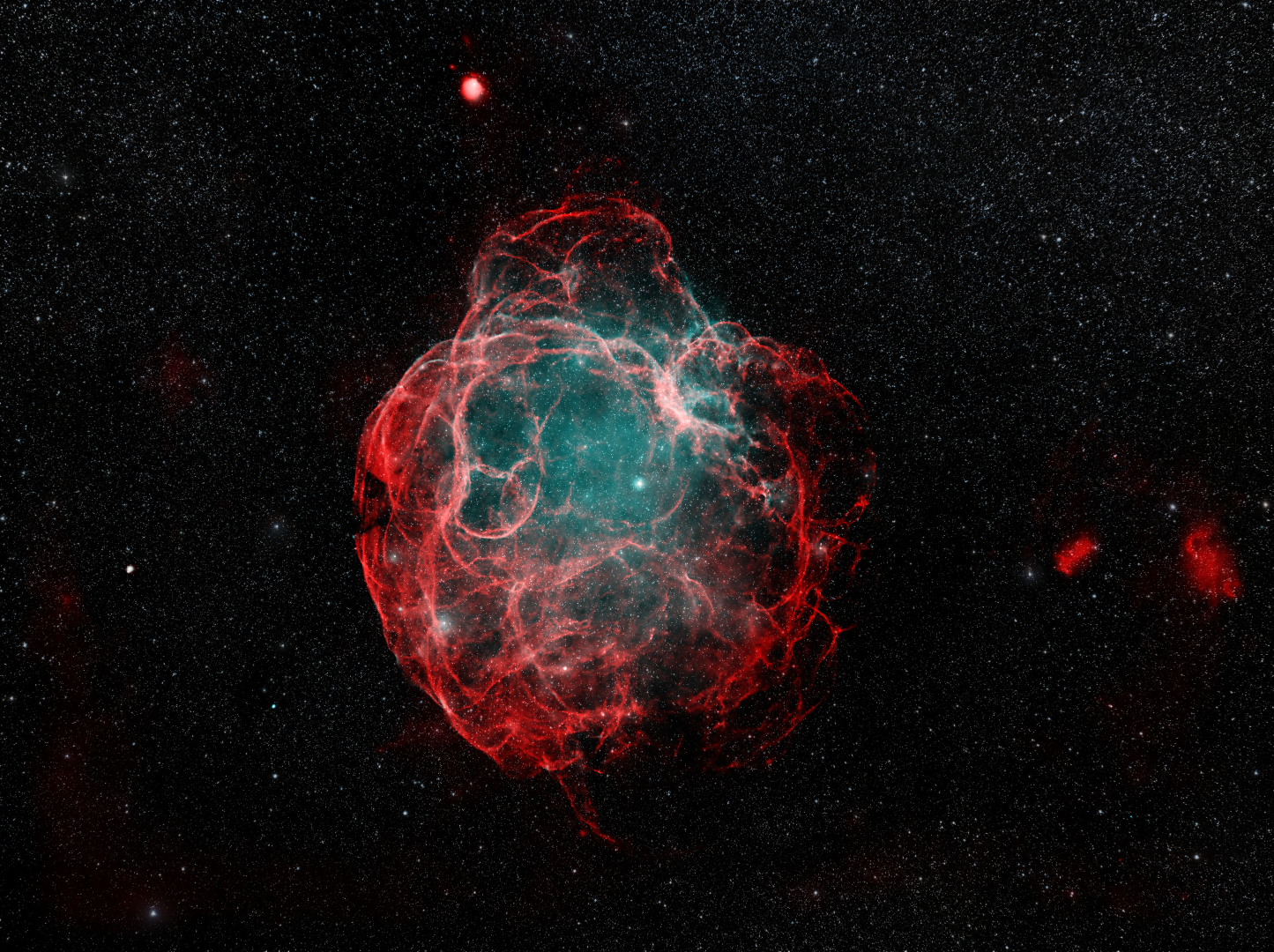
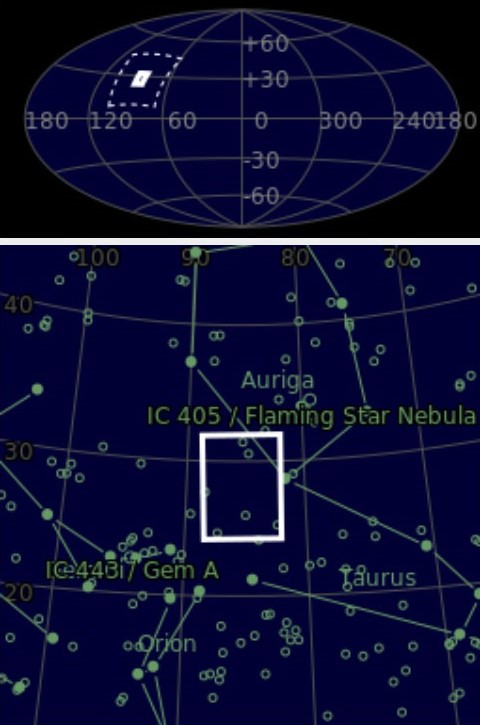
Straddling the boundary of Taurus and Auriga, is the giant supernova remnant (SNR) Simeis-147 AKA SH2-240 or the Spaghetti Nebula. It is believed that the stellar explosion that created Simeis-147 occurred some 40,000 years ago, leaving behind a rapidly spinning neutron star or pulsar at the core of the now complex, expanding SNR; the nebulous area has an almost spherical shell consisting of numerous filamentary structures. With an apparent diameter of 3o the SNR spans some 160 light-years, making it a very large astrophotography target.
I’ve long admired the spectacular SNR Simeis-147 AKA Spaghetti Nebula, which I first imaged with my standard William Optics GT81 scope in January 2022. The outcome (see image below) was pleasing but with the limited FOV it had to be just a nibble of this large object – something of an appetiser you might say. Therefore, ever since putting my Samyang rig together last summer I’ve had only one object in mind with this excellent widefield set-up, which had to be the full menu version of Simeis-147!

Apart from its size, Simeis-147 is very faint, making long exposure time essential, which is always difficult in the UK. However, a rare spell of cold, clear nights this January provided sufficient opportunity over five nights to obtain just over 20-hours integration and a complete image of this truly magnificent SNR.
Notwithstanding the favourable conditions and long-time achieved – a record for me at this location – the faint nature of this object made image processing difficult too. After experimenting, I eventually adopted a tone mapping technique: pre-processing each individual wavelength stack before removing the stars, stretching and processing each of the starless Ha and OIII images before combining using Pixel Math in the ratio: R – (Ha*1.70) + G – (OIII*0.80)+(Ha*0.20) + B- (OIII*0.80)+(Ha*0.20).
With further processing of the HOO starless combination I was able to obtain the desired result of marvellous SNR detail, together with pleasing Ha (red) and especially OIII (blue/green) colours, that altogether with the addition of the stars and some final tweaking produced a striking image with good depth. Moreover, I feel the widefield setting achieved using the Samyang 135 lens produces a striking setting for this fascinating object.
| IMAGING DETAILS | |
| Object | Simeis 147 / SH2-240 AKA Spaghetti Nebula |
| Constellation | Taurus |
| Distance | 3,000 light-years |
| Size | Approx. 3.0o |
| Apparent Magnitude | Extremely faint |
| Scope / Lens | Samyang 135 @f2.8 |
| Mount | SW AZ-EQ6 GT + EQASCOM computer control & Cartes du Ciel |
| Guiding | Sky-Watcher EvoGuide 50ED |
| + Starlight Xpress Lodestar X2 camera & PHD2 guiding | |
| Camera | ZWO1600MM-Cool mono CMOS sensor |
| FOV 7.5o x 5.67o Resolution 5.81”/pix Max. Image Size 4,656 x 3,520 pix | |
| EFW | ZWOx8 EFW & 31mm ZWO LRGB & 7nm Narrowband filters |
| Capture & Processing | Astro Photography Tool + PHD2 + PixInsight v1.8.9-1 |
| Image Location & Orientation | Centre: RA 05:41:15.081 DEC +28:05:32.778 Right = North Top = East |
| Exposures | 60 x 600 sec Ha, 62 x 600 sec OIII Total Integration Time: 20 hr 20 min |
| @ 139 Gain 21 Offset @ -15oC | |
| Calibration | 5 x 600 sec Darks 20 x Flats & Flat Darks |
| Location & Darkness | Fairvale Observatory – Redhill – Surrey – UK Typically Bortle 5 – 6 |
| Date & Time | 12th 17th 18th 19th & 21st January 2023 @ +18.30h |
| Weather | Approx. <=0oC RH >=80% 🌙 70% to 0o New Moon |
 WATCH THIS SPACE(MAN)