
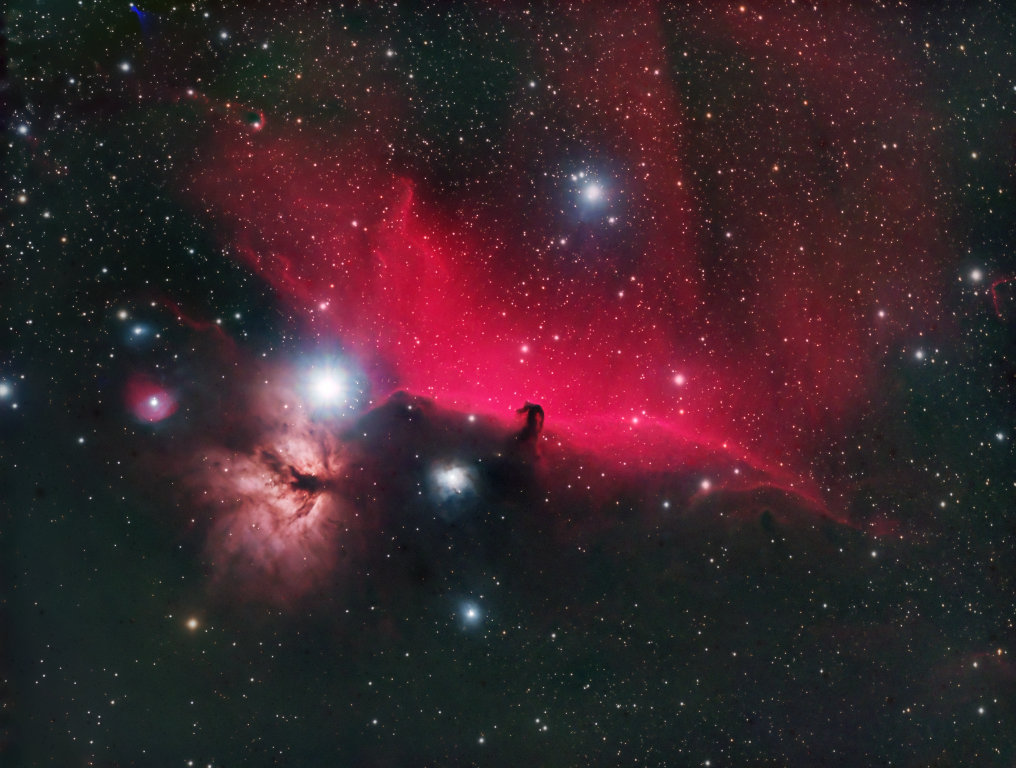
The dark silhouette of the Horsehead Nebula against the surrounding rich HII-region, is one of astronomy’s most iconic images. Surprising then that I’ve never imaged this object in broadband wavelengths before with my mono camera: the first image was in February 2015 using a modded Canon 55OD camera, then in January 2019 with the ASI1600MM + narrowband filters and most recently in January 2021 using a widefield Samyang 135/f2 rig and modded Canon DSLR. Therefore, somewhat belatedly and with the benefit of unusually long spells of clear skies, this February I set out to rectify this omission from my astrophotography repertoire.
Whilst B33 the Horsehead Nebula gets most of the attention, this large HII-region contains many other exciting objects which a broadband image shows off well, aided here by additional Ha-data (see below) to enhance the breath-taking detail that abounds across the area. Situated in close proximity to Orion’s Belt, controlling bright stars such as Alnitak is key to achieving a good image and in this regard my new Chroma filters proved helpful. The final image shows a good rendition of the Horsehead at the centre, framed against the striking red curtain of Ha-rich nebulosity and two other interesting objects nearby.

Within the large molecular cloud, located just below and to the left of the Horsehead, is the emission and reflection nebula NGC 2023. Discovered by William Herschel in 1785, at 10 x 10 arcminutes it is one of the largest reflection nebulas, illuminated at its centre by the Herbig Ae/Be star HD 37903 (a pre-main-sequence star). Then, just to the left (north) of NGC 2023 is the dramatic NGC 2024 Flame Nebula, an emission nebula energised by the adjacent and very bright Alnitak star and a cluster of young stars within. I was keen to preserve its more natural colour during processing and am very satisfied with the outcome, which captures its relationship with Alnitak to best effect.
Overall, I’m very happy with the resulting HaLRGB broadband image of the Horsehead and its neighbours. Armed with better filters, guiding, integration and processing I feel the long wait was perhaps worth it, so that this image does justice to one of winter’s most spectacular views. As the Horsehead now moves out-of-sight over the western horizon for another year, I trust my next image of these objects will be sooner than it took this time!
| IMAGING DETAILS | |
| Object | B33 Horsehead Nebula + NGC 2023 & Flame Nebula |
| Constellation | Orion |
| Distance | 1,375 light-years |
| Size | Horsehead only approx..8.0’ X 6.5’ |
| Apparent Magnitude | Varies, Horsehead +6.8 |
| Scope | William Optics GT81 + Focal Reducer FL 382mm f4.72 |
| Mount | SW AZ-EQ6 GT + EQASCOM computer control & Cartes du Ciel |
| Guiding | William Optics 50mm guide scope |
| + Starlight Xpress Lodestar X2 camera & PHD2 guiding | |
| Camera | ZWO1600MM-Cool mono CMOS sensor |
| FOV 2.65o x 2.0o Resolution 2.05”/pix Max. image size 4,656 x 3,520 pix | |
| EFW | ZWOx8 EFW & 31mm Chroma LRGB & 3nm Ha, OIII, SII filters |
| Capture & Processing | Astro Photography Tool + Deep Sky Stacker, PixInsight v1.8.8-12, Photoshop CC, Topaz Denoise |
| Image Location & Orientation | Centre: RA 05:40:41.563 DEC -02:23:42.659 Left = North |
| Exposures | 35 x 120 sec LRG(34)B + 78 x 300 sec Ha Total Integration Time: 11hr 8min |
| @ 139 Gain 21 Offset @ -20oC | |
| Calibration | 10 x 120 sec & 5 x 300sec Ha Darks + 15 x LRGB Flats & Dark Flats @ ADU 25,000 |
| Location & Darkness | Fairvale Observatory – Redhill – Surrey – UK Typically Bortle 5-6 |
| Date & Time | 21st 22nd 24th 25th February 2022 @ +19.15h |
| Weather | Approx. <4oC RH >=75% 🌙 <60% waning |
 WATCH THIS SPACE(MAN)