Two’s Company

For good reason spring is known as “galaxy season” by astronomers but during this period, shortly before astronomical darkness inevitably disappears for summer, there’s also another show in town.  Closer to home in the denser extremities of our galaxy, over 150 globular clusters have so far been identified orbiting above and below the plane of the Milky Way within the galactic halo.  Globular clusters consist of hundreds of thousands of tightly packed stars that are surely one of the more enigmatic features of astronomy, as we now know that similar clusters also are associated with other galaxies throughout the Universe.  Whilst the formation of globular clusters is poorly understood, we do know that at 10.0 to 13.5 billion years they are very old.  Given their age, location and density, it seems that globular clusters formed under very different circumstances to the more recent dispersed star clusters.
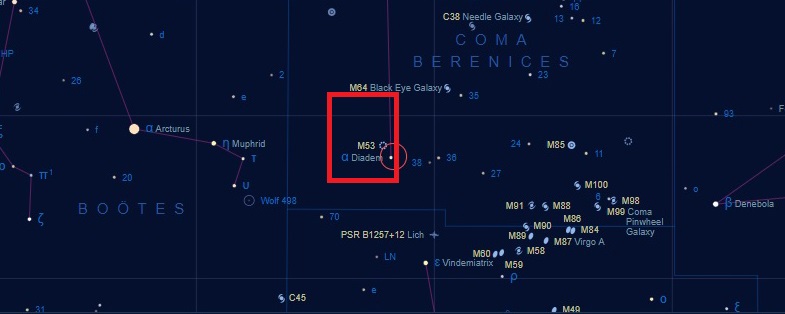
Image Setting / Location

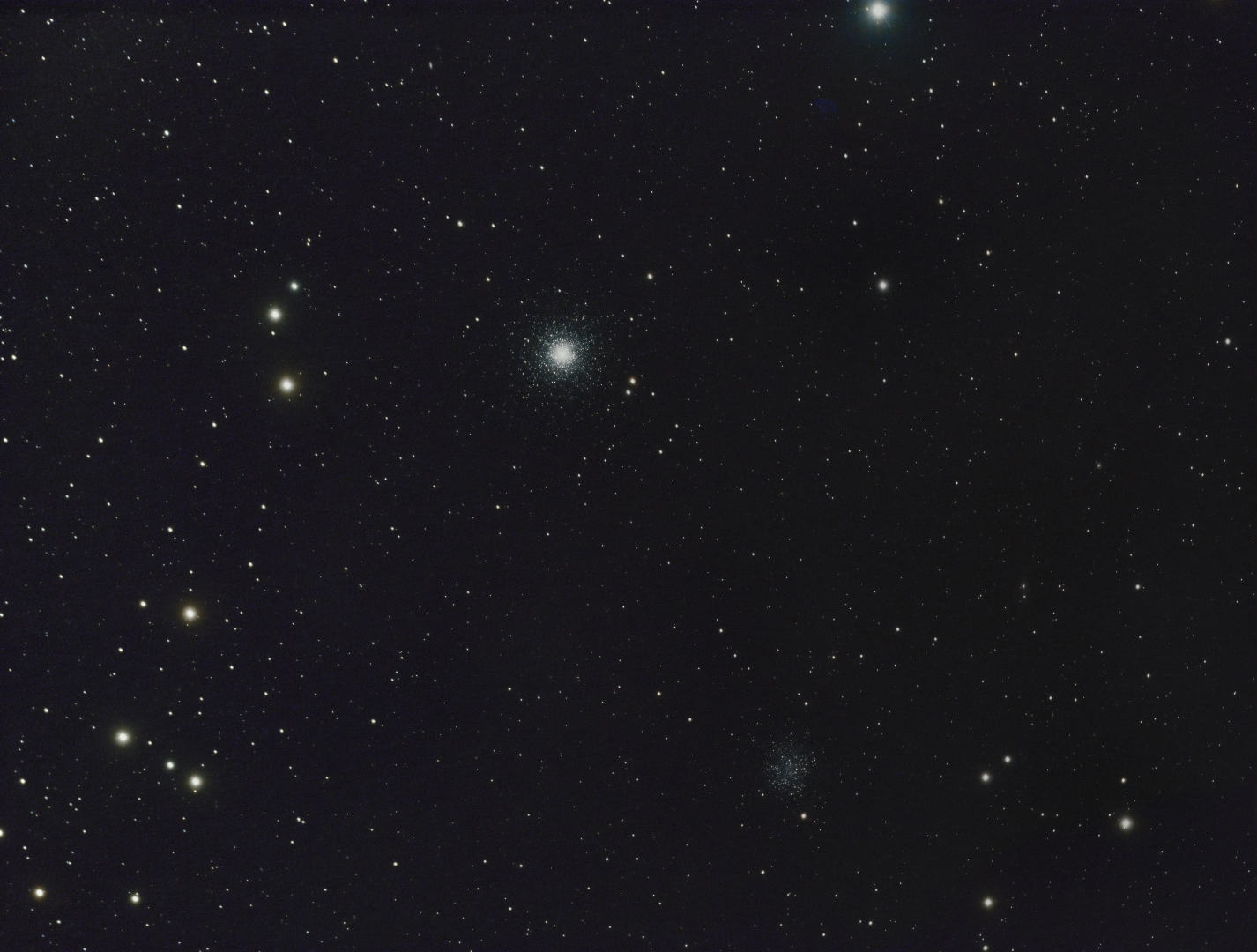
 Sagittarius and Ophiuchus brim with globular clusters but at the higher latitude here at Fairvale Observatory it is necessary to view those around the regions of Canes Venatici, Virgo or Coma Berenices; the Great Cluster of M13 and others such as M92 and NGC 6229 located in the aforesaid Hercules constellation move into a better view later during early summer. Having previously imaged a number of these clusters in the past, this spring I looked around for something new and different, which I found in the name of M53 (Above + left of centre – main image top of the page) .  In this case it turned out to be two for the price of one, as with careful framing it was possible to include a second globular cluster, NGC 5053 (Below + right of centre – main image top of the page).

True Orientation (top = North) + 30% crop – Image Rotated 90 degrees clockwise

Located in the southern area of the Coma Berenices constellation, M53 (Above left of centre – main image, top of the page) is some 58,000 light years from Earth.  Containing some 500,000 metal-poor stars, the cluster equates to 13 arc minutes of sky or about 220 light years in diameter, with an estimated age of 12.67 billion years.  Just over 1o east of M53, NGC 5053 is 53,500 light-years away, with an apparent size of 10.5 arc minutes or 160 light-years.  Although classified as a globular cluster, NGC 5053 is more irregular and dispersed in nature without a distinct bright core and is therefore dimmer than its neighbour, making it more difficult to image.

M35 Full Crop

All-in-all I believe these two globular clusters, combined with the star studded background that just includes the binary Diadem star (Upper edge + right of middle – main image, top of the page) southwest of M53, altogether makes for a rich and interesting final image.

 IMAGING DETAILS
ObjectM53 & NGC 5053
ConstellationComa Berenices
DistanceApprox.. 58,000 & 53,000 light-years
Size  13.0 & 10.5 arc minutes
Apparent Magnitude+8.33 & +10.00    
  
Scope William Optics GT81 + Focal Reducer FL 382mm  f4.72
MountSW AZ-EQ6 GT + EQASCOM computer control & Cartes du Ciel
GuidingWilliam Optics 50mm guide scope
 + Starlight Xpress Lodestar X2 camera & PHD2 guiding
CameraZWO1600MM-Cool mono  CMOS sensor
 FOV 2.65o x 2.0o Resolution 2.05”/pix  Max. image size 4,656 x 3,520 pix   
EFWZWOx8 EFW & 31mm Chroma LRGB filters 
Capture & ProcessingAstro Photography Tool + PHD2 +  Deep Sky Stacker, PixInsight v1.8.8-7, Photoshop CS3, Topaz Denoise
Image Location &          OrientationCentre  RA 13:13:59.405      DEC +18:01:48.627                      Lower Left Corner = North   Top = South West    
Exposures55 x 180 sec L , 34 x 180 sec R,  30 x 180 sec G&B Total Integration Time: 7hr 27 min     
 @ 139 Gain   21  Offset @ -20oC    
Calibration10 x 60 sec Darks  15 x  LRGB Flats & Dark Flats         @ ADU 25,000
Location & DarknessFairvale Observatory – Redhill – Surrey – UK        Typically Bortle 5-6
Date & Time13th, 15th & 16th April 2021  @ +21.00h  
WeatherApprox. <5oC   RH >55%                  🌙 6% waxing


Galactic Stepping Stones

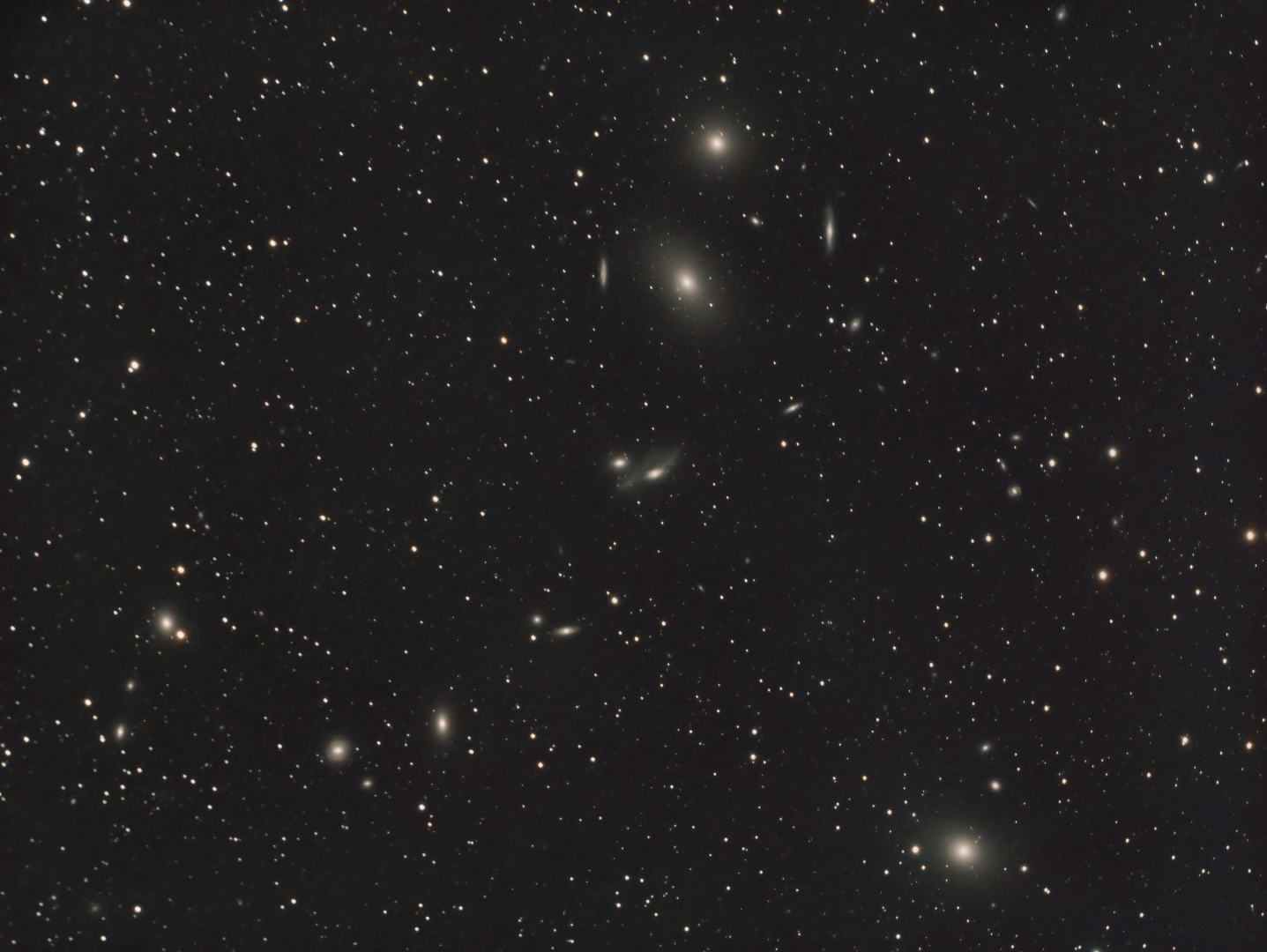
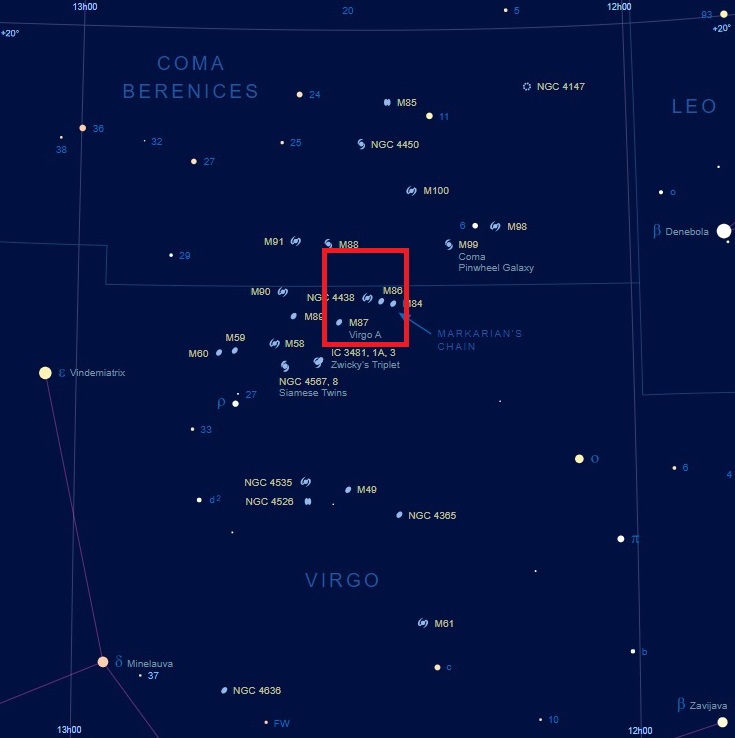
The Virgo Cluster consists of more than 2,000 galaxies, which unfortunately are optically too much for my small William Optics GT81 telescope individually.  However, one of several sub-groups within the Virgo Cluster forms a striking J-curve shape that does make for a pleasing LRGB image.  Discovered and named after the Armenian astrophysicist Benjamin Markarian, Markarian’s Chain is a string of bright galaxies that share a common motion through space.  I first imaged the Chain in April 2015 using a modded DSLR and then again in April 2017, as my first LRGB image with the then new ZWO ASI1600MM-Cool camera but with integration times of less than 1-hour on both occasions, the resulting images were far from ideal.  On this occasion using my new Chroma LRGB filters for the first time I was determined to do better.

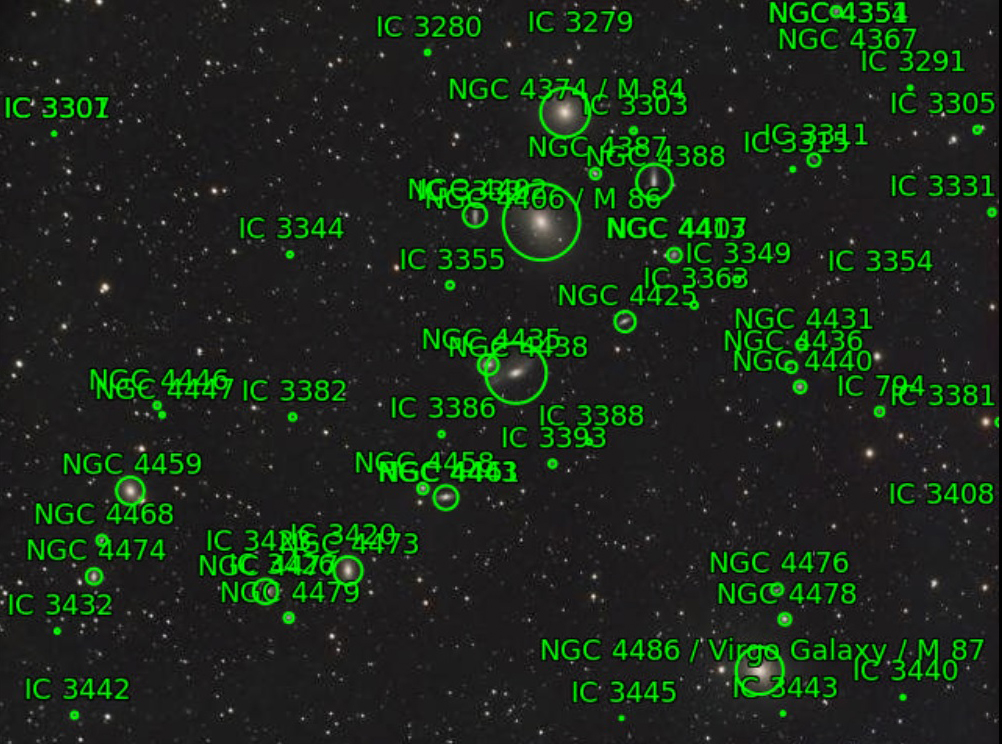
The new filters and nearly 7-hours integration time has resulted in a much more dynamic and detailed image, which I believe now does justice to this spectacular group of galaxies.  Analysis of the image using Astrometry.net shows just how crowded this area of Virgo is with galaxies (see annotated image above) but it is Markarian’s Chain that inevitably stands out together with a few other adjacent galaxies.

  • Large 10th magnitude M84 & M86 galaxies at the western end of the Chain dominate the image.  M84 is the object with the highest blue shift in the Messier catalogue, which is a result of its rapid movement (244km/sec) towards the centre of the Virgo Cluster and us.  At the centre of M84 is a 1.5 billion solar mass black hole.
  • NGC 4420 & NGC 4388 – by comparison these edge-on galaxies together with even smaller NGC 4413 & NGC 4425 seem to frame the larger M84 and M86.   
  • Next along the Chain is a pair of interacting galaxies, the smaller round shaped NGC 4435 and NGC 4438 with its distorted disk, known as “The Eyes”.                             
  • As the Chain starts to turn, some 20’ along is NGC 4458 and its partner, the 11th magnitude elliptical NGC 4461.
  • The final section of the Chain consists first of NGC 4473, its brightness generated by a supermassive black hole – at 100 million solar masses its diameter of 4.46au which would stretch from the Sun to the asteroid belt!  Thereafter the 11.4 magnitude barred lenticular galaxy NGC 4477 defines the north eastern extremity of Markarian’s Chain.
  • As previously noted, there are many other galaxies in this part of the Virgo Cluster.  Perhaps most notable though is M87, from which the first ever image of a black hole was the obtained in 2019 – consisting of some 6.5 billion solar masses.


All-in-all Markarian’s Chain makes for a rewarding image using my small telescope combined with the new Chroma filters.  Such is the nature of the image the galaxies might also suggest a string of pearls or perhaps galactic stepping stones – metaphorically leading to the next phase of my astroimaging journey.

 IMAGING DETAILS
ObjectMarkarian’s Chain
ConstellationVirgo & Coma Berenices
Distance50 – 55 million light-years
Size  ~2.5o total
Apparent MagnitudeVaries +10 to +12 approx.  
  
Scope William Optics GT81 + Focal Reducer FL 382mm  f4.72
MountSW AZ-EQ6 GT + EQASCOM computer control & Cartes du Ciel
GuidingWilliam Optics 50mm guide scope
 + Starlight Xpress Lodestar X2 camera & PHD2 guiding
CameraZWO1600MM-Cool mono  CMOS sensor
 FOV 2.65o x 2.0o Resolution 2.05”/pix  Max. image size 4,656 x 3,520 pix   
EFWZWOx8 EFW & 31mm Chroma LRGB filters 
Capture & ProcessingAstro Photography Tool + PHD2 +  Deep Sky Stacker, PixInsight v1.8.8-7, Photoshop CS3, Topaz Denoise
Image Location &           OrientationCentre  RA 12:27:46.65      DEC +13:03:06.44  @21.30h                      Left = North     
Exposures100 x 60 sec L , 54 x 60 sec R,  55 x 60 sec G&B Total Integration Time: 6hr 44 min     
 @ 139 Gain   21  Offset @ -20oC    
Calibration10 x 60 sec Darks  15 x  LRGB Flats & Dark Flats         @ ADU 25,000
Location & DarknessFairvale Observatory – Redhill – Surrey – UK        Typically Bortle 5-6
Date & Time5th & 6th April 2021  @ +21.00h  
WeatherApprox. <2oC   RH >=45%                  🌙 30% waning