
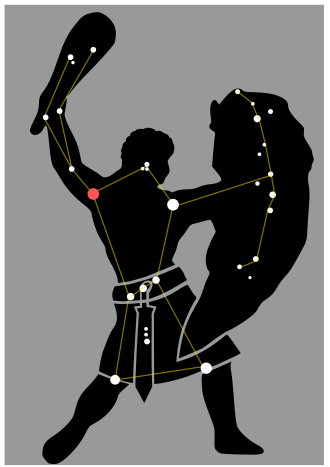
In ancient history Orion’s stars were considered to form a pattern that resembled a hunter holding a club above with his right arm and a shield in front with his left. The appearance of Orion each year marks the highlight of the astronomy for many including me but for the second year running months of continuous cloud have precluded any astronomy since October; I note from comments online far-and-wide that this phenomenon has prevailed across much of the northern hemisphere, no doubt resulting in a lot of unhappy astronomers.
Finally the clouds briefly relented over Fairvale Observatory in February but only for a few hours each time, thus eliminating the possibility of imaging with a CMOS mono camera. Faced with these problems I therefore returned to my somewhat neglected modded Canon 550D camera and suitable lenses for appropriate widefield compositions, in order to image some classic targets around the Orion constellation in a broader context. Having first whetted my appetite with the Samyang 135 f2 and its large 9.45o x 6.30o FOV to successfully image the iconic area that encompasses Orion’s belt, the Horsehead Nebula and M42 (see Going Big), it was time to go really big in order to capture the entire constellation literally and figuratively in a new light.
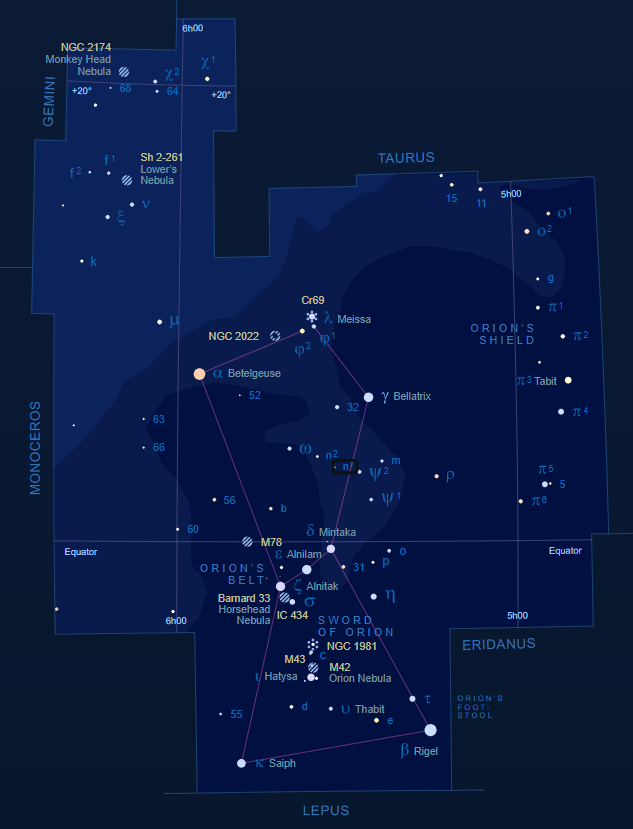
Seven bright stars define the area which outlines the torso and upper legs of Orion the Hunter: Betelgeuse, Bellatrix, Rigel and Saiph at the top and bottom, connected across the centre by his ‘belt’ formed from Alnitak, Alnilam and Mintaka. The H-shape thus created by these stars is a familiar sight over the winter months but like so many asterisms of the night sky all is not what it seems. Plotting the distance from Earth of each star it is immediately obvious that their spatial relationship significantly changes the shape of the constellation compared to what as we perceive by eye. It is a sobering thought that with the passage of time those asterisms familiar to astronomers today will look very different in the future as the stars move though space and therefore continue to change their relative positions, look and shape.
| Star | Betelgeuse | Bellatrix | Rigel | Saiph | Alnitak | Alnilam | Mintaka |
| Distance from Earth* (light years) | 643 | 243 | 772 | 724 | 800 | 1,359 | 900 |
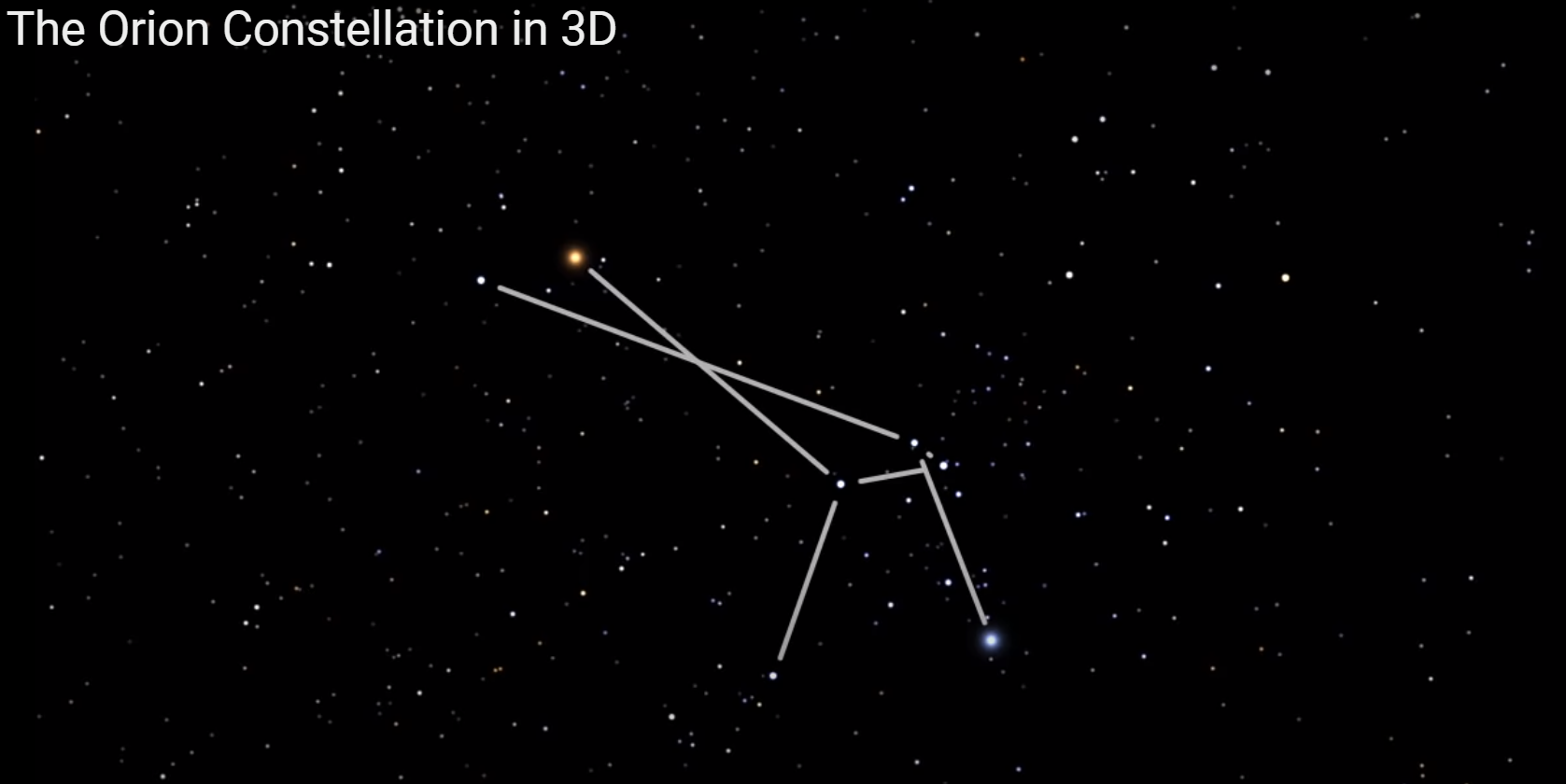
Click HERE for annotated version of the Orion Constellation in 3D ref. Space Science Telescope Instititue
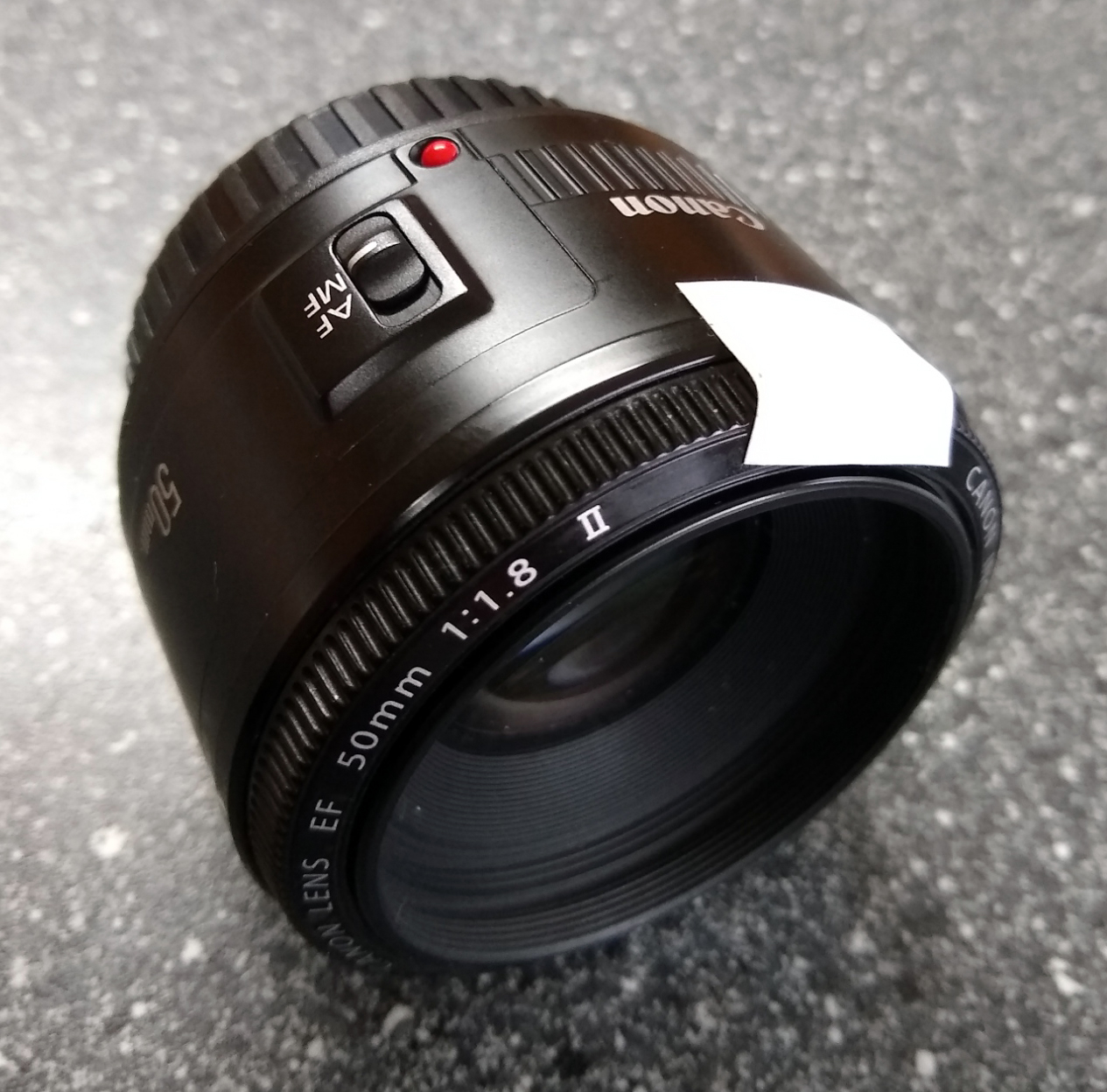
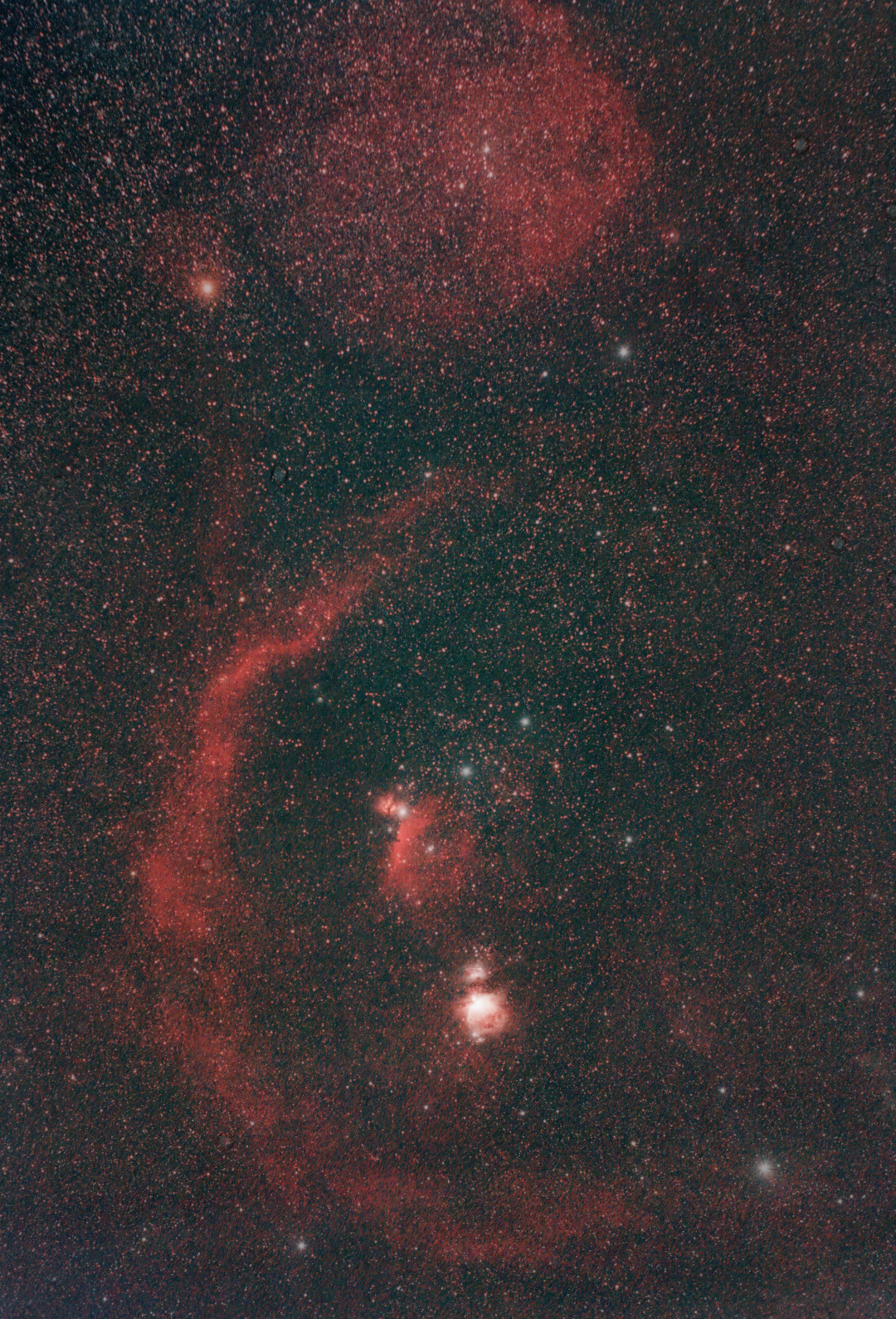
Aside from the said visual perspective of Orion, like so much of space we only see a fraction of what is really present in the Universe but can nevertheless often be disclosed by astrophotography. And so I next decided to image the entirety of Orion, this time with a basic Canon 1.8 50mm lens – the so called “nifty fifty”- with the purpose of capturing in one shot the constellation with which we are all familiar, together with vast spectacular HII-regions that encompass much of the constellation but usually remain unseen. This camera-lens combination provides an enormous 25.5o x 17.0o field-of-view (x7 > Samyang lens, x83 William Optics GT81!) albeit with lower resolution, which perfectly encompasses most of Orion and therefore the entire arc of Barnard’s Loop on the left and the Angelfish Nebula (Orion’s “head”) located above and between Betelgeuse and Bellatrix.

Above: Orion constellation from Fairvale Observatory 24th December 2014 (Left) compared with long exposure image + modded camera 10th February 2020 (right)
Barnard’s Loop is an emission nebula, forming part of the Orion Molecular Cloud Complex which also contains the dark Horsehead and bright Great Orion Nebulae M42. The Loop is believed to have originated from a supernova explosion about 2 million years ago, which is now ionized by stars from within and around the Orion Nebula and takes the form of a large arc centred approximately on the Orion Nebula. Discovered and photographed by E. E. Barnard in 1894, this vast feature extends over some about 600 arcminutes when viewed from Earth or physically up to 300 light years across, depending on the distance from Earth.
The Angelfish Nebula SH2-264 is centred on the young star cluster of Lamda Orionis, of which Meissa is the brightest. An HII-region with an apparent size of 5 degrees and actual size of 150 light years, it is also an emission nebula that is energised by the aforesaid star cluster and is considered to form the so-called head of Orion.
Having previously imaged notable parts throughout Orion, I’ve long wanted to capture the full extent of this wonderful constellation in all its glory and am very pleased with the outcome on this occasion.
| DSLR IMAGING DETAILS* | |
| Object | Orion Constellation |
| Constellation | Orion |
| Distance | 243 to 1,360 light-years |
| Size | 594o2 |
| Apparent Magnitude | Varies |
| Lens / Scope | Canon 50mm f1.8 |
| Mount | SW AZ-EQ6 GT + EQASCOM computer control & Cartes du Ciel |
| Guiding | No Guiding |
| Camera | Canon 550D modified |
| FOV 25.5o x 17.7o Resolution 17.72”/ pixel | |
| Capture & Processing | Astro Photography Tool + PHD2 Deep Sky Stacker, PixInsight, Photoshop CS3 & Topaz Denoise AI |
| Image Location & Orientation | Centre RA 05:37:37.3 DEC +00:48:50.26 Top = North Right = West |
| Exposures & Aperture | 42 x 120 sec @ ISO800 Total: 1hr 24 min F1.8 |
| Calibration | 5 x 120’ Darks, 20 x 1/4000 sec Bias 20 x Flats |
| Location & Darkness | Fairvale Observatory – Redhill – Surrey – UK Typically Bortle 5-6 |
| Date & Time | 10th February 2021 @ +21.00h |
| Weather | Approx. <=0oC RH <=65% 🌙 NEW MOON |
*For higher resolution and plate-solving data go to Astrobin HERE and click on image
 WATCH THIS SPACE(MAN)