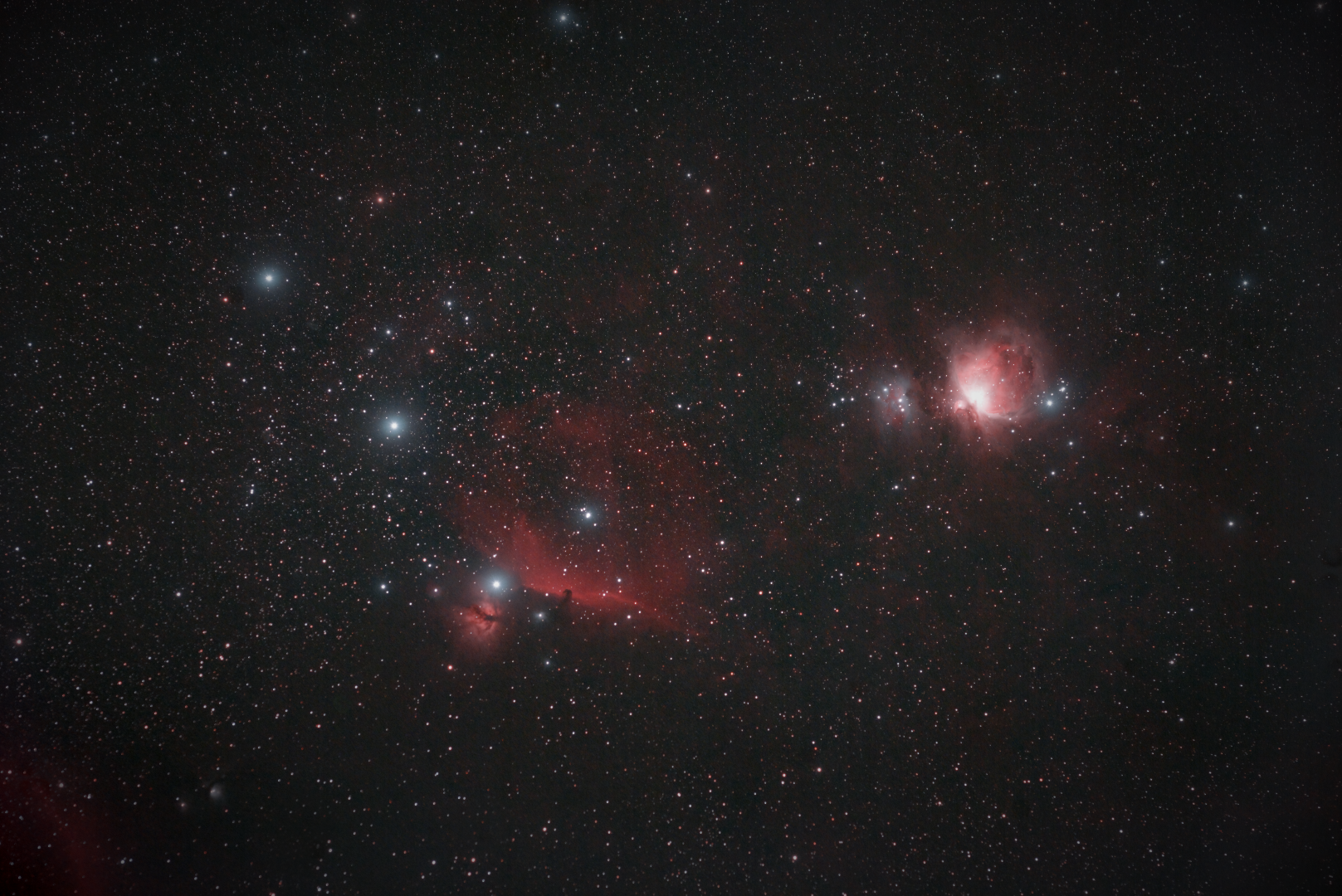
After considering the limitations created by UK weather, I chose to purchase a Samyang 135 f/2 lens last year, rather than typically moving to a larger aperture / focal length scope. Unfortunately because of the aforesaid poor weather conditions that have since prevailed its use has so far been restricted. However, after literally months at last the clouds briefly relented over Surrey recently and I was able to get a couple of hours imaging the Orion constellation.
I really enjoy the widefield aspect of astrophotography, particularly without resorting to a mosaic which is too often impractical given the lack of favourable imaging conditions in the UK. Such images can produce another perspective of favourite targets previously imaged with a telescope or are just fascinating in their own right. For the moment I’m using the Samyang lens at f2.8 with a modded Canon 550D, manual focus and no guiding but eventually intend to pair it with a mono CMOS camera. This combination results in a whopping 9.45o x 6.30o field-of-view, no-less than 11x that of my standard William Optics GT81 and ZWO1600 set-up. Whilst using the lens at its maximum f/2.0 aperture would be even better, stopping down to f2.8 improves focus quality and removes any possibility of vignetting.
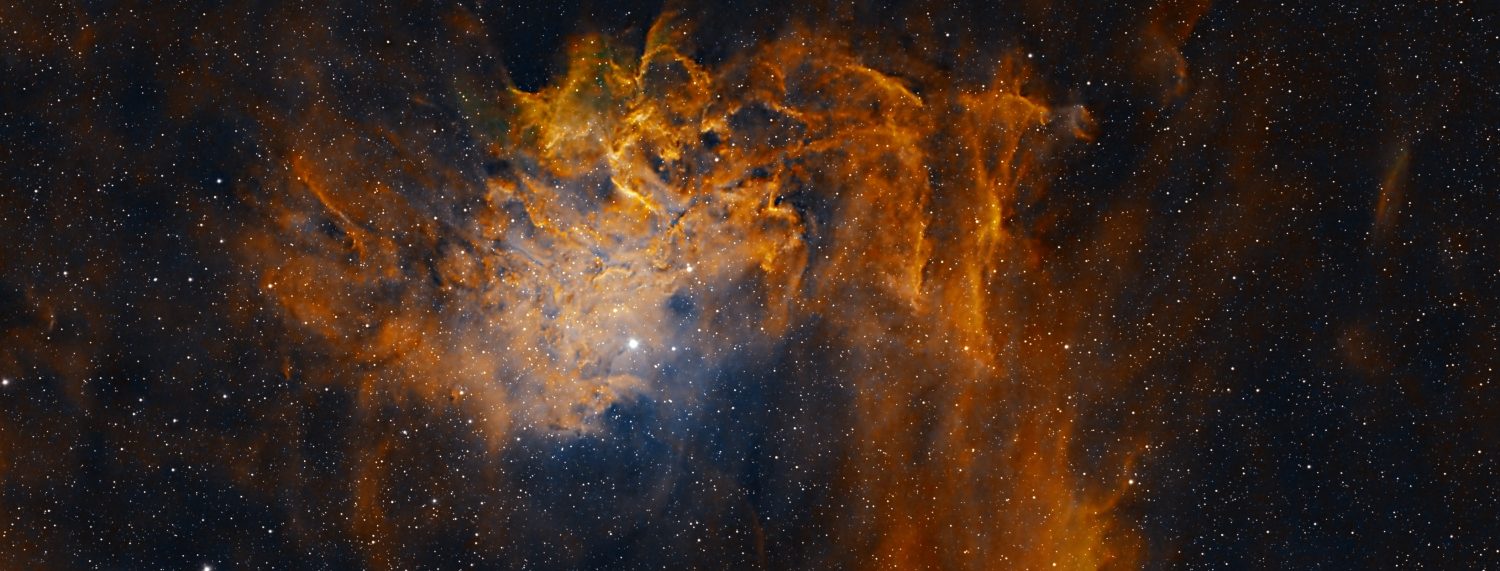
In this instance I chose to frame the image around the area of Orion’s Belt and the Great Orion Nebula M42 but such is the lens’ extensive field-of-view that M78 and part of Barnard’s Loop have also sneaked into the lower left corner. Even though this was something of a ‘quick & dirty’ session resulting in just 112 minutes integration time, looking closer at M42 (see cropped version) the detail and colours achieved with this lens has far exceeded my expectations. As well as the detail of M42 and the Horsehead Nebula, I’m also impressed at how well the lens has dealt with the usually difficult large bright stars of Orion’s Belt & others in the image.

The quality produced with this small lens is quite extraordinary and it is definitely one of my star astronomy purchases. Going forwards the challenge will be to find suitable targets that can fill its very large field-of-view, as well the inevitable wait for clear skies!
| DSLR IMAGING DETAILS* | |
| Object | Orion: M42, Horsehead, M78 & Barnard’s Loop |
| Constellation | Orion |
| Distance | 243 to 1,360 light-years |
| Size | 594o2 |
| Apparent Magnitude | Varies |
| Lens / Scope | Samyang 135 f/2 |
| Mount | SW AZ-EQ6 GT + EQASCOM computer control & Cartes du Ciel |
| Guiding | No Guiding |
| Camera | Canon 550D modified |
| FOV 9.45o x 6.30o Resolution 6.45”/pix | |
| Capture & Processing | Astro Photography Tool + PHD2 Deep Sky Stacker, PixInsight, Photoshop CS3 & Topaz Denoise AI |
| Image Location & Orientation | Centre RA 05:36:48 DEC -03:11:30.4 Right = North Top = West |
| Exposures & Aperture | 56 x 120 sec @ ISO800 Total: 1hr 52 min F2.8 |
| Calibration | 5 x 120’ Darks, 20 x 1/4000 sec Bias 20 x Flats |
| Location & Darkness | Fairvale Observatory – Redhill – Surrey – UK Typically Bortle 5-6 |
| Date & Time | 3rd February 2021 @ +22.00h |
| Weather | Approx. 6oC RH +85% 🌙 67% waning |
 WATCH THIS SPACE(MAN)