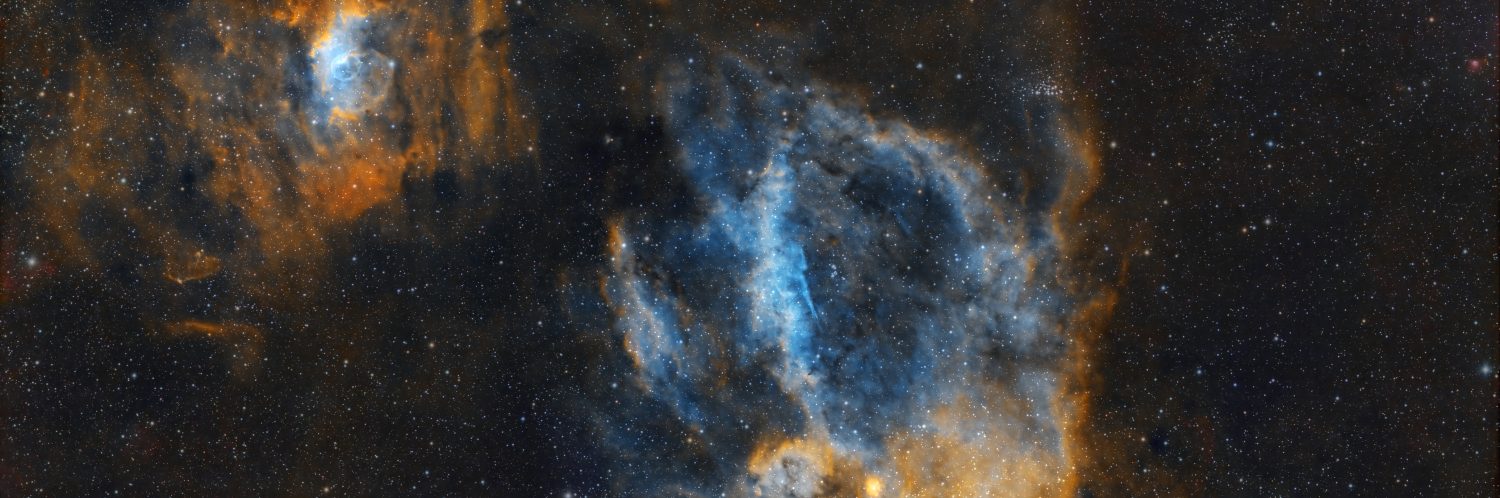
I first visited the constellation of Cygnus soon after starting astrophotography, inevitably to image the Veil Nebula and North America (NAN) & Pelican Nebula, or parts thereof. As my abilities and equipment improved I’ve often returned to each of these popular targets, in the hope of obtaining a better image each time and I’m sure I will continue in this pursuit. However, such is the draw of these iconic objects that it’s easy to overlook other equally exciting targets within the same constellation.
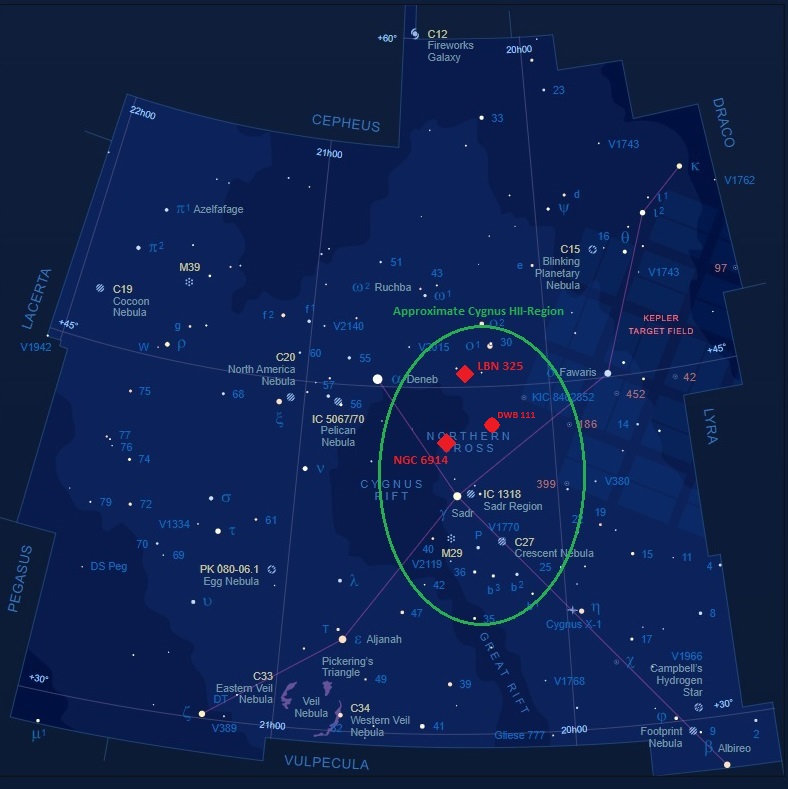
Last year (2019) my attention was drawn to such a target in the form of DWB 111 or the Propeller Nebula, which I successfully imaged and thereby ignited my interest in the rich, very large HII-region of Cygnus (see above), within which imaging possibilities are almost endless. I therefore recently went back during this September to image two less popular targets located within the aforesaid HII-region; I had already imaged the NAN and Veil Nebula again in early September, on which occasion using my new Samyang 135mm f2 lens set-up to obtain wide-field shots.
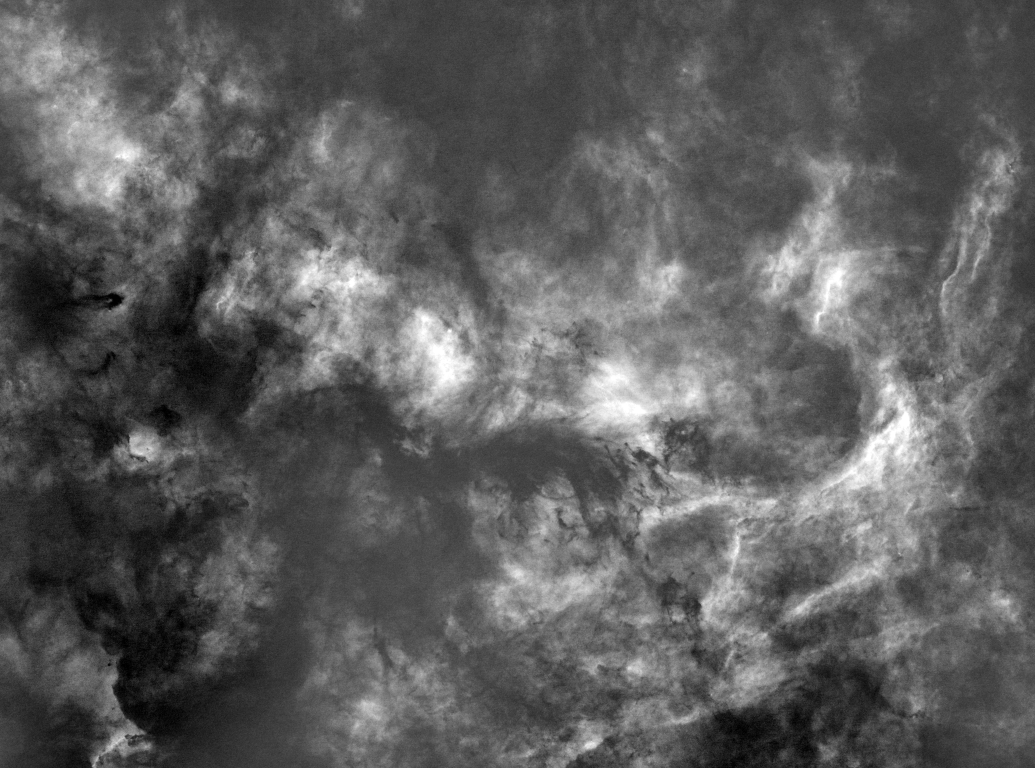
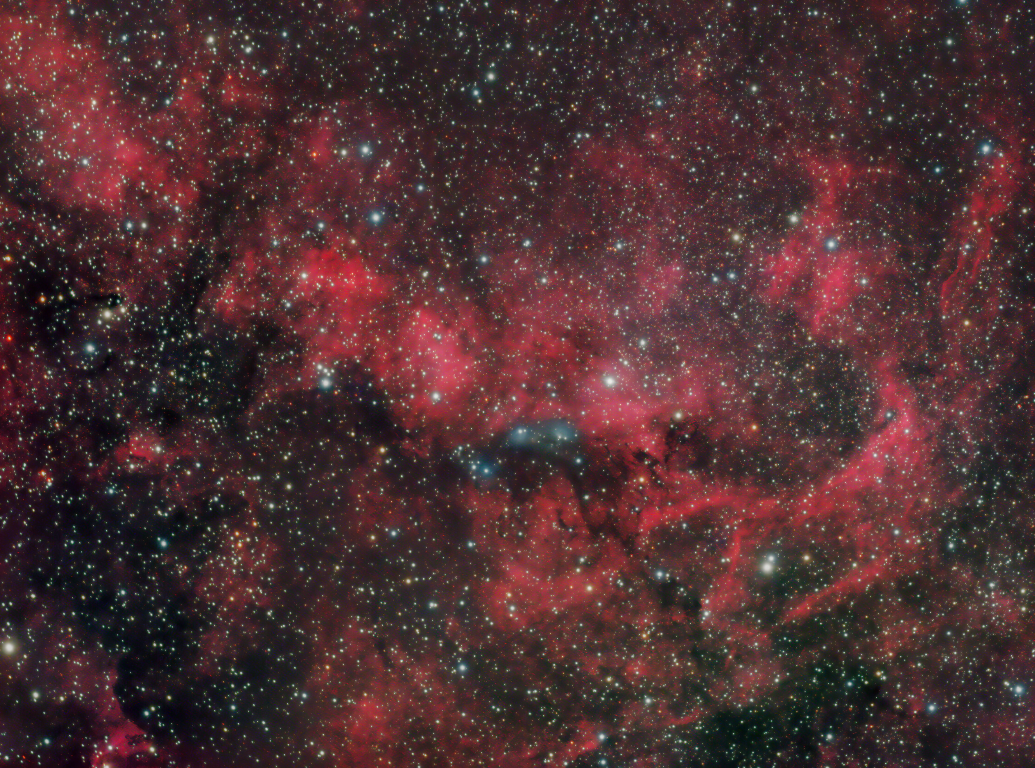
After first imaging LBN 325 and other emission nebulae across the adjacent area, I turned my attention to a neighbouring part of the said HII-region of Cygnus, likewise found in the quadrant of Cygnus defined by the stars Deneb – Sadr – Delta Cygni. Similarly this area is full of numerous emission nebulae but furthermore here strikingly intercalated with dark nebula, star clusters and in particular reflection nebulae. Most prominent of these near the centre of the image is NGC 6914, vdB 131 & vdB32 (Main image top-of-the-page), which are conspicuously highlighted by associated bright blue nebulosity. Dotted throughout the rest of the image the use of HaLRGB picks out many other blue and rare yellow refection nebula and stars that all together make for an exciting image (Ha starless image above). Such is the quality and vastness of this part of Cygnus for potential image targets that I feel sure I’ll be coming back to this region for many years to come.
| IMAGING DETAILS | |
| Category / Object | Reflection Nebula NGC 6914 |
| Constellation | Cygnus |
| Distance | 6,000 light-years |
| Size | 2.5o x 1.90o |
| Apparent Magnitude | ? |
| Scope | William Optics GT81 + Focal Reducer FL 382mm f4.72 |
| Mount | SW AZ-EQ6 GT + EQASCOM computer control & Cartes du Ciel |
| Guiding | William Optics 50mm guide scope |
| + Starlight Xpress Lodestar X2 camera & PHD2 guiding | |
| Camera | ZWO1600MM-Cool mono CMOS sensor |
| FOV 2.65o x 2.0o Resolution 2.05”/pix Max. image size 4,656 x 3,520 pix | |
| EFW | ZWOx8 + ZWO LRGB & Ha OIII SII 7nm filters |
| Capture & Processing | Astro Photography Tool + PHD2 + Deep Sky Stacker + PixInsight + Photoshop CS3 + Topaz AI Denoise |
| Image Location & Orientation | Centre: RA 20h 25’ 23.097” DEC +42o 22’ 41.092” Top of image = approximately North |
| Exposures | 36 @ 300 sec Ha + 37 x LGB 36 x R @ 180 sec Time: Ha 3hr LRGB 7hr 21min = Total 10hr 21 min |
| @ 139 Gain 21 Offset @ -20oC | |
| Calibration | 5 x 300 sec Ha + 10 X 180’ LRGB Darks, 20 x 1/4000 sec Bias 10 x HaLRGB Flats @ ADU 25,000 |
| Location & Darkness | Fairvale Observatory – Redhill – Surrey – UK Typically Bortle 5-6 |
| Date & Time | 17th 20th 21st September 2020 @ +21.00h |
| Weather | Approx. 15oC RH = 45- 70% 🌙 New – 22% waxing |
 WATCH THIS SPACE(MAN)