
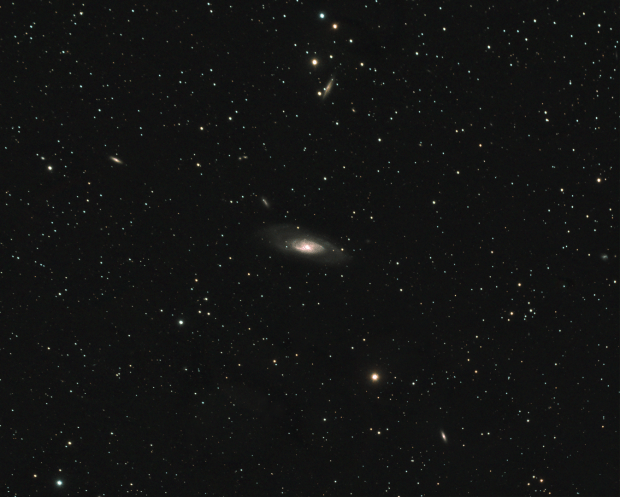
Having last year discovered that I could see parts of the zenith region of the sky at Fairvale Observatory (North), in particular Ursa Major and adjacent constellations for short periods during the spring galaxy season, it was an obvious location to return to this year. Furthermore, a protracted period of good weather for most of 12-days coinciding with a New Moon provided an unprecedented opportunity to obtain long integration times on a number of smaller galaxies that abound there.


Following the aforementioned discovery, I was pleased to successfully image M101 AKA the Pinwheel Galaxy in 2019. On this occasion I decided to start with M106 in the adjacent Canes Venatici (“the Hunting Dogs”) constellation, an intermediate galaxy thought to have a supermassive black hole at its centre (see location map and image orientation above). Smaller than M101 with a slightly warped disc and viewed obliquely, it is not an easy target with my equipment but the area also teems with other galaxies and colourful stars that make for an attractive composition; it is intriguing that M106 is of similar size and luminosity to the Andromeda Galaxy M31 but is much further away.
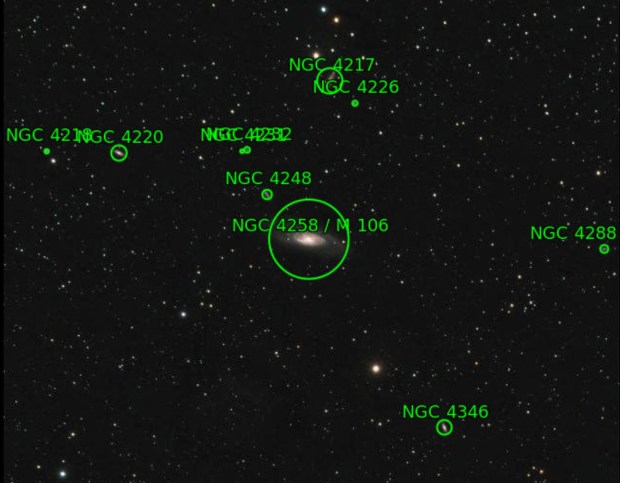
Taken over five evenings, the final HaLRGB image integration time of nearly 10 hours is the longest I’ve achieved to-date, producing a pleasing image of M106 with good colours and detail throughout the surrounding area (see image at the top-of-the-page). Moreover, across the wider field-of-view a number of other galaxies can be seen clearly, thereby framing the centrally placed M106 and making for a more dramatic image (see annotated kimage above).
Most of the other galaxies vary in age between 20 to 60 million years old, with the edge-on spiral galaxy NGC 4217 thought to possibly be a companion galaxy of M106, however, it is NGC 4226 that I am most excited by. Close to NGC 4217 and resolved only as a small blurred area with my equipment, nonetheless the light from this galaxy has travelled for 334 million years before reaching my camera. The time it left the galaxy we know as the Carboniferous period, when the major coal measures and rocks of the Yorkshire and the Mendip Hills were laid down, a long time before even dinosaurs roamed the Earth – ancient photons from amongst the furthest distance I’ve ever managed to capture on my sensor!
| IMAGING DETAILS | |
| Object | M106 AKA NGC 4258 |
| Constellation | Canes Venatici |
| Distance | 24 million light-years |
| Size | 18.6’ x 7.2’ Diameter 135,000 light-years |
| Apparent Magnitude | +8.4 |
| Scope | William Optics GT81 + Focal Reducer FL 382mm f4.72 |
| Mount | SW AZ-EQ6 GT + EQ-ASCOM computer control & Cartes du Ciel |
| Guiding | William Optics 50mm guide scope |
| + Starlight Xpress Lodestar X2 camera & PHD2 guiding | |
| Camera | ZWO1600MM-Cool mono CMOS sensor |
| FOV 2.65o x 2.0o Resolution 2.05”/px Max. image size 4,656 x 3,520 px | |
| EFW | ZWOx8 + ZWO LRGB & Ha OIII SII 7nm filters |
| Capture & Processing | Astro Photography Tool + PHD2 + Deep Sky Stacker & Photoshop CS3 |
| Image Location & Orientation | Centre RA 12:18:58 DEC +47:18:14
North = Left West = Top |
| Exposures | L x 58 R x 36 G x 36 B x 39 Ha x 20 x 180 secs
Total Time: 9hr 27 min |
| @ 139 Gain 21 Offset @ -20oC | |
| Calibration | 10 x 180 sec x HaLRGB Darks 20 x 1/4000 sec Bias 10 x HaLRGB Flats @ ADU 25,000 |
| Location & Darkness | Fairvale Observatory – Redhill – Surrey – UK Typically Bortle 5-6 |
| Date & Time | x5 nights 16th – 27th March 2020 @ +21.00h |
| Weather | Approx. <=5oC RH 45-65% 🌙 <=10% waning |
 WATCH THIS SPACE(MAN)
Pingback: Canine Capers | WATCH THIS SPACE(MAN)