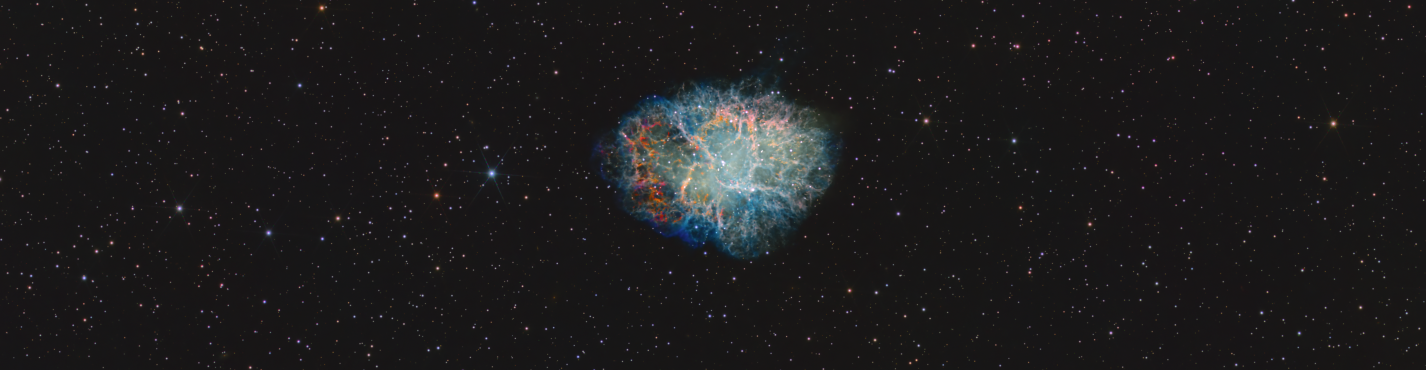

It seems the start of the year has been jinxed, resulting in something of a mixed bag for my astronomy but thankfully not without some positives. A combination of illness, house decoration and some quite awful weather, really curtailed the possibility of any significant astrophotography projects. Despite these difficulties, in the few moments that were available I have managed to carry out some useful experiments which hopefully lay the foundations for greater things the future – clear skies permitting!
Following the success of my first mosaic in 2019, I decided to undertake something more ambitious over the winter, inevitably returning to Orion – specifically Barnards’s Loop. Unseen with the naked eye, the camera discloses the presence of this large arc of ionized gas that is approximately centered on the Orion Nebula, so large that only a conventional wide field camera lens can usually capture the entire Loop. To obtain a higher quality image using a telescope it’s therefore necessary to create a mosaic. With this in mind and keen to expand – physically and metaphorically – my use of the mosaic technique, Barnard’s Loop seemed a worthy object.
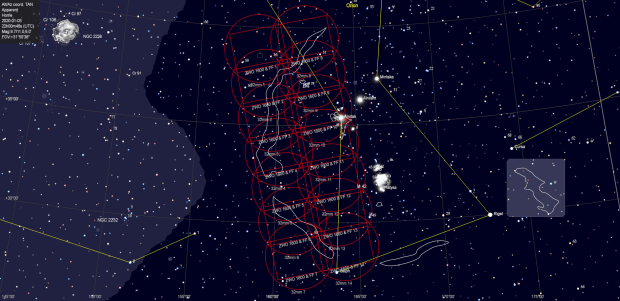
I planned and compiled my previous mosaic of the Heart & Soul Nebula manually but following the recent addition of a mosaic tool to Cartes du Ciel (CdC), which importantly also integrates with my image capture software Astro Photography Tool (APT), this time I was able to plan a 14 (2×7) panel mosaic to image Barnard’s Loop (see accompanying CdC plan above) and the adjacent region. With the ability to vary the overlap and mosaic size up to 10 x 10 panels, once constructed using the CdC mosaic planning the related data is saved to a file, which can then be imported as a series of custom objects into the Point Craft plate solving section of APT; each object is defined by its central RA and DEC co-ordinates. Thereafter, using the plate solving function, the camera and scope are centered one-by-one on each panel for imaging, either manually or by writing a suitable script to automate imaging.
Given the size of the undertaking and difficulties with weather at this time of the year inevitably limiting imaging time, plus the strong Ha-nature of Barnard’s Loop, I chose to confine imaging to only Ha subs, which would pick-out the feature well and thus form a good basis for compiling the final mosaic. The project started well on 3rd January when I was able to complete imaging the three panels covering the central sections of the large upper arm of the arc, unfortunately thereafter it all went downhill – mostly!
As Orion and therefore the Loop moved inexorably westwards, imaging time became increasingly restricted, further compounded by poor weather and when it was clear, poor seeing conditions. Thus acquisition of the remaining panels became more and more difficult, with many of the resulting panels of only poor quality. All-in all I managed to image twelve of the total 17 panels, adding three to the original plan to incorporate the lower ‘tail’ located between Saiph and Rigel. Whilst the said panels covered the entire feature, such was the poor quality of many they could not be used to achieve the final aim of the project – a Ha-image of the entire Barnard’s Loop.
Using Microsoft’s ICE software, the upper section of the Loop came together well but I’ve not been able to incorporate the middle and lower sections which were of low-quality. I’m quite pleased with the general outcome but consider the project has demonstrated that very large mosaics of this scale are an unlikely proposition at Fairvale Observatory given UK weather conditions and lack of a permanent a setup required to maximize imaging opportunities. Notwithstanding, I believe up to four panel mosaics should be OK – we shall see.
Subsequently the weather was very bad and very, very wet, so unable to image I reprocessed NGC 1333 from last year, which at the time had not come out well. I’d previously noticed that for some reason images had been exhibiting poor quality in the corners, where for no obvious reason stars showed trailing in the processed stacks – though not in the original subs. The solution, thankfully discovered via the Deep Sky Stacking Forum, was to change the Stacking Alignment setting from Automatic to Bilinear and bingo, all was well.
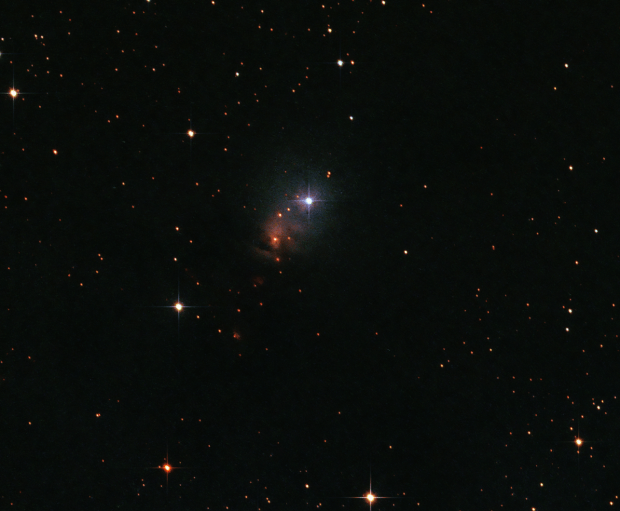
NGC 1333 is a colorful reflection nebula located within the dark nebula Rho Ophiuchi, a vast area of gas and dust which is one of the closest star forming regions to the Solar System. In order to evaluate its potential for my equipment I collected just over two hours of LRGB data in January 2019. As previously noted, at the time I was disappointed with the outcome but I now think the revised image processing indicates that with much greater integration time this object could work with more subs – watch this space.
As the bad weather continued throughout most of February there have been very few clear skies but on two such nights I managed brief imaging tests of two other January / February objects which I hope to return to in another year. First of these was another dark nebula Barnard 22, illuminated from behind by the reflection nebula IC 2087. With total LRGB imaging time of just 1hr 24 minutes the processed image was extremely noisy but it was good to see the broad outline of B22 framed well within my FOV and suggests it too could be a viable object for another day.
Finally, with the daffodils already blooming, it was clear that winter was going to be a disappointing time for serious astrophotography, however, I was still able to attempt one final object before the winter night skies receded beyond the western horizon for another year. Surprisingly I had hitherto overlooked this object, visually located just beyond the upper edge of Barnard’s Loop, which though difficult is fortunately also strong in the Ha-wavelength. Lynds’ Dark Nebula (LDN) 1622 AKA the Bogeyman Nebula, describes the somewhat jinxed period I’ve experienced but this time fortuitously brought my earlier work together (x4 panel mosaic below: The Bogeyman – lower left + upper Barbard’s Loop + M78 – top right).
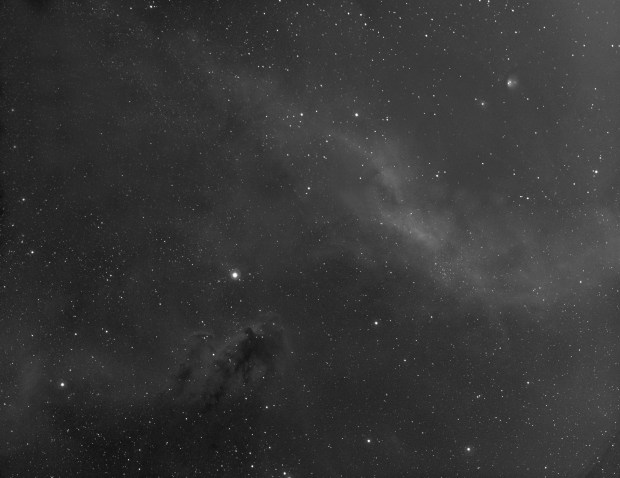
Despite my best efforts I was unable to see the Bogeyman when framing the image in APT even after stretching but fortunately it still turned out well. I noticed that most other successful images were mainly undertaken in HaRGB, however with limited time before the clouds again inevitably rolled, the few RGB subs obtained failed to add much colour to my image on this occasion. Notwithstanding, with much greater integration time the final Ha-image holds great promise. Furthermore, the said image could be incorporated into the upper main section of the Barnard’s Loop, together with the M78 reflection nebula, to finally make a complete and worthy mosaic image consisting of six panels – see main image at the top of the page and detailed x4 panel mosaic above. Contrary to the name, on this occasion the Bogeyman completed the jigsaw and saved the day!
| IMAGING DETAILS | |
| Object | Barnard’s Loop |
| Constellation | Orion |
| Distance | 1.434 light-years |
| Size | 10o ~300 light-years |
| Apparent Magnitude | 5 |
| Scope | William Optics GT81 + Focal Reducer FL 382mm f4.72 |
| Mount | SW AZ-EQ6 GT + EQASCOM computer control & Cartes du Ciel |
| Guiding | William Optics 50mm guide scope |
| + Starlight Xpress Lodestar X2 camera & PHD2 guiding | |
| Camera | ZWO1600MM-Cool mono CMOS sensor |
| FOV 2.65o x 2.0o Resolution 2.05”/pix Max. image size 4,656 x 3,520 pix | |
| EFW | ZWOx8 + ZWO LRGB & Ha OIII SII 7nm filters |
| Capture & Processing | Astro Photography Tool + PHD2 + Deep Sky Stacker & Photoshop CS3 |
| Image Location & Orientation | Various |
| Exposures | 10 x 5 x 300 sec Ha
i.e. 25 minutes / panel or total time: 4hr 10 minutes |
| @ 139 Gain 21 Offset @ -20oC | |
| Calibration | 5 x 300 sec Ha, OIII & SII Darks, 20 x 1/4000 sec Bias 10 x Ha, OIII & SII Flats @ ADU 25,000 |
| Location & Darkness | Fairvale Observatory – Redhill – Surrey – UK Typically Bortle 5-6 |
| Date & Time | Panels 2, 3 & 4 January 3rd 2020 @ +21.00h
Panels 5, 6, 7, 8, 9 &14 January 18th 2020 @ +20.0h Panels 15*,16 & 17* January 19th 2020 @ +19.45h *rejected |
| Weather | Approx. 2oC RH <=80% 🌙 30% waning |
| IMAGING DETAILS | |
| Object | NGC 1333 refection nebula |
| Constellation | Orion |
| Distance | 1,000 light-years |
| Size | 6’ x 3’ |
| Apparent Magnitude | 5.6 |
| Scope | William Optics GT81 + Focal Reducer FL 382mm f4.72 |
| Mount | SW AZ-EQ6 GT + EQASCOM computer control & Cartes du Ciel |
| Guiding | William Optics 50mm guide scope |
| + Starlight Xpress Lodestar X2 camera & PHD2 guiding | |
| Camera | ZWO1600MM-Cool mono CMOS sensor |
| FOV 2.65o x 2.0o Resolution 2.05”/pix Max. image size 4,656 x 3,520 pix | |
| EFW | ZWOx8 + ZWO LRGB & Ha OIII SII 7nm filters |
| Capture & Processing | Astro Photography Tool + PHD2 + Deep Sky Stacker & Photoshop CS3 |
| Image Location & Orientation | Centre RA 03:29:07 (23?) DEC 31:28:14 @ +19.16h
Top = North |
| Exposures | 6 x 300 sec L&B 7 x 300 sec R&G
Total Time: 2hr 10 min |
| @ 139 Gain 21 Offset @ -20oC | |
| Calibration | 5 x 300 sec Ha + 10 X 300’ RGB Darks, 20 x 1/4000 sec Bias 10 x HaRGB Flats @ ADU 25,000 |
| Location & Darkness | Fairvale Observatory – Redhill – Surrey – UK Typically Bortle 5-6 |
| Date & Time | 28th January 2020 @ +19.15h |
| Weather | Approx.? RH <=? 🌙 9% waxing |
| IMAGING DETAILS | |
| Object | Lynds’ Dark Nebula (LDN) 1622 AKA Bogeyman Nebula |
| Constellation | Orion |
| Distance | 500 light-years |
| Size | 1o ~10 light-years? |
| Apparent Magnitude | ? |
| Scope | William Optics GT81 + Focal Reducer FL 382mm f4.72 |
| Mount | SW AZ-EQ6 GT + EQASCOM computer control & Cartes du Ciel |
| Guiding | William Optics 50mm guide scope |
| + Starlight Xpress Lodestar X2 camera & PHD2 guiding | |
| Camera | ZWO1600MM-Cool mono CMOS sensor |
| FOV 2.65o x 2.0o Resolution 2.05”/pix Max. image size 4,656 x 3,520 pix | |
| EFW | ZWOx8 + ZWO LRGB & Ha OIII SII 7nm filters |
| Capture & Processing | Astro Photography Tool + PHD2 + Deep Sky Stacker & Photoshop CS3 |
| Image Location & Orientation | Centre RA 05:55:38 DEC 01:59:40 @20.49h
Image rotated 180o for presentation Top = South |
| Exposures | 19 x 300 sec Ha, 4 x 300 sec RGB
Time: Ha only 1hr 35 min Total 2hr 35 min |
| @ 139 Gain 21 Offset @ -20oC | |
| Calibration | 5 x 300 sec Ha + 10 X 300’ RGB Darks, 20 x 1/4000 sec Bias 10 x HaRGB Flats @ ADU 25,000 |
| Location & Darkness | Fairvale Observatory – Redhill – Surrey – UK Typically Bortle 5-6 |
| Date & Time | 17th January 2020 @ +20.50h |
| Weather | Approx. 16oC RH <=75% 🌙 29% waning |
 WATCH THIS SPACE(MAN)