Having established an alternative imaging site at the southern end of my garden in the summer of 2018 AKA “The Shed Observatory”, I was thrilled to be able to image objects in the north sky for the first time, hitherto obscured by my house from the usual observing location. Soon thereafter it was with great pleasure I achieved a good narrowband image of IC 1805 the Heart Nebula but was subsequently disappointed to find that part of the neighbouring object, IC 1848 the Soul Nebula, had been missed after encountering a framing problem.
One year on I was back in The Shed with new objectives for these targets: (i) to obtain a complete image of the Soul Nebula, and (ii) given the relative proximity of the Heart & Soul Nebula, to compile a mosaic which included the two objects; surprisingly I’d not attempted a mosaic before and this seemed like a good place to start. Given the increased imaging time needed to complete even a small mosaic + the lack of darkness at the end of August + British Weather, I chose to restrict imaging to just the Ha-wavelength, which works well with both these targets and could build on the Ha subs already obtained of the Heart Nebula in 2018.
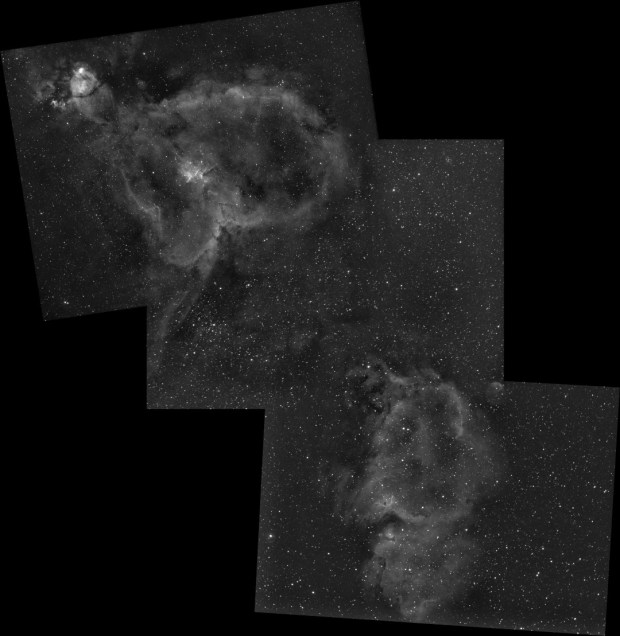
Traditionally mosaic images are based on a grid of say 1+1, 1+1+1, 2 x 2, 3 x 3 etc., which are then combined using the relevant aforesaid sequences, however, in this case starting with the original Heart Ha-subs such a system was not possible. Since moving to mono imaging with the ZWO ASI1600-Cool camera I’ve used the excellent APT (Astro Photography) image capture software, which hitherto has catered very well with all my needs – including plate solving. However, at this time APT did not yet have a comprehensive mosaic facility (see footnote) which would allow an imaging grid to be planned and pre-programmed. Instead it was therefore necessary to first determine suitable image coordinates for each mosaic panel that would cover the Heart & Soul + 25% overlap and then manually establish each position prior to imaging.
Given the proximity of each component I estimated a suitable mosaic could be achieved with three panels, one for each of the main objects and an intermediate panel that would bridge the space between, thus linking the objects to form a continuous mosaic. Given the spatial relationship, each ofthe three panes needed to be stepped relative to each other and also slightly rotated. The final data for each nebula consisted of 1h 40m integration time + a further 1h 15m for the link panel, or 4h 35m in total for the complete mosaic.
To my relief the final mosaic was relatively easy to create. First modestly stretching each panel, paying attention to the background levels and removing any gradients, in order to ensure uniformity between the images before compilation. I then used Microsoft’s free ICE (Image Composite Editor) software to stich the three panels together into a final mosaic, after which further adjustments were made in Photoshop.
I’m very pleased with the outcome of my first, albeit modest mosaic. With the ability to return to targets on any occasion using plate solving and, as always weather permitting, multi-image mosaics now open up whole new possibilities which can be captured and compiled over a period of time – even years. However, until I am able to use a suitable mosaic programme for sequencing, I’m more likely to restrict such projects to small areas that only require limited imaging time, such as the Heart & Soul.


The Greeks and Romans knew a thing or two about mosaics and I’ve long enjoyed Escher’s use of the mosaic form as a basis for his graphic art (see above). I’m quite sure they would marvel at the astrophotography of Deep Sky Objects and how mosaics can be used in their creation. The mosaic is all about the sum of the parts, which not only produces a wider, more encompassing view but in doing, so the combined parts add a different quality to the final image. For now my first mosaic has been quite successful, was good fun and moreover, I can see that the technique ultimately has the potential to open up new and exciting possibilities even with my existing equipment.
Footnote: Since imaging and processing the Heart & Soul mosaic, a recently updated Cartes du Ciel (CdC) verson 4.2 has been released, which incorporates a mosaic planning function. Moreover, the aforesaid plan can then be imported into the APT software (subject to a minor adjustment being undertaken by APT to fix a panel numbering issue) and thereby provide integrated mosaic planning and programming.
| IMAGING DETAILS – 2018 | |
| Object | Heart Nebula IC 1805 |
| Constellation | Cassiopeia |
| Distance | 7,500 light-years |
| Size | 150’ x 150’ = 2.5o or 200 light-years |
| Apparent Magnitude | +18.3 |
| Scope | William Optics GT81 + Focal Reducer FL 382mm f4.72 |
| Mount | SW AZ-EQ6 GT + EQASCOM computer control |
| Guiding | William Optics 50mm guide scope |
| + Starlight Xpress Lodestar X2 guide camera & PHD2 control | |
| Camera | ZWO1600MM-Cool (mono) CMOS sensor |
| FOV 2.65o x 2.0o Resolution 2.05”/pix Max. image size 4,656 x 3,520 pix | |
| EFW | ZWOx8 + ZWO LRGB & Ha OIII SII 7nm filters |
| Capture & Processing | Astro Photography Tool + PS2, Deep Sky Stacker & Photoshop CS2, HLVG |
| Image Location & Orientation | Centre RA 02:33:09 DEC 61:24:23
|
| Exposures | Heart Nebula 20 x 300 sec Ha = 100 minutes |
| @ 139 Gain 21 Offset @ -20oC | |
| Calibration | 5 x 300 sec Darks 20 x 1/4000 sec Bias 10 x Flats Ha @ ADU 25,000 |
| Location & Darkness | Fairvale Observatory – Redhill – Surrey – UK Typically Bortle 5 |
| Date & Time | 16th & 17th August 2018 @ +23.30h |
| Weather | Approx. 12oC RH <=95% |
| IMAGING DETAILS – 2019 | |
| Object | Soul Nebula IC 1848 & Link Pane |
| Constellation | Cassiopeia |
| Distance | 6,500 light-years |
| Size | 150’ x 75’ or 100 light-years |
| Apparent Magnitude | +18.3 |
| Scope | William Optics GT81 + Focal Reducer FL 382mm f4.72 |
| Mount | SW AZ-EQ6 GT + EQASCOM computer control |
| Guiding | William Optics 50mm guide scope |
| + Starlight Xpress Lodestar X2 guide camera & PHD2 control | |
| Camera | ZWO1600MM-Cool (mono) CMOS sensor |
| FOV 2.65o x 2.0o Resolution 2.05”/pix Max. image size 4,656 x 3,520 pix | |
| EFW | ZWOx8 + ZWO LRGB & Ha OIII SII 7nm filters |
| Capture & Processing | Astro Photography Tool + PS2, Deep Sky Stacker & Photoshop CS2, HLVG |
| Image Location & Orientation | Centre – Soul Nebula RA 02:56:16 DEC 60:20:07
Centre – Link Pane RA 02:43:38 DEC 60:55:59 |
| Exposures | Soul Nebula 20 x 300 sec Ha = 100 mins
Link Pane 15 x 300 sec Ha = 75 mins |
| @ 139 Gain 21 Offset @ -20oC | |
| Calibration | 5 x 300 sec Darks 20 x 1/4000 sec Bias 10 x Flats HaI @ ADU 25,000 |
| Location & Darkness | Fairvale Observatory – Redhill – Surrey – UK Typically Bortle 5 |
| Date & Time | 23rd & 25th August 2019 @ +23.30h |
| Weather | Approx. 18oC RH <=60% |
 WATCH THIS SPACE(MAN)