I have often written about imaging difficulties here at Fairvale Observatory, which apart from overflying aircraft from Gatwick and Heathrow airports, 24/7 helicopters from Redhill aerodrome and general light pollution, also consists of numerous sightline obstructions in the form of large trees to the east and south, high garden hedges and the complete obstruction of the north sky by my house! I have toyed with the idea of moving onto the lawn so as to look back northwards over the house but was concerned by all the faffing about to get the equipment down and back up a flight of steps, as well as added complications with equipment control and dew problems; I concede that many do operate successfully in this way but with plenty of other problems to cope with, I like my hobby to be as easy and convenient as possible.
Last year I enjoyed working outside during the summer months – notwithstanding the lack of darkness during much of this period – and therefore over the past winter finally considered how such a garden-based set-up could be achieved, primarily for use between May and September. The resulting Plan-A was to place three paving stones within the lawn to support the tripod and run a USB-cable back to the house for control. However, after recently expanding a small paved area outside the shed at the end of the garden and looking at the potential sightlines from this location, it was obvious that a Plan-B set-up here could also work. Whilst not quite as good viewing angles as the original location, there are a number of other worthwhile benefits:
- Being off the lawn on paving it seemed likely that dew could be less of a problem;
- Working on the paving around the mount would be more convenient and dry;
- By clearing out the adjacent shed it could be used as a dry location from which to control the equipment.
And so early in May I set about establishing Plan-B and soon afterwards putting it to work.
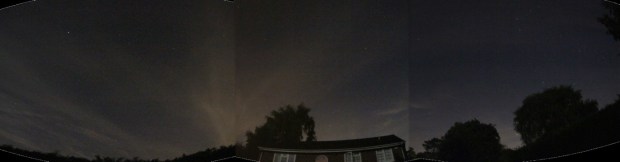
The view from the shed looking northwards is surprisingly quite good (see above) and I don’t know why I hadn’t considered this before. There are a few large trees to the north east, a high hedge along the western boundary and of course my house is still somewhat in the way but altogether it’s not too bad and for the first time I have a clear view of Polaris, as well as a whole new plethora of imaging targets! Whilst this direction looks directly towards south London, being on the southern slope of the Greensand Ridge the worst of the city’s glow is fortunately obscured by the hill. Furthermore, it is ironic that my house and the hedges also provide considerable protection from the local street lights, which I’m pleased to say are now turned off after midnight anyway.
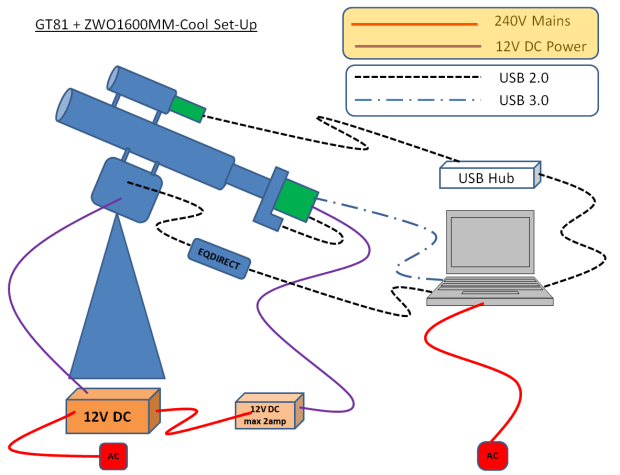
Local equipment layout the same as previously
I cut-back some of the adjacent vegetation to improve sightlines and ran a power cable from the house to the shed otherwise it’s exactly the same set-up which was being used at the main, south looking location on the patio by the house. I looked into WiFi-control of the equipment but from the experience of others concluded it could be unreliable and instead considered using Teamviewer software via a USB Cat-5 repeater cable from the mount / shed computer to a second computer in the house. However, given the distance of some 30 metres I finally decided to adopt a more robust LAN Cat-6 ethernet cable for this purpose. Unfortunately whilst this had worked successfully during testing in the house, I have so far been unable to get it to work outside and for now have had to operate the equipment from inside the shed, which has nonetheless proved to be a comfortable and effective alternative.
Being lazy and cautious about changing too much about the set-up, I levelled, aligned and reset the new location data of the tripod but kept all other settings the same for now. I realise this is not ideal but initially just wanted to experience the new location and north sky to understand what was possible within the given field-of-view and identify any obvious problems. Fortunately a settled period of good weather allowed me to try out the new location soon thereafter.

White area shows optimum imaging area from Fairvale Observatory South – AKA ‘The Shed’
What I hadn’t expected on first use was that slewing and tracking would become more difficult and takes noticeably longer at higher latitudes, especially approaching Polaris. Following subsequent enquiries and with some further thought it now makes sense. At higher latitudes near and above about 70 degrees as the lines of Longitude are closer together, it makes the RA slew rate bigger and bigger the closer you get to the North Celestial Pole. Of course the celestial pole is not coincident with the terrestrial pole, which means that those objects within the latitude of 90o minus the observer’s latitude – in my case this equals 39o – means that all those objects above 39o will be circumpolar from my point-of-view i.e. will rotate over the year around North Celestial Pole. This is basic astronomy but hitherto I had not considered the implications for tracking and guiding before and will need to bear it in mind when selecting targets in the future.
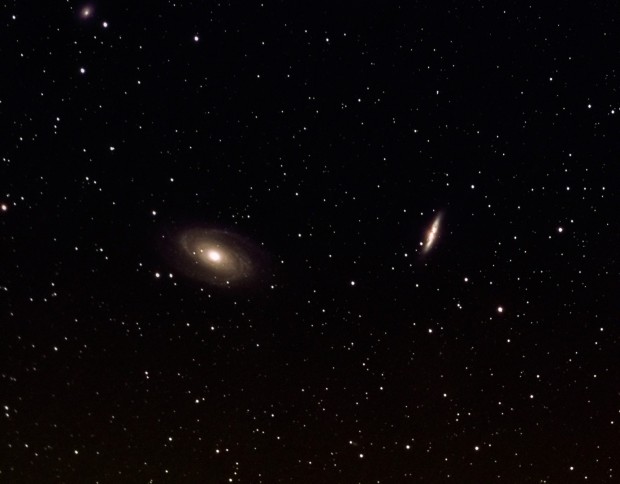
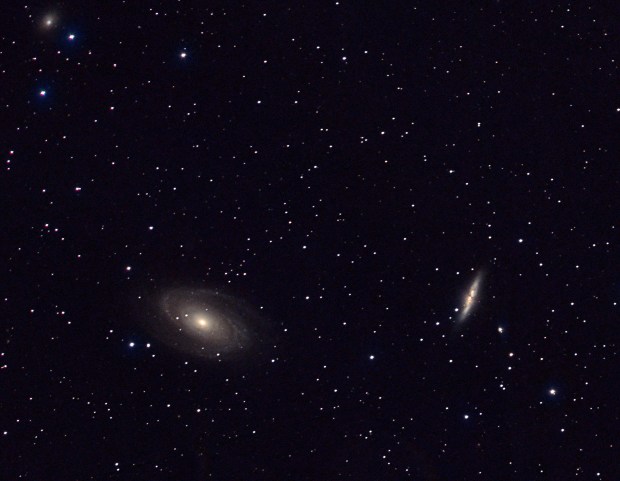
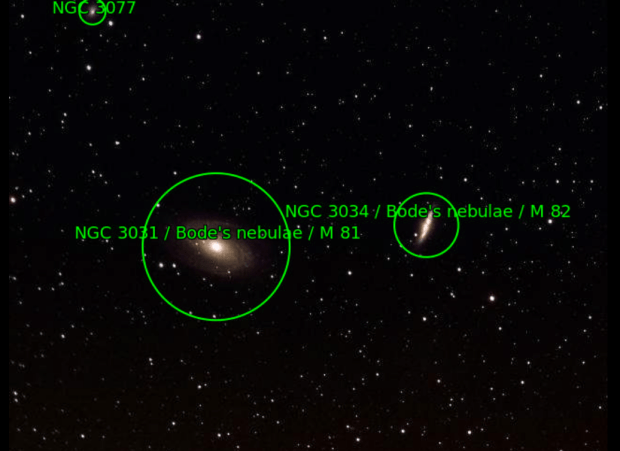
I had one particular target in mind but as it was only viable much later in the night, on this occasion I chose to start imaging the north sky for the first time with Bode’s Galaxy AKA M81 and the nearby Cigar Galaxy AKA M82; for comparison using low gain, long exposure on the first night (top of the page) and high gain, short exposure (below) on the following night. Given the target’s DEC position of 70o I soon discovered the aforesaid tracking difficulties, which resulted in the RMS guiding error varying from 3’ to 20’ and deleterious consequences for the images!


Whilst I’m pleased with my very first north sky images, it is obvious I’ll need to return again with better guiding and much longer integration time. On a positive note the general set-up worked very well and the shed provided an excellent place from which to operate the control and image capture equipment. Furthermore, despite a few restrictions the overall view of the northern night sky is good and holds much promise for future, hitherto inaccessible imaging objects. As a result of establishing this new site I intend to name the new north looking location Fairvale Observatory South or ‘The Shed Observatory’ (see mosaic above) and the principal, south looking location by the house Fairvale Observatory North or ‘The Patio Observatory’. Altogether this marks a major breakthrough for my astronomy and I eagerly await the return of astronomical darkness on 20th July onward.
| IMAGING DETAILS | |
| Objects | Bode’s Galaxy M81 & Cigar Galaxy M82 |
| Constellation | Ursa Major |
| Distance | M81 11.8 & M82 11.4 -12.4 million light-years |
| Size | M81 26.9’ x 14.1’ & M82 11.2’ x 4.3’ |
| Apparent Magnitude | M81 +8.0 & M82 +8.4 |
| Scope | William Optics GT81 + Focal Reducer FL 382mm f4.72 |
| Mount | SW AZ-EQ6 GT + EQASCOM computer control |
| Guiding | William Optics 50mm guide scope |
| + Starlight Xpress Lodestar X2 guide camera & PHD2 control | |
| Camera | ZWO1600MM-Cool (mono) CMOS sensor |
| FOV 2.65o x 2.0o Resolution 2.05”/pix Max. image size 4,656 x 3,520 pix | |
| EFW | ZWOx8 + ZWO LRGB & Ha OIII SII 7nm filters |
| Capture & Processing | Astro Photography Tool + PS2, Deep Sky Stacker & Photoshop CS2 |
| Image Location | Centre Image-B RA 09:55:13.46 DEC 69:21:08.36 (19/0518) |
| Exposures
|
A 18/05/18 10 x 180 sec L + 5×180 sec RGB (Total time: 75 minutes) @ 139 Gain 21 Offset @ -20oC
B 19/05/18 45 x 60 sec L + 15 x 60 sec RGB (Total time: 90 minutes) @ 300 Gain 50 Ofsett @ -20oC |
| Calibration
|
A 15 x 180sec Darks 20 x 1/4000 sec Bias 10 x Flats LRGB @ ADU 25,000
B 15 x 60sec Darks 20 x 1/4000 sec Bias 10 x Flats LRGB @ ADU 25,000 |
| Location & Darkness | Fairvale Observatory South – Redhill – Surrey – UK Typically Bortle 5 |
| Date & Time | (A) 18th & (B) 19th May 2018 @ +23.45h approx. |
 WATCH THIS SPACE(MAN)
Pingback: Jumbo Joy | WATCH THIS SPACE(MAN)
Pingback: Heart Of Darkness | WATCH THIS SPACE(MAN)
Pingback: New Northern Horizons | WATCH THIS SPACE(MAN)
Pingback: Game On | WATCH THIS SPACE(MAN)
Pingback: The Sum Of The Parts | WATCH THIS SPACE(MAN)