

The latter part of 2016 was very productive, especially around the end of November and early December. Remarkably the clouds were completely absent for over a week, it was cold but the air was unusually dry and furthermore it was only just past the New Moon, all-in-all excellent conditions for astrophotography. With Orion starting its Christmas-New Year parade across the night sky it was also a good time to investigate other parts of this fascinating constellation which I had not previously imaged.
Depicted in Greek mythology as Orion the Hunter, attention is most often given to the ‘sword’ that hangs from his belt – formed by three open star clusters which notably includes M42 the Orion Nebula. Located just above, in the eastern region of the Hunter’s so-called belt and is NGC 2014 the Flame Nebula and the nearby Barnard 33, or as it is more famously known – the Horsehead Nebula. I have imaged these and other targets such as the reflection nebulae M78 just above the aforementioned Flame Nebula and the difficult to image IC 2118, better known Witch’s Head nebula, situated just beyond the bright star Rigel which forms the Hunter’s left foot.
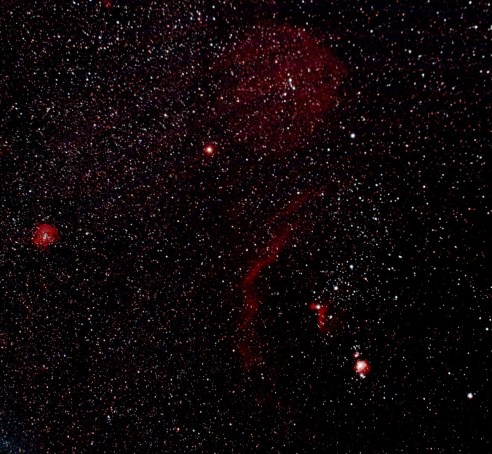
Barnard’s Loop & Lamda Orionis Nebula + Rosette Nebula on far left (east) : Vixen Polarie & modded Canon 550D + Sigma UWA lens @ 20mm | 14 x 240 secs @ ISO 800 | 14th January 2016
However, a much wider view of Orion shows the presence of very large regions of HII nebulosity enveloping the main constellation, which altogether form the Orion Molecular Cloud Complex. Most notable of these areas is Barnard’s Loop, a large HII cloud that arcs across some 10o of the sky encircling the lower, eastern section of the Orion star asterism. I have had some limited success imaging the Loop before but on this occasion I tried some of the other areas of HII nebulosity which are located within the higher parts of Orion the Hunter.
The combination of the William Optics GT81 and their x0.80 field flattener reduces the focal length from 478mm to 387mm and increases the speed from f5.9 to a fast f4.72. Apart from removing distortion at the periphery of the image, when used with the Canon 550D DSLR the field flattener increases the field-of-view by a staggering 64% or from 2.67o x 1.70o to 3.34o x 2.23o. This has its shortcomings when imaging galaxies which generally have a small FOV but is perfect for large DSOs such as my first target.
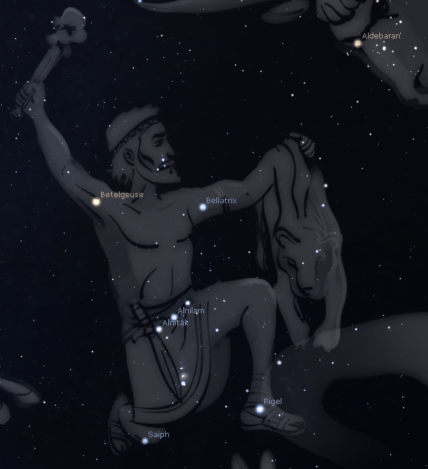
The basic ‘anatomy’ of the Hunter is outlined by a number of stars that form his legs, waist and arms, with a club held above in his right hand and either a shield, lion’s pelt or bow held outstretched in his left hand. On this occasion I first attempted to image his head; catalogued as SH2-264 it is otherwise known as the Lamda Orionis Nebula or sometimes the Angelfish Nebula. This very large HII cloud is located, as would be expected, at the top of the Hunter’s body and should be a good target for the aforementioned equipment with a modded camera, now aided by the longer exposures from my newly found PHD2 guiding expertise.
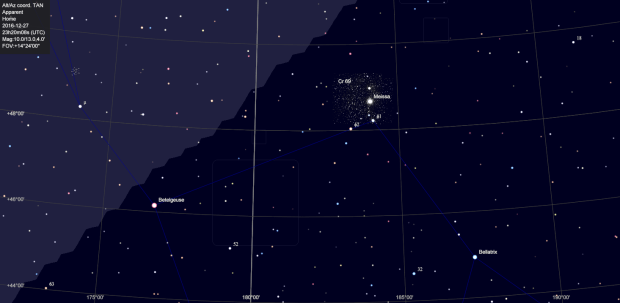
Upper Orion constellation & Lamda Orionis setting
This HII-feature is broadly centred on the giant double star Meissa or Lamda Orionis, which is itself at the apex of a triangle with the red giant superstar Betelgeuse to the east and blue giant star Bellatrix to the west and thus forms the outline of the Hunter’s shoulders. Some 8o in its entirety, the Lamda Orionis Nebula is enormous but consists mainly of very faint Ha-light, so that despite good imaging conditions, long exposures and good framing I was unable to obtain any sign of its presence on this occasion.
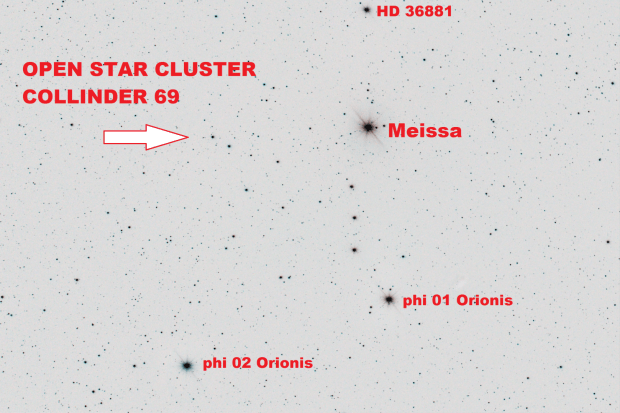
Frankly I was surprised there wasn’t at least a vestige of red Ha-light somewhere in the image but for now I will have to admit defeat. However, looking back I can see the Hunter’s head in previous wide-field nightscapes of Orion taken in January 2015 and 2016. Notwithstanding, together with other nearby stars Meissa forms the open star cluster Collinder 69, which on this occasion fortunately produced something of a pleasant alternative image.
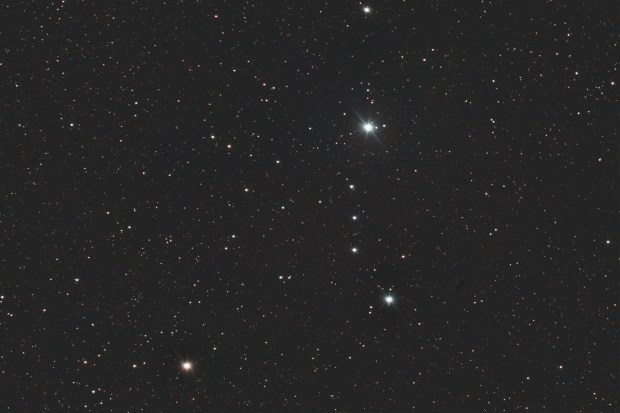
Meissa double star & Collinder 60 open star cluster | William Optics GT81 + modded Canon 550D & 0.80 FF + Guiding | 14 x 300 secs @ ISO 800 & full calibration | 4th December 2016
Subsequently I slewed the telescope and camera to another, nearby HII-cloud, this time situated along the Hunter’s right arm, just above his elbow. Discovered by amateur Californian astronomers Harold and Charles Lower in 1939, at about 45’ x 45’ size H2-261 or Lower’s Nebula is much smaller than the Lamda Orionis Nebula but also faint and difficult to image. However, here I did manage to capture something of the Ha-feature, albeit that the image was rather noisy when processed and yes I did apply Gradient Exterminator, though it doesn’t look like I did.

Lower’s Nebula SH2-261 | William Optics GT81 & modded Canon 550D + FF + guiding | 12 x 30 sec @ ISO 800 | 4th December 2016
The Orion Molecular Cloud Complex is one of the best known areas for star formation that is closest to Earth and provides an abundance of wonderful imaging targets at this time of the year. However, as previously experienced with Barnard’s Loop, the large areas of HII cloud that encircle much of Orion’s constellation can be elusive and difficult to image, which will probably require a camera of greater sensitivity and many more exposures to achieve success. However, on this occasion the image of Lower’s Nebula was some consolation as I continue my quest for Orion’s scalp.
 WATCH THIS SPACE(MAN)