Due to my viewing limitations at Fairvale Observatory planning is essential, with the best imaging range mainly restricted to a zone between 65o and 85o and within +/-20o of the Meridian. Furthermore, as I am mostly using the William Optics GT81 telescope at the moment, imaging targets should preferably be large – something between 1o & 2o is perfect, such as the Rosetta Nebula at 1.3o or Andromeda Galaxy at 190’ x 60’. As luck would have it these conditions are favourable for a number of objects at the moment and I have been somewhat spoilt for choice: North America Nebula, Veil Nebula and Andromeda.
Notwithstanding, for some reason I have until now overlooked the Sadr Region IC 1318, which is also large and in a similar part of the sky as the aforementioned North America and Veil Nebulae but perhaps overshadowed by their notoriety. In reality it is an enormous area of nebulosity containing many features worthy of imaging which are perfect at this time of the year from my location.

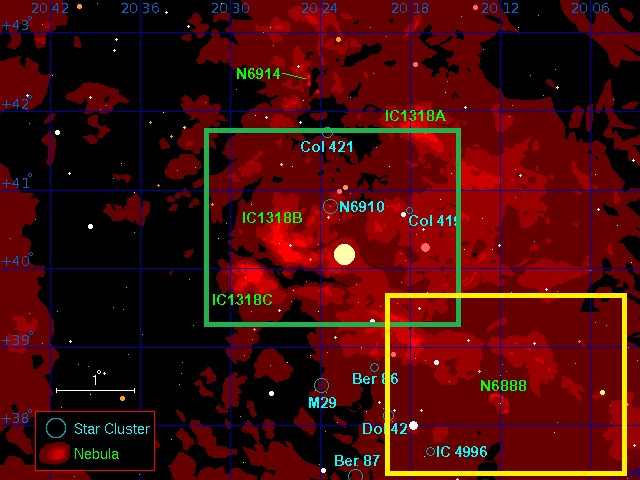
Sadr Region: green rectangle indicates the approximate area of IC 1318 image, yellow rectangle the NGC 6888 Crescent Nebula image.
IC 1318 is a diffuse emission nebula surrounding the star Sadr or Gamma Cygni, which is at the centre of the Cygnus Cross and on the plane of the Milky Way. The Sadr region is located deep within the Orion arm of the Milky Way about 3,000 light-years from Earth, with Gamma Cygni actually situated closer in the foreground. Such is the size of IC 1318 that its three constituent parts, A – B – C, extend over some 200 light-years or about 4 degrees, which is well beyond the FOV of the WO GT81; how could I have overlooked his enormous area of nebulosity before? As a result of its size and complexity I also chose to image two other interesting features nearby.
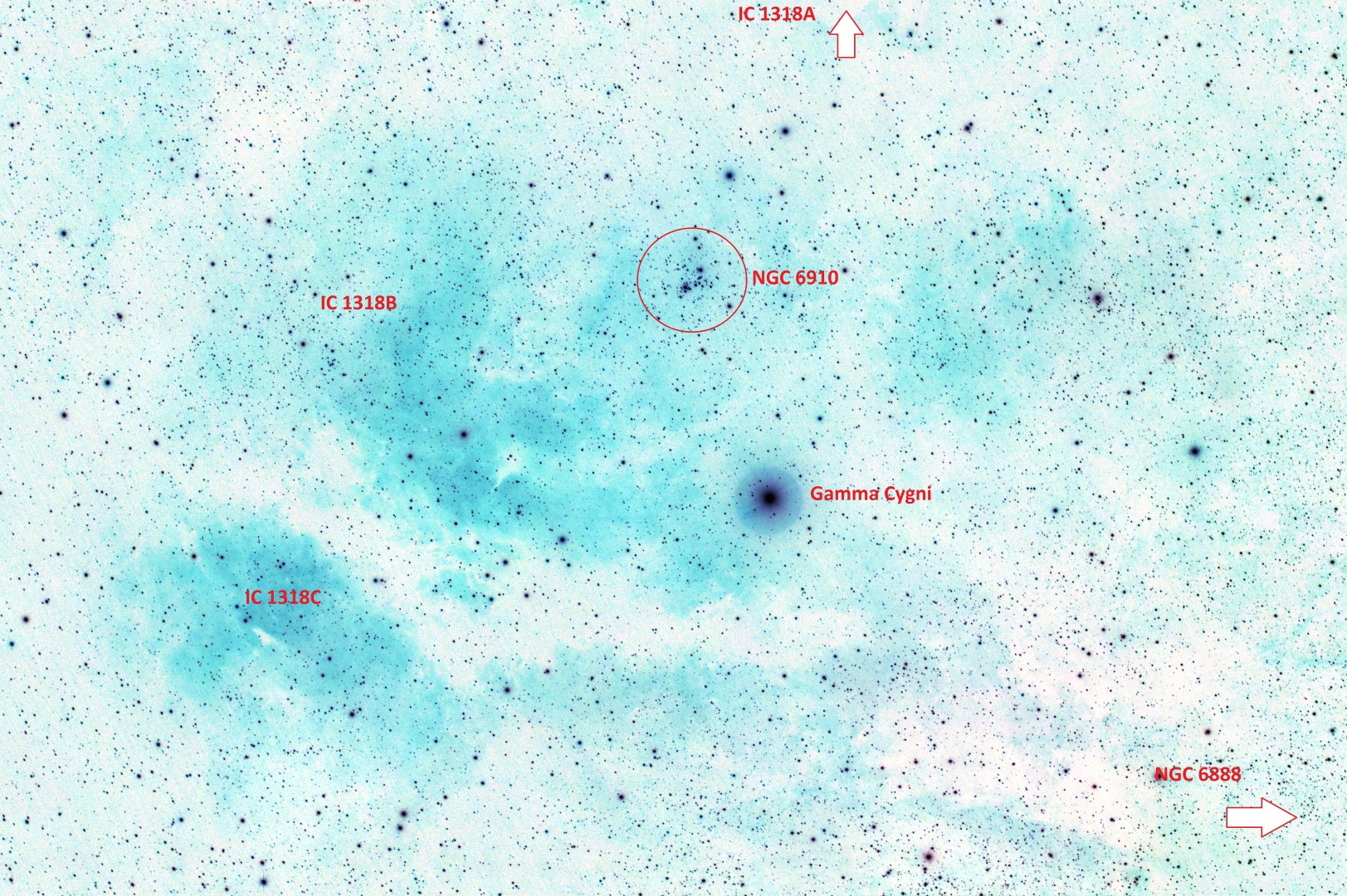
IC 1318 Sadr Region – image inverted & annotated

IC 1318 Sadr Region
WO GT81 + modded Canon 550D & FF | 30 x 120 secs @ ISO 1,600 | 30th September 2015
Situated just above Sadr is the small star cluster of NGC 6910 AKA Rocking Horse Cluster. Although only 10’ in size the cluster is visually quite prominent, though I struggle to see the little horse that others have identified. Notwithstanding, it is an interesting and attractive part of the Sadr region.

NGC 6910 The Rocking Horse Nebula as recorded by StarObersever.eu – located just above Gamma Cygni in the previous image.
Located about 2 degrees south west of Sadr is the Crescent Nebula NGC 6888, which is not unlike the Jellyfish Nebula in appearance but is younger in its evolution. An emission nebula, NGC 6888 is formed by a stellar wind from the Wolf-Rayet star WR 126 colliding with a slower moving wind ejected when the star previously became a red giant. The result is an illuminated shell-like feature consisting of two shock waves, one moving inward and the other outward, producing this amazing spectacle which measures some 25 light-years across. Near the end of its existence, the star will eventually end its life in a spectacular supernova explosion – now that would be an image.
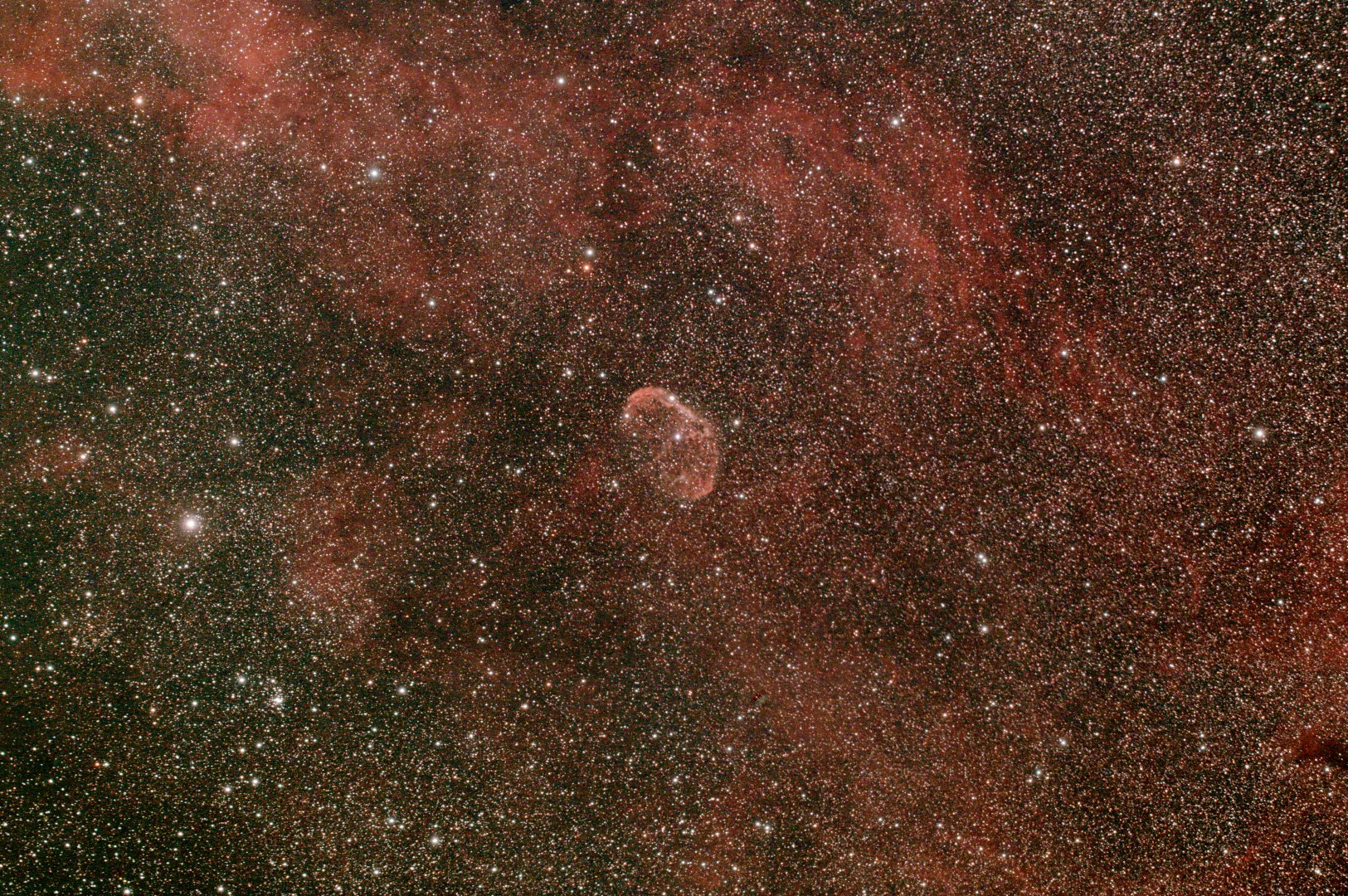
NGC 6888 Crescent Nebula
WO GT81 + modded Canon 550D & FF | 20 x 180 secs @ ISO 1,600 | 9th October 2015
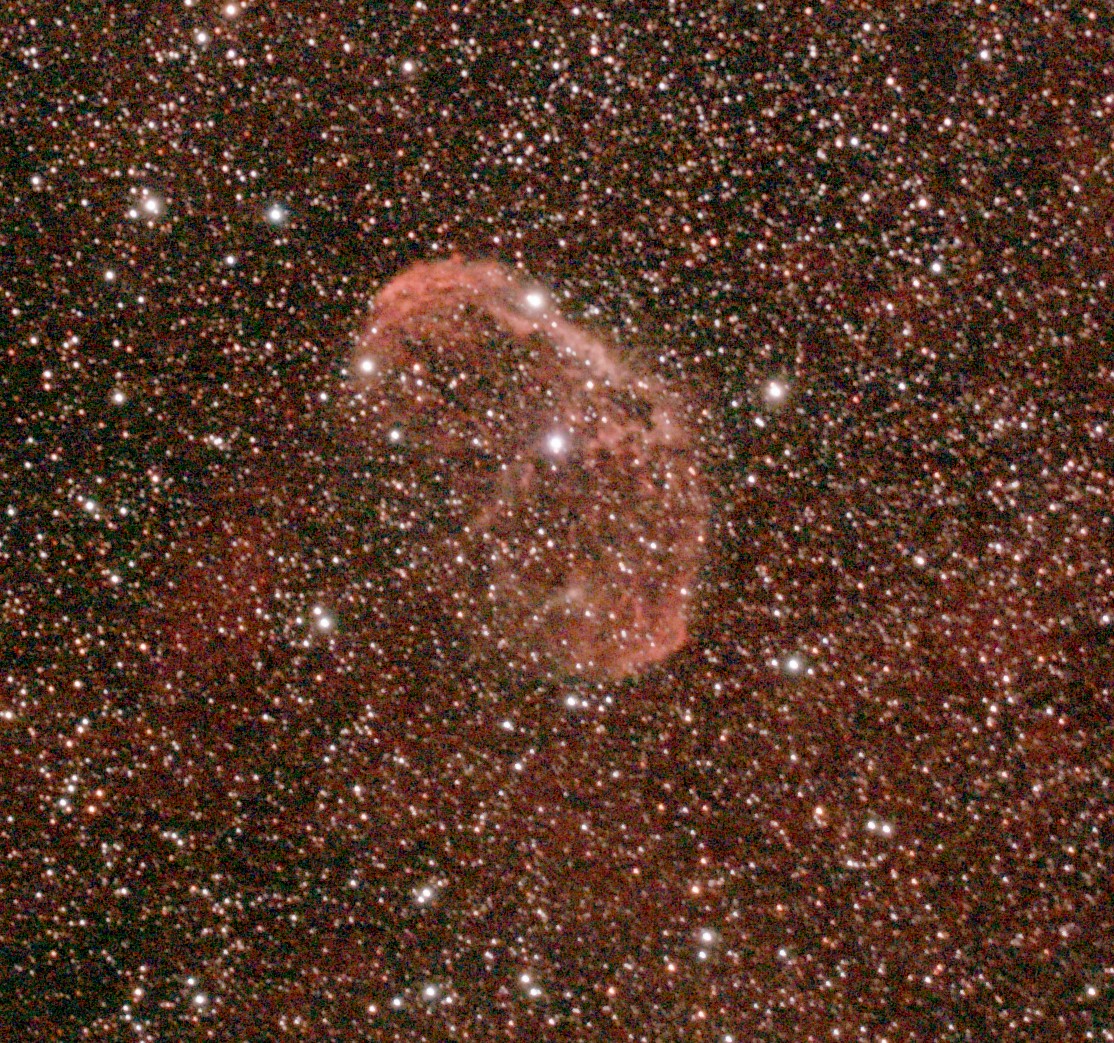
Crescent Nebula – cropped
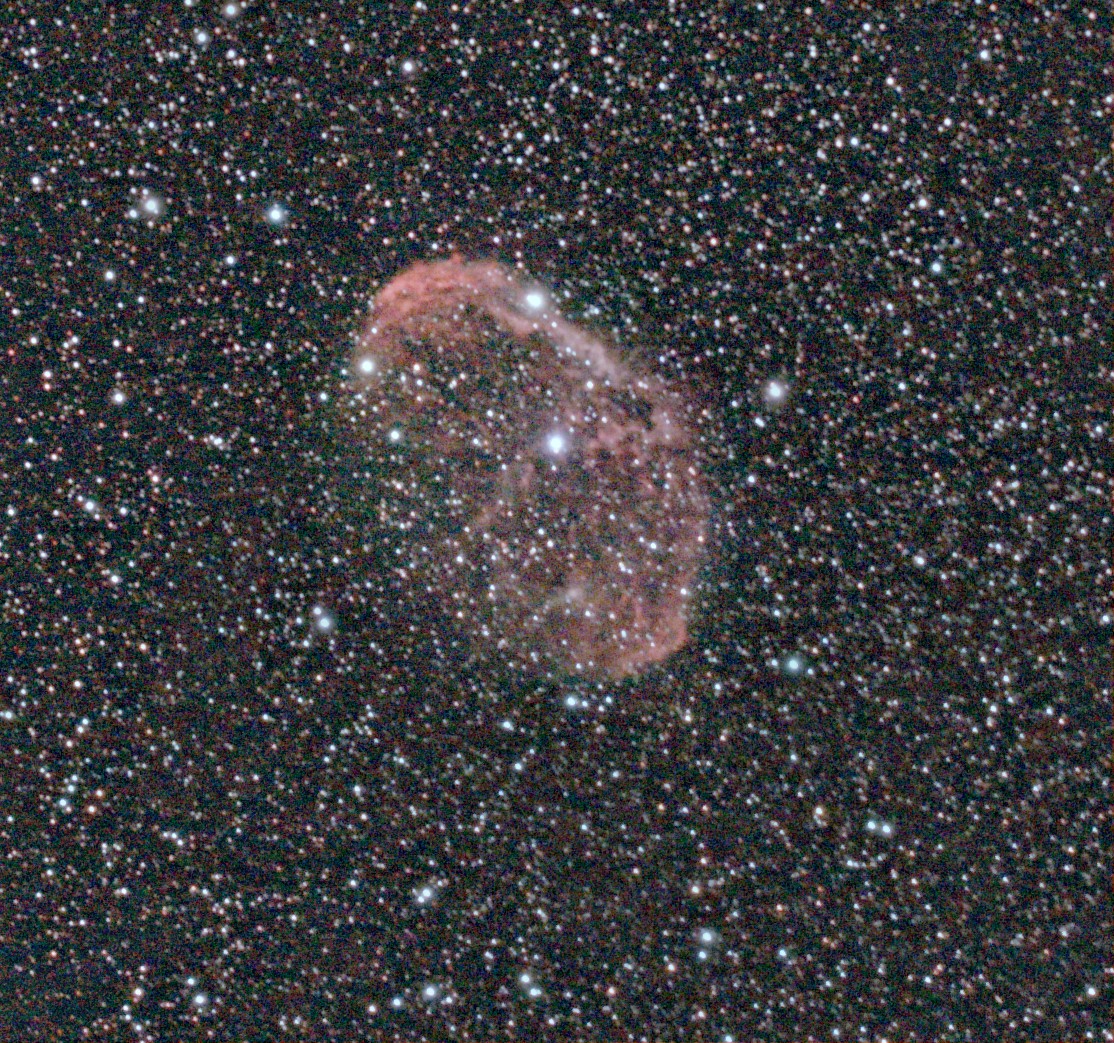
Crescent Nebula – GradientXTerminator applied
Whilst IC 1318 has proved to be an excellent and productive imaging target for my equipment, it has become clear that it represents a much, much larger area of nebulosity that incorporates or is at least immediately adjacent to NGC 7000, the North America Nebula. At a rough estimate this larger area spans a distance of some 2,000 light-years and is some 50-times bigger than the Sadr region. Like other major areas of nebulosity (Barnard’s Loop) such a scale is way beyond the ability of my equipment and most others without resorting to a mosaic technique.
However, my interest in seeing and potentially imaging the bigger picture has been piqued and I have recently purchased a Vixen Polarie tracking mount, which can be fixed onto a camera tripod with a standard camera and lens in order to take long exposures without forming star trails. This set-up has two advantages over prime focus + telescope imaging: (i) it is highly portable and can easily be taken anywhere in a rucksack, and (ii) by using a camera lens of say <=50mm focal length it is possible to achieve a much wider FOV and thus photograph some of these very large nebulous areas in one image.
Alas the Sadr region is now moving on and it is probably too late to tackle using the Polarie mount but it will be something to look forwards to again next autumn and meanwhile Orion is just round the corner. Watch this space for developments!
 WATCH THIS SPACE(MAN)
%26rotation%3d-179.5336144%26name%3dIC1318%2b300915%2bFINAL%2b(Large)%26reverseparity%3dFalse%26scale%3d7.10589068325%26thumb%3dhttps%3a%2f%2ffarm1.staticflickr.com%2f624%2f22151786542_f8063ab793_q.jpg%26ra%3d305.859018599%26y%3d540%26x%3d811%26dec%3d40.3758467471%26wtml%3dtrue)