
Only very recently the BBC Horizon programme covered the increasing problem of space junk that now orbits Earth forming a virtual cloud of debris posing a serious threat in general and, in particular, to future space activity: obsolete satellites, broken, damaged or even fragments from destroyed man-made objects. In addition to the ISS, communication and other satellites can often be seen passing overhead but in reality these only represent the tip of the iceberg.

Earth’s Junkyard
Computer-generated image of objects and debris currently being tracked orbiting Earth; it’s the stuff we can’t see or track that is most worrying!
Whilst visiting my daughter in Somerset at the weekend the night sky was clear and fantastically dark thanks to the New Moon and lack of light pollution when compared to Fairvale Observatory in Surrey. Having already tried to image the Perseids in the preceding week unsuccessfully, I thought I’d try again in these much better conditions using a basic DSLR on a tripod and an intervalometer.
Despite excellent seeing conditions, the air was cool’ish and therefore prone to quickly form dew on the camera lens after just 20 minutes or so. At the time it didn’t seem as though I had captured anything of interest, however, looking at the images subsequently on the computer, I was excited to find a bright flash appearing between two of the pictures pictures – what could this be, it seemed too short to be a Perseid? Whatever it is was had gone in the next image 5 seconds later. I discovered the anomaly whilst flicking from one picture to the next when suddenly a bright point stood out from the otherwise unchanging starry sky by blinking – a characteristic of something unusual taking place.
I posted a query on SGL and the overwhelming consensus has been that it is most likely to be a satellite or debris flare from the aforementioned space junk – either a spinning satellite or debris that briefly produced a reflection as it passed through the field of vision. Looking closely the bright spot does seem to be elongated from left to right, suggesting movement, though I am still perplexed why it has therefore not produced a more significant trace given the 30-second exposure being used – for a moment I even thought it might be a Super Nova!
Notwithstanding, it’s an interesting effect, though sadly seems to confirm the extent to which mankind has already made a mess of the space around our planet.
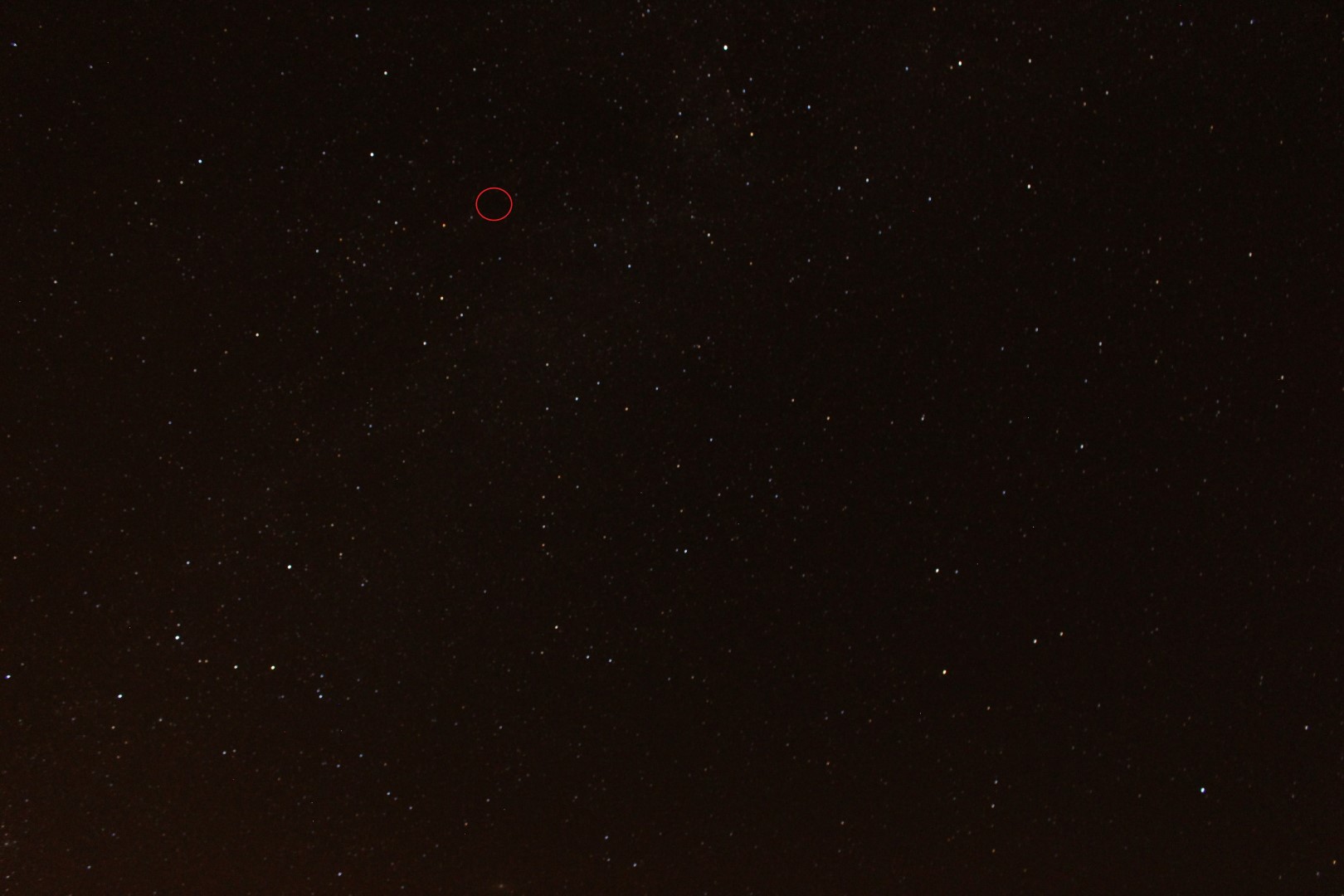
Image before the satellite flare appears – red circle indicates the area of interest.
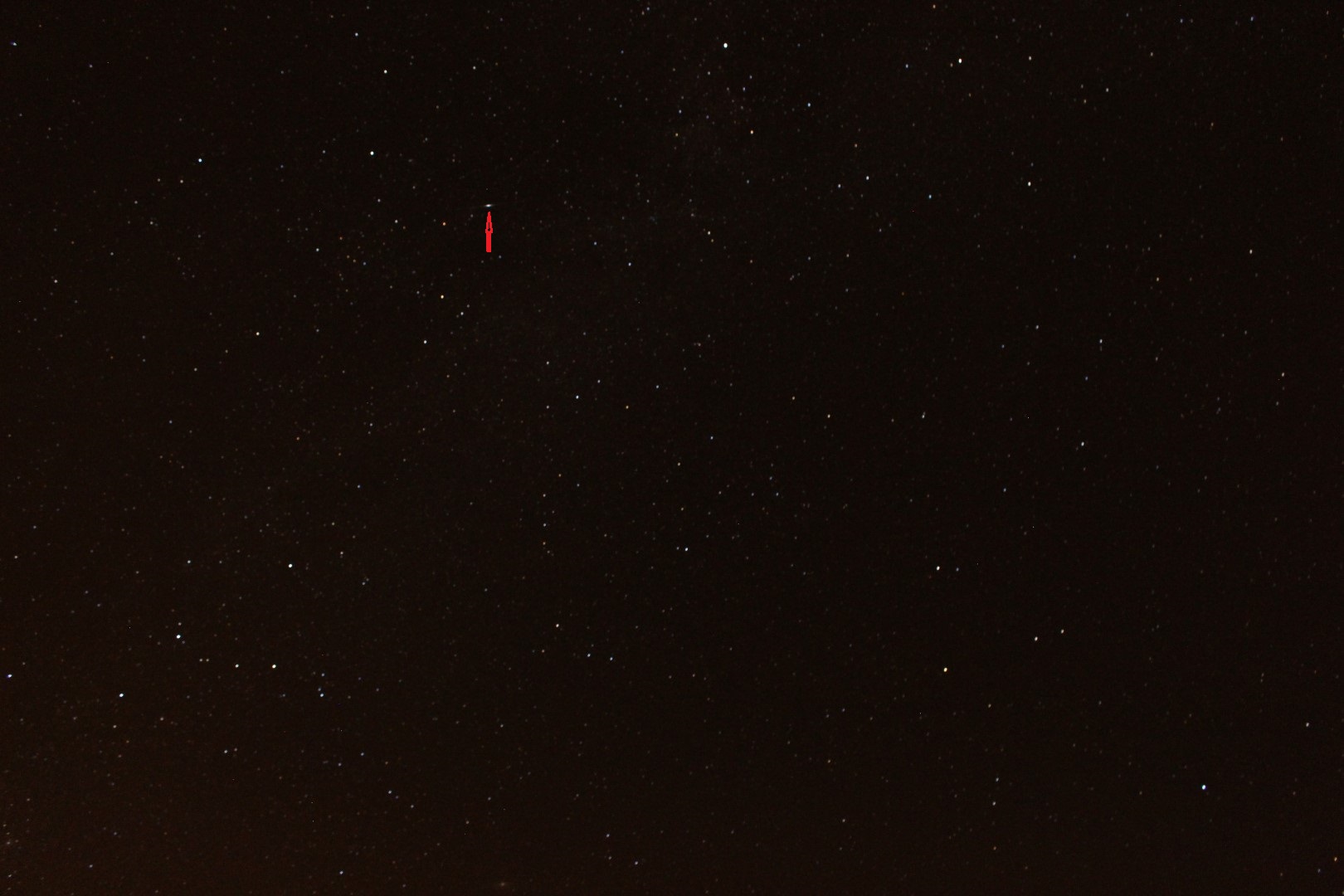
+ 5 seconds later a satellite / debris flare, indicated by the red arrow?
Notes: The pictures were taken at 10.37pm on 16th August, looking north east, at about +70o inclination using a Canon EOS 700D + 18-55 lens, at 18mm and f5.6. Both images are 30 secs exposure at ISO1,600 with an interval of 5-seconds. The area of interest is indicated with a red ring in the first image, with the white ‘object’ appearing in the following image shown by a red arrow.
 WATCH THIS SPACE(MAN)