Earth’s Junkyard

Only very recently the BBC Horizon programme covered the increasing problem of space junk that now orbits Earth forming a virtual cloud of debris posing a serious threat in general and, in particular, to future space activity: obsolete satellites, broken, damaged or even fragments from destroyed man-made objects.  In addition to the ISS, communication and other satellites can often be seen passing overhead but in reality these only represent the tip of the iceberg.
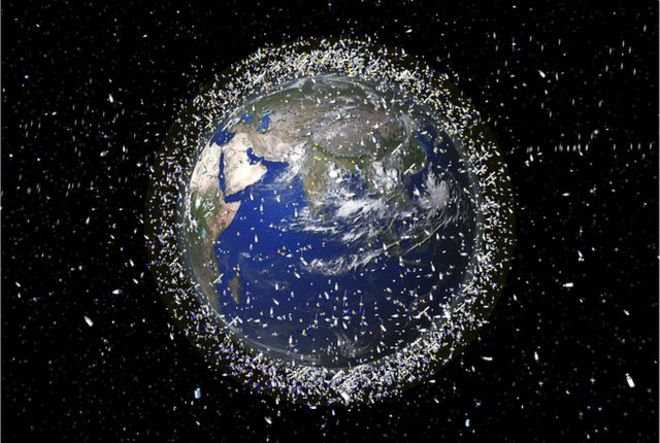
Earth's Junkyard Computer-generated image of objects and debris currently being tracked orbiting Earth; it's the stuff we can't see or track that is most worrying!

Earth’s Junkyard
Computer-generated image of objects and debris currently being tracked orbiting Earth; it’s the stuff we can’t see or track that is most worrying!

Whilst visiting my daughter in Somerset at the weekend the night sky was clear and fantastically dark thanks to the New Moon and lack of light pollution when compared to Fairvale Observatory in Surrey.  Having already tried to image the Perseids in the preceding week unsuccessfully, I thought I’d try again in these much better conditions using a basic DSLR on a tripod and an intervalometer.

Despite excellent seeing conditions, the air was cool’ish and therefore prone to quickly form dew on the camera lens after just 20 minutes or so. At the time it didn’t seem as though I had captured anything of interest, however, looking at the images subsequently on the computer, I was excited to find a bright flash appearing between two of the pictures pictures – what could this be, it seemed too short to be a Perseid?  Whatever it is was had gone in the next image 5 seconds later.  I discovered the anomaly whilst flicking from one picture to the next when suddenly a bright point stood out from the otherwise unchanging starry sky by blinking – a characteristic of something unusual taking place.

I posted a query on SGL and the overwhelming consensus has been that it is most likely to be a satellite or debris flare from the aforementioned space junk – either a spinning satellite or debris that briefly produced a reflection as it passed through the field of vision.  Looking closely the bright spot does seem to be elongated from left to right, suggesting movement, though I am still perplexed why it has therefore not produced a more significant trace given the 30-second exposure being used – for a moment I even thought it might be a Super Nova!

Notwithstanding,  it’s an interesting effect, though sadly seems to confirm the extent to which mankind has already made a mess of the space around our planet.
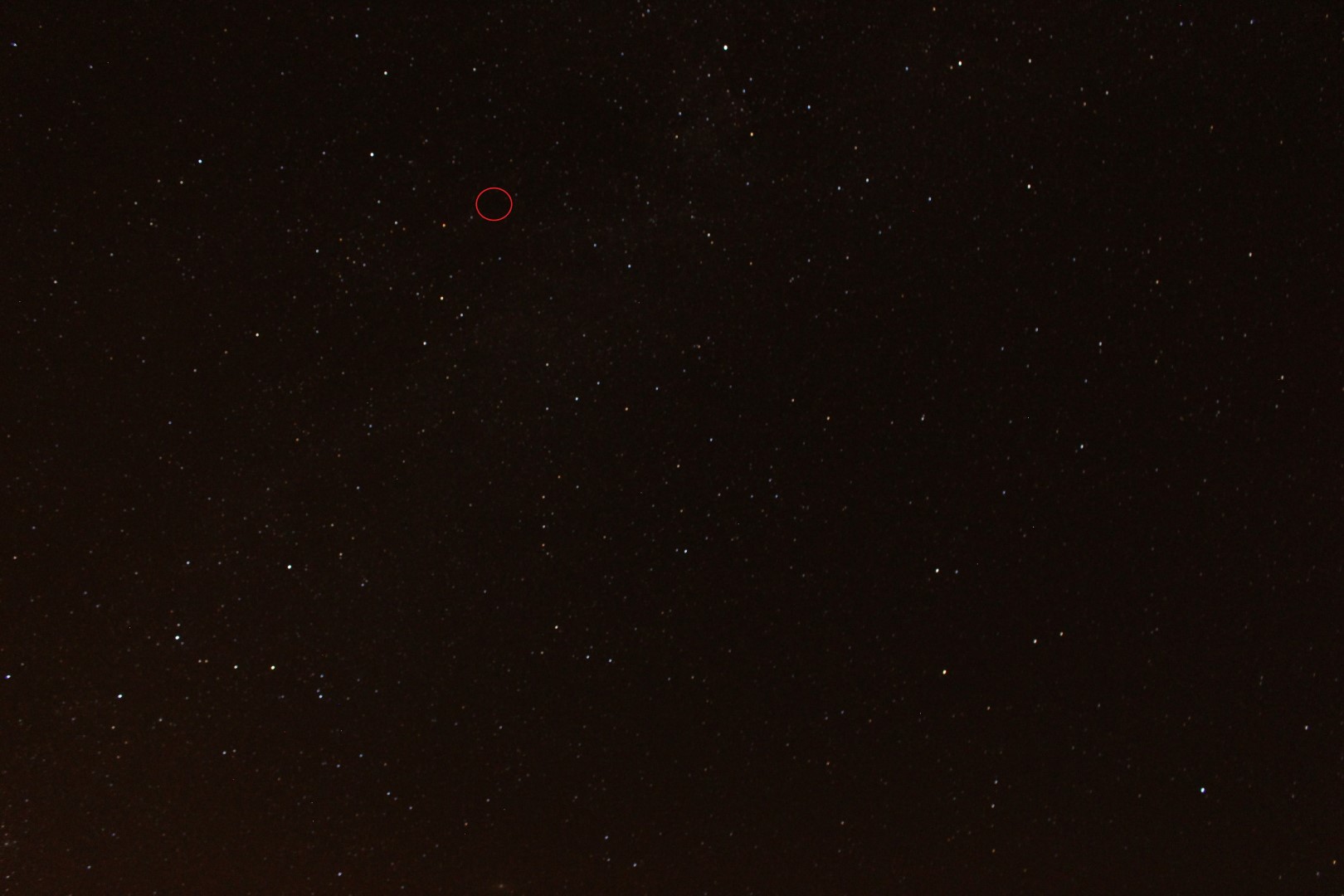
Image before the solar flare appears - red circle indicates the area of interest.
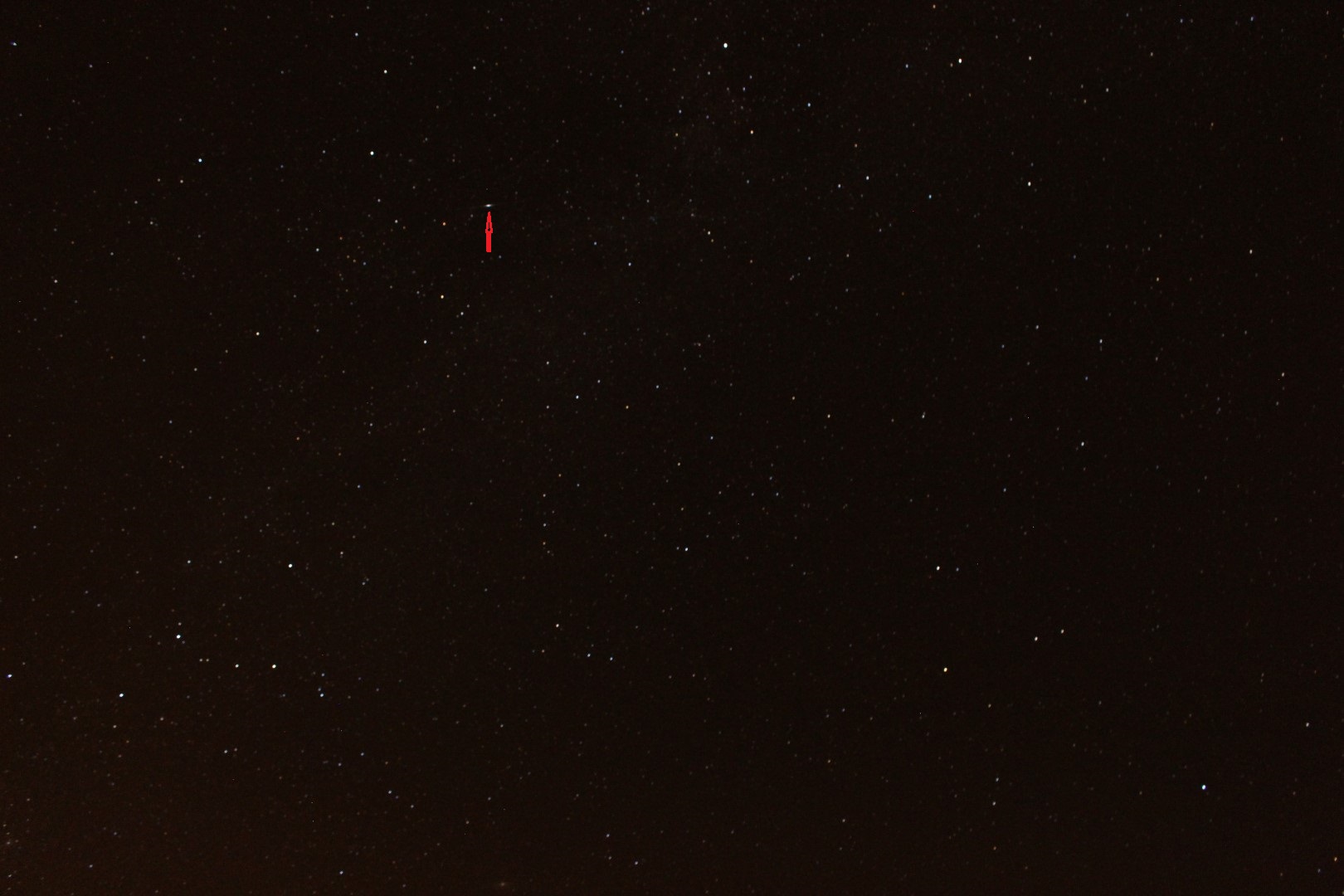
Image before the satellite flare appears – red circle indicates the area of interest.

Solar flare, indicated by the red arrow?

+ 5 seconds later a satellite / debris flare, indicated by the red arrow?

Notes: The pictures were taken at 10.37pm on 16th August, looking north east, at about +70o inclination using a Canon EOS 700D + 18-55 lens, at 18mm and f5.6. Both images are 30 secs exposure at ISO1,600 with an interval of 5-seconds.  The area of interest is indicated with a red ring in the first image, with the white ‘object’ appearing in the following image shown by a red arrow.
180 Degrees

Viewing from Fairvale Observatory is far from ideal but I have no choice and need to make the most of it:

(i) Without going down the garden (which is not practical and would then totally obscure the southerly view) my house blocks the entire northern sky, critically including Polaris;

(ii) We have very high +/-12ft hedges surrounding the garden;

(iii) Directly east is a large house that completely obscures the horizon;

(iv) South east and south are very large trees;

(v) To the west is a wooded hill, thus blocking the horizon in that direction, and

(vi) Some 7-miles to the south is Gatwick Airport which produces significant light pollution, as well as aircraft that regularly fly through my images as well as others from Heathrow, also not far away.

It’s a miracle I am able to undertake any astrophotography and I long for the day I live somewhere with better conditions.

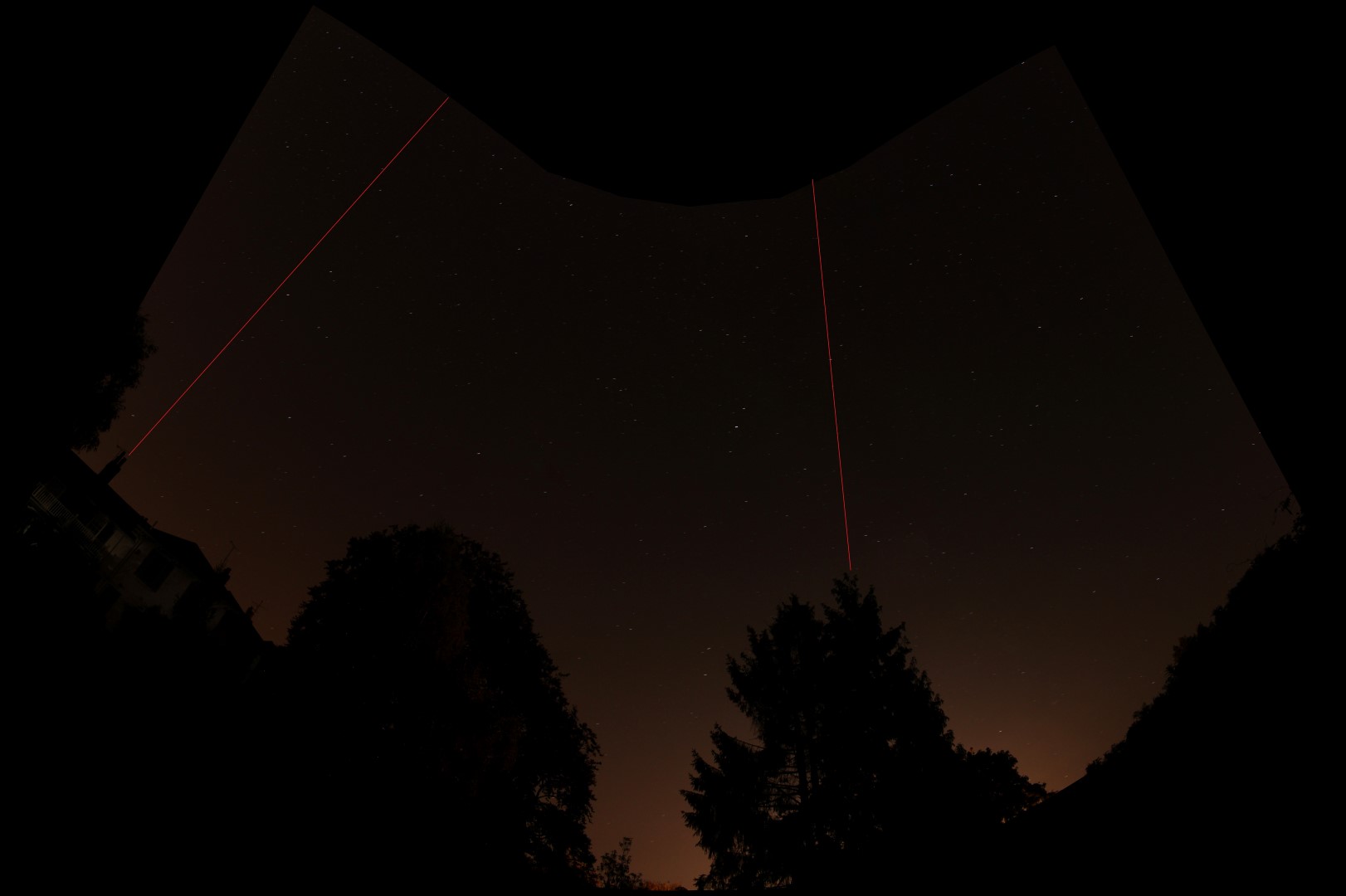
In the meantime I have to make do with the 180o I have available.  For the record and with great skies and good weather, this week I compiled a photo mosaic of the aforesaid view – which illustrates some of the aforementioned problems and is in itself an interesting picture. The scene is stitched together from six DSLR shots that encompass most of the east to west panorama but in order to achieve this, the resulting photograph becomes severely distorted.

The principal view is directly south, with the Meridian pretty much straight ahead.  Low angle viewing and imaging is almost completely impossible but depending on the timing and some crafty shooting, the mid-angle objects can be accessed as they pass between the trees. The best imaging is therefore mostly restricted to a 20o range between about 65o and 85o and within +/- 20o of the Meridian; high angle east and west views are feasible but seeing in these directions is impacted by the greater atmospheric distance through which the light has to travel.

For now this is my night time playground: it is challenging and can be frustrating but with clear skies, preparation and patience it’s good fun and much can still be achieved.

Night sky panorama from Fairvale Observatory + obstacles: the tree on the left is very large +200 year-old copper beech, the coniferous trees  due south are closer to the property boundary - thus increasing their impact   on seeing.  The red line on the left approximately marks the East and the central red line is the Meridian.

180 degree night sky panorama from Fairvale Observatory + obstacles: the tree on the left is a very large +200 year-old copper beech, the coniferous trees due south are closer to the property boundary – thus increasing their impact on seeing. The red line on the left approximately marks the East and the central red line is the Meridian.

Equivalent Cartes du Ceil planetarium view at the same time.

Equivalent Cartes du Ceil planetarium view at the same time.

Looking Up

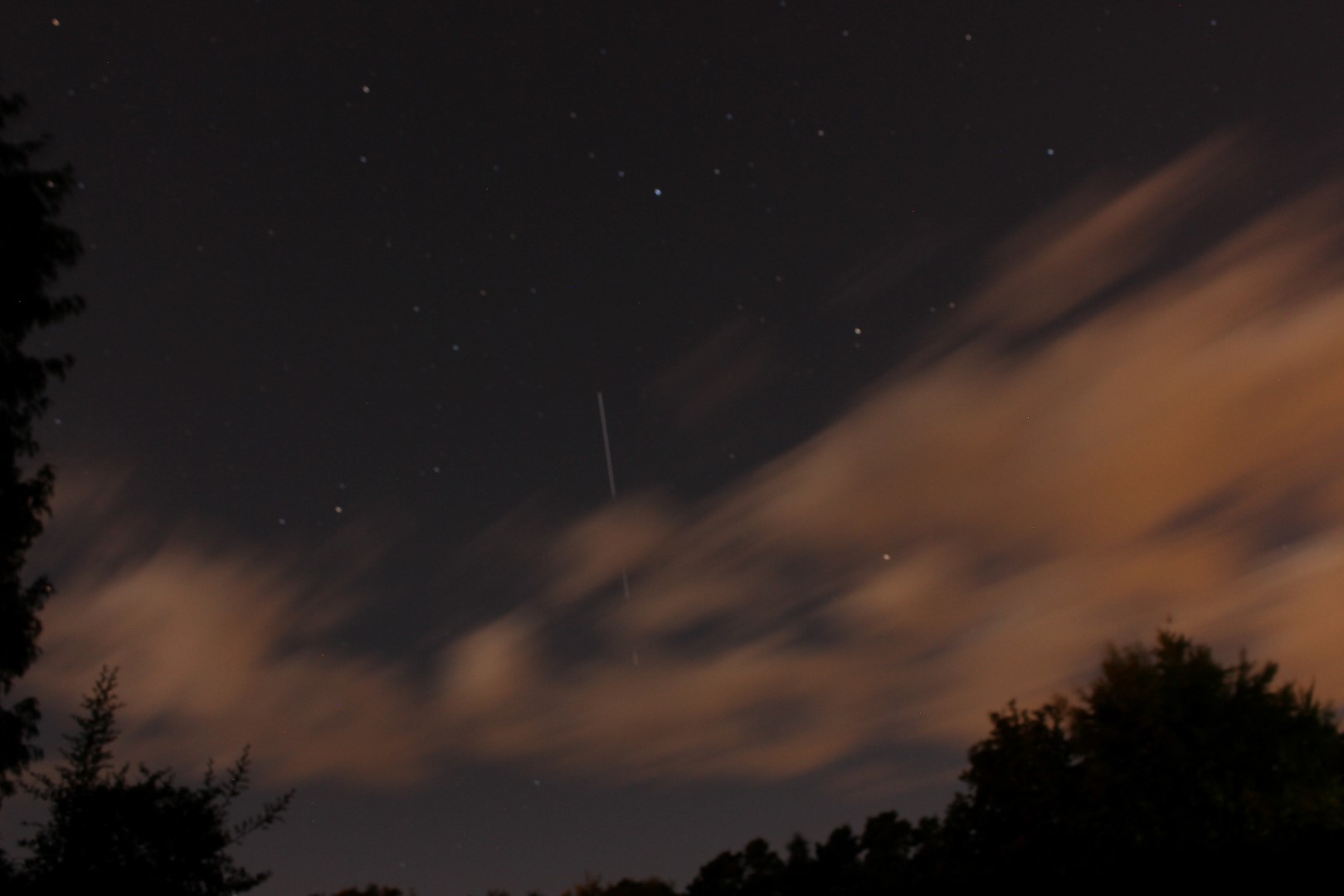
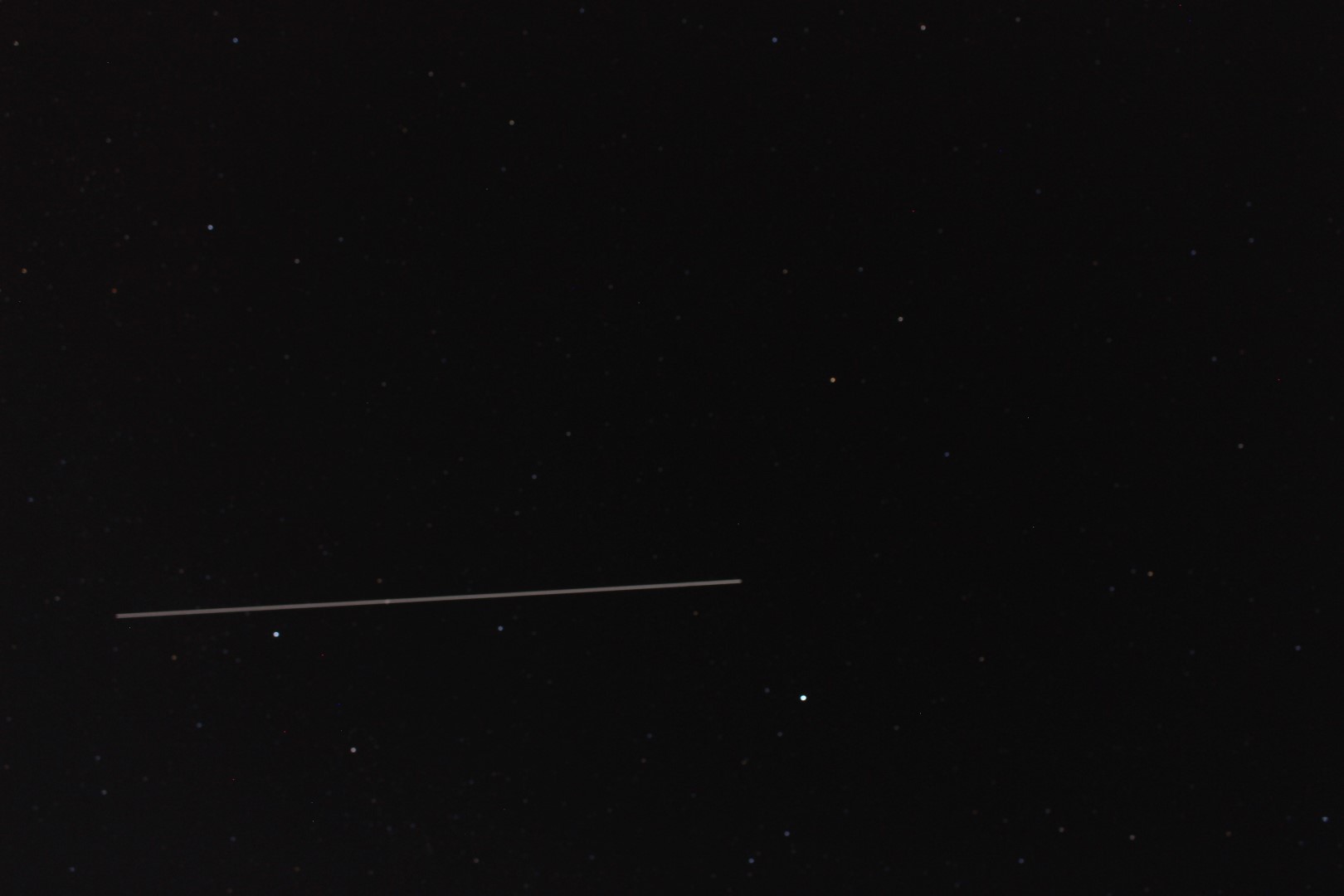
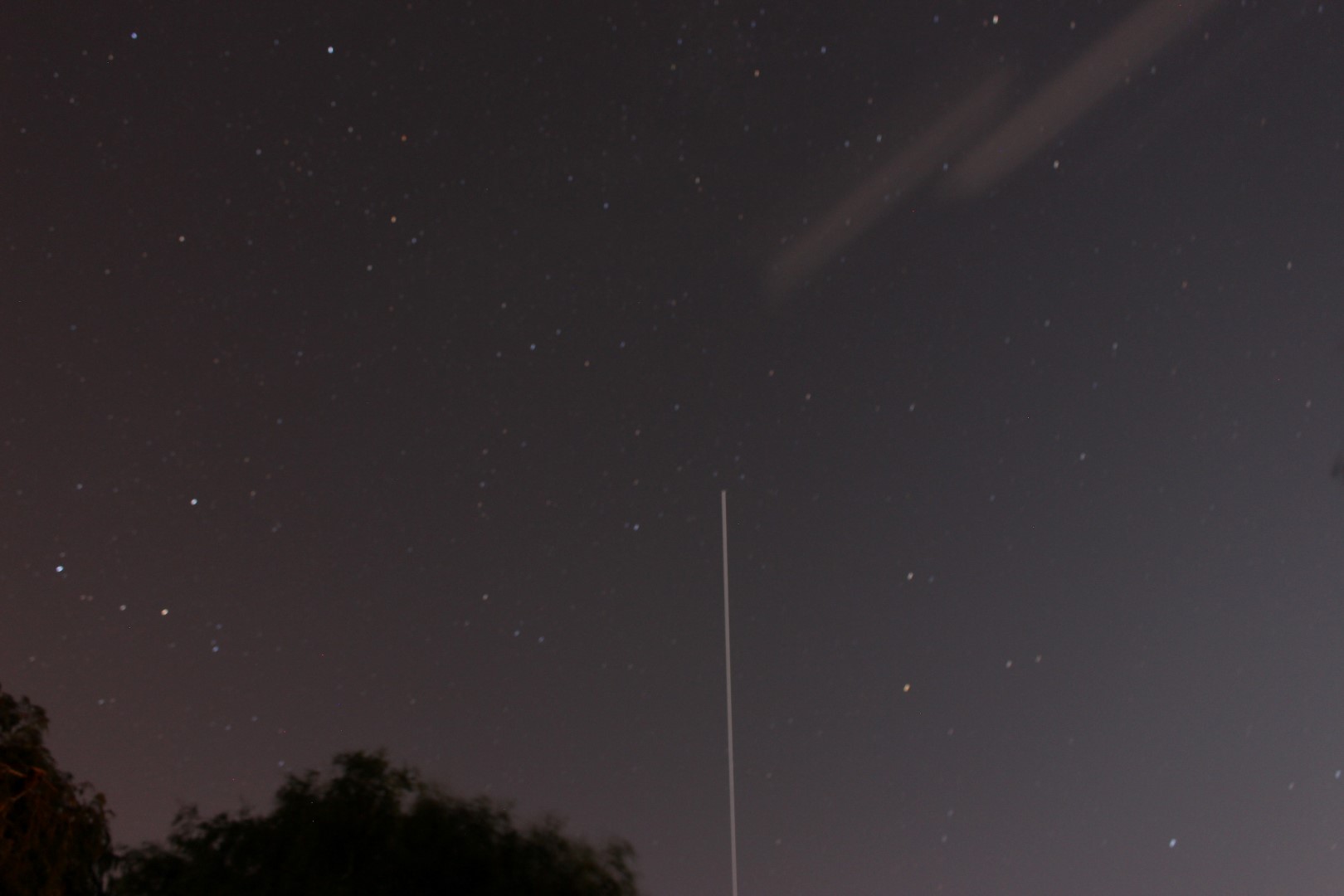
Having been unable to set-up Fairvale Observatory since April, it has been frustrating with almost no hands-on astronomy taking place.  However, last night the march of time and serendipity played their part; by chance I glanced out of the window and lo and behold saw the International Space Station (ISS), which was then scheduled to pass almost directly overhead again 90-minutes later at 11.17 p.m.  Now six weeks past the Summer Equinox sunset is coming increasing earlier, currently 8.45pm and by the time the ISS would be back the night sky was almost at astronomical darkness.  This would provide a favourable setting for viewing and imaging – furthermore, the sky was almost clear and the temperature a comfortable 180C, far from the sub-zero conditions back in February.

I have just purchased a second-hand EFS 55 – 250mm Canon IS telephoto lens, so what else was there to do but get outside and get ready to image the ISS next time round, thereafter one thing led to another!  Being a more mobile set-up I was able to venture further from the house than usual and thereby obtain images of some constellations and asterisms which I cannot usually achieve from the Observatory.

Though not as spectacular as the Planets and DSO images, I found the simple sky photographs satisfying to shoot and enjoyable to look at.  The beguiling night environment, exciting subjects, improving darkness conditions and my increased mobility, suggests things are looking up – in more than one way.


ISS Western view: 6 minute transit from West to East at 850

ISS Western view: 6 minutes total transit time from West to East at 85 degrees elevation.

ISS Overhead view

ISS Overhead view


ISS Eastern view

ISS Eastern view

Summer Triangle – signature asterism of the summer night sky: clockwise from top left: Deneb - Vega – Altair.

Summer Triangle – signature asterism of the summer night sky: clockwise from top left: Deneb – Vega – Altair.

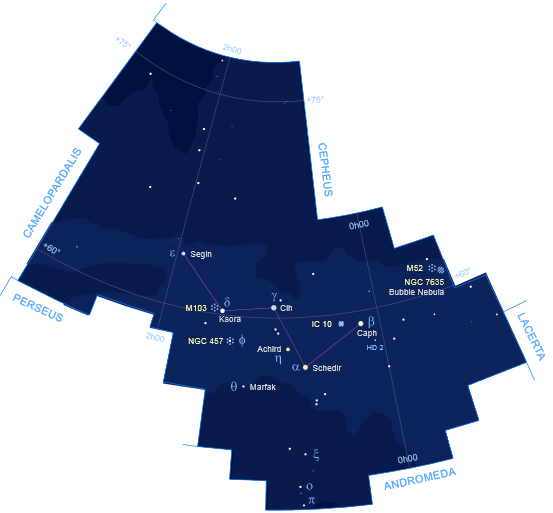
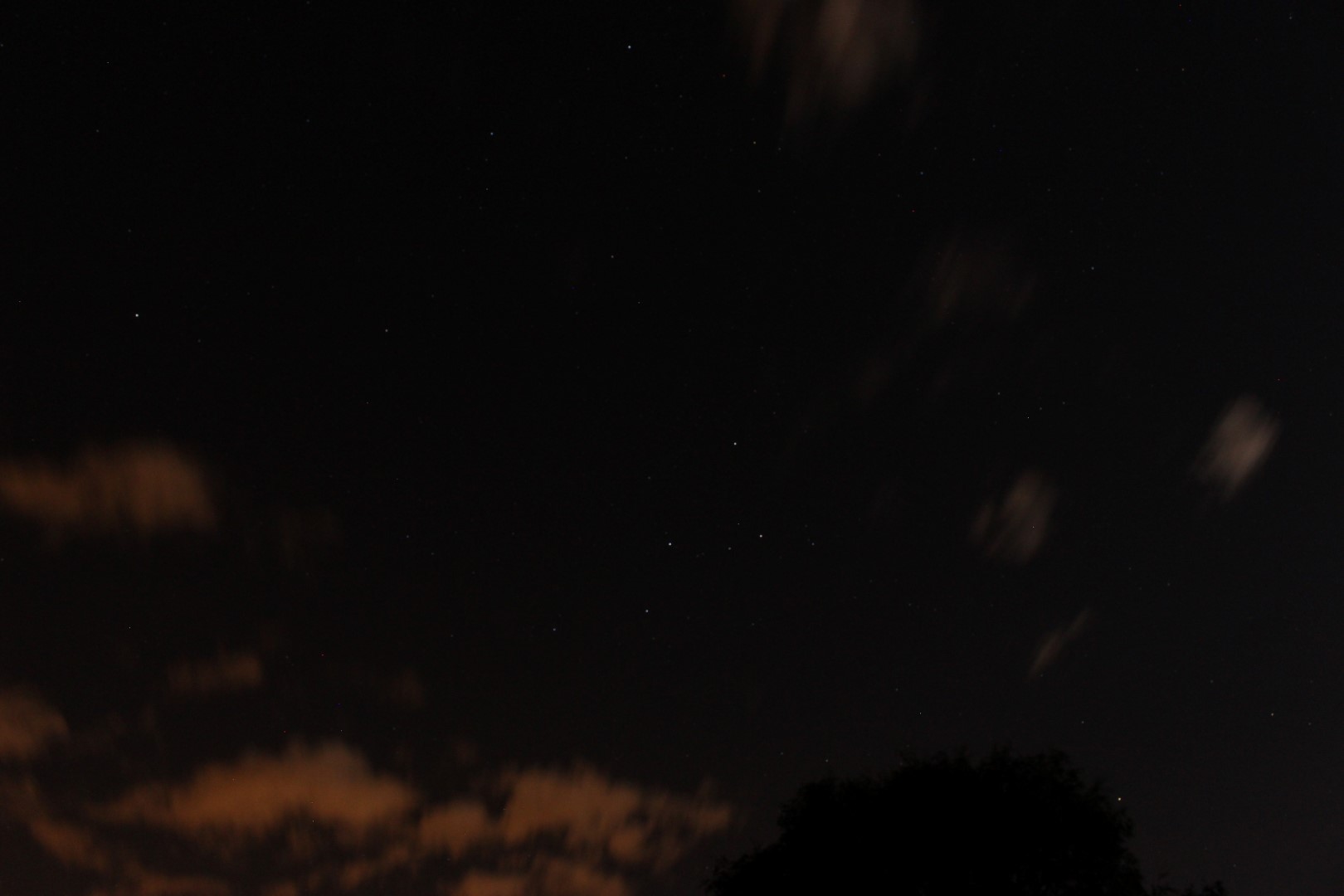
The W-shaped asterism of the Cassiopeia straddles the Milky Way in the northern sky and is made of  5-stars: Segin, Ksora, Cih, Schedar and Caph.  The constellation contains a number of star clusters, most notable being M52 and close to Ksora, M103.

cassiopeia


Cassiopeia

Cassiopeia

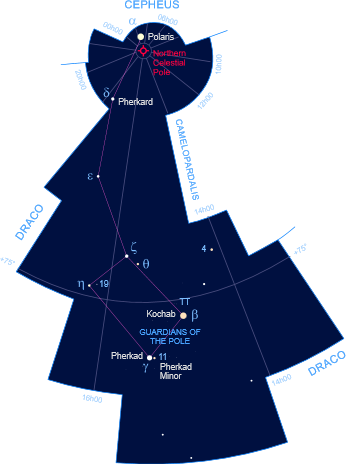
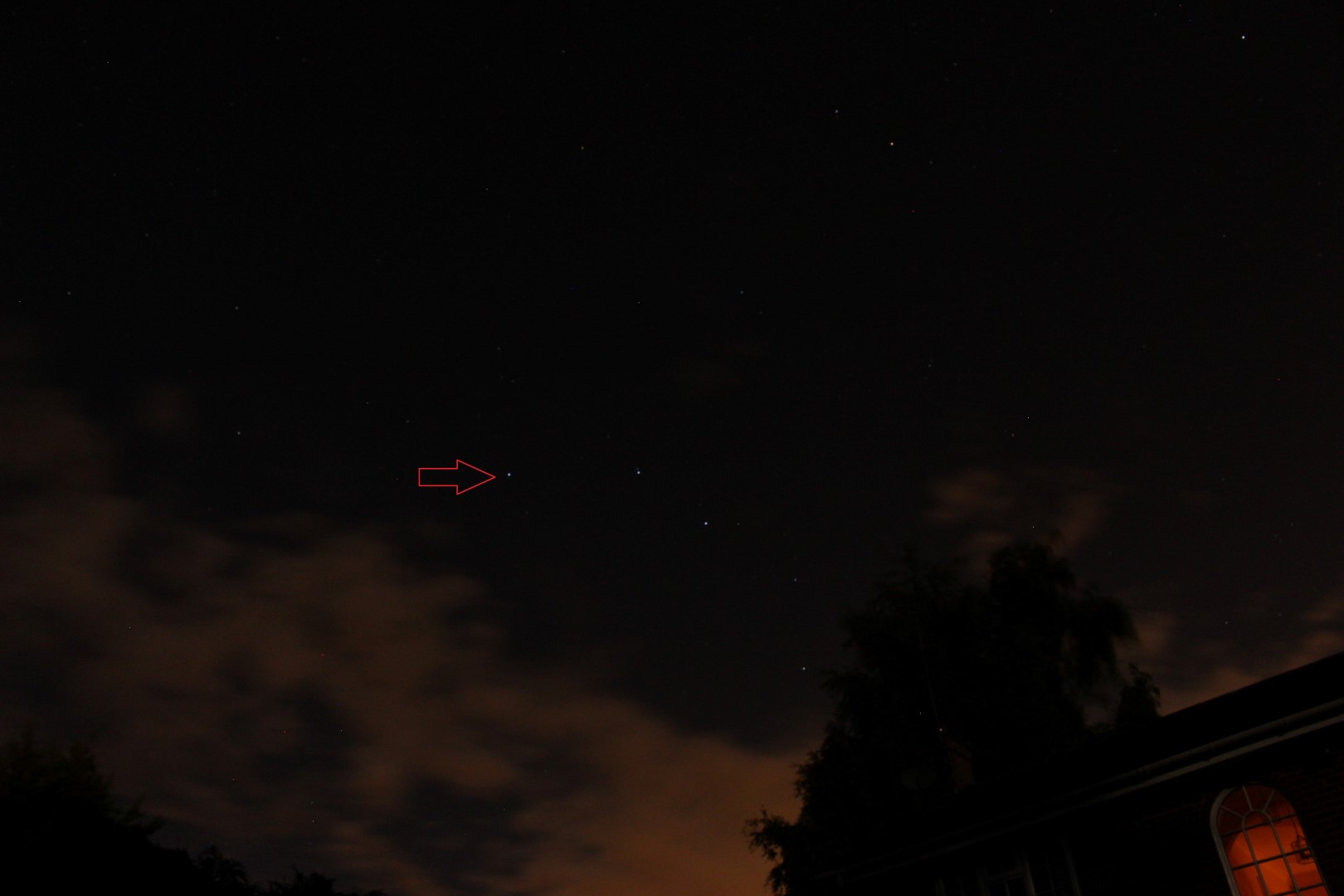
Ursa Minor –  Like the Plough in Ursa Major, Ursa Minor has a ‘dipper-like’ shape and they are therefore respectively known as the Big and Little Dippers.  Ursa Minor’s main significance is the North or Pole Star, AKA Polaris.  Situated very close to the Celestial Pole, alignment of the telescope mount with Polaris is essential to achieve accurate tracking; unfortunately Polaris is obscured from Fairvale Observatory but can be seen from the garden.

ursaminor


Ursa Minor - Polaris star indicated by red arrow, with the 'dipper' to the right.

Ursa Minor – Polaris star indicated by red arrow, with the ‘dipper’ to the right.