
Perspective:
- The appearance of objects relative to each other, as determined by their distance from the viewer, or the effects of this distance on their appearance – The Free Dictionary.
- Noun: The art of representing three-dimensional objects on a two-dimensional surface so as to give the right impression on their height, width, depth and position in relation to each other – Oxford English Dictionary
I have just finished an Open University MOOC (Massive Open Online Course) on Orion, which it has to be said was mixed in its content and quality. Notwithstanding, the course provided a useful basic understanding of objects in the Universe, particularly Orion, how they related to each other and as a whole. Through my professional experience I am used to viewing and understanding objects in 3D, all the more so since computer modelling has provided a tool with which to visually illustrate such spatial shapes and relationships. Although it is obvious that such relationships also describe the astronomical space in which we exist i.e. the Universe, and commonly describe the location of stars and other heavenly bodies by their distance, RA and DEC, I have seen very few of these objects visually modelled for common asterisms or constellations.
The constellation of Orion is probably the main feature of the winter night sky and it is certainly my favourite, particularly when looking at its rich content: M42 the Great Orion Nebula, the Running Man Nebula, the Horsehead and Flame Nebulae, M78, Barnard’s Loop and many more. Sadly after more than 4-months imaging these objects for the first time, Orion is now starting to rise very early in the evening and by 11pm is well past the Meridian – it will not be long before this magnificent feature will be gone for another year, until on the very early mornings of next October it will reappear again, can’t wait!
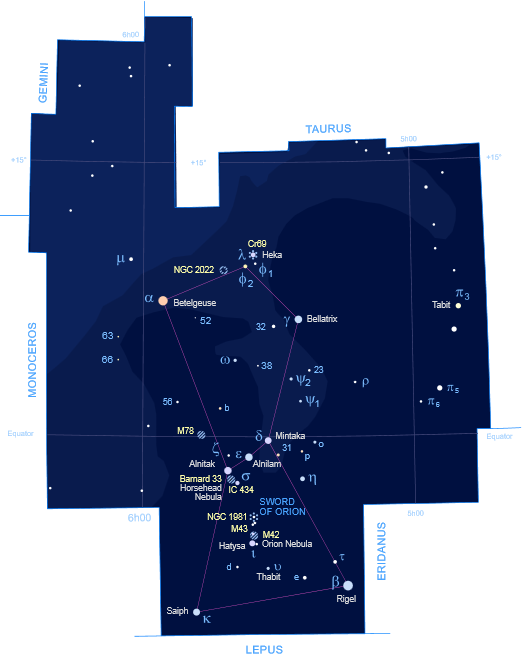
With my new found interest in astroimaging I have almost exclusively used a DSLR camera and focused my attention on DSO features, using a telescope and GoTo mount, somewhat neglecting the use of the camera for basic widefield photography. Apart from the attraction of playing with my new toys, I was put off by the lack of a suitable camera attachment and a wide angle lens; because of the inherent crop factor associated with the cropped digital sensors employed in most DSLR cameras (except very expensive full frame cameras), the real focal length of a camera lens will be extended and hence the field-of-view narrowed – in my case with a x1.61 crop factor, a 50mm lens operates at an apparent focal length of 80mm! However, using the top off an old camera tripod I recently I managed to jerry rig the camera onto the GoTo mount, thus providing tracking and enabling longer exposures. It’s only a start but there is great promise in such photography, as seen on this excellent website, and I intend to pursue more of these images with a better way of attaching the camera and decent wide-angle lens when I can.
As a result, on Christmas Eve I obtained my first reasonable image of the whole Orion constellation, which with better exposure shows the detail, beauty and context of the numerous DSO items contained within and images previously noted.
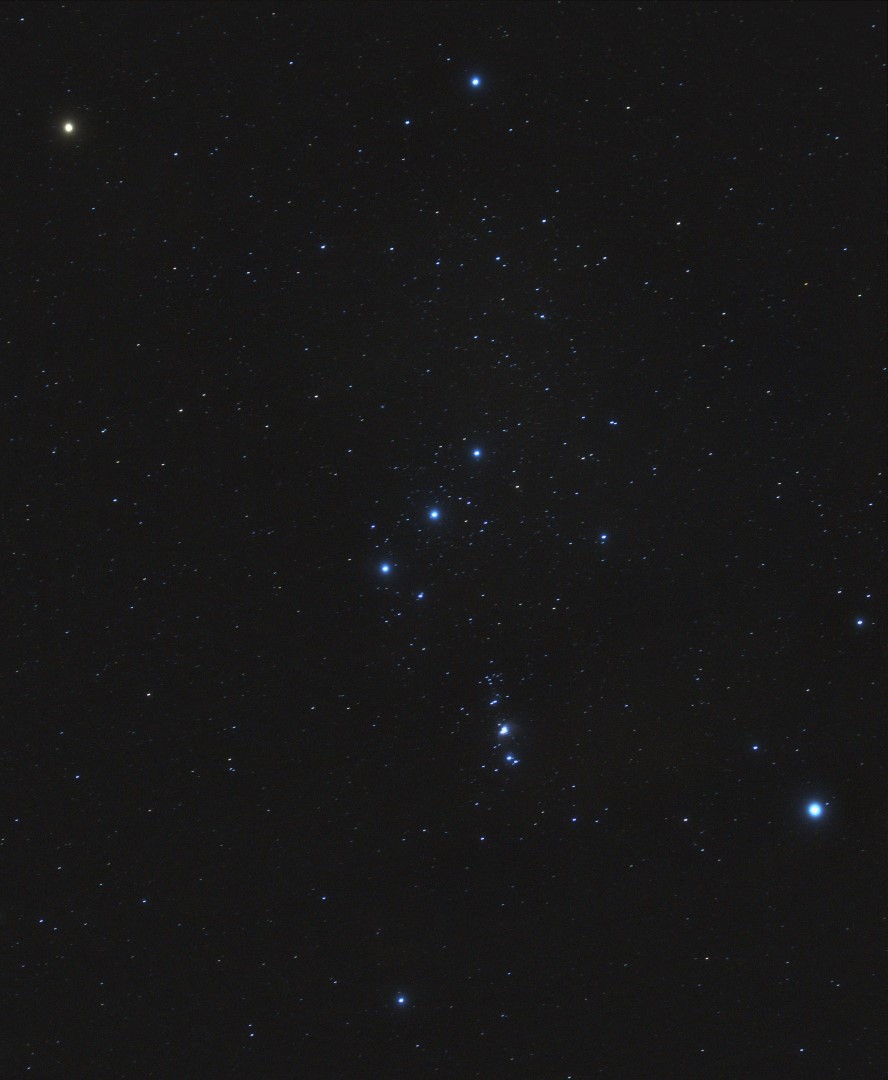
The Orion Constellation
Canon 700D & Telephoto 200 mm | 27 x 10 secs @ ISO 1,600 & calibration | 24th December 2014
In the early days of my astroimaging about 12 months ago, I found focussing something of a challenge but, with the assistance of the wonderful Bahtinov mask and Live View on-screen computer focusing, I thought that had become a thing of the past, unfortunately not! Guided by the infinity mark on the camera lens for focussing, I set out to image some of Orion’s more elusive nebulosity, in particular Barnard’s Loop, with which I am fascinated – its enormous size of some 10o or 600 arcminutes and complete absence from ordinary view are both intriguing, exciting and challenging. I had tried to photograph this feature before, which completely envelops Orion’s Sword and extends up towards Betelgeuse, but to no avail. With my bodged but useable camera set-up I tried again two weeks ago. This time the problem was once again focussing; it turns out that with widefield astroimaging using a standard camera lens, infinity does not necessarily mean infinity, as there is some leeway either side. The out-of-focus images that resulted could therefore not be stacked but, using a single image, calibration and extensive post-process stretching in Photoshop, Barnard’s Loop was finally revealed and even Lambda Orionis above Betelgeuse and Bellatrix, albeit very noisy and out of focus. Notwithstanding, I am pleased with this enticing glimpse and will return another day to rectify the problems.
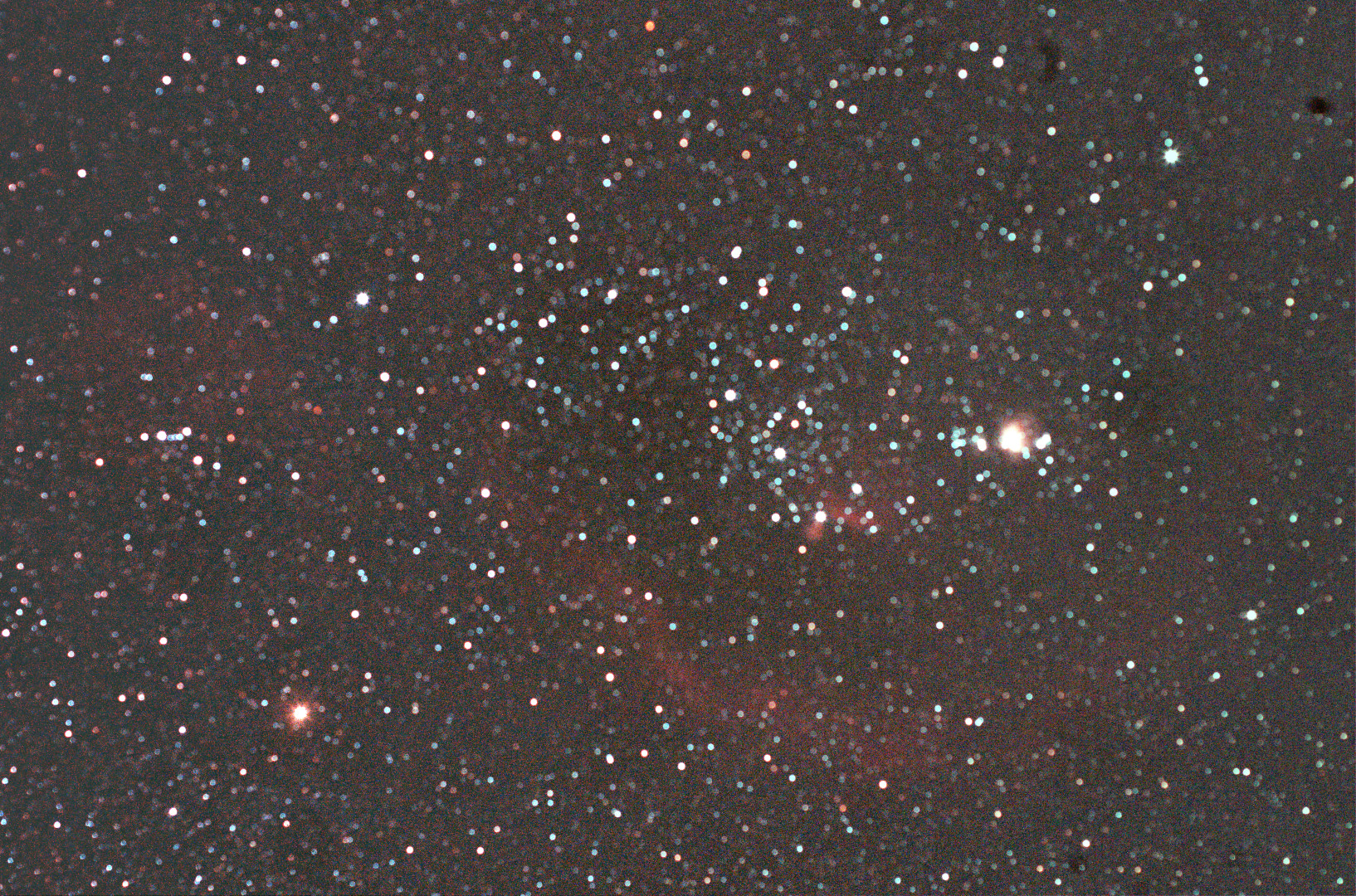
The Orion Constellation & Barnard’s Loop (up / north is left)
AZ-EQ6 Mount + Canon 550D & Telephoto 200 mm | 180 secs @ ISO 1,600 & calibration | 22nd January 2015
Since my first decent image of the Great Orion Nebula on a very early morning at the beginning of last October, I have had hours of fun and some frustration imaging various parts of the Orion Constellation. But despite my new familiarity with the Orion constellation, 3D modelling and, I’d like to think, good spatial awareness, I was still pleasantly surprised and impressed by this wonderful 3D video of the constellation produced by the Space Telescope Science Institute for NASA and used during the aforementioned Open University course, which really does put it all into perspective: The True Shape of Orion.
 WATCH THIS SPACE(MAN)