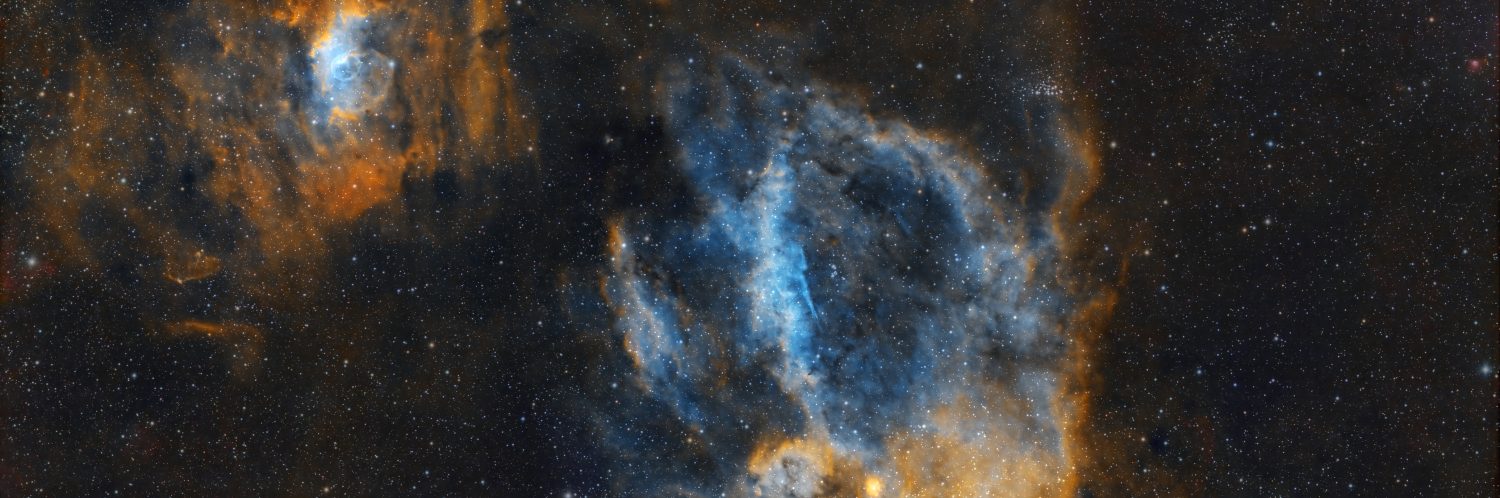
OK it’s not news but a tribute to the man who opened our eyes to the way the Solar System works.
Like most newcomers to astronomy viewing and imaging starts at home and that is the Solar System. So it was with my Skywatcher 150PL Newtonian scope last year – first the Moon (of course) and then on to the planets, in this case it had to be Saturn – surely the most exciting / beautiful planet? Despite my growing years it was only in April 2013 I got to see Saturn for the first time through the 13″ Astrographic Refractor at Herstmonceaux http://www.the-observatory.org/telescopes. WOW I am hooked and following much previous prevarication over what to buy now rapidly sought to purchase my first telescope in the form of the aforementioned 150PL with a basic EQ3-2 mount.
The early summer of 2013 was very good for viewing Saturn and so it was I spent many late nights and early mornings gazing at this wonderful planet. Of course I had to get a photograph but this was easier said than done. Despite years of SLR photography I did not own a DSLR, considering them too bulky and inconvenient for day-to-day use, I therefore resorted to my trusty Canon Ixus 860IS to try my hand at afocal photogrpahy i.e. holding the camera up to the eyepiece. The results were awful so I purchased a camera bracket that clamped to the eyepiece and held the camera more steady, unfortunately this too was little better. I came to the conclusion that this wasn’t going to work and in some shape or other I would need to take a video instead, with subsequent processing through Registax (more about this another time) which is able to sort and stack the best frames to produce a final, single image.
I tried the cheap route first by adapting an old Logitech webcam I already had (this involves removing the front lens so the light fall directly on the sensor) but could not get an image and therefore in the end decided to purchase a ZWO 120 MC http://www.365astronomy.com/zwo-asi120mc-colour-13-cmos-usb20-camera-with-autoguider-port-p-3536.html which also provides an autoguiding function, as yet not tested. Again I encountered major problems getting an image but after visiting the retailer Zoltan at 365 Astronomy, who also had great difficulty getting it to work by using a more up-to-date version of Firecapture, I was finally up and running – all I needed was a clear sky and an object to image. Of course, it had to be Saturn.
As I have now learnt every facet of astrophotography is difficult and this was no exception. The problems this time fell into two categories: the general capture settings and that old thorn in the side, focus. It took a while but eventually I had Saturn on film which, after some Registax processing I successfully turned into a picture.
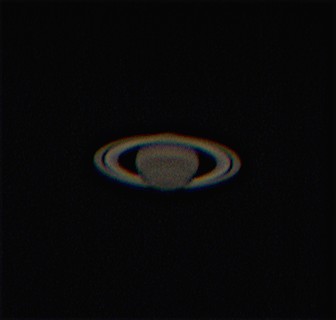
ZWO 120MC
Still plenty of scope for improvement but it is clearly Saturn and to my eyes looks great.
With this success under my belt, earlier this year I tried Mars which, as I was to find, is a notoriously difficult subject – the problem being size i.e. it is small. Depending on their respective orbits relative to Earth, the angular diameter http://en.wikipedia.org/wiki/Angular_diameter of Saturn varies from 14.5″ to 20.1″, with Mars 3.5 to 25.1″. Notwithstanding, I eventually managed to capture some video, which looked awful, but thanks to Registax emerged looking like, well ….Mars! It has been described as ‘pizza looking’ but for the moment I’m happy.
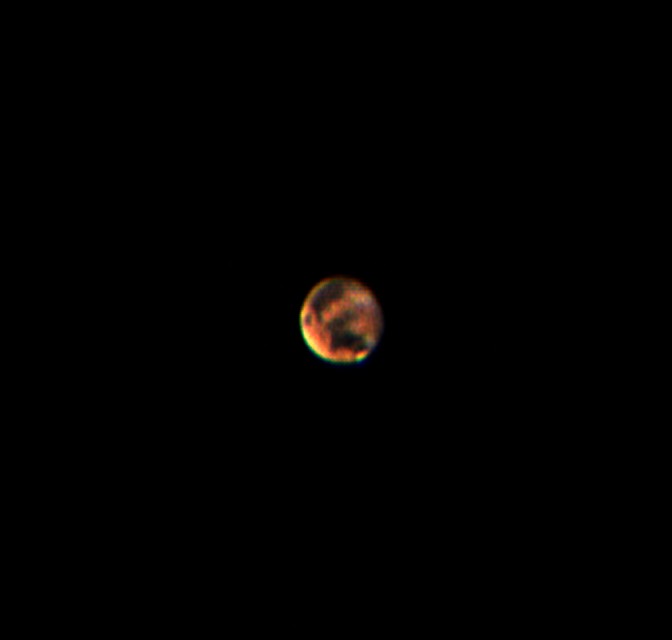
ZWO 120 MC + Registax
I had hoped to get Jupiter too but for various reasons (which I can’t remember) it didn’t happen, so that’s on the ‘to-do’ list next time it comes around. And thanks to Nicolaus Coperincus we will be able to predict when that is.
 WATCH THIS SPACE(MAN)