Core Blimey

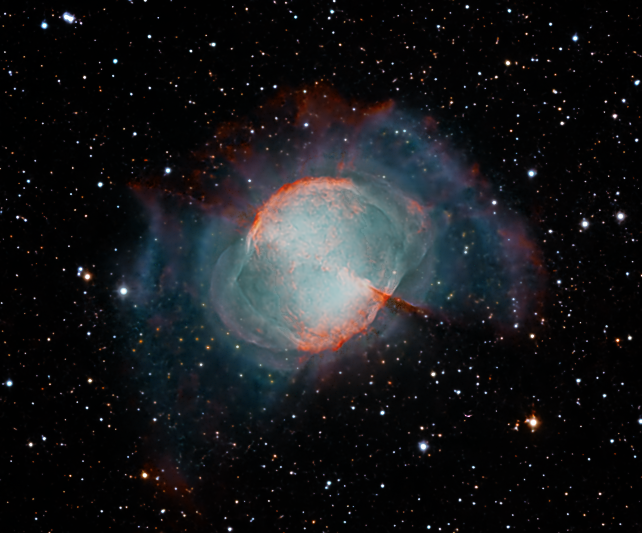
A popular object at this time of the year, the planetary nebula M27 consists of a glowing shell of ionized gas, which has been ejected from a red giant star in its late stage of its life to become a white dwarf.  Like many planetary nebulae, the main inner shell exhibits numerous dark and light knots, of which red ionized hydrogen areas form two bright lobes that together make the shape of an apple- core / dumbbell, which are M27’s two nicknames. There also seems to be different bi-polar influences occuring, that have resulted in complex Ha (red) and OIII (blue) fans around the outer regions and a pulsar-like beam transecting the nebula (see cropped version at the top of the page). 

Despite the good data quality and long integration time, the complicated nature of the planetary nebula made processing very difficult, in particular, teasing out the aforesaid but very faint outer fans.  In this case it was necessary to carry out individual soft stretches of the Ha and OIII stacks before combining them into an HOO image, from which a starless colour image was created and then processed further to bring out the fans.  Thereafter, Pixelmath was used to amalgamate this image with two other starless HOO and RGB versions that emphasized the main part of the nebula, before finally adding back RGB stars and finishing off. 
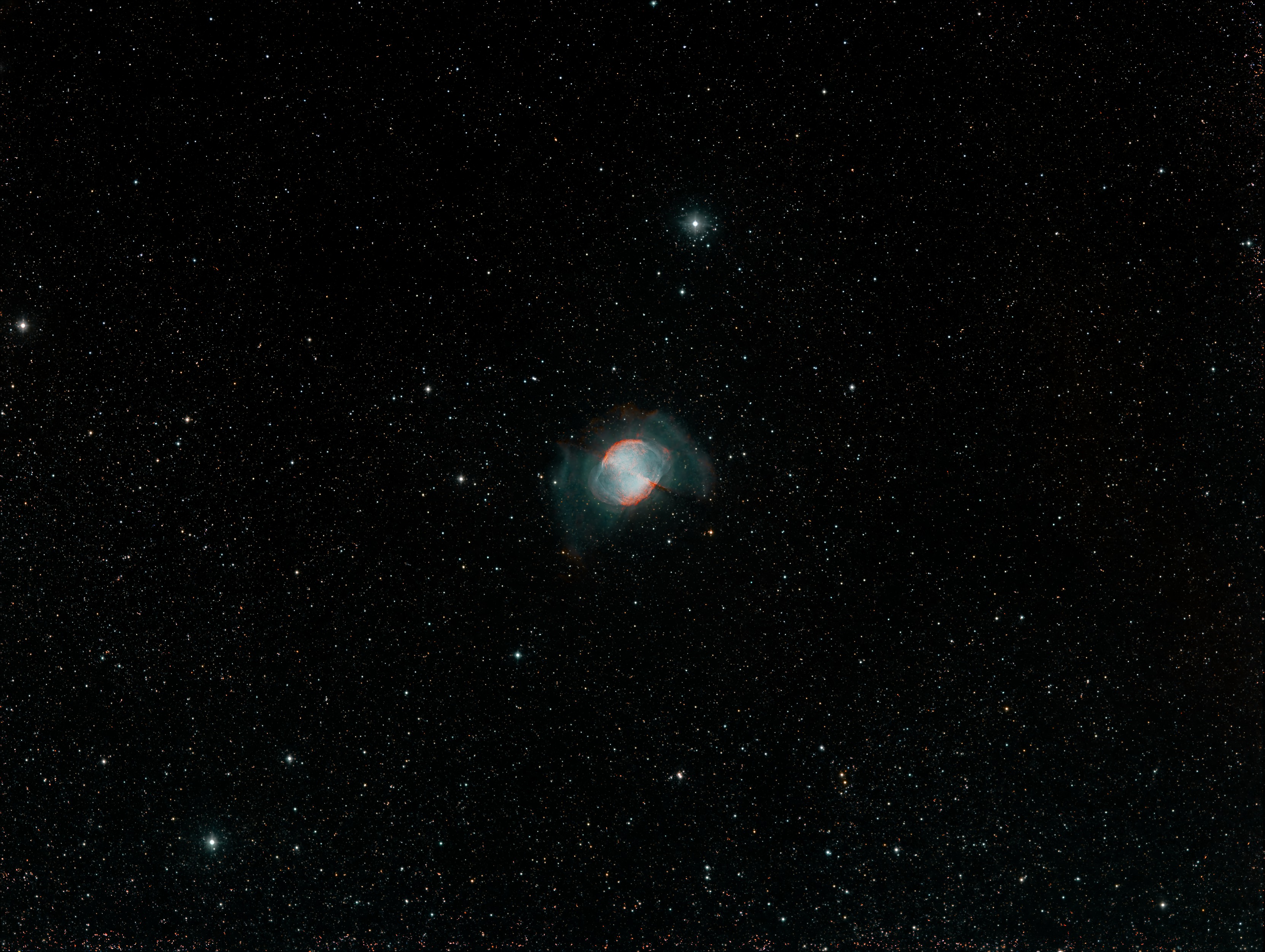
After considerable experimentation to obtain this result, I’m happy with the final image, which I hope shows off the said apple core / dumbbell and its outer fans to good effect (see above).


 IMAGING DETAILS
ObjectM27 AKA Dumbbell or Apple Core Nebula or NGC 6853
ConstellationVulpecula
Distance1,360 light-years
Size 8.0 x 5.7 arc-minutes (core) 15 arc-minutes (total) or 5 light-years (actual)
Apparent Magnitude+7.5
  
Scope Takahashi FSQ 106  FL 530mm  f/5  +  Moonlight Nightcrawler focuser  
MountParamount MyT
GuidingYes
CameraQSI 683-WSG8    KAF-8300 full frame CCD sensor   5.4nm pixels  
 FOV 1.94o x 1.46o   Resolution 2.1”/pix.   Image array 3326 x 2,507 pix   
ProcessingDeep Sky Stacker,  PixInsight v1.8.9-1
Image Location              & OrientationCentre – RA 19:59:35.363      DEC +22:42:54.383                    Up = North  Left = East
ExposuresHa x28 & OIII x 35 x20min + R x12, G x22, B x14 x10min @ -20C Total Integration Time: 29hrs      
Calibration24 x 20min & 30 x 10 min Darks   x60 Bias & x20 Ha, OIII & RGB Flats  
Location & DarknessDeep Sky West – amateur hosting facility near Rowe, New Mexico  – USA    SQM Typically >= 21.7
DateQ2 2019    

Death Throes of a Star

Abell 21 RGB 1Final (Large)

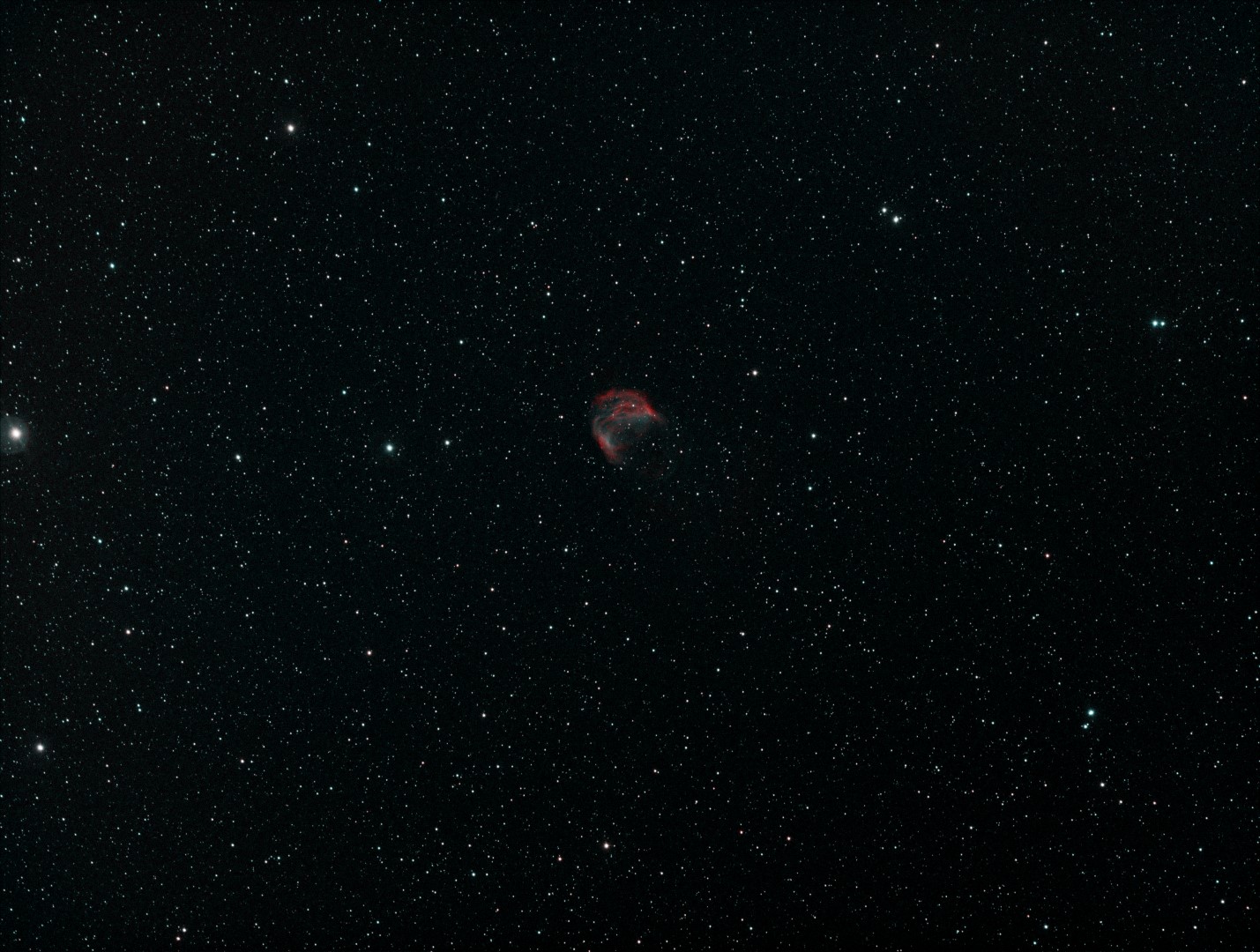
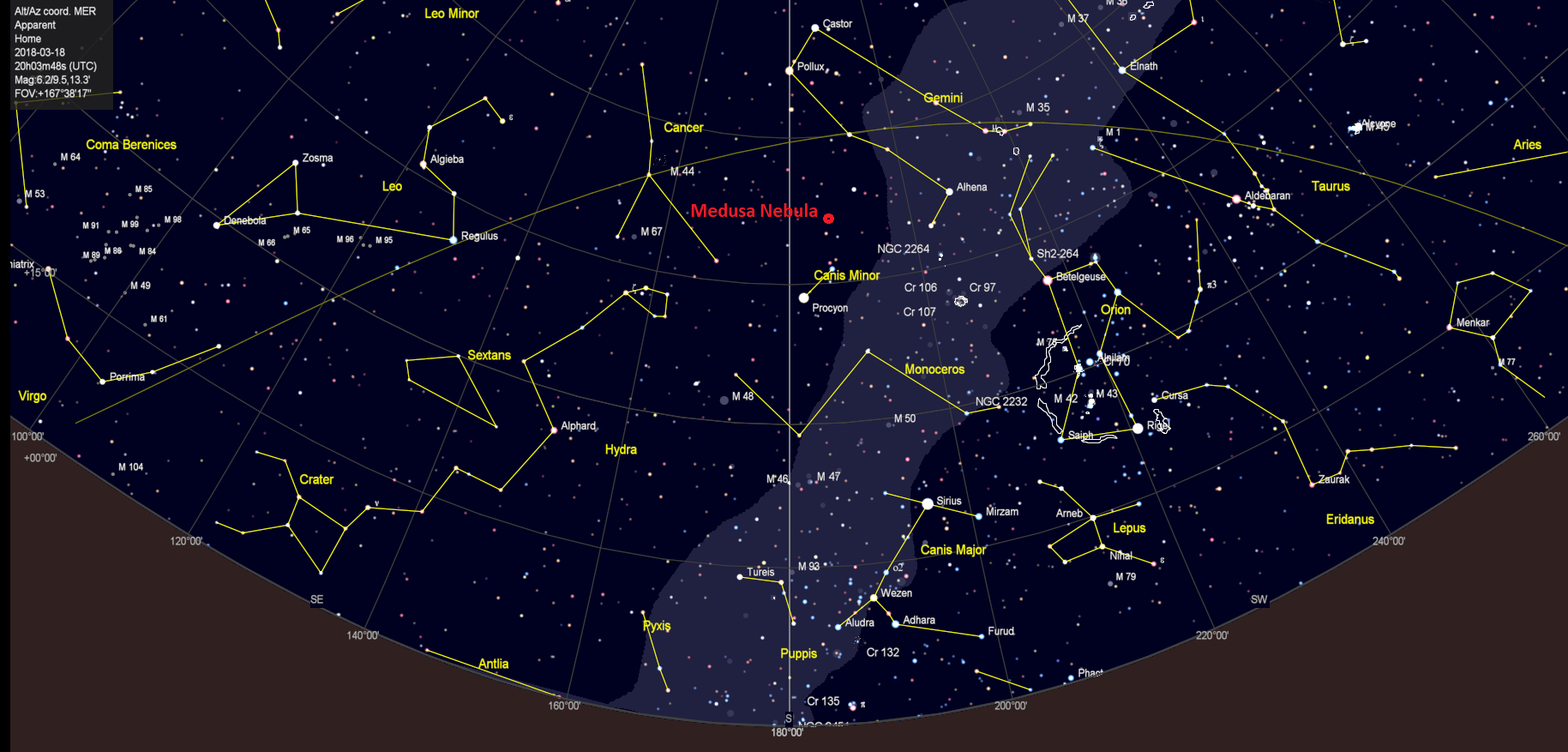
As the winter arm of the Milky Way proceeds inexorably towards the west, I’ve been seeking new objects and was pleasantly surprised to recently discover a small but nonetheless interesting planetary nebula located just to the east of the galactic plane between Canis Minor and Gemini.  Consisting of large filaments of glowing ionized gas, the feature goes by the popular name of the Medusa Nebula, after the Greek mythological gorgon figure which has hair of writhing snakes!

145615-004-A364787F

Statue of Medusa

Also known as Abell 21 (discovered by George Abell in 1955), Medusa is an ancient planetary nebula some 1,500 light-years away, officially situated within the constellation Gemini.  Like its dramatic mythological namesake, the planetary nebula represents the final stages of a low mass star such as our sun in the process of transforming from a red giant to hot a white dwarf star, in the process shedding its outer layers which are illuminated by ultraviolet radiation from the hot star within which powers its glow.

Medusa

At 4-light years across the Medusa Nebula is a small though reasonable size but with an apparent magnitude of some +15.99 is very faint and is therefore difficult to image.  Nonetheless, Ha and OIII gases are prevalent and as something of an experiment I chose to try and image this object at narrowband wavelenghts.

Abell 21 RGB 1FinalCrop (Large)

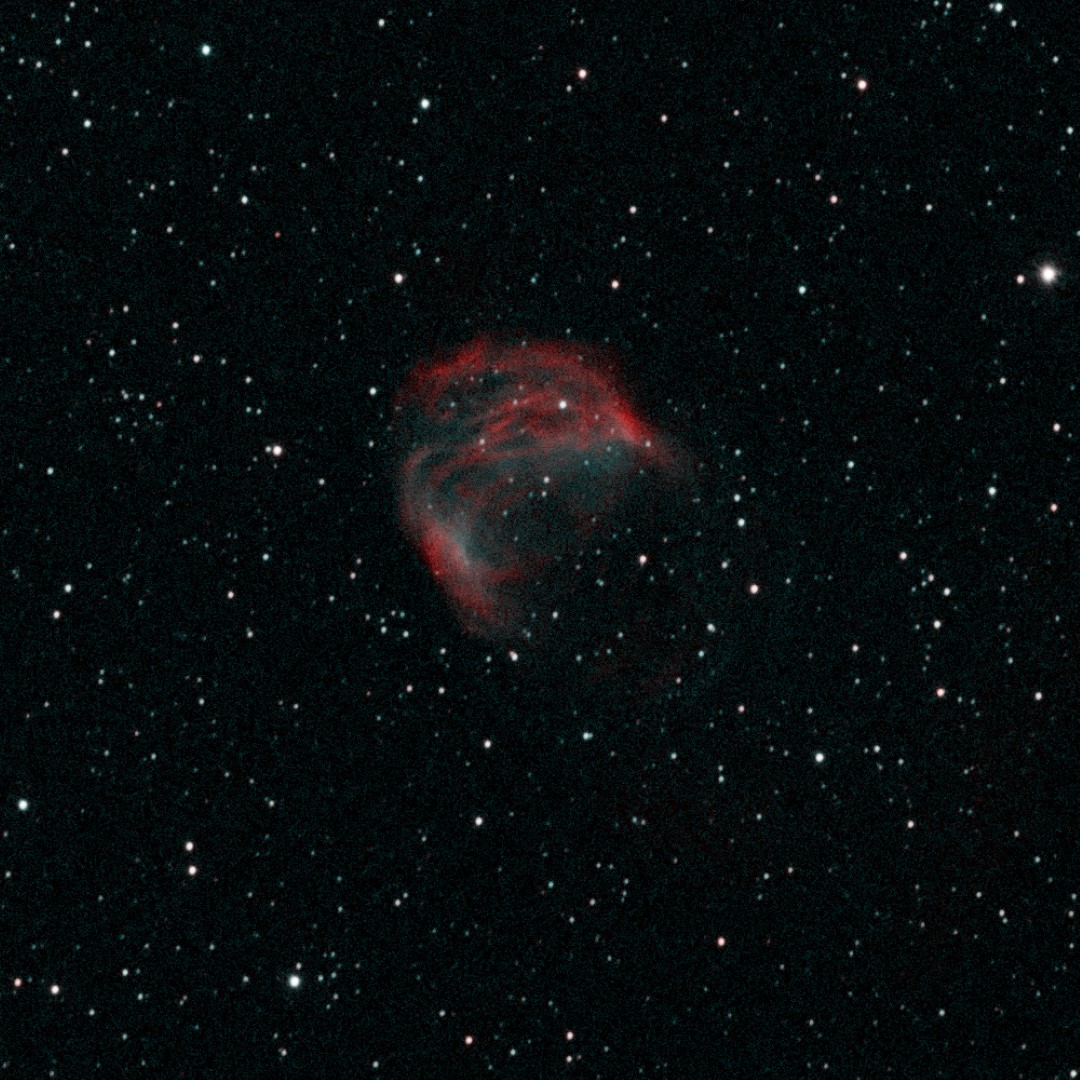
Considering the aforesaid problems I am quite pleased with the outcome (top of page), indeed I was surprised to see I had captured anything.  However, given its challenging low brightness and a total integration time of only 75-minutes, the final image was always going to be lacking in detail and noisy (cropped image immediately above).  Notwithstanding, now I know of its presence I will surely be returning to The Medusa Nebula on another occasion to improve the integration time and perhaps use a larger telescope to grab those photons which prove elusive to my current equipment set-up.


IMAGING DETAILS
Object The Medusa Nebula    (Abell 21 / Sharpless 2-274)     
Constellation Gemini
Distance 1,500 light-years
Size Approx. 12’ x 9’
Apparent Magnitude +15.99
 
Scope  William Optics GT81 + Focal Reducer FL 382mm  f4.72
Mount SW AZ-EQ6 GT + EQASCOM computer control
Guiding William Optics 50mm guide scope
  + Starlight Xpress Lodestar X2 guide camera & PHD2 control
Camera ZWO1600MM-Cool (mono)   CMOS sensor
  FOV 2.65o x 2.0o    Resolution 2.05”/pix  Max. image size 4,656 x 3,520 pix   
EFW ZWOx8 + ZWO LRGB & Ha OIII SII 7nm filters 
Capture & Processing Astro Photography Tool,  Deep Sky Stacker & Photoshop CS2
Exposures 10 x 300 sec Ha, 5 x 300 sec  OIII   (Total time: 75 minutes)
  @ 139 Gain  21 Offset @ -20oC  
Calibration 5 x 300 sec Darks  20 x 1/4000 sec Bias  10 x Flats Ha, OIII & SII @ ADU 25,000  
Location & Darkness Fairvale Observatory – Redhill – Surrey – UK        Typically Bortle 5
Date & Time 11th February 2018 @ 23.00h approx.