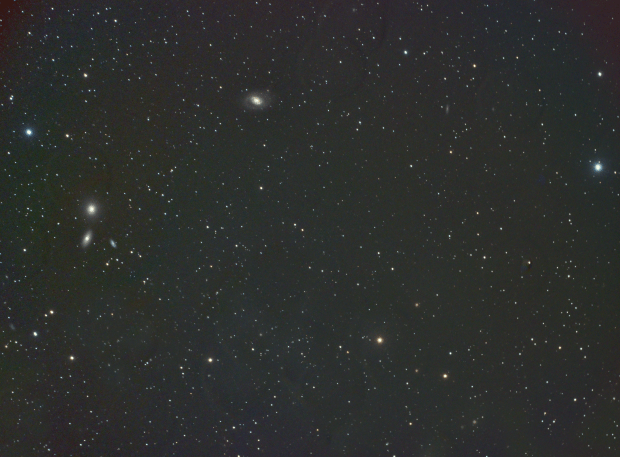
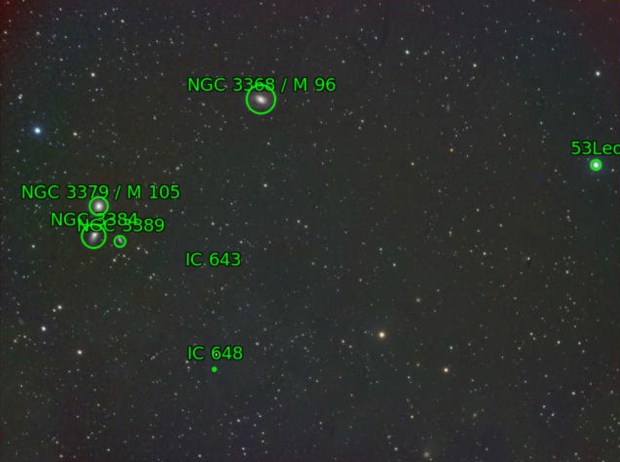
At Fairvale Observatory North it’s normal that I struggle to find suitable objects when the so-called Galaxy Season arrives in late winter through spring. Despite the abundance of galaxies my William Optics 81mm aperture rules out all but a few for imaging as they are mostly just too small. However, smaller galaxies that make up features such as Markarian’s Chain and the Leo group do produce a pleasing widefield image full of the so-called faint-fuzzies but hitherto with the exception of M31 the Andromeda galaxy I’ve struggled to obtain the real thing – a decent, full-on spiral galaxy – they are there of course but are either obscured to the north by my house and trees or, as indicated, are too small for my equipment to resolve properly.
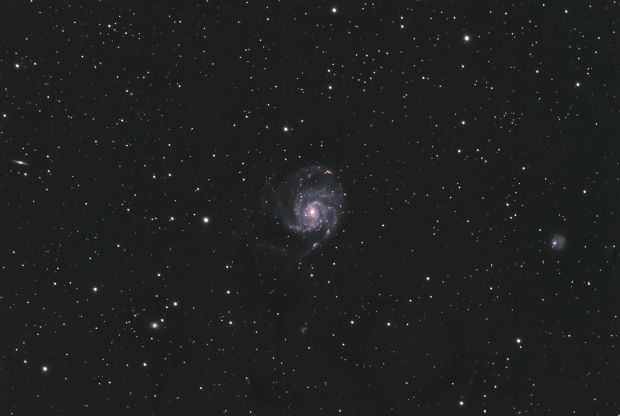
Nonetheless, this year after playing around imaging the aforesaid Leo Group (see above), I looked directly above the observatory and to my surprise discovered a new world of galaxies close to the Zenith that were just visible, briefly transiting along the southern edge of the house roof, which included a few large classics in-and-around the constellation Ursa Major. After 2-hours imaging the Leo group time was too short for a serious attempt at any of these galaxies but nonetheless was sufficient to experiment with what looked like a potential target, the wonderful M101 the Pinwheel Galaxy, which at over 28 arc seconds showed real potential with only 42 minutes of subs before it disappeared out of sight for the night. Moreover, large parts of Ursa Major and nearby galaxies also briefly appeared at other times on the night from behind the roof, tracking close to the gutter for nearly 2.5 hours before returning behind the roof in a similar manner to M101. Thus assuming full set-up could be achieved earlier in the evening, this seemed to provide a window of opportunity that I grasped over two subsequent evenings with a very satisfactory outcome.
With nearly 5-hours of subs, processing of M101 would be a challenge in order to bring out the galaxy’s colours and perhaps highlight the stellar nursery areas that are found along the spiral arms and are rich in Ha-light. To do this I first changed the RGB image stack to Lab Colour in Photoshop, increased the saturation in the (a) and (b) channels before returning to RGB mode. This had the desired effect of successfully enhancing the colours, which can otherwise look washed-out after stacking, stretching and combining. After this I split the RGB channels and pasted the Ha-stack into the Red channel, before re-combining again into an RGB image, at which point the H II regions along the spiral arms just lit up! These were both new processing techniques for me that greatly improved the final image and hold great promise for processing HaLRGB objects in the future.
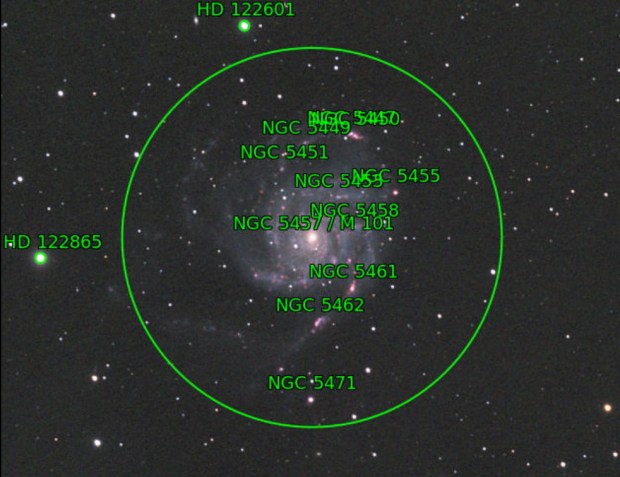
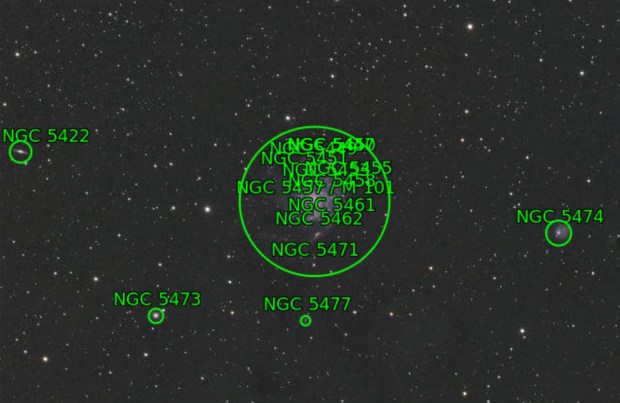
The final image (top of the page + crop below) far exceeded my expectations in detail and colour, showing off much of the galaxy’s wonderful structure and the aforementioned HII regions. There’s no doubt that further integration time will benefit the faint extremities of the galaxy but for now it was a very satisfying outcome of a spectacular object that hitherto I thought was beyond my seeing at Fairvale Observatory. Also noteworthy, the image has caught a plethora of companion galaxies close to and around M101 (see annotated images above), most conspicuous of which is the classic side-view of NGC 5422 (left of M101) and the more unusual dwarf spiral galaxy NGC 5474 (right of M101), which has been noticeably distorted by gravitational interaction with the Pinwheel itself. All-in-all a fine display of galactic fireworks worthy of November 5th.

| IMAGING DETAILS | |
| Object | M101 Pinwheel galaxy |
| Constellation | Ursa Major |
| Distance | 20.9 million light-years |
| Size | 28.8’ x 26.9’ or 170,000 light-years |
| Apparent Magnitude | +7.86 |
| Scope | William Optics GT81 + Focal Reducer FL 382mm f4.72 |
| Mount | SW AZ-EQ6 GT + EQASCOM computer control & Cartes du Ciel |
| Guiding | William Optics 50mm guide scope |
| + Starlight Xpress Lodestar X2 camera & PHD2 guiding | |
| Camera | ZWO1600MM-Cool mono CMOS sensor |
| FOV 2.65o x 2.0o Resolution 2.05”/pix Max. image size 4,656 x 3,520 pix | |
| EFW | ZWOx8 + ZWO LRGB & Ha OIII SII 7nm filters |
| Capture & Processing | Astro Photography Tool + PHD2 + Deep Sky Stacker & Photoshop CS3 |
| Image Location & Orientation | Centre RA 14:03:15 DEC 54:20:46
Top = North |
| Exposures | (A) L 31 x 180 sec HaRGB each 16×180 sec (Total time:4hr 45 minutes) |
| @ 139 Gain 21 Offset @ -20oC | |
| Calibration | 10 x 180 sec & 15 x 60 sec Darks 20 x 1/4000 sec Bias 10 x HaLRGB Flats @ ADU 25,000 |
| Location & Darkness | Fairvale Observatory – Redhill – Surrey – UK Typically Bortle 5-6 |
| Date & Time | 29th & 31st March 2019 @ +22.00h |
| Weather | Approx. 8oC RH <=70% 🌙 ¼ waning |
 WATCH THIS SPACE(MAN)