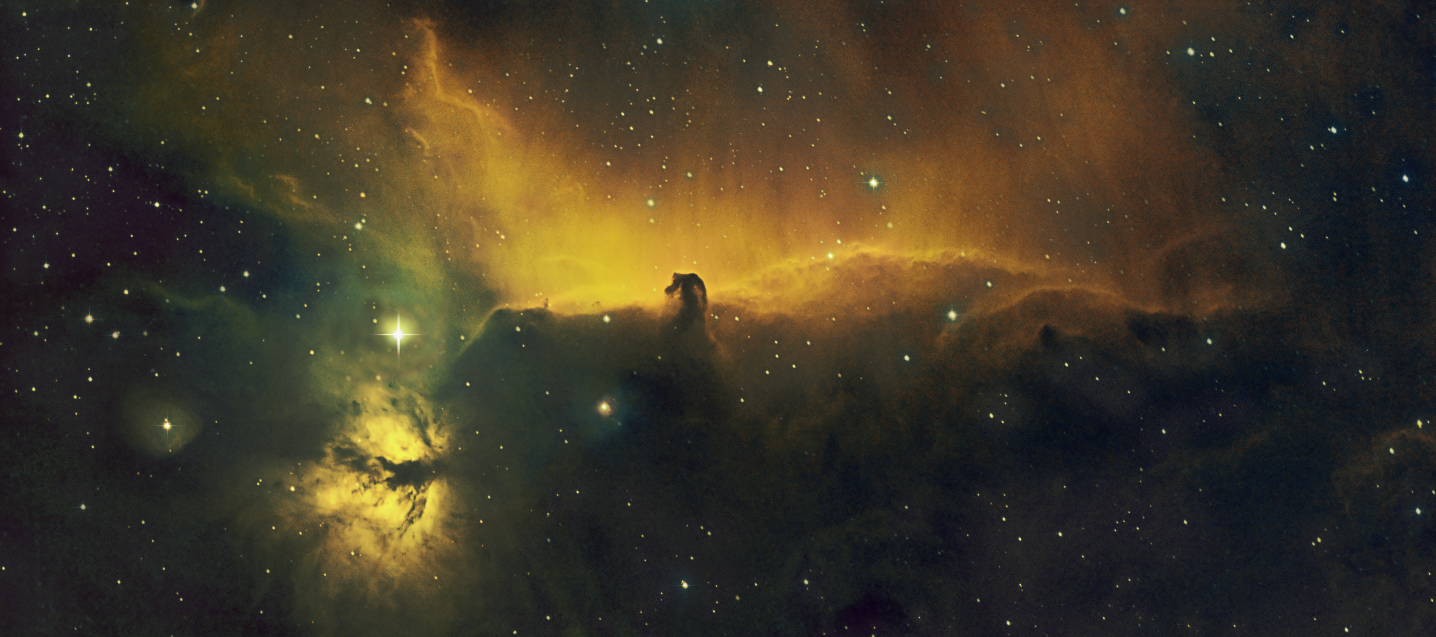
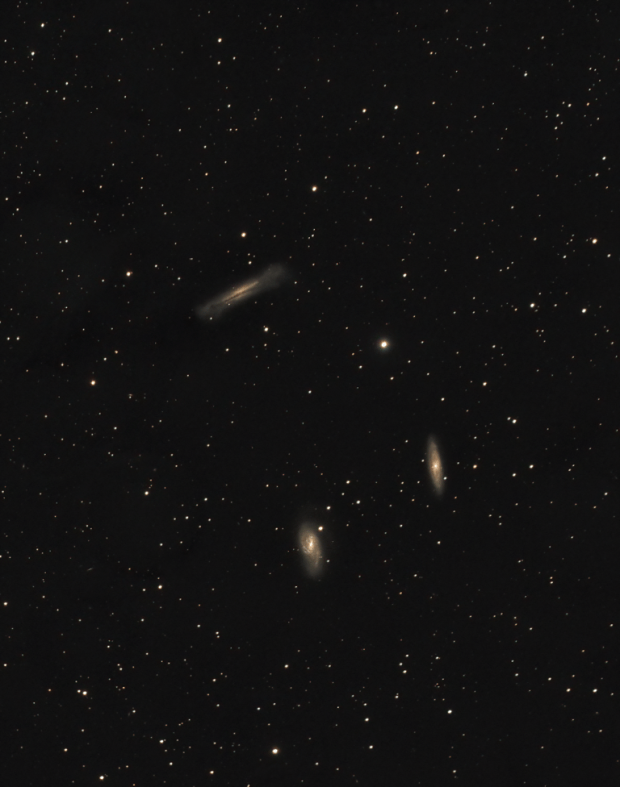
The period between March and May provides an excellent opportunity to see and image objects in and around the constellation of Leo. Located close to the ecliptic, this area of the sky is packed with galaxies and can therefore be seen from most parts of the northern and southern hemispheres. Located to the east of the Leo 1 Group is perhaps the best known of these M65, M66 and NGC 3628, also known as the Leo Triplet.
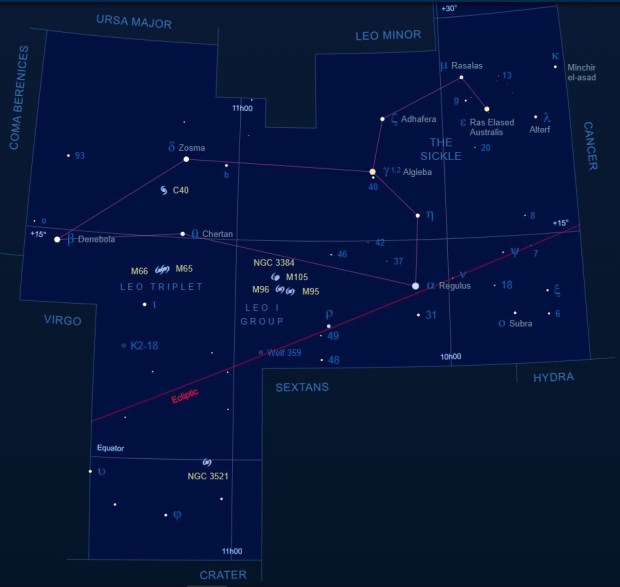
I last imaged this attractive group of galaxies shortly after changing to a CMOS mono camera in March 2017. Unfortunately on that occasion it was only a test with just 45 minutes integration time at 300-gain, so a more serious attempt to image these three beauties was obviously long overdue. On this occasion imaging over three nights during late March and then finally again in April produced well over 7-hours of integration time.
Whilst the earlier test image showed promise, each of these objects is small and certainly push my equipment it to the limit. However, the benefit of much longer time and imaging at unity settings is self-evident. I’m very pleased with the final LRGB image, which shows good detail and colour for all three galaxies. Furthermore, the advantage of a wider view using the William Optics GT81 and ZWO ASI1600MM-Cool camera combination, has also captured numerous other colorful stars and even smaller galaxies, thereby providing a more interesting background for the main show – the Leo Triplet (see below).
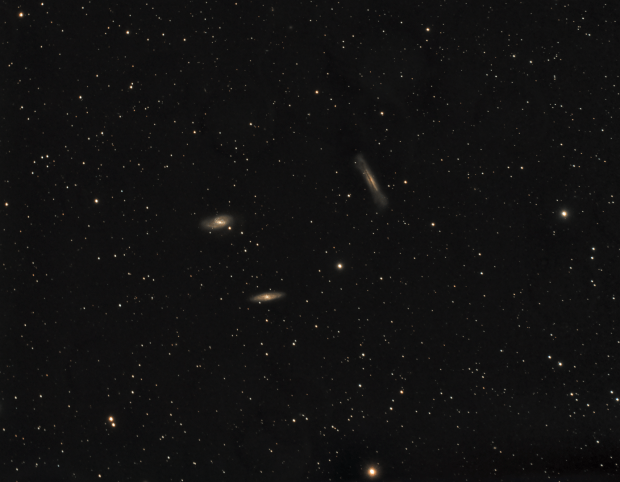
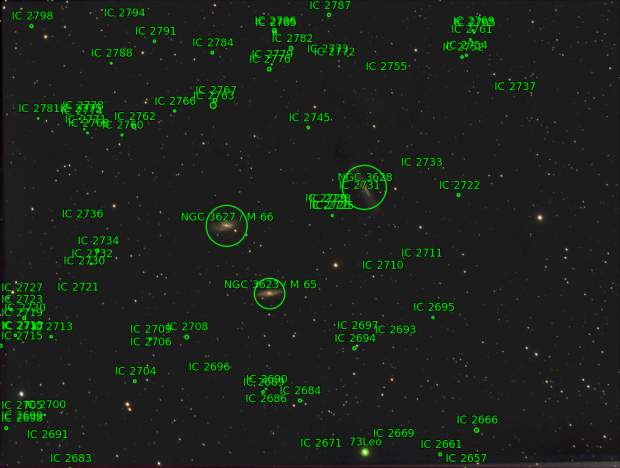
Each of the galaxies that make up the Leo Triplet is tilted at different angles relative to the view from Earth, thereby producing a variety of form and perspective in the image (cropped & adjusted to accurate orientation @ top-of-the-page). In addition, various distortions of the galactic discs and other effects demonstrate that the three galaxies in the M66 Group have all been affected by gravitational interactions with each other. Seen edge-on, the unbarred spiral galaxy NGC 3628 clearly shows a broad band of dust stretching along its outer edge, thus obscuring young stars within the galaxy’s spiral arms. NGC 3628 seems to be the most affected by the said intergalactic forces which, moreover, has drawn out a tidal tail from the eastern side of the galaxy spanning some 300,000 light years; unfortunately the aforesaid tail is very faint and does not often appear in images – something for another day and a larger telescope!
| IMAGING DETAILS | |
| Objects | The Leo Triplet or M66 Group: M65, M66, NGC 628 AKA the Hamburger or Sarah’s Galaxy |
| Constellation | Leo |
| Distance | 35 million light-years |
| Size | M65 = 8.71’ x 2.45’ M66 = 9.1’ x 4.2’ NGC 3628 = 15.0’ x 3.6’ |
| Apparent Magnitude | M65 +10.3 M66 +9.97 NGC 3628 +9.4 |
| Scope | William Optics GT81 + Focal Reducer FL 382mm f4.72 |
| Mount | SW AZ-EQ6 GT + EQASCOM computer control & Cartes du Ciel |
| Guiding | William Optics 50mm guide scope |
| + Starlight Xpress Lodestar X2 camera & PHD2 guiding | |
| Camera | ZWO1600MM-Cool mono CMOS sensor |
| FOV 2.65o x 2.0o Resolution 2.05”/pix Max. image size 4,656 x 3,520 pix | |
| EFW | ZWOx8 + ZWO LRGB & Ha OIII SII 7nm filters |
| Capture & Processing | Astro Photography Tool + PHD2 + Deep Sky Stacker & Photoshop CS3 |
| Image Location & Orientation | Original Subs: Centre RA 11h 19’ 44.95” DEC +13o 19’ 06.48”
Main Image Top = East + Cropped Image Top = North |
| Exposures | 180 sec x 42 L Ha, x37 RGB = 153subs
Total Integration Time 7hr 39min |
| @ 139 Gain 21 Offset @ -20oC | |
| Calibration | 10 x 180 sec Darks 20 x 1/4000 sec Bias 10 x LRGB Flats
@ ADU 25,000 |
| Location & Darkness | Fairvale Observatory – Redhill – Surrey – UK Typically Bortle 5-6 |
| Date & Time | x4 nights: 18th + 29th + 31st March + 26th April 2020 @ +21.00h |
| Weather | Approx. 2 – 8oC RH 60 -75% 🌙 19 – 43% waxing |
 WATCH THIS SPACE(MAN)