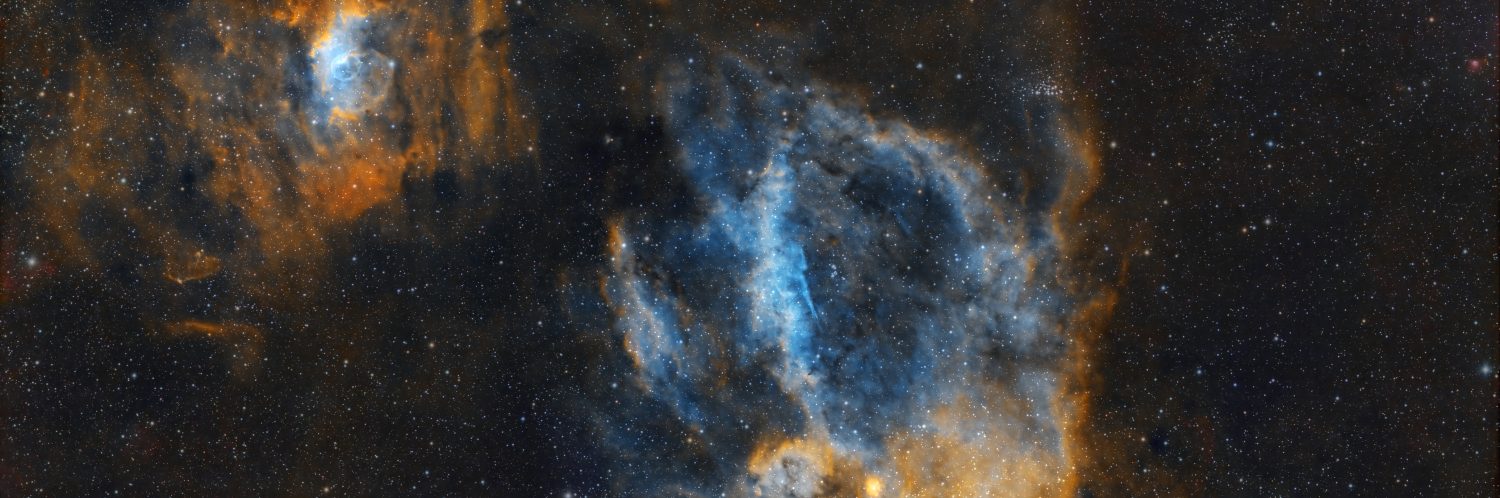
The Witch’s Broom

With polar alignment and tracking now working quite well, I have been hunting around for potential new targets before moving on to the next challenges of computer control and auto-guiding.  Within the constraints of my limited sight lines, light pollution, weather and a rapidly encroaching full moon, I decided to tackle the somewhat elusive Veil Nebula.  Although the apparent magnitude of 7.0 is not unduly challenging, the delicate nature and low surface brightness of this very large ionized gas cloud can make it difficult to image.

Located in the Cygnus constellation, the Veil Nebula is a very large but feint supernova remnant about 1.400 ly from Earth that exploded between 5,000 and 8,000 years ago i.e. quite recently.  The Veil Nebula, Cirrus and Filamentary Nebula usually refer to those parts that can be viewed, the rest of the feature not being in the visible spectrum; the Veil is one of the largest, brightest features in the x-ray sky.  So big is the Veil that various sections are recorded as separate NGC numbers: 6960, 6992, 6995, 6974, 6979 and IC 1340.

Located close to the binary star system 52 Cygni, the classic view is of the Western Veil or NGC 6960, AKA the “Witch’s Broom”, “Finger of God or “Filamentary Nebula”, which spans across 35 light-years and I therefore set out to photograph.  Following the recent success of the North America Nebula I undertook a test shot at the same settings: 90 seconds at ISO 1,600.  However, the resulting picture looked excessively washed out and so changed to 90 seconds at ISO 800, which seemed to work better – though you never really know until the late stages of post-processing.  Despite forecasts to the contrary, the cloud rolled in after just six shots but two hours later and still tracking, the clouds parted leaving a clear sky and just enough time to take another twenty shots.

Initial processing was not encouraging.  Truth be told there’s still a lot to learn with this part of astro-imaging but, with some difficulty and courtesy of Mrs G, a good image of the Witch’s Broom was eventually teased from the data.
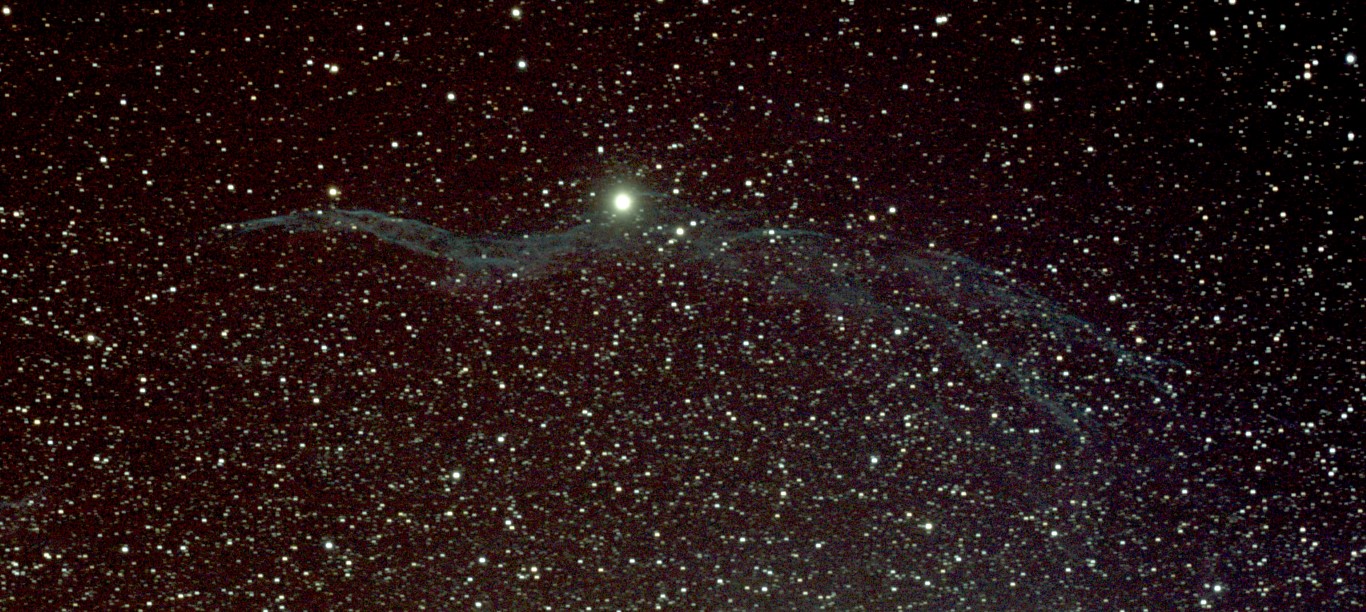
NGC 6960 AKA The Witch's Broom Canon 700D | 20x90 sec + darks.bias/ flats @ ISO 800

NGC 6960 AKA The Witch’s Broom
Canon 700D | 20 x 90 sec + darks/bias/ flats @ ISO 800
 

Zen and the art of Nebulae astrophotography

Wow, the title should get your attention. Of course it’s a corruption of Robert Pirsig’s famous book, Zen and the art of motorcycle maintenance, which in turn formed the basis of a new philosophy, that of the Metaphysics of Quality. Heavy eh?

The link is Cosmology or the metaphysical study of the origin and nature of the universe and, in this case, capturing evidence of what might be going on out there in the form of astrophotography. Unfortunately, whilst this blog might have high ambitions, you will not find the answer here to – Life the Universe and Everything.  However, my first half-decent picture of the M57, the Ring Nebula, does make you think.  Of all the features in the universe I find these most fascinating.  As the end and beginning of stars and other matter, they are, as far as we can know the origin of life itself ultimately. OK I am getting carried away but just look at the Wikipedia description of M57:

The Ring Nebula (also catalogued as Messier 57, M57 or NGC 6720) is a planetary nebula in the northern constellation of Lyra.[5] Such objects are formed when a shell of ionized gas is expelled into the surrounding interstellar medium by a red giant star, which was passing through the last stage in its evolution before becoming a white dwarf.


That in itself is mind boggling and last week I was able to capture some of its photons on my camera in Redhill; sureal even, except it’s not. Nebulae are somewhat elusive, look at NGC 7000 the North American Nebula in the earlier post; look up and there’s nothing – apply some technology and PING, out jumps a nebula. In time I hope to capture far bigger and wonderful such features buried deep in the universe but this is my first, so it’s special.

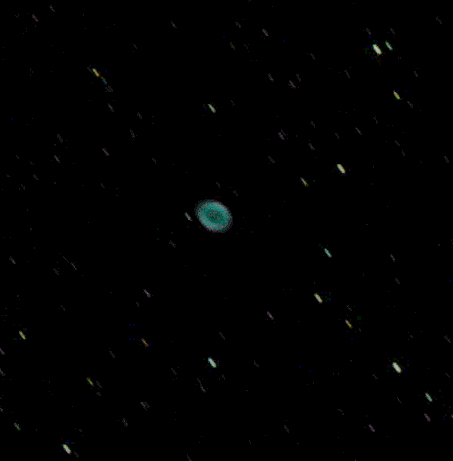
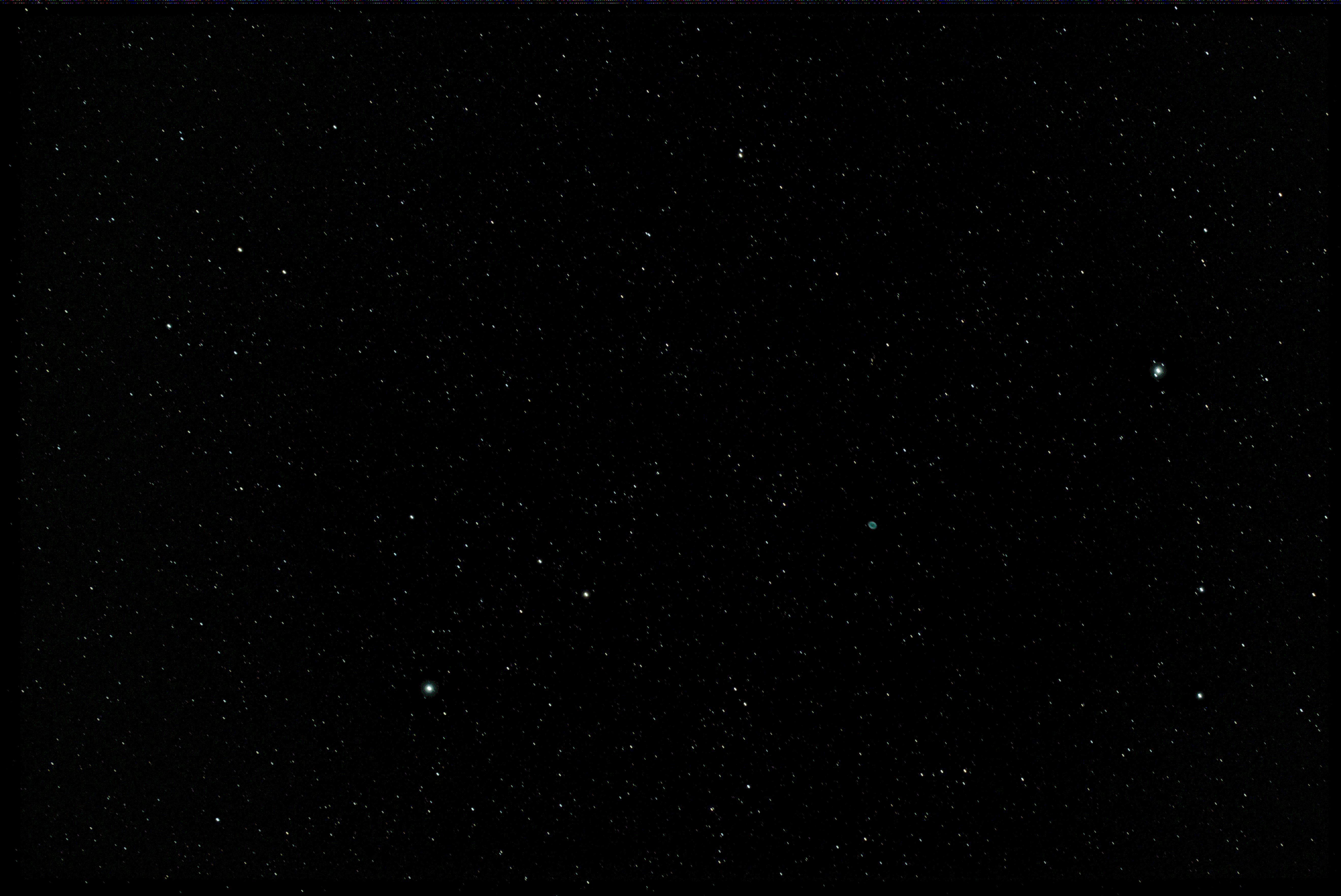
On taking the initial images and only on close inspection on the computer screen, could I see a small but clear and yet anomalous blue spot. It could, at first glance, be another blue earthly like planet, except it is M57 in the constellation of Lyra some 2,283 ly from earth, with a diameter of 2.6 ly, that’s 15,280,000,000,000 miles, a temperature of 125,000K and is 200 times more luminous than our Sun.  However, through the vast distance of space it is insignificant to the eye.

M57 The Ring Nebula. WO GT81 + FF 10x30 sec at ISO 800

M57 The Ring Nebula, just to the right of centre of the two stars at 2.00 o’clock and 8.00 o’clock.
Canon 700D ; WO GT81 + FF ; 10×30 sec at ISO 800

A bit more work by Mr GIMP and all is revealed:

M57 The Ring Nebula, cropped from the main image above.

M57 The Ring Nebula, cropped from the main image above.