

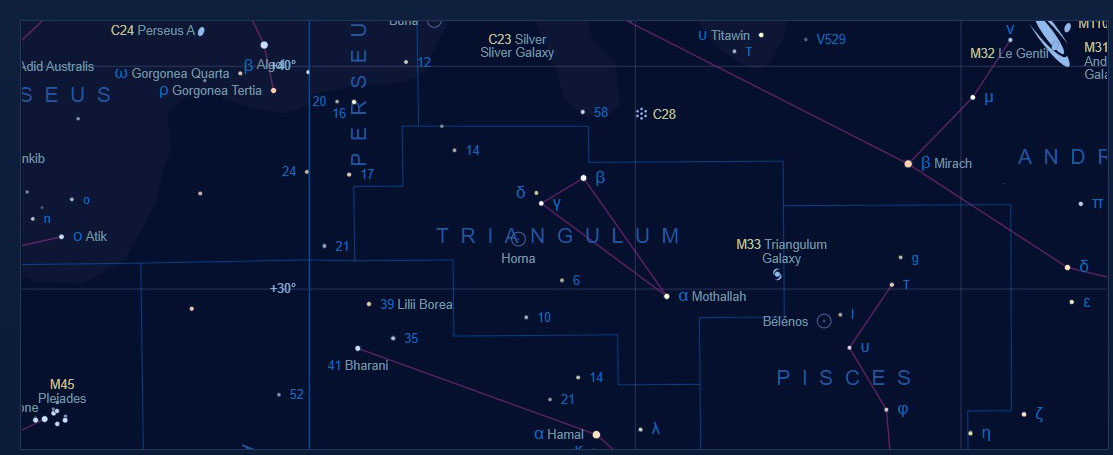
After successfully imaging M31 the Andromeda galaxy at new moon in early October, I was lucky that the next moon cycle in early November also provided good conditions and it seemed appropriate to just shift attention to Andromeda’s closest neighbour, which at this time of the year occupies a favourable part of the eastern sky in the early evening. Only 15o from M31, M33 AKA the Triangulum Galaxy is the third-largest member of the Local Group of galaxies after Andromeda and the Milky Way. Although very faint, in very good dark night sky conditions M33 can apparently be viewed with the naked eye. Along with our own Milky Way, this group travels together in the universe, as they are gravitationally bound.
Andromeda is eight times brighter and nearly four times larger than Triangulum, which for various reasons I have previously found difficult to image, despite its relative proximity to us. On this occasion I was therefore very pleased to obtain a good data set over three nights that included 3-hours of 10-minute Ha exposures. The result is definitely my best image yet of this tricky but attractive target, which in particular highlights the numerous red star-forming regions that abound throughout the galaxy’s arms. I’ll almost certainly be back again another day but for now I am at last satisfied with the result.
| IMAGING DETAILS | |
| Object | M33 Triangulum Galaxy |
| Constellation | Triangulum |
| Distance | Approx. 2.7 million light-years |
| Size | 71’ x 42’ ~ 60,000 light-years |
| Apparent Magnitude | +5.72 |
| Scope | William Optics GT81 + Focal Reducer FL 382mm f4.72 |
| Mount | SW AZ-EQ6 GT + EQASCOM computer control |
| Guiding | William Optics 50mm guide scope |
| + Starlight Xpress Lodestar X2 guide camera & PHD2 control | |
| Camera | ZWO1600MM-Cool (mono) CMOS sensor |
| FOV 2.65o x 2.0o Resolution 2.05”/pix Max. image size 4,656 x 3,520 pix | |
| EFW | ZWO x8 EFW & 31mm LRGB + 3nm Ha Chroma filters |
| Capture & Processing | Astro Photography Tool, Deep Sky Stacker, PixInsight v 1.8.8-9, Photoshop CS3, Topaz Ai Denosie |
| Image Location & Orientation | Centre: RA 01:33:53.6 DEC 30:39:18.9 Top = North Right = West |
| Exposures | 15 x 300 sec LRGB + 18 x 600 sec Ha Total time: 8 hours |
| @ 139 Gain 21 Offset @ -20oC | |
| Calibration | 5 x 300 sec & 5 x 600 sec Darks + 15 x LRGBHa Flats & Dark Flats @ ADU 25,000 |
| Location & Darkness | Fairvale Observatory – Redhill – Surrey – UK Typically Bortle 5 |
| Date & Time | 2nd 3rd 4th November 2021 @ +19.00h |
| Weather | Approx. <6oC RH = >=80% New Moon |
 WATCH THIS SPACE(MAN)