

Located in the constellation Corona Australis (Southern Crown), the spectacular object NGC 6729 (AKA Caldwell 68) is a combined reflection and emission nebula, set within the Australis Molecular Cloud. Being just south of Sagittarius, it is inaccessible from my observatory in Somerset, so this excellent data was consequently acquired from the dark skies of Chile in the Southern Hemisphere, using a superb Planewave CDK200 f/6.8 508cm aperture telescope at the El Sauce Observatory.
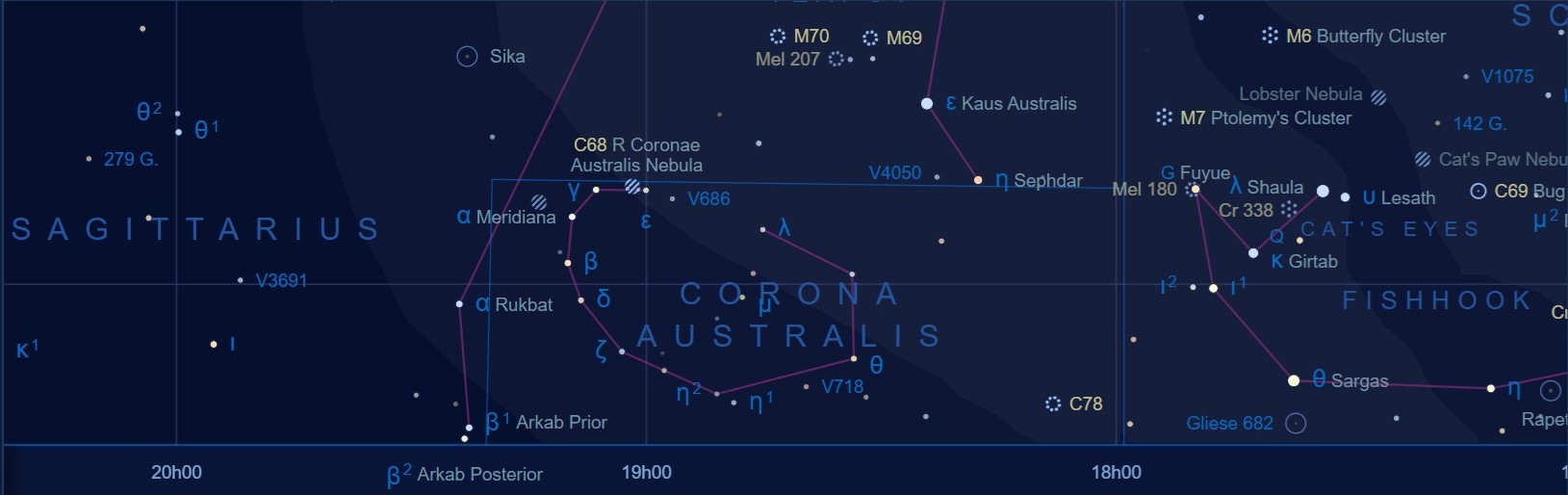
The star illuminating NGC 6729 is a T Tauri star – a type of young star whose brightness fluctuates over time. The fan-shaped nebula opens-up between the variable stars R Corona Australis (R CrA) and T CrA to the south-east (see skymap below ref. Robert Mura). R CrA is a pre-main-sequence star within the Corona Australis molecular complex, which is one of the closest star-forming regions to the Milky Way galaxy. Intriguingly, this wonderful, hazy looking nebula exhibits both variable brightness and morphology over time.
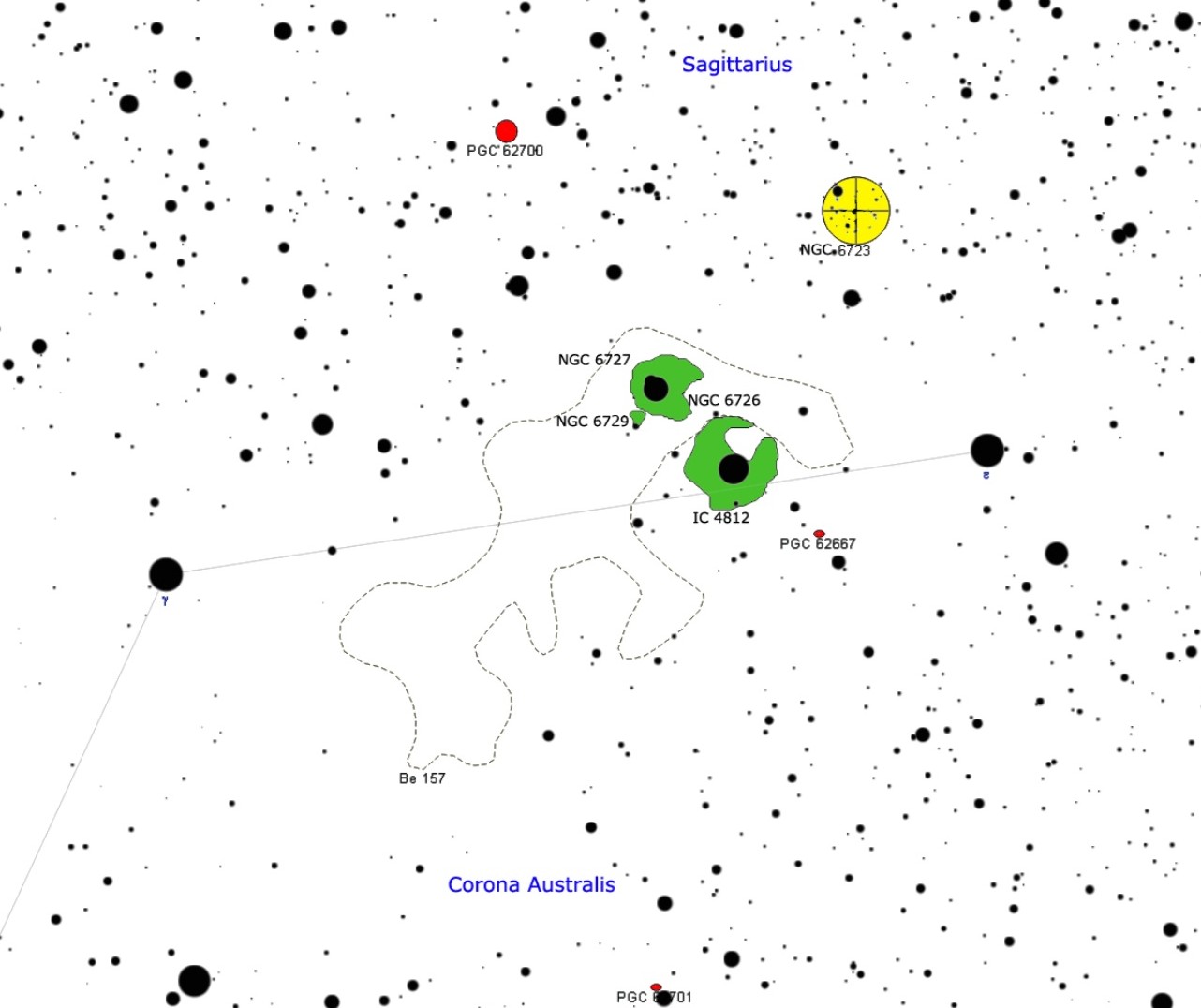
| IMAGING DETAILS | |
| Object | NGC 6729 Corona Australis Molecular Cloud |
| Constellation | Corona Australis |
| Distance | Approximately 420 light-years |
| Size | 2.50 x 2.0 arc minutes (actual 0.30 light years) |
| Apparent Magnitude | +9.5 |
| Scope | Planewave CDK20 |
| Mount | Planewave L500 |
| Focuser | Optec Gemini |
| Camera | QHY600PH-M |
| Filters | Chroma LRGB + Ha 3nm |
| Processing | Deep Sky Stacker & PixInsight v1.9-3 |
| Image Location & Orientation | Centre: RA 19:01:42.392 DEC -36:59:48.53 Up = North |
| Exposures | L x 77, R x 50, G x 50, B x 50 @ 5mins Total Integration Time: 19hr |
| Location & Darkness | Obstech El Sauce Observatory, Chile |
| Date | July 2024 |

 WATCH THIS SPACE(MAN)