
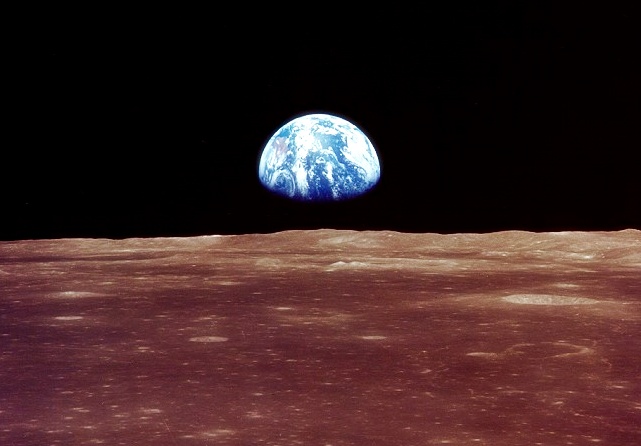
I’m now into my second year of ‘serious’ astronomy and astrophotography, which accompanied by a greater knowledge of the Universe has brought an element of familiarity: with the equipment, with viewing & imaging techniques and space itself. In the past I have worked underground as a geologist on mines and like to think that I have good spatial awareness. Through this growing familiarity and knowledge of the night sky, I have become increasingly aware of our place in the Universe and how we on Earth are travelling through space; I also feel a growing empathy other peoples such as mariners who use and relate to the sky and space in a way ordinary people do not.
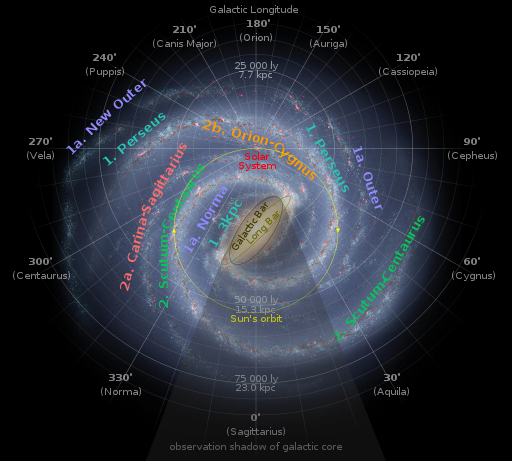
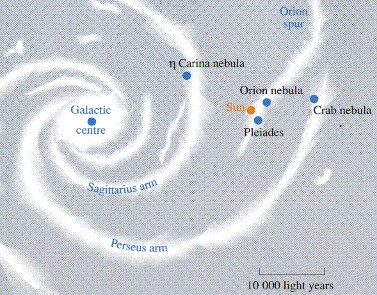
Whilst spinning on its axis at 1,037 mph at the equator (653 mph here at Fairvale Observatory’s higher latitude), the Earth is moving at about 70,000 mph round the Sun. Furthermore, located in the Orion-Cygnus arm of the Milky Way, the Solar System is also moving around the spiral galaxy at 500,000 mph, resulting in a galactic year of nearly 250,000 Earth years . Notwithstanding these complex and frankly mind boggling statistics, it thankfully all feels quite serene when outside at night with my telescope at Fairvale Observatory.
Going back some 5,000 years the constellations might seem to describe the ‘shape’ of space and provide a sense of stability to the sky but this is misleading. These and other asterisms are 2D patterns that mankind has created for practical use, whereas in reality most of the stars that make up these patterns bear little if any meaningful relationship with each other when viewed in 3D – like this animation showing the true shape of Orion.
Furthermore, under the force of gravity and other as yet unknown influences e.g. dark energy, these too are moving through space in their own way at vast speeds. In reality the constellations are therefore anything but permanent and through the millennia their apparent shapes change and will eventually be destroyed as far as we on Earth are concerned. As with my professional subject geology, this is the problem with space – it is very big and the timescales are very, very large, essentially beyond human comprehension, which result in otherwise unimaginable events; this animation wonderfully illustrates the scale and complexity of the known Universe.
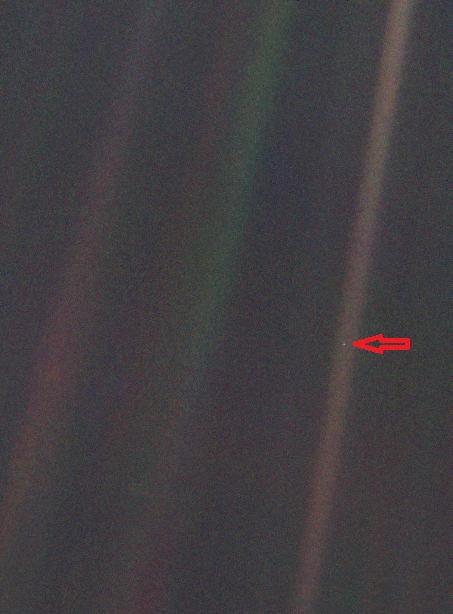
Space selfie = the insignificance of Earth.
The Pale Blue Spot photograph of Earth (right side of picture) taken 6 billion kilometers (40.5 AU) away by Voyager-1 on February 14th 1990,
The beauty of such a system is that it can be modelled very accurately, from which it is possible to predict with great certainty the projected position of all these celestial objects, thus making spaceflight and the prediction of astronomical events possible. Likewise using the same data modelling it is possible to look backwards at past events. Such computerisation is no longer just the preserve of NASA and University academics but is at our fingertips using a computer based planetarium, in my case Carte du Ciel – incredible!
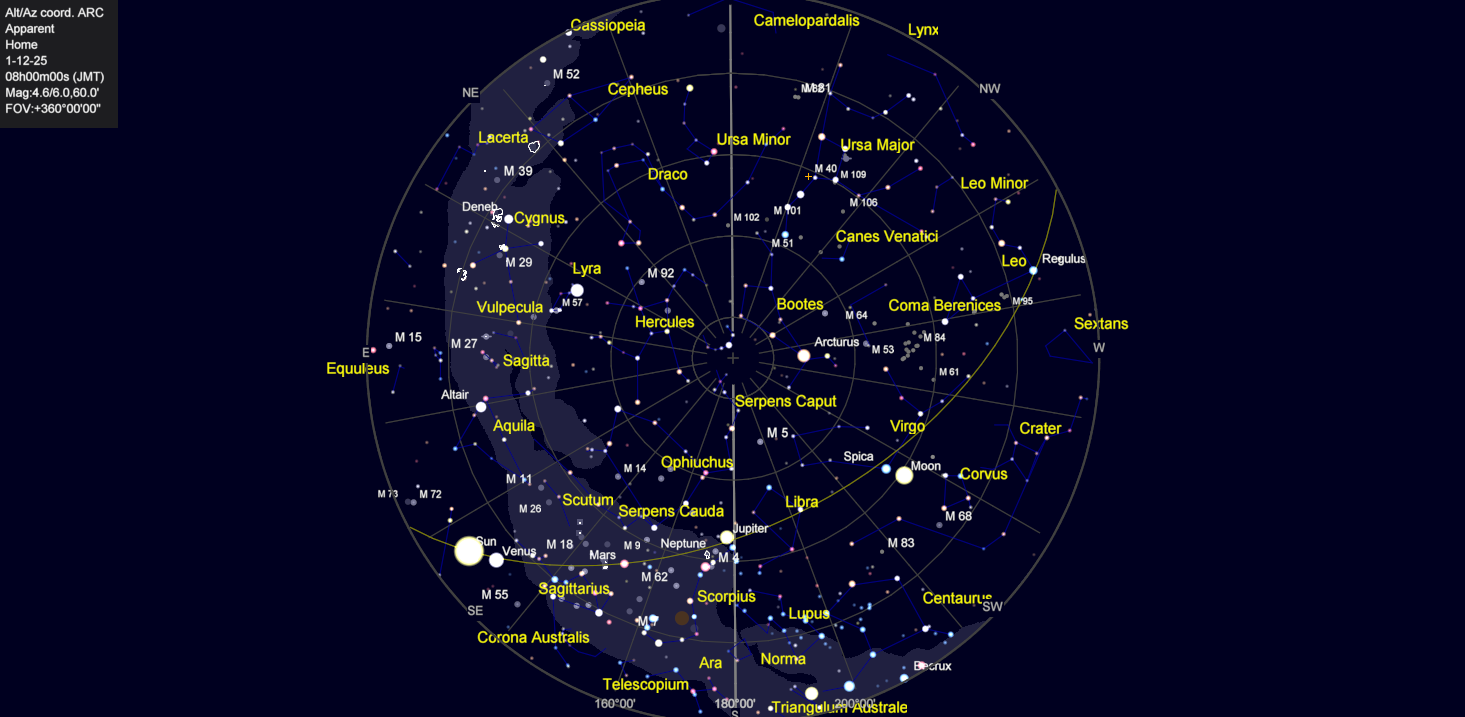
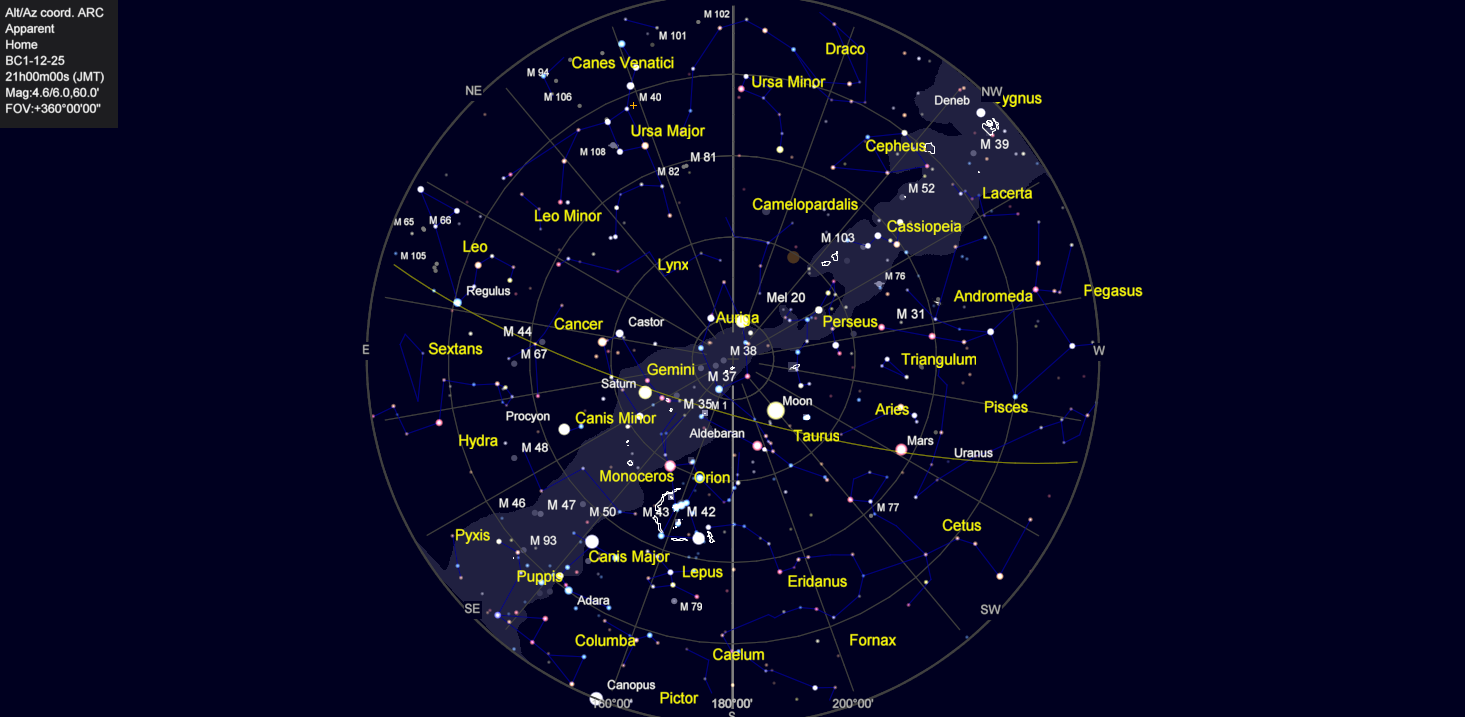
Given the time of year I have therefore used the aforesaid programme to generate a view of the night sky from Bethlehem 2015 years ago on the morning and evening of 25th December. Even then differences can be seen in the shape of the constellations compared to now. If we are to believe the story of the Three Wise Men following a bight ‘star’ at this time, it seems it would be most likely to be in the morning when first Jupiter and then Venus are present. Either way it’s fascinating to be able to model the night sky in this way for any chosen moment in time.
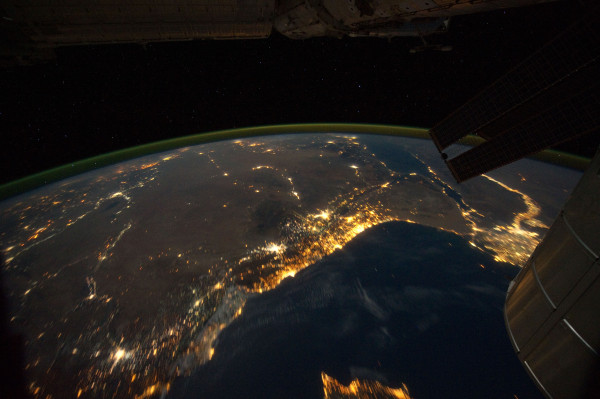
Santa’s view of Bethlehem from the ISS on 24th December 2011
After weeks of cloud cover I recently managed to get outside again for what turned out to be a wonderfully clear night, from dawn to dusk, furthermore there was no Moon! As a result imaging was productive and included some exciting new objects. However, again given the time of year for the moment I am repeating an object used last Christmas. One year on the difference is that this time I have used a modded Canon 550D DSLR camera and thus improved (I think) the red Ha-light detail.

Cone Nebula & Christmas Tree Cluster – right of centre
WO GT81 + Modded Canon 550D & FF | 15 sec @ ISO 1,600 + calibration | 8th December 2015
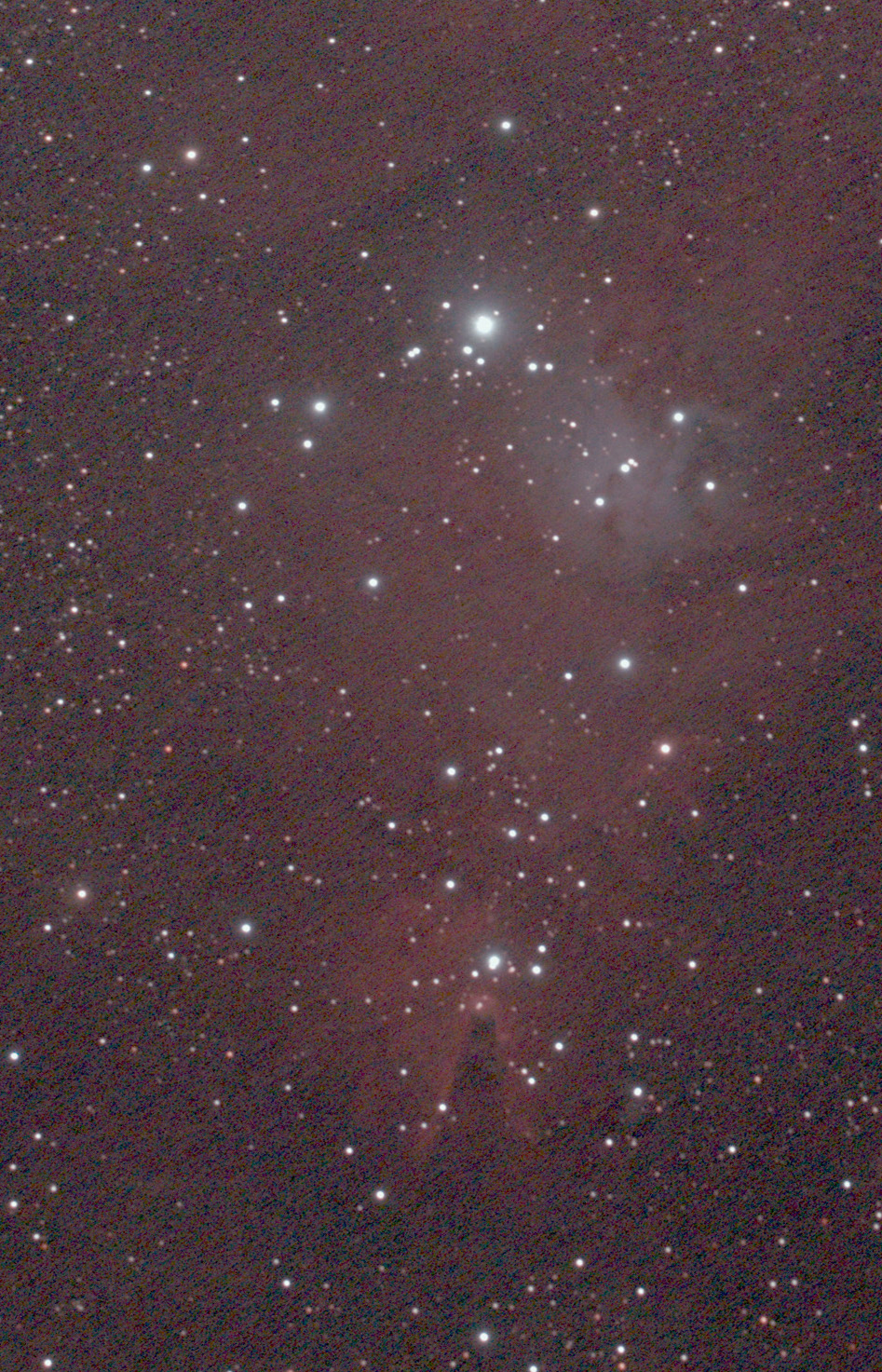
Cone Nebula (bottom centre) & Christmas Tree Cluster (inverted)
NGC 2264 or Christmas Tree cluster and its neighbour the Cone Nebula are located within the Monoceros AKA Unicorn constellation, which being part of the Milky Way are therefore inextricably linked to a similar destiny as spaceship Earth as it makes its way through space. Being some 2,700 light-years away we are unlikely to meet, though you never know with space and time!

HAPPY CHRISTMAS
 WATCH THIS SPACE(MAN)