The Needle Galaxy

Perspective is everything – in life and so it is, with astronomy.  Hipparchus first pointed the way in 127 BC when he described the procession of the equinoxes and, as they say one thing led to another as,  Nicolas Copernicus (1473-1543), Tycho Brahe (1546-1601), Galileo Galilei (1564-1642), Johannes Kepler (1571–1630), Johannes Hevelius (1611–1687), Giovanni Cassini (1625-1712), John Flamsteed (1646-1719) and others opened our eyes to the night sky and what lay beyond Earth. Notwithstanding, it was Edwin Hubble’s discovery of galaxies in 1924 that ultimately led to mankind’s recognition that there was much, much more, that we now take for granted to be the Universe.  However, even to the experienced modern astronomer the scale, complexity and beauty of the Universe can be somewhat overwhelming, like when we consider that the observable Universe may consist of 2 trillion galaxies!

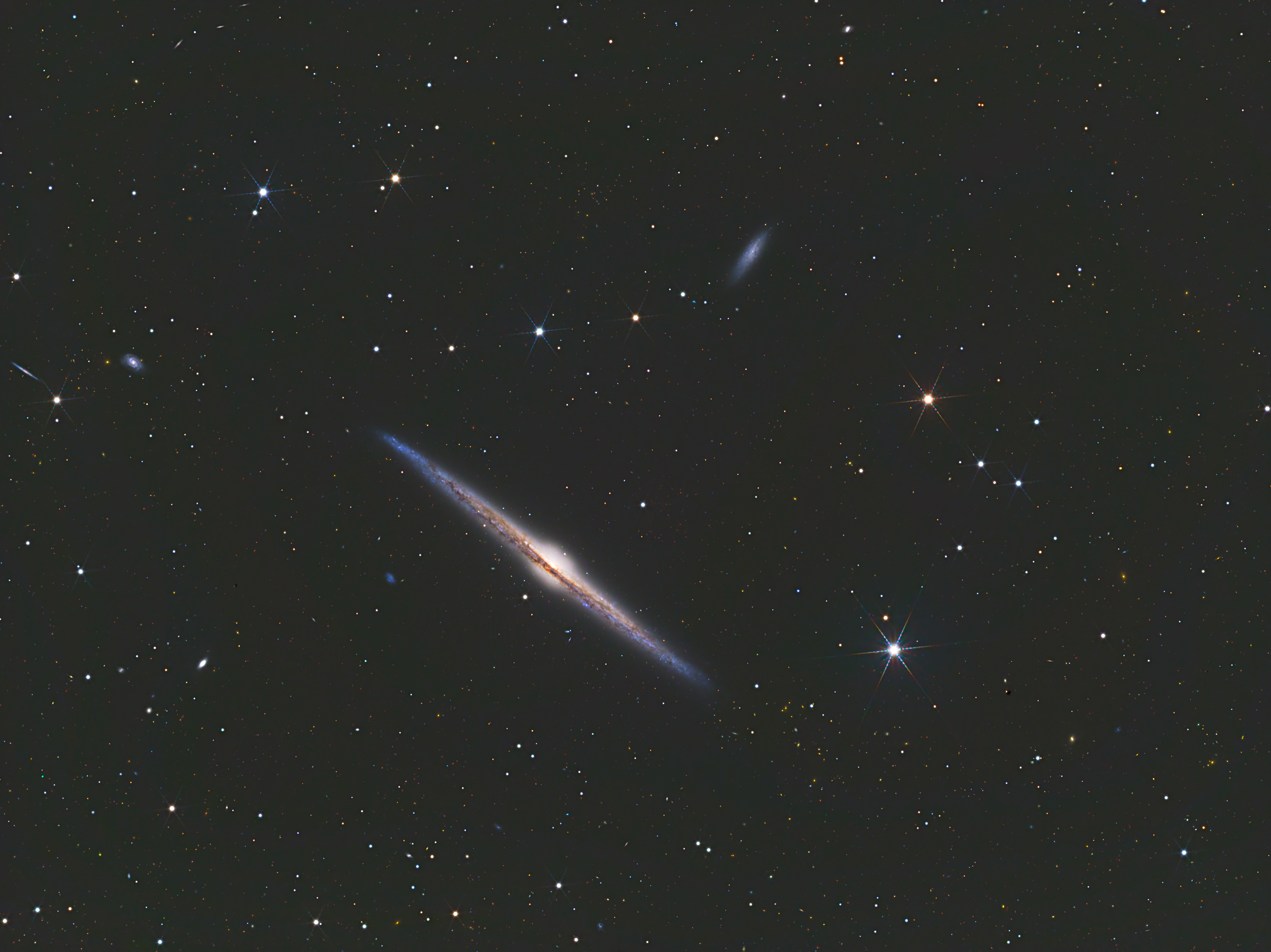
Since Hubble’s work we have become familiar with many types of galaxies, which the average person might describe as a colourful spinning firework-like disc, consisting of vast gravitationally bound systems of stars, stellar remnants, interstellar gas, dust and dark matter.  This stereotypic impression arises because most galaxy images are viewed face-on or at an inclined angle, so that we can see the structures and processes that have created it.  However, given the number of galaxies and therefore the many possible views, it is not surprising that some can only be seen edge-on from our perspective on Earth, the Needle Galaxy AKA NGC 4546 is one of these.
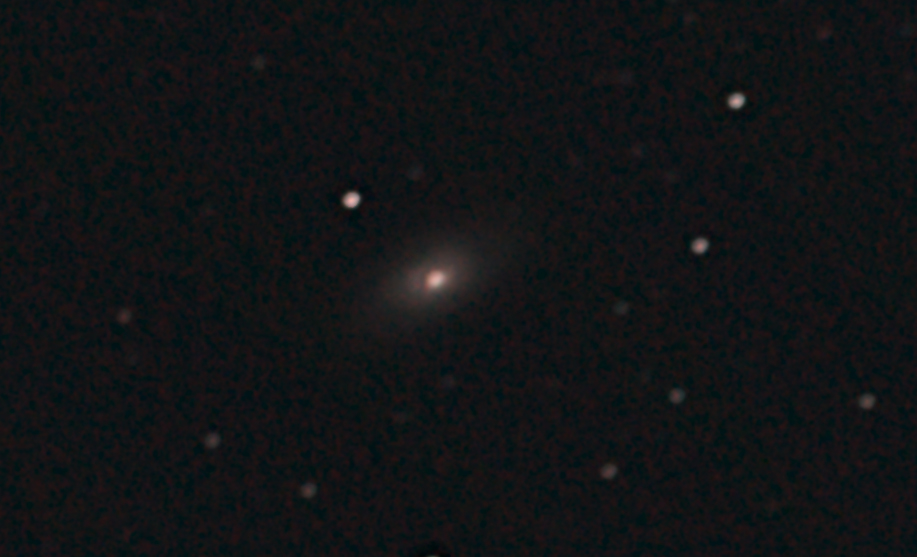
Thought to be a barred spiral galaxy, NGC 4546 is some 33% larger than the Milky Way.  It has at least two satellite galaxies, about 240 globular clusters (Milky Way ~ 150) and is the brightest of the Coma 1 Group of galaxies.  Seen through a telescope or when imaged the Needle Galaxy it appears like a thin streak drawn across the dark night sky but look closer and its magnificence is revealed, as in the image above.

Here ribbons of dust can be seen criss-crossing along the edge of the thin galactic disc, thereby blocking much of the from light behind.  However, it is the bright central bulge that inevitably catches the eye but remains something of an enigma, as little can be seen from within.  This excellent data set obtained using the MOANA 10” Newtonian telescope located in Texas’ dark skies, reveals such exquisite details that are provided by the less common edgewise perspective of this intriguing galaxy.   

Footnote & credit: Following a knee replacement I’m currently unable to set-up and use my astronomy equipment, fortunately I havve been able to continue processing using this excellent public amateur data from the MOANA project located near Fort Davis, Texas  https://erellaz.com/moana/. Many thanks to its creator Elleraz.

Galactic Stepping Stones

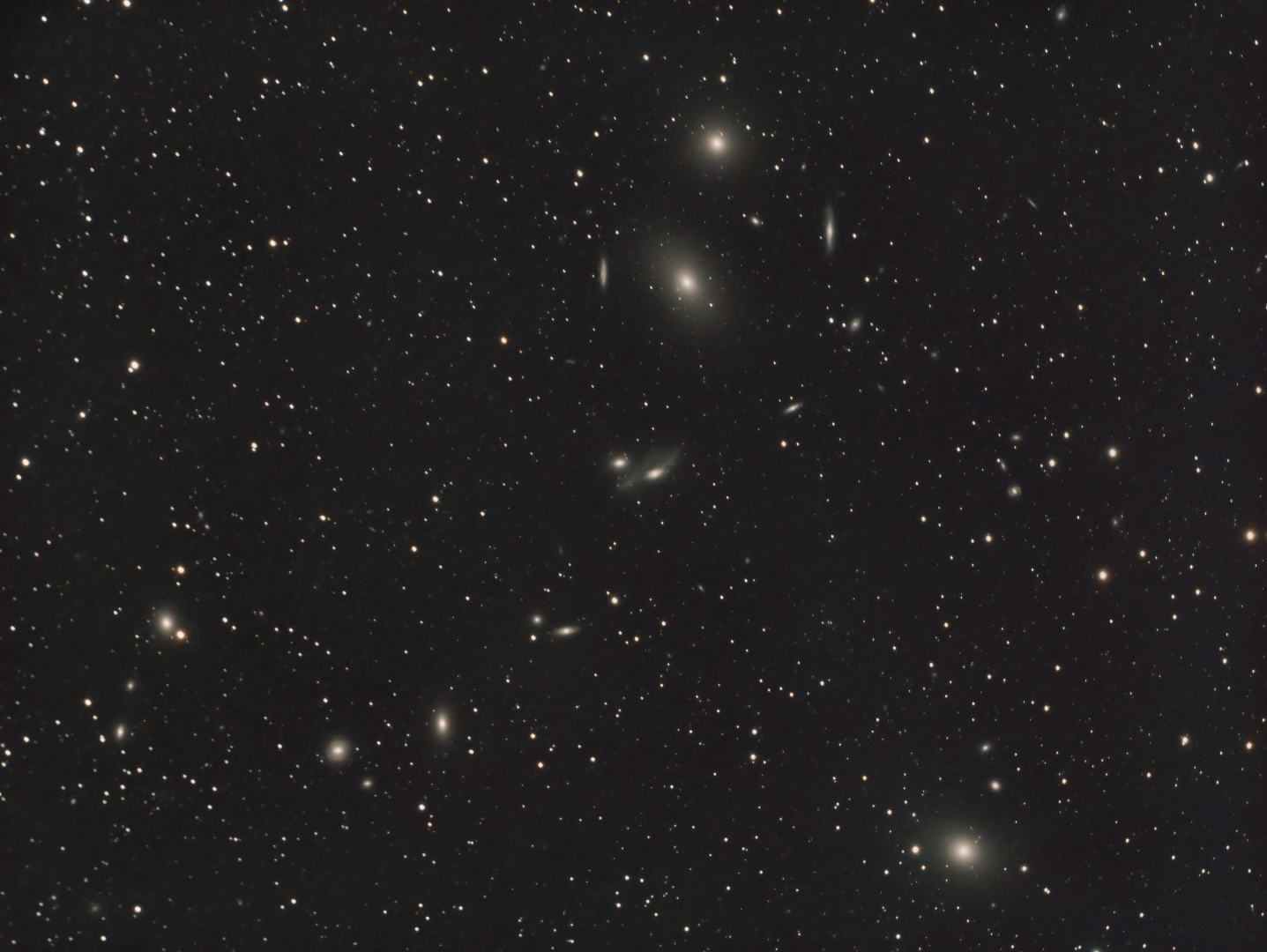
The Virgo Cluster consists of more than 2,000 galaxies, which unfortunately are optically too much for my small William Optics GT81 telescope individually.  However, one of several sub-groups within the Virgo Cluster forms a striking J-curve shape that does make for a pleasing LRGB image.  Discovered and named after the Armenian astrophysicist Benjamin Markarian, Markarian’s Chain is a string of bright galaxies that share a common motion through space.  I first imaged the Chain in April 2015 using a modded DSLR and then again in April 2017, as my first LRGB image with the then new ZWO ASI1600MM-Cool camera but with integration times of less than 1-hour on both occasions, the resulting images were far from ideal.  On this occasion using my new Chroma LRGB filters for the first time I was determined to do better.

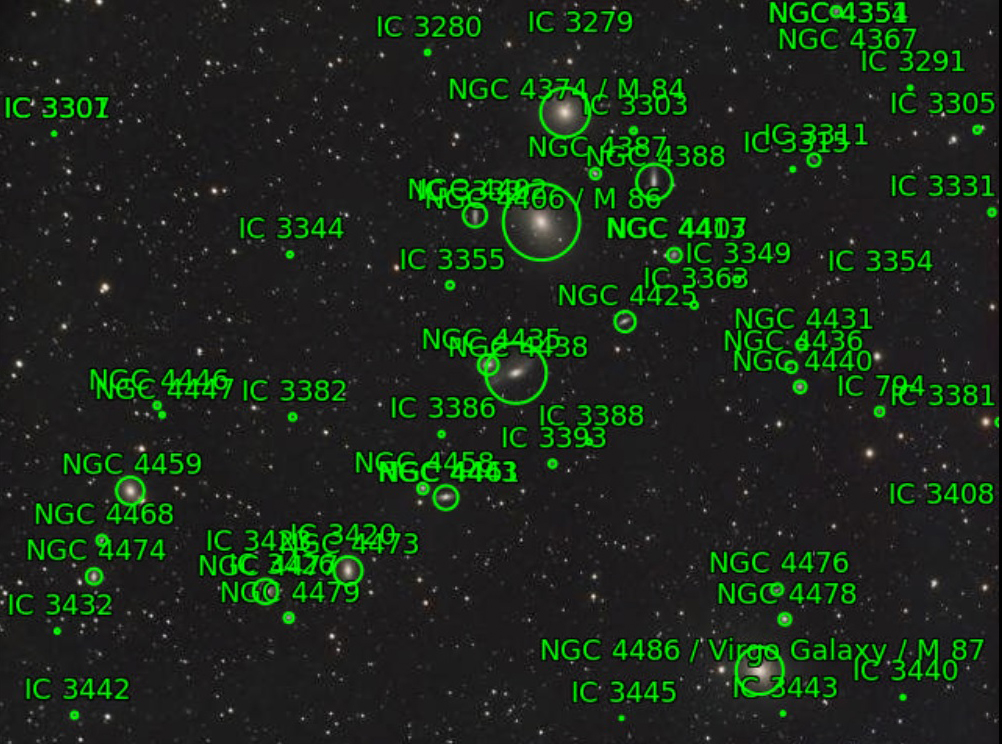
The new filters and nearly 7-hours integration time has resulted in a much more dynamic and detailed image, which I believe now does justice to this spectacular group of galaxies.  Analysis of the image using Astrometry.net shows just how crowded this area of Virgo is with galaxies (see annotated image above) but it is Markarian’s Chain that inevitably stands out together with a few other adjacent galaxies.

  • Large 10th magnitude M84 & M86 galaxies at the western end of the Chain dominate the image.  M84 is the object with the highest blue shift in the Messier catalogue, which is a result of its rapid movement (244km/sec) towards the centre of the Virgo Cluster and us.  At the centre of M84 is a 1.5 billion solar mass black hole.
  • NGC 4420 & NGC 4388 – by comparison these edge-on galaxies together with even smaller NGC 4413 & NGC 4425 seem to frame the larger M84 and M86.   
  • Next along the Chain is a pair of interacting galaxies, the smaller round shaped NGC 4435 and NGC 4438 with its distorted disk, known as “The Eyes”.                             
  • As the Chain starts to turn, some 20’ along is NGC 4458 and its partner, the 11th magnitude elliptical NGC 4461.
  • The final section of the Chain consists first of NGC 4473, its brightness generated by a supermassive black hole – at 100 million solar masses its diameter of 4.46au which would stretch from the Sun to the asteroid belt!  Thereafter the 11.4 magnitude barred lenticular galaxy NGC 4477 defines the north eastern extremity of Markarian’s Chain.
  • As previously noted, there are many other galaxies in this part of the Virgo Cluster.  Perhaps most notable though is M87, from which the first ever image of a black hole was the obtained in 2019 – consisting of some 6.5 billion solar masses.


All-in-all Markarian’s Chain makes for a rewarding image using my small telescope combined with the new Chroma filters.  Such is the nature of the image the galaxies might also suggest a string of pearls or perhaps galactic stepping stones – metaphorically leading to the next phase of my astroimaging journey.

 IMAGING DETAILS
ObjectMarkarian’s Chain
ConstellationVirgo & Coma Berenices
Distance50 – 55 million light-years
Size  ~2.5o total
Apparent MagnitudeVaries +10 to +12 approx.  
  
Scope William Optics GT81 + Focal Reducer FL 382mm  f4.72
MountSW AZ-EQ6 GT + EQASCOM computer control & Cartes du Ciel
GuidingWilliam Optics 50mm guide scope
 + Starlight Xpress Lodestar X2 camera & PHD2 guiding
CameraZWO1600MM-Cool mono  CMOS sensor
 FOV 2.65o x 2.0o Resolution 2.05”/pix  Max. image size 4,656 x 3,520 pix   
EFWZWOx8 EFW & 31mm Chroma LRGB filters 
Capture & ProcessingAstro Photography Tool + PHD2 +  Deep Sky Stacker, PixInsight v1.8.8-7, Photoshop CS3, Topaz Denoise
Image Location &           OrientationCentre  RA 12:27:46.65      DEC +13:03:06.44  @21.30h                      Left = North     
Exposures100 x 60 sec L , 54 x 60 sec R,  55 x 60 sec G&B Total Integration Time: 6hr 44 min     
 @ 139 Gain   21  Offset @ -20oC    
Calibration10 x 60 sec Darks  15 x  LRGB Flats & Dark Flats         @ ADU 25,000
Location & DarknessFairvale Observatory – Redhill – Surrey – UK        Typically Bortle 5-6
Date & Time5th & 6th April 2021  @ +21.00h  
WeatherApprox. <2oC   RH >=45%                  🌙 30% waning

Spring’s Playground

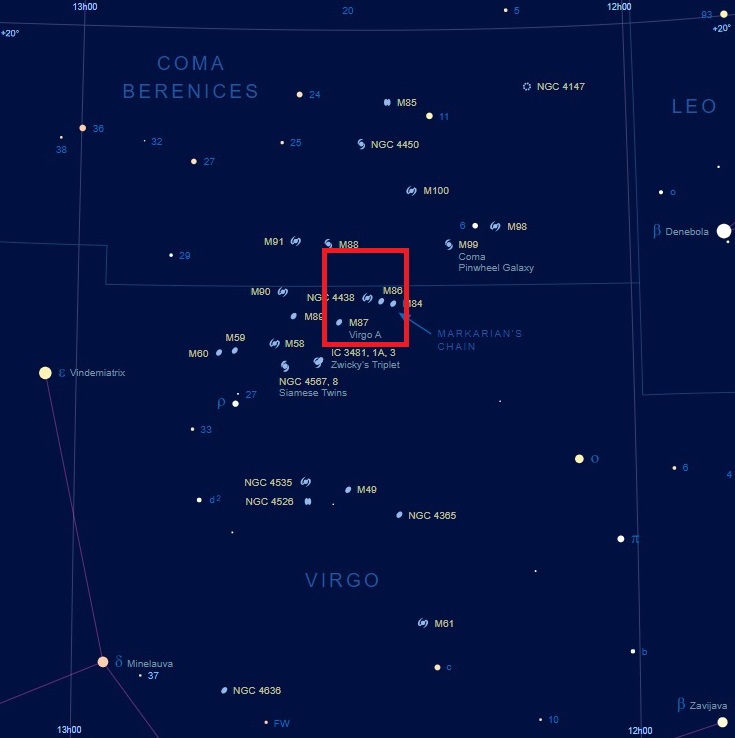
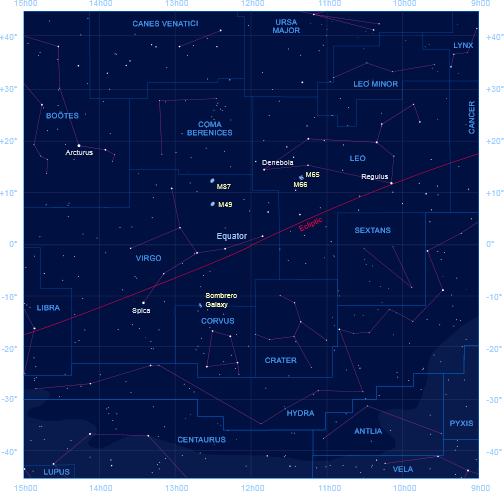
The night sky has been full of surprises for me this Spring, in particular the very extensive presence of galaxies.  Their occurrence has been mostly associated with the constellations of Leo and Virgo but also less well known (to me) Coma Berenices, located between the two aforementioned constellations.  Despite being the 42nd constellation by size and relatively small with few bright stars, Coma Berenices is nonetheless something of a little gem and every bit as interesting as it’s more famous neighbours.

comaberenices

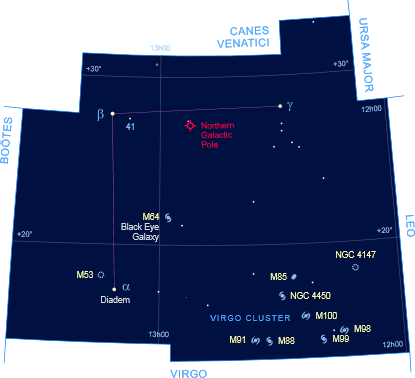
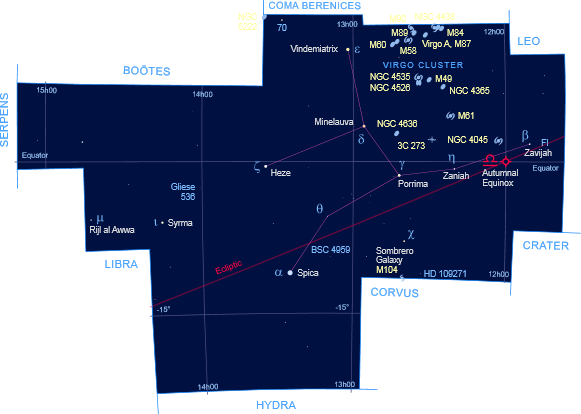
Previously part of the Leo Constellation, Coma Berenices was promoted to a constellation in the 16th Century and named after Queen Berenice II of Egypt; the asterism was previously considered to be the tuft of hair at the end of the lion’s (Leo) tail, which has now become the ‘Queens Hair’.  Though small, Coma Berenices contains eight Messier objects, several globular clusters and is rich in galaxies – including the northern part of the Virgo cluster – also with the North Galactic Pole located within its boundaries.  All-in-all the constellation forms an impressive and interesting part of the sky at this time of the year.

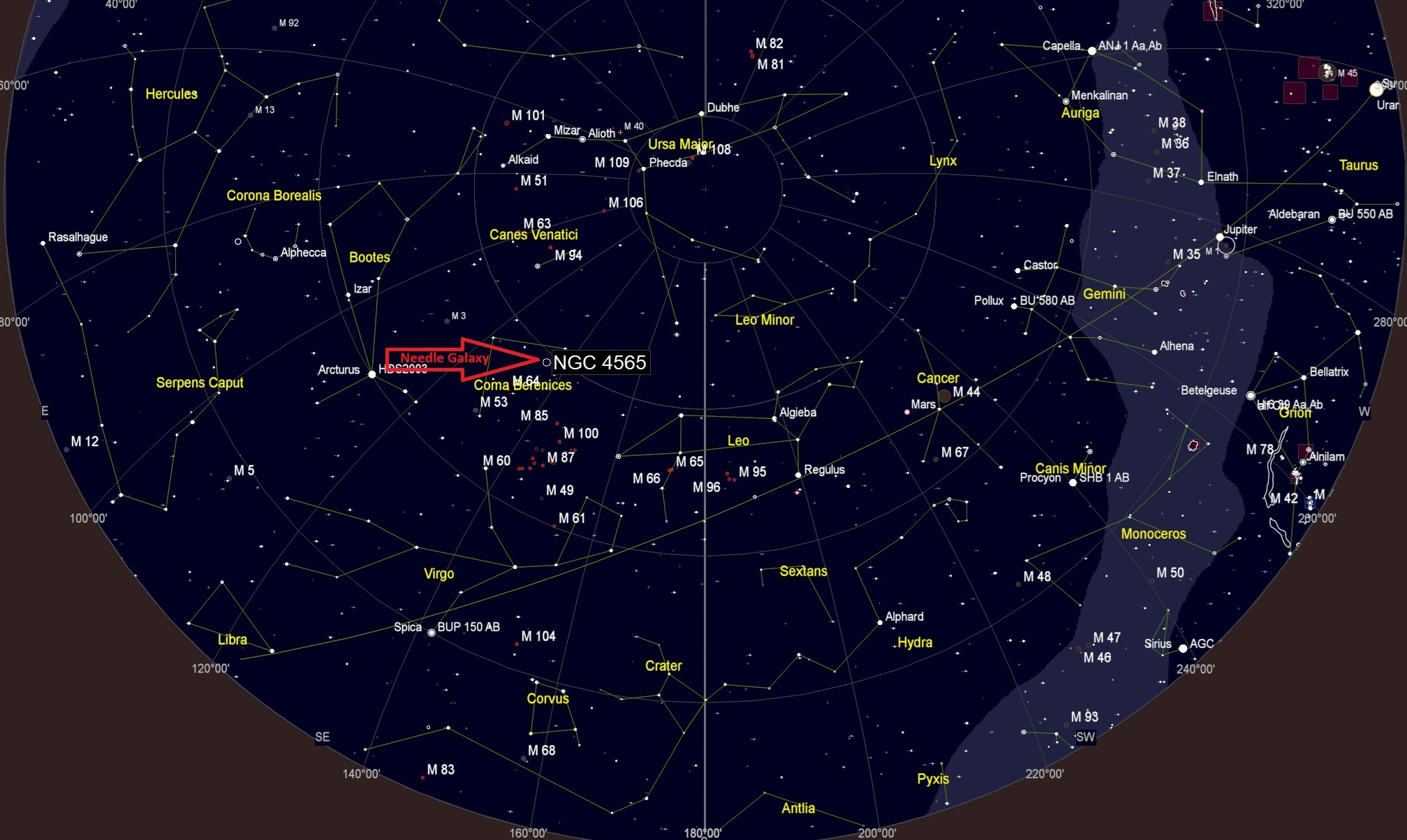
Notable objects are: M53 (NGC 5024), M85 (NGC 4382), M88 (NGC 4501), M91 (NGC 4548), M98 (NGC 4192), M99 (NGC 4254), and M100 (NGC 4321).  Whilst amongst the more famous features of the Coma Berenices is the Black Eye Galaxy (M64), the Needle Galaxy (NGC 4565) and the Coma Cluster of galaxies.

M64, AKA Black Eye Galaxy, Evil Eye Galaxy or the Sleeping Beauty Galaxy is the brightest in Coma Berenices and gets its name from the dark (black) dust band that obscures the stars in its bright core.

M64 Black Eye Galaxy WO GT81 & Canon 550D (modded) + FF | 10 x 180 secs @ ISO 1,600 | 11th April 2015

M64 Black Eye Galaxy
WO GT81 & Canon 550D (modded) + FF | 10 x 180 secs @ ISO 1,600 | 11th April 2015

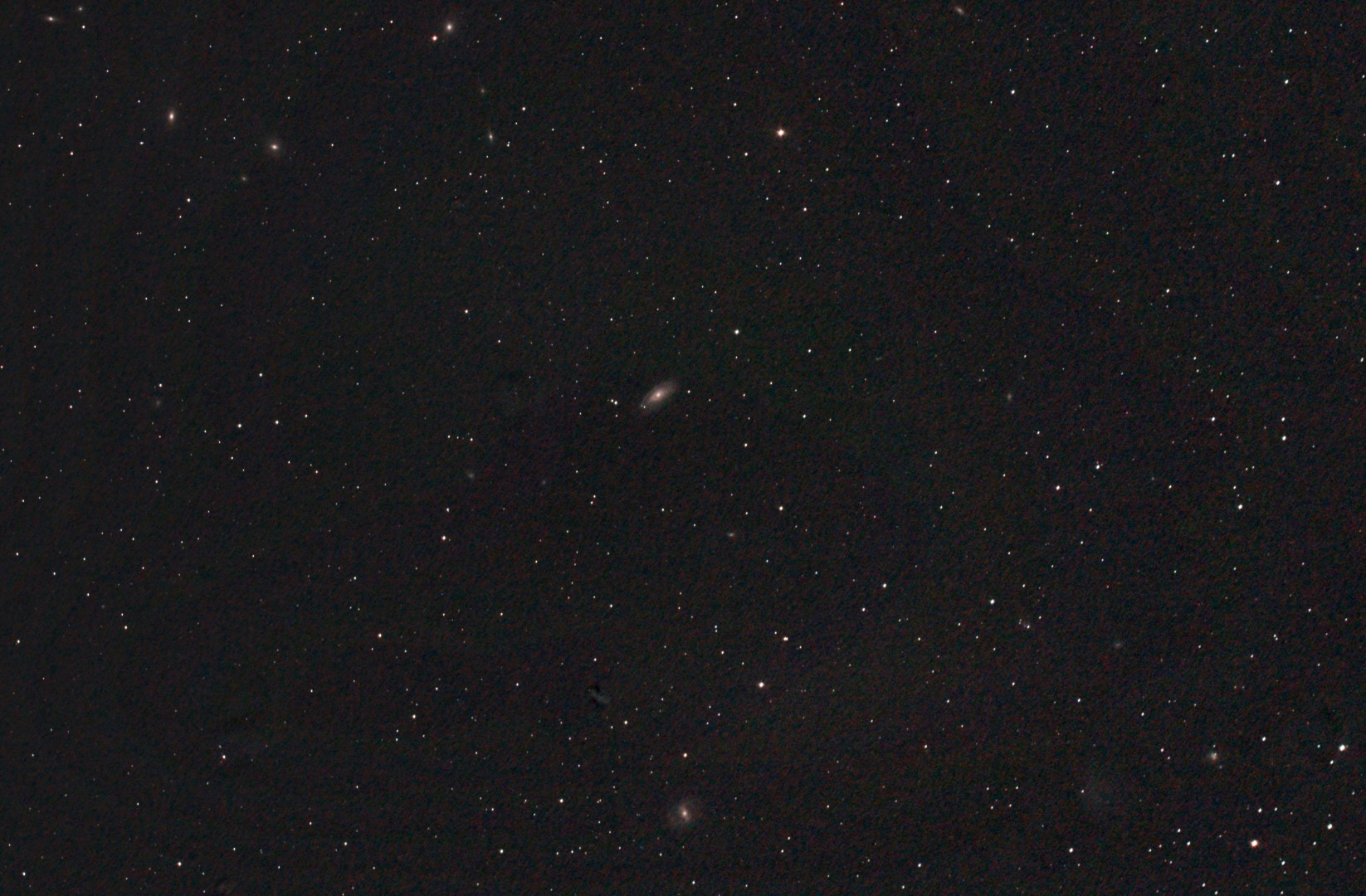
NGC 4565 or the Needle Eye Galaxy is considered one of the finest examples of an edge-on galaxy, thus producing a slender, needle-like profile. Located 40 million light years away, almost directly above the North Galactic Pol, this giant barred spiral galaxy is about one third larger than the Milky Way and is more luminous that Andromeda.

NGC 4565 Needle Eye Galaxy WO GT81 & Canon 550D (modded) + FF | 10 x 180 secs @ ISO 1,600 | 11th April 2015

NGC 4565 Needle Eye Galaxy
WO GT81 & Canon 550D (modded) + FF | 10 x 180 secs @ ISO 1,600 | 11th April 2015

Some 60 million light-years away, M88 is located in the lower area of Coma Berenices, is over 100,000 light years diameter and one of the brightest galaxies of the Virgo Cluster.


M88 with other galaxies of the Virgo Cluster nearby. WO GT81 + Canon 550D (modded) + FF | 20 x 180 secs @ ISO 1,600 | 25th March 2015

M88 with other galaxies of the Virgo Cluster nearby.
WO GT81 + Canon 550D (modded) + FF | 20 x 180 secs @ ISO 1,600 | 25th March 2015


Apart from a few occasional opportunities since obtaining my new equipment last Summer, I have been yearning for more galaxies to image and have thoroughly enjoyed Spring’s veritable playground of galaxies that have filled the sky in their hundreds and sometimes thousands since February. Notwithstanding, my 81mm refractor though good struggles to obtain the detail of these magnificent, mind-blowing Deep Sky Objects and I can only look forward to the day of owning a larger aperture telescope and have mastered the art of long-exposure tracking, which I am still working on.  In the meantime, I now await the development of the Summer sky and another crack at objects first encountered last year.

All in a spin

It is now just over six months since acquiring my new astronomy equipment and therefore the first time I have experienced imaging DSO objects of the Spring night sky.  Following the passage of Leo, the main show has now well and truly arrived as the constellations of first Coma Berenices and then Virgo pass overhead, bringing with them a virtual fireworks type display of spectacular stellar features. sky-12h00 comaberenices virgo To DSO fans Spring means one thing – galaxies – too many to comprehend, making it difficult to know where to start.  In my case the detailed beauty of these galaxies will need to wait until I have a substantially larger telescope and can achieve much, much longer exposures.  In the meantime I just marvel at the spectacle and have been trying to image some of the more iconic of these springtime beauties.  Both constellations seem abound with galaxies but two groups are particularly exciting: the Coma Cluster and Virgo Cluster, within which there a large number of fine examples to choose from.

Just the tip of the iceberg: part of the Virgo Cluster that is crowded by galaxies.

Just the tip of the iceberg: part of the Virgo Cluster crowded with thousands of galaxies.

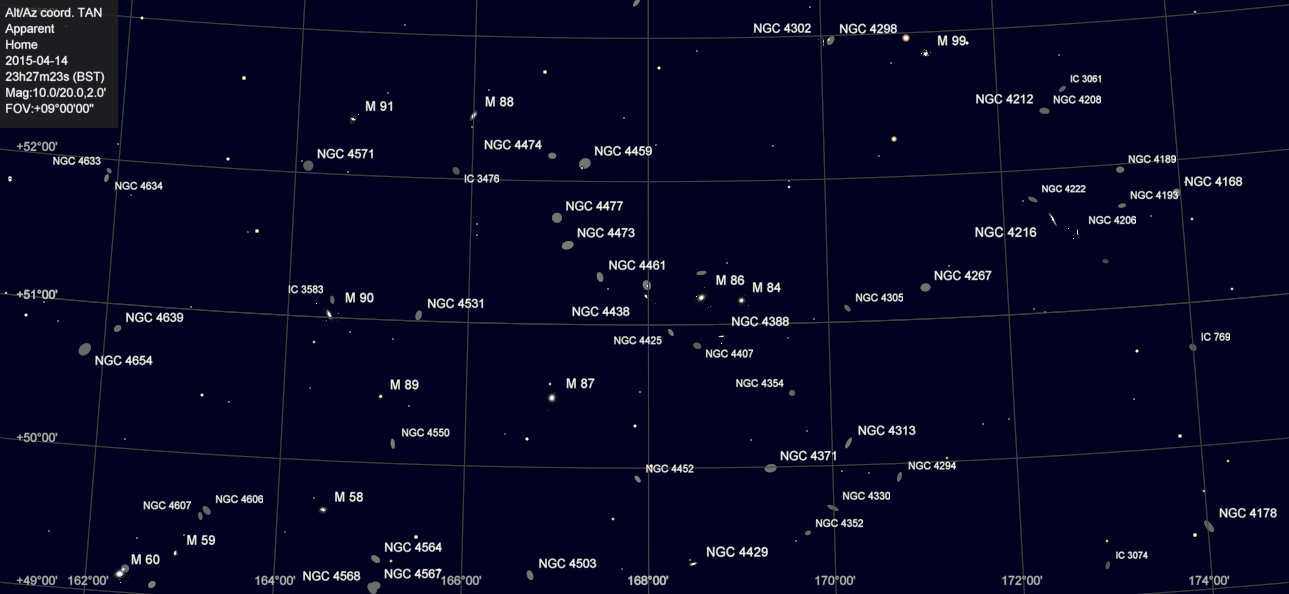
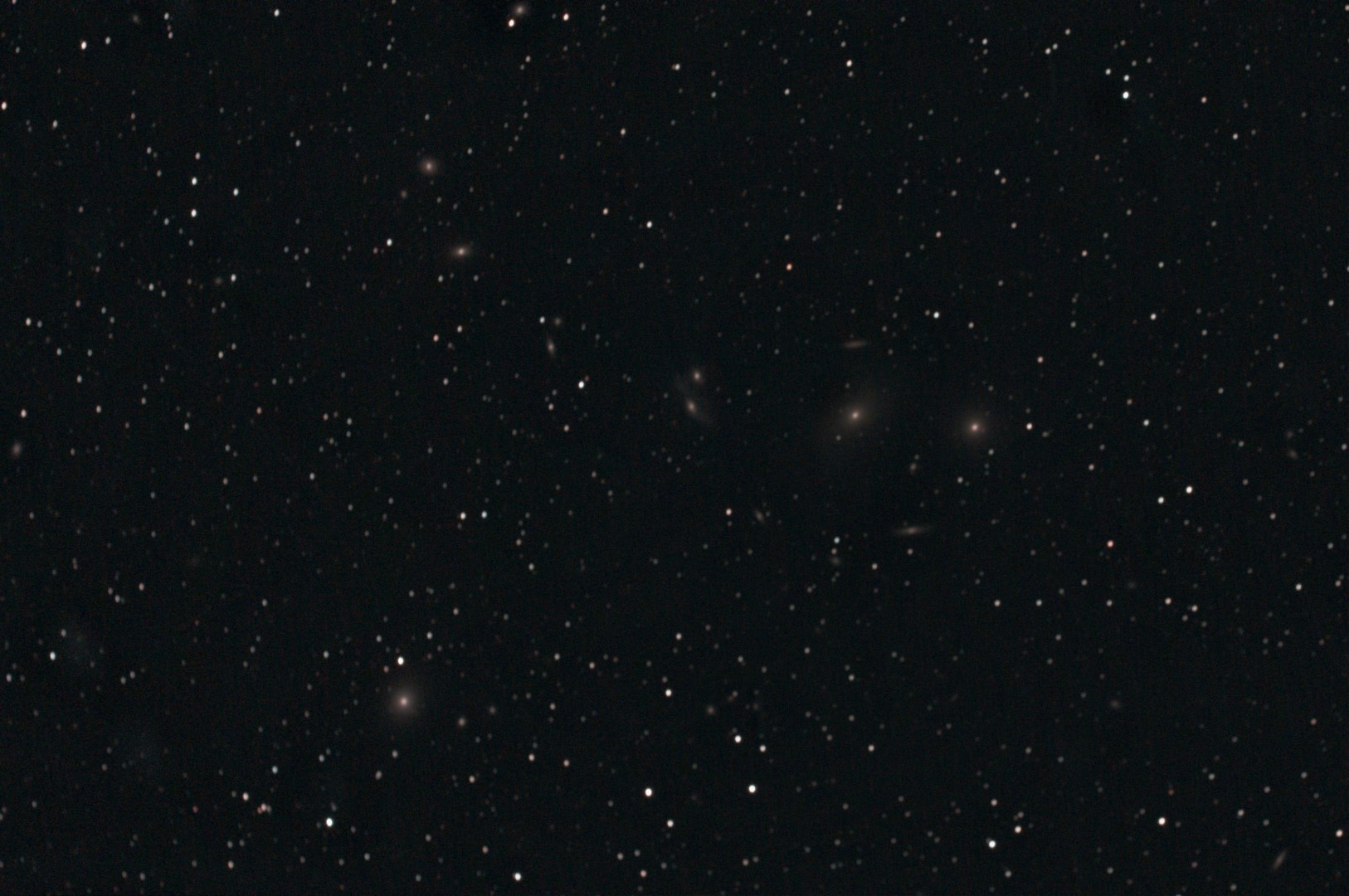
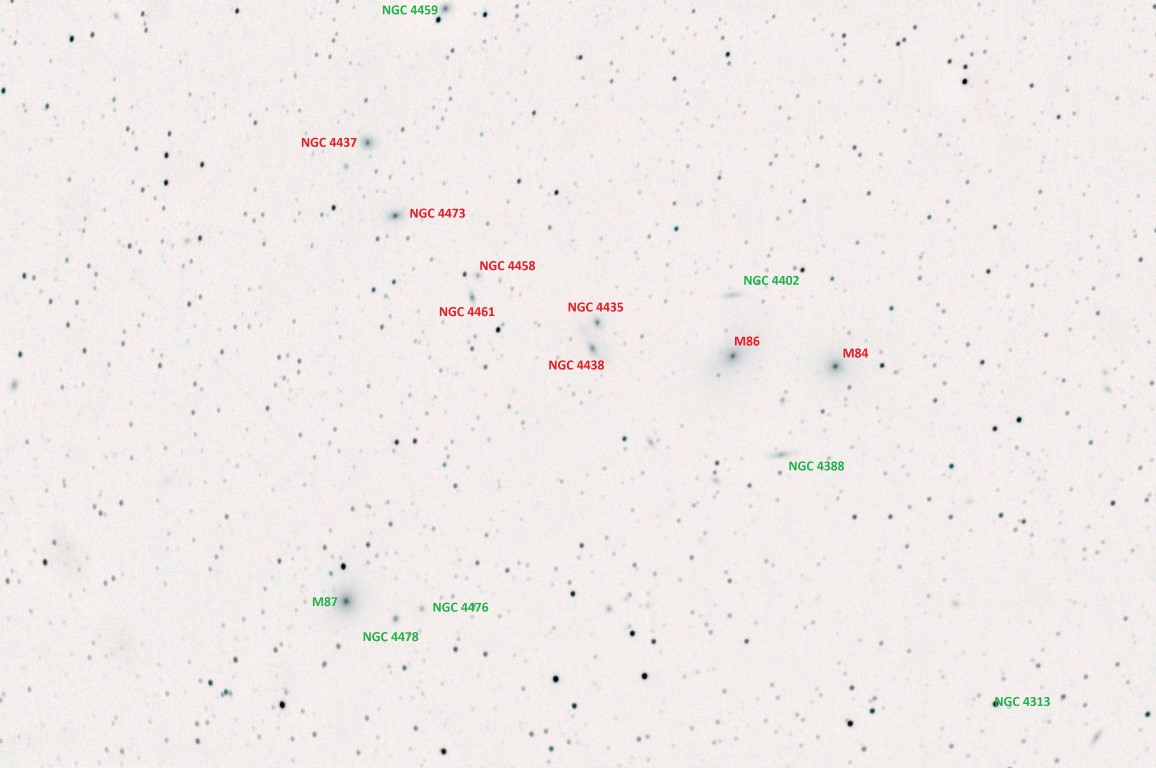
I was first drawn to Markarain’s Chain in the Virgo Cluster, a string of galaxies that form a gentle curve.  Stretched over some x ly the chain includes two Messier Objects – M86 & M84, together with NGC 4438, NGC 4435, NGC 4461, NGC 4458, NGC 4473 & NGC 4477 amongst many others.  In fact this entire part of the sky contains literally thousands of galaxies, of which Markarain’s Chain is just a small but interesting part.

Markarain's Chain WO GT81 & Canon 550D + FF | 15 x 180 secs @ ISO 1,600 | 26th March 2015

Markarian’s Chain
WO GT81 & Canon 550D + FF | 15 x 180 secs @ ISO 1,600 | 26th March 2015

Markarian's Chain (red)  &  some other galaxies (green) inverted.

Markarian’s Chain (red) & some other galaxies (green) – inverted image.