Somerset Magic

I try to ensure that since Watch This Space (Man) blasted off in August 2014, it does what it says on the tin (top of the page): A personal discovery of the Universe through astronomy and astrophotography. Naturally, alongside this journey life goes on, which this year has been a significant challenge for me in many ways.  Shortly after imaging the Flaming Star Nebula at Fairvale Observatory, Surrey, in early January, I underwent major surgery to replace my right knee and inevitably, all physical astronomy came to a halt; latterly I managed to remotely obtain and process data from sources in Texas, USA and Chile, which was good fun.

Just two months later, whilst still in early recovery (which can take over a year), serendipity made an unexpected appearance, and by at the end of June, after 40-years living in Redhill, Surrey, we moved to a new house just outside England’s smallest city of Wells (population 11,145), in the beautiful countryside of north Somerset.  This upheaval, combined with my recovery, has led to a protracted absence from astrophotography imaging but, at last, I’m now very pleased to present my first image from the new Castle Farm Observatory, in Somerset, of course.

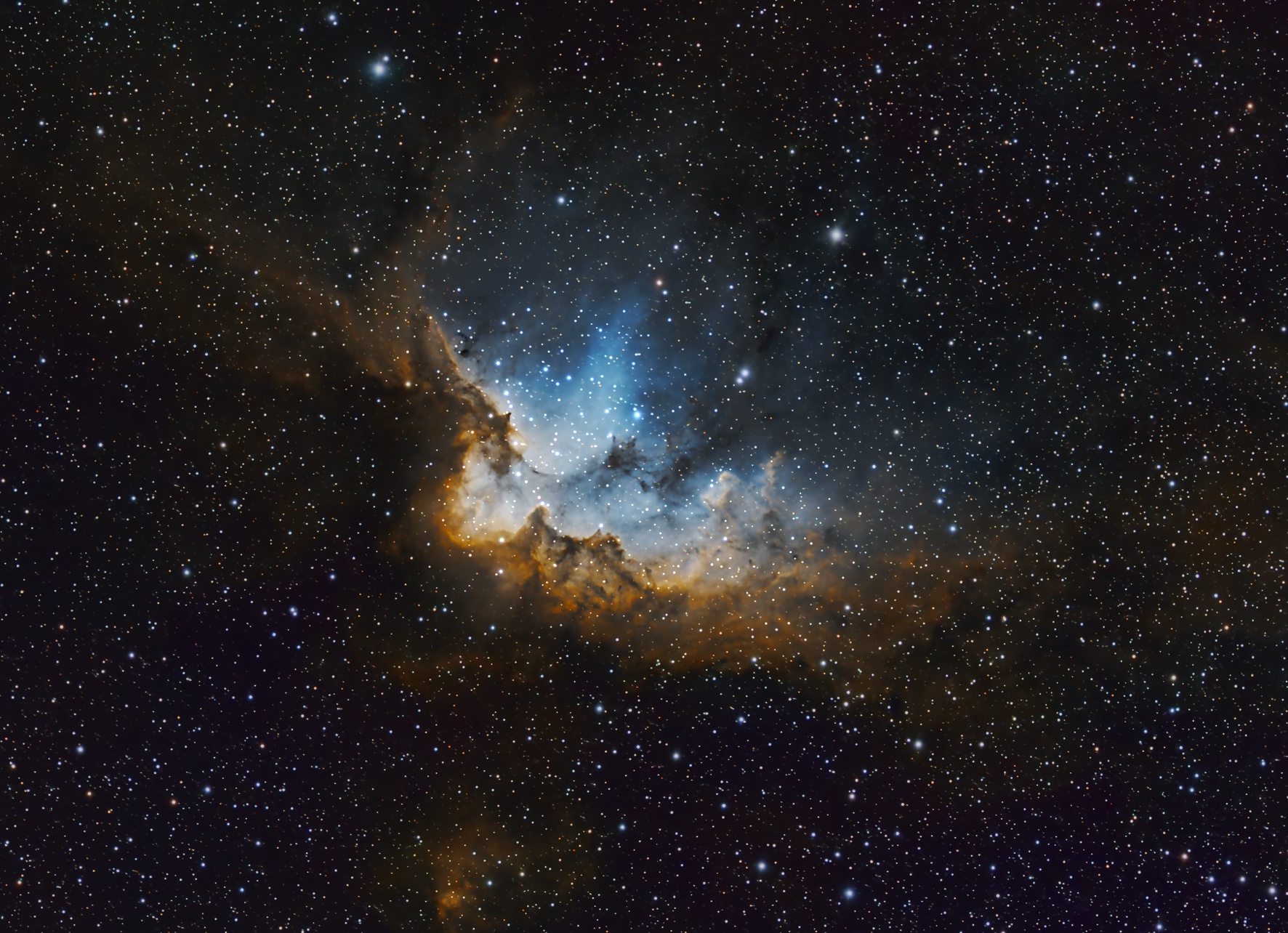
Astronomically speaking, only one thing counts when imaging and that is the quality of viewing conditions (and clear skies), which I can already attest to be excellent here in Somerset.  At my previous location just south of London in Surrey, conditions were poor, with an SQM value of 19.82 that was further complicated by low flying aircraft from three nearby airports.  In comparison, the SQM at Castle Farm Observatory is 21.11, which being a log scale equates to a difference of x3.28 better sky darkness than before and, moreover, overflying aircraft are no longer a problem.  Given this setting, combined with clear skies and a new moon in early September, I had high expectations for my first imaging session since moving to Somerset and was not disappointed by the results obtained of the object chosen for this auspicious occasion, the Wizard Nebula.    
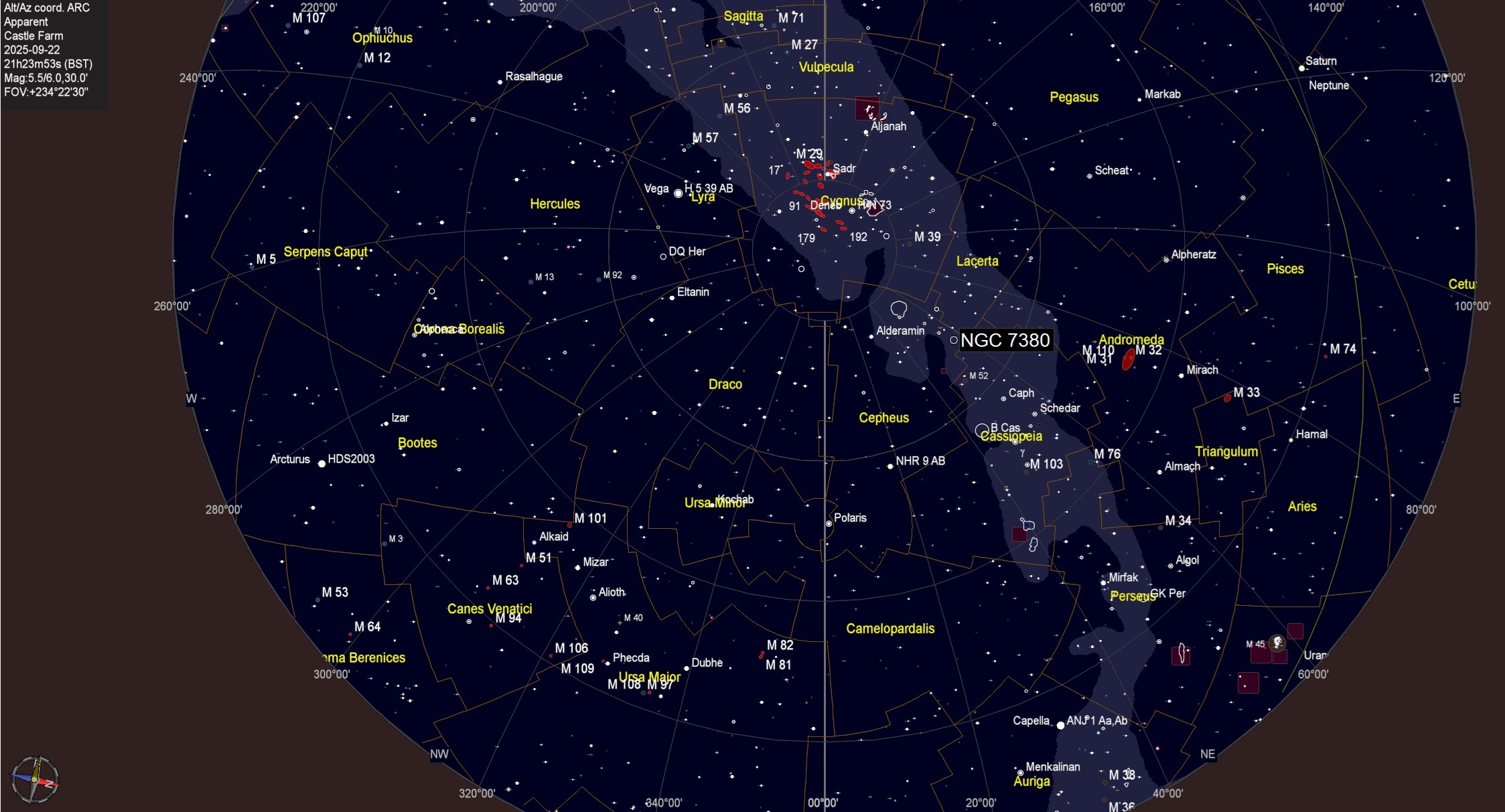
The Wizard Nebula, designated by the central star cluster of NGC 7380, is an emission nebula, in which its gases glow due to intense radiation from hot, massive stars from within the aforesaid embedded cluster.  Interwoven within this glowing gas are dark, dense regions of dust that sculpt the nebula’s dramatic and somewhat mystical appearance, in this case a wizard.   NGC 7380 was only formed a few million years ago and within it, young and massive O- and B-type stars generate strong stellar winds that shape and erode the surrounding material.
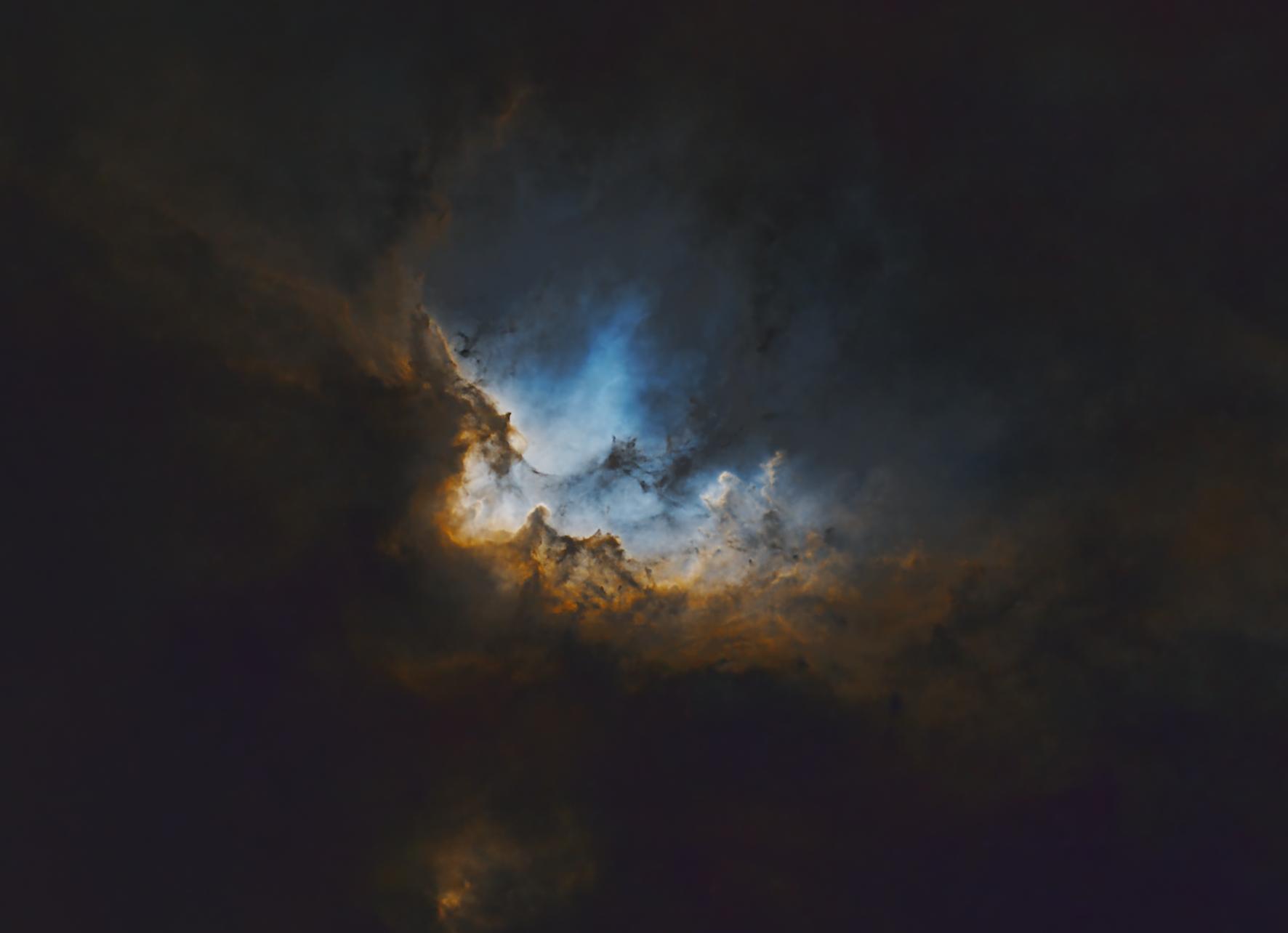
Thus, after an unprecedented break of some 257 days, I’m more than pleased to return to my own backyard astrophotography again, now based in the magic county of Somerset.  The quality of the subs obtained on this first occasion confirmed the outstanding sky conditions, which were literally saturated by stars (see starless image above).  Altogether, it was significantly better than experienced in Surrey and bodes well for what I hope will be an exciting time here at Castle Farm Observatory – Watch This (new) Space! 


Celestial Fleur-De-Lys

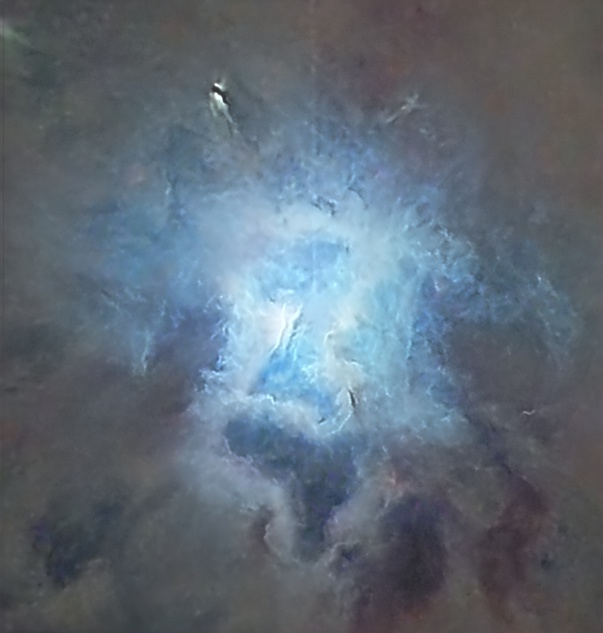
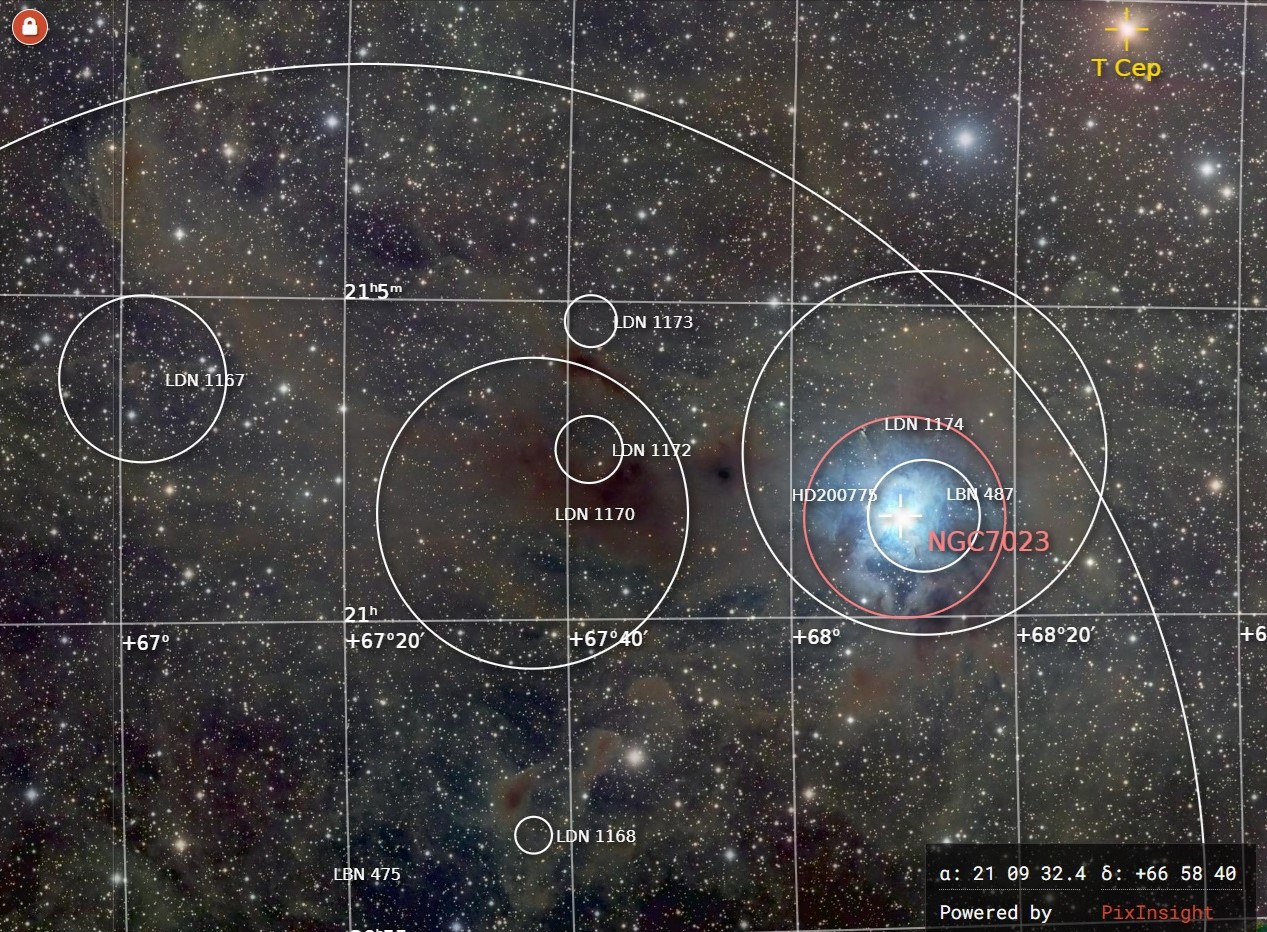
Whilst the highlight is the alluring bright blue reflection nebula NGC 7023 AKA Iris Nebula, careful processing reveals that this celestial flower is enveloped within a vast region of interstellar dust, altogether making for a spectacular image.   Strictly speaking NGC 7023 refers to an open cluster within the reflection nebula, which is itself illuminated by a magnitude +7.4 star designated HD 200775 – the cropped starless image shows the beautiful detail that makes up the Iris ‘flower’. 

Night Safari

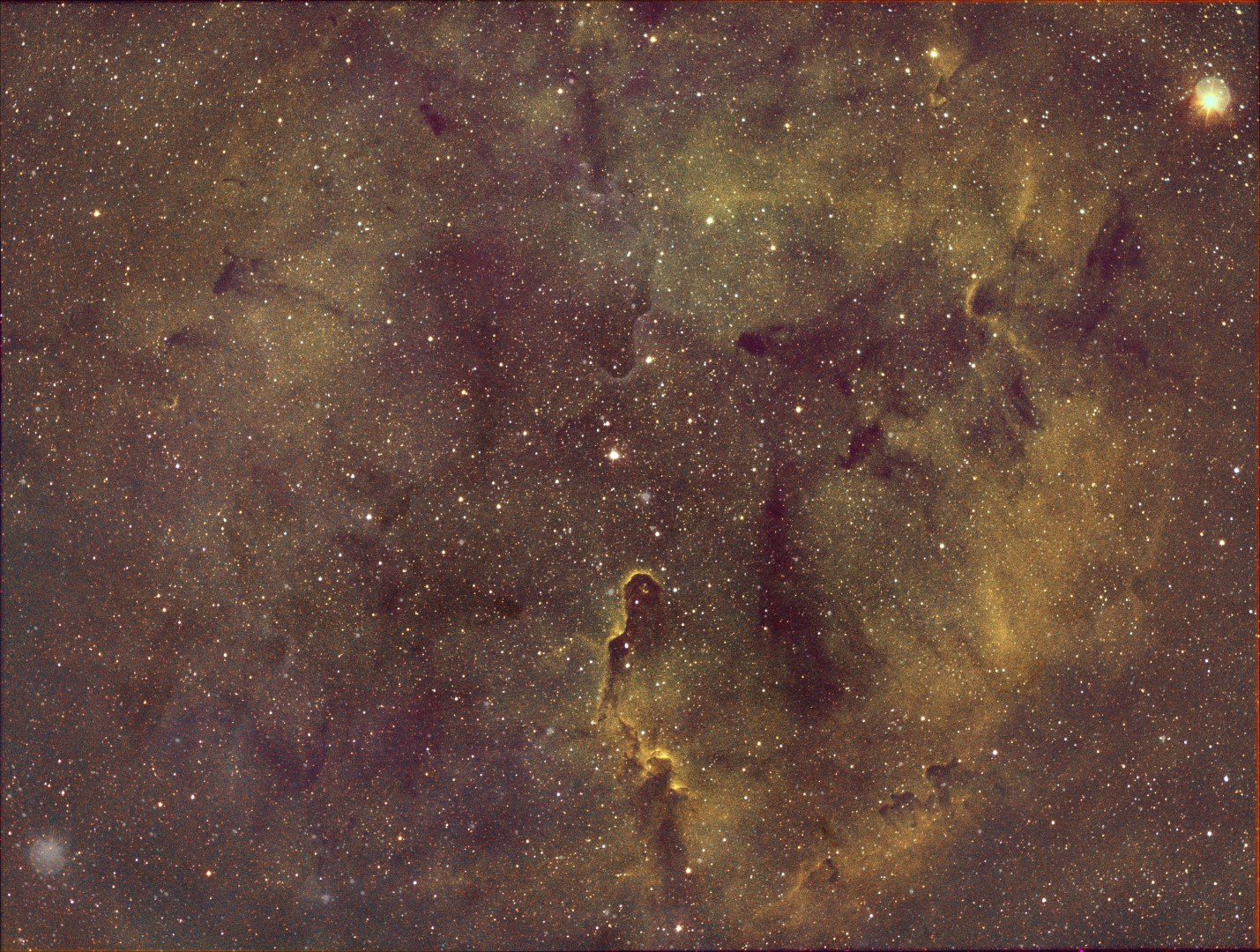
  A very large emission nebula, the so-called Elephant’s Trunk Nebula in the Cepheus constellation is rightly one of astrophotography’s most iconic images.  Unfortunately my house obscures northern views of the sky from the main observatory and I’ve therefore only imaged this once before in 2018 with some success but definite room for improvement.  However, using a Takahashi FSQ 106 located at the DSW observatory in New Mexico, USA during Q3 there were no such constraints, which has resulted in a 29.5 hour data set that forms the foundation of this exciting HaSHO image.  

 SH2-131 consists of glowing gases illuminated by an open star cluster, which is divided by lanes of dark interstellar dust clouds.  The ‘trunk’ itself, designated IC 1396A, dominates the centre of this image and is spectacularly illuminated from behind by a bright star forming region; a longer focal length combined with the QSI camera and 30% crop has produced much  closer view than previoulsy in 2018. Together with the Cave Nebula, Fyling Bat and Giant Squid Nebula, the dark nebula LDN-1250 and now the Elephant Trunk Nebula, Cepheus, has proved a very productive area for me this year.

 IMAGING DETAILS
ObjectElephant’s Trunk Nebula SH2-131 (IC 1396)
ConstellationCepheus
Distance2,400  light-years
Size45’ Trunk only
Apparent Magnitude+3.5 to 5.7
  
Scope Takahashi FSQ 106  FL 530mm f/5 = Moonlight Crawler focuser
MountParamount MyT
GuidingYes
CameraQSI 683-WSGB   KAF-8300  full frame CCD sensor    5.4nm pixels
 FOV  1.94o x 1.46o   Resolution 2.1”/pix  Image array  3326 x 2507 pix     
ProcessingDeep Sky Stacker,  PixInsight 1.8.8-8, Photoshop CS3 Topaz AI Denoise
Image Location            onCentre  RA 21:34:59.08      DEC +57:28:05.86                             
Exposures22 Ha, 18 SII & 15 OIII x 1,800 sec Total Time:  27hr 30 min   
Calibration4 x 1,800 sec  Darks  34 Ha SII OIII Flats  32 Flat Darks
Location & DarknessDeep Sky West – amateur hosting facility near Rowe, New Mexico, USA SQM typically >= 21.7
Date & Time5th August to 27th September 2021   

Galactic Grotto

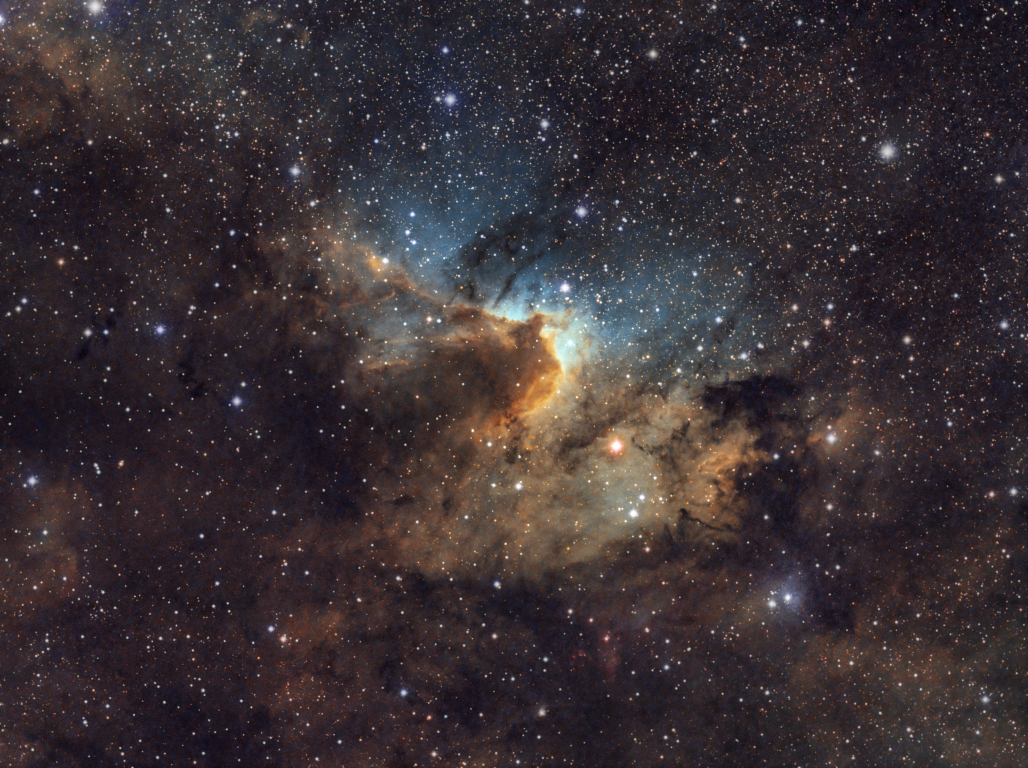
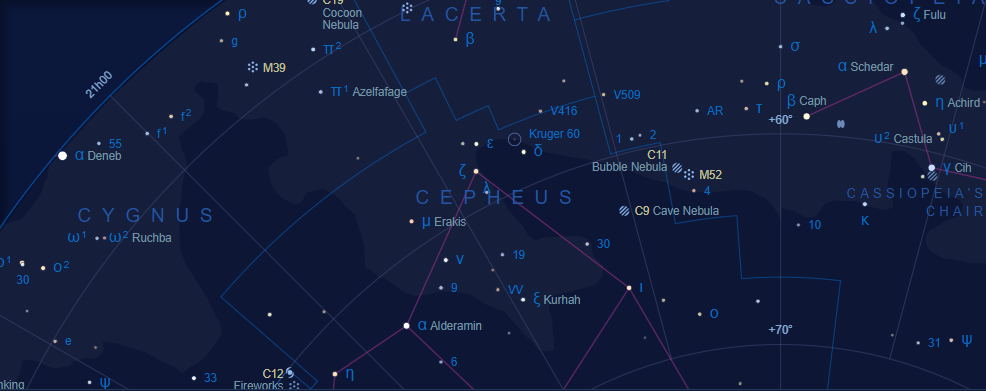
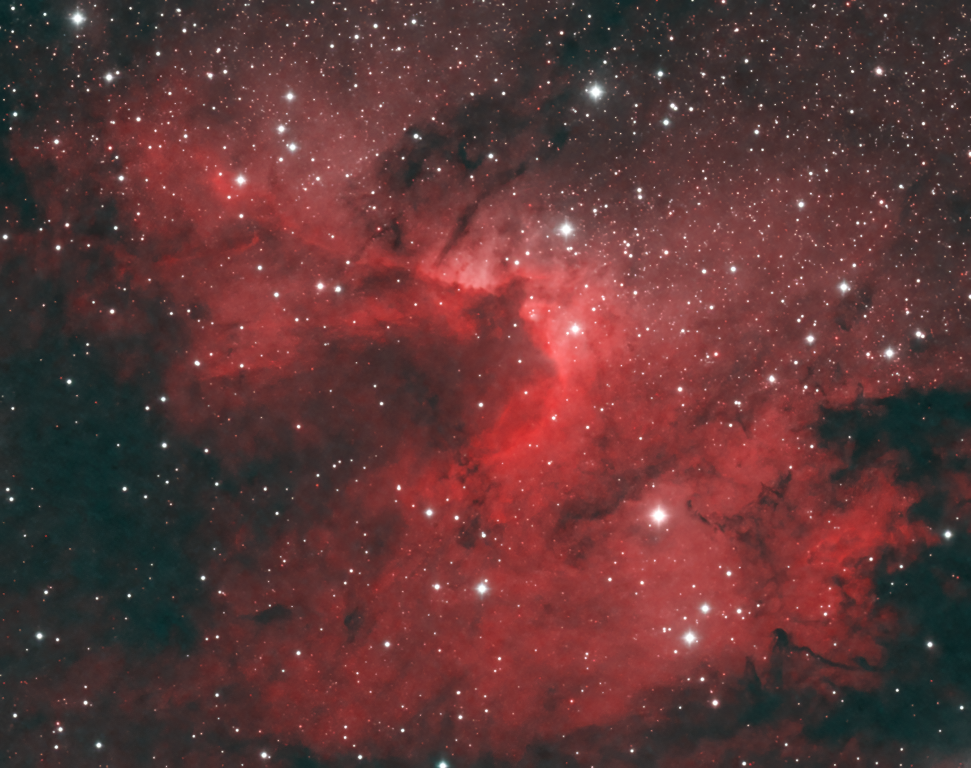
Located along the plane of the Milky Way in the Cepheus constellation is the diffuse emission nebula Sh2-155, commonly referred to as the Cave Nebula.  This widefield view shows the so-called Cave at centre of the image, critically located at the boundary of the massive Cepheus molecular cloud and the hot, young stars of the Cepheus OB-3 association which ionize the surrounding gases to great effect. 

Location of the Cave Nebula

Overall the features are very faint and even with a total integration time of nearly 40-hours for the full data-set the Cave is difficult to capture and process using the Hubble SHO palette but nonetheless has resulted in a striking final image (see top-of-the-page).  An alternative bicolour HOO cropped version (see below) perhaps shows the details of Cave itself better?

 IMAGING DETAILS
ObjectSH2-155 Cave Nebula  AKA Caldwell 9
ConstellationCepheus
Distance2,400  light-years
Size 50 x 30 arc minutes  ~70.0 light-years;  Cave Nebula ~10.0 light- years  
Apparent Magnitude+7.7
  
Scope Takahashi FSQ 106  FL 530mm  f/5  +  Moonlight Nightcrawler focuser  
MountParamount MyT
GuidingYes
CameraQSI 683-WSG8    KAF-8300 full frame CCD sensor   5.4nm pixels  
 FOV 1.94o x 1.46o   Resolution 2.1”/pix.   Image array 3326 x 2,507 pix   
ProcessingDeep Sky Stacker,  PixInsight v1.8.8-7,  Photoshop CS3, Topaz Denoise
Image Location              Centre  –  RA 22:57:37.145      DEC +62:32:54.296                      
Exposures20 Ha  30 OIII  29 SII x 1,800 secs  @ -20C Total Integration Time: 39hr 30min     
Calibration24 x 1,800 secs Darks   x200 Bias  &  x32  Flat Darks  
Location & DarknessDeep Sky West – amateur hosting facility near Rowe, New Mexico  – USA    SQM Typically >= 21.7
Date & TimeQ3  2018    

Dark Art

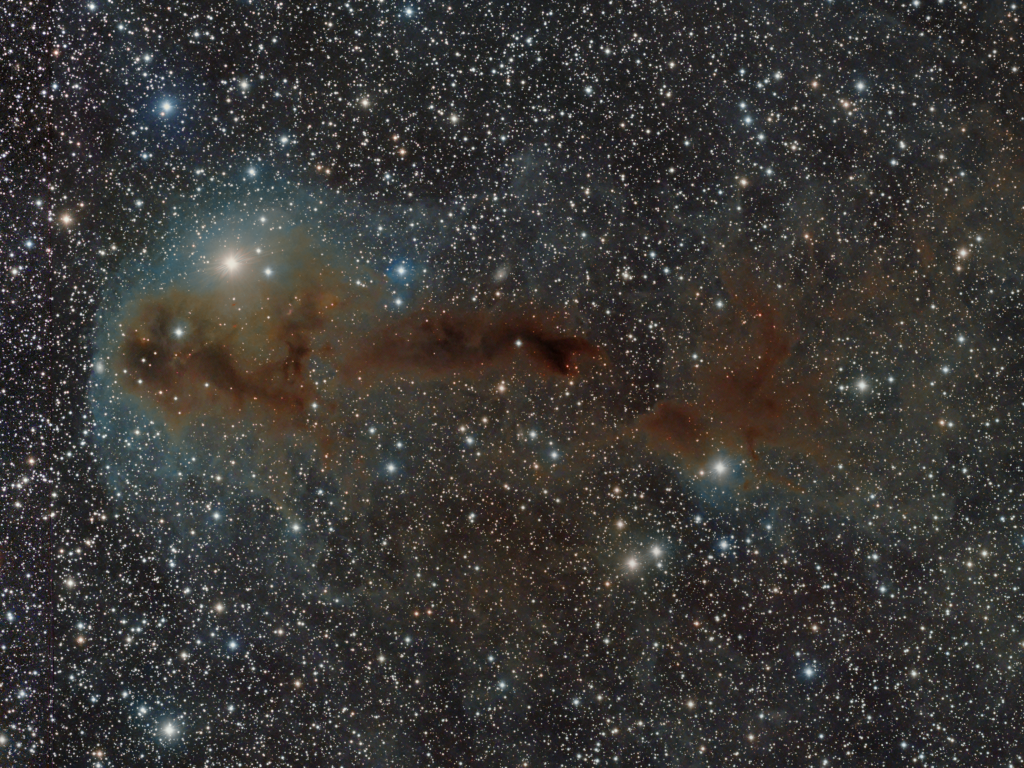
Somewhat tongue-in cheek, astrophotography is often referred to as something of a dark art and to be fair it sometimes seems that way, particularly when it comes to processing.  My main interests in astrophotography are Deep Sky Objects such as emission nebulae, galaxies and planetary nebula but have long aspired to capture a more elusive category that abounds throughout the Universe – dark nebula.

Popular with astrophotographers, emission nebulae consist of vast clouds of ionised gases and regions of interstellar dust which reflect light from the said gases and or from stars and stellar nurseries that lie within – depending on their make-up the results are colourful in both broadband and narrowband wavelengths.  Dark or absorption nebulae are also a type of interstellar cloud but are so dense they completely obscure and / or soak-up visible light emitted from objects behind or within, which as a result contrasts with general light flux of the Universe forming large dark regions.  Because of their darkness they are usually faint, hard to see and moreover, difficult to image, especially from locations with light pollution.

The Horsehead Nebula is a dark nebula that has formed a part of my previous images but I’ve only imaged an isolated dark nebula once before – Barnard 142-3, which for obvious reasons is also known as the E-nebula (see above & here).  Larger more complex dark nebulae require much darker skies to image than prevail at Fairvale Observatory, such as in New Mexico, USA where the Deep Sky West observatory is located and on this occasion has produced my first ‘serious’ image of a stand-alone dark nebula.

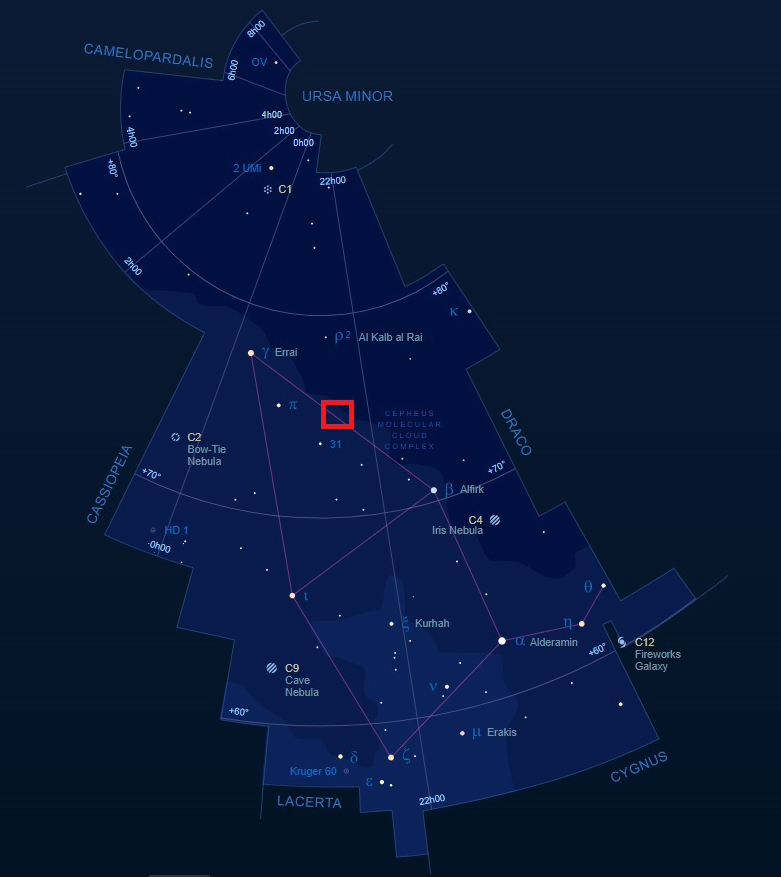
Cepheus & the aproximate location of LDN 1250 image indicated by the red square

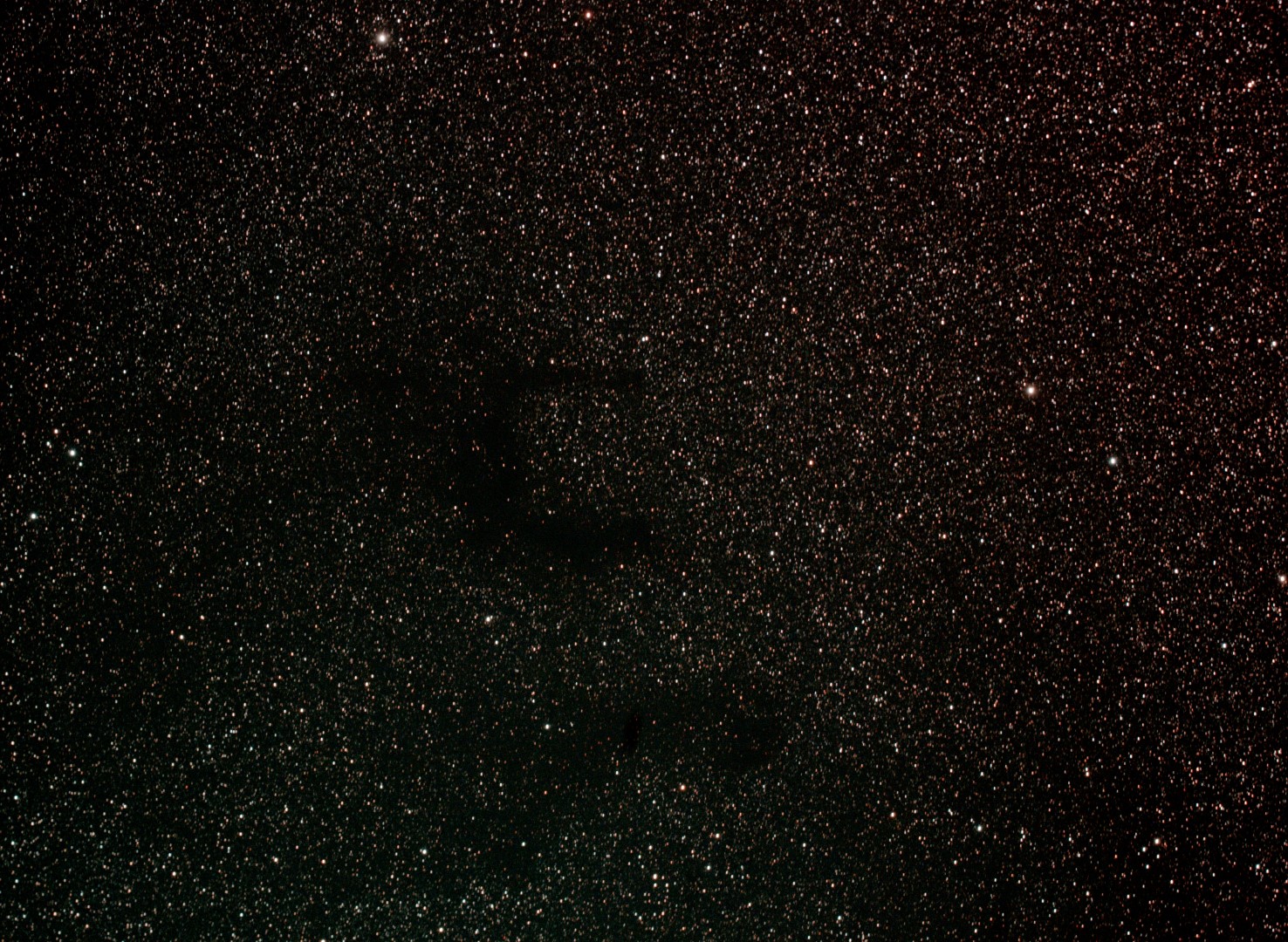
Lynds Dark Nebula (LDN) catalogue of dark nebulae was compiled by the eponymous Beverly T. Lynds in 1962 and is based on the study of red and blue photographic prints from the National Geographic-Palomar Observatory Sky Atlas. Situated in the north close to Polaris, the constellation of Cepheus has a number of dark nebulae, of which LDN 1250 is part of a huge complex of dark nebula surrounded by dust and scattered light from the stars of Cepheus.

LDN 1250 luminance – RGB wavelengths are also strong

Imaged here in LRGB the features come out well in all wavelengths, however, such are the subtleties of the dark nebula components I found processing difficult and required plenty of ‘dark art’ techniques.  The final image at the top of the page shows to good effect the main dark nebula, togeher with widespread but less opaque nebulosity and star colours, as well as some distant galaxies lurking in the background that together has produced a satisfying and very interesting outcome.

 IMAGING DETAILS
ObjectLDN 1250 & 1251
ConstellationCepheus
Distance1,000 light years
SizeMain nebula approximately 1o  ~ 17 light-years
Apparent Magnitude–  
  
Scope Takahashi FSQ 106  FL 530mm  f/5  +  Moonlight Nightcrawler focuser  
MountParamount MyT
GuidingYes
CameraQSI 683-WSG8    KAF-8300 full frame CCD sensor   5.4nm pixels  
 FOV 1.94o x 1.46o   Resolution 2.1”/pix.   Image array 3326 x 2,507 pix   
ProcessingDeep Sky Stacker,  PixInsight v1.8.8-7,  Photoshop CS3, Topaz Denoise
Image Location &             OrientationCentre  –  RA 22:28:54.702      DEC +75:09:45.158                    
North = Up
 
Exposures23L  + 18R +  16G + 17B x 900 secs  @ -15C
Total Integration Time: 18hr 30min     
Calibration41 x 900 secs Darks   x 50 Bias  &  x16 LRGB Flats   
Location & DarknessDeep Sky West – amateur hosting facility near Rowe, New Mexico  – USA    SQM Typically >= 21.7
Date & TimeQ4  2020    


The Bat & Squid

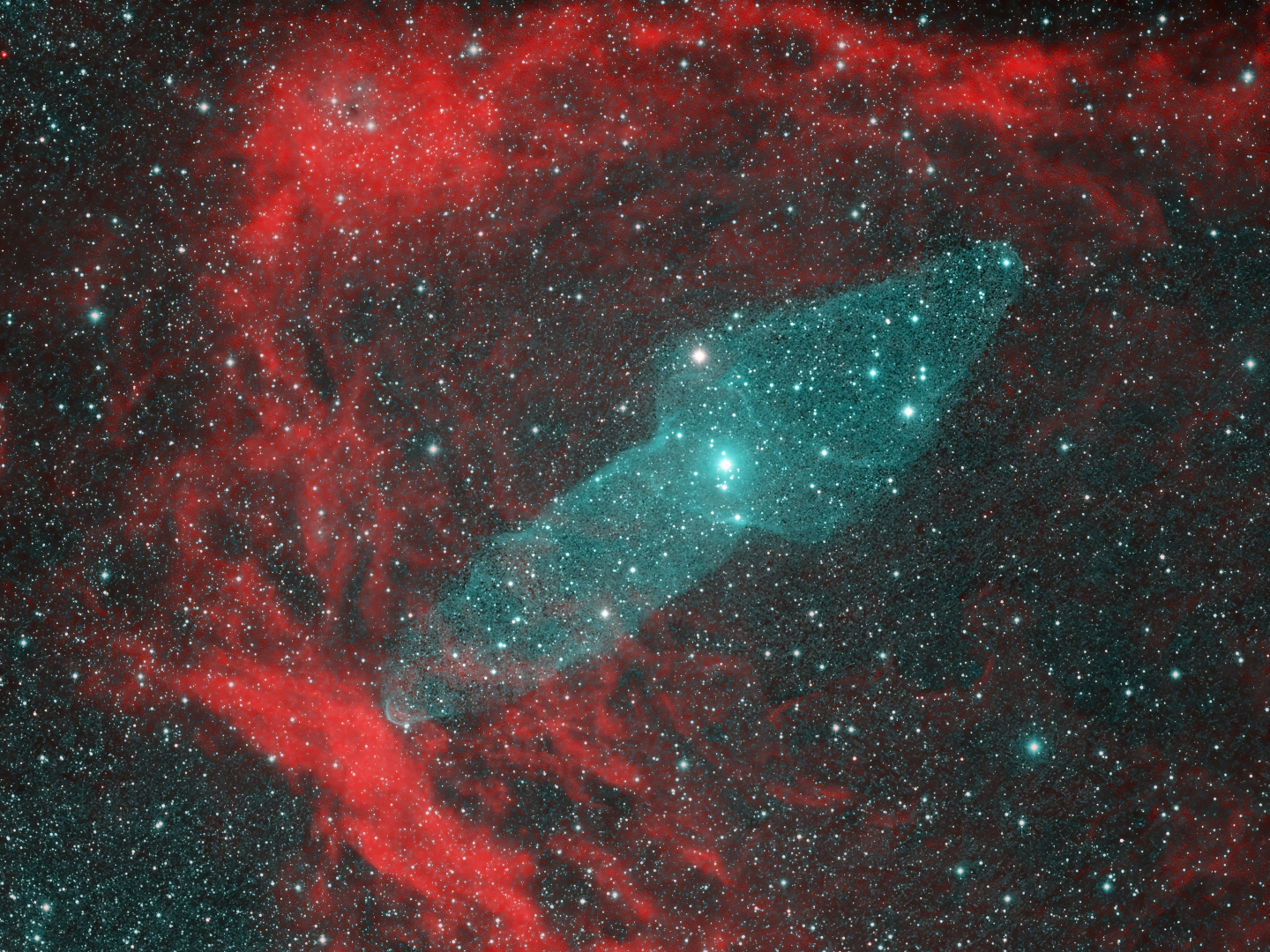
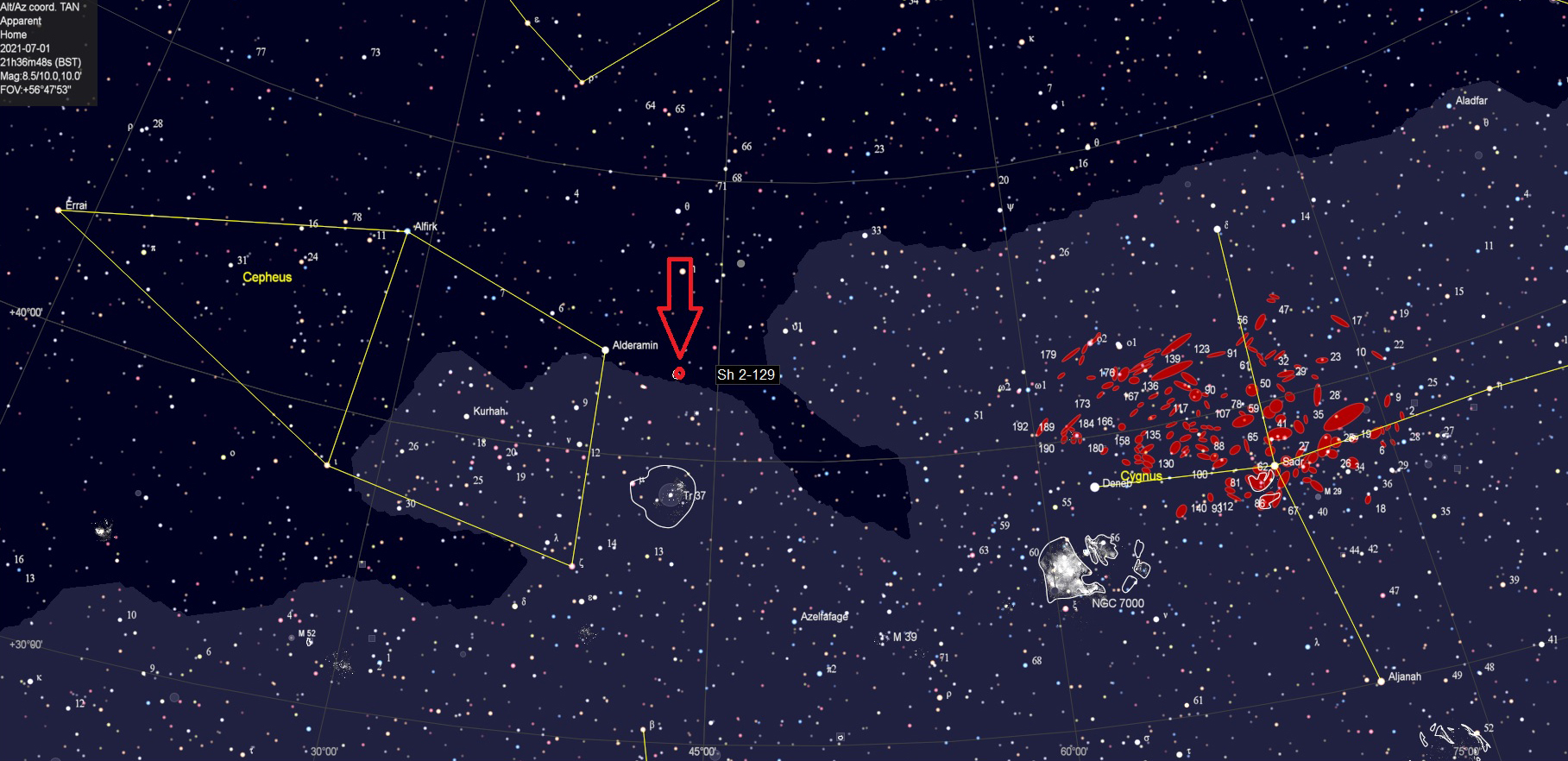
Discovered as recently as 2011 by French astronomer Nicolas Outters, is the very faint OIII emission nebula Ou4.  Located in the constellation of Cepheus , this somewhat elusive object requires very long exposures and integration time to successfully image.  For obvious reasons Ou4 has become known more commonly as the Giant Squid Nebula and belongs to the difficult but must-do objects list of astrophotographers.  Moreover, the Squid lies within the much larger SH2-129 HII emission region or the Flying Bat Nebula, only part of which is shown here.  In this case some 40-hours of exposure, of which the Squid is 15-hours, combined with careful processing has produced a wonderful image of both these exciting objects.

Initially considered to be a Planetary Nebula, Ou4 is now thought to be a bipolar outflow that was discharged 90,000 years ago from the hot massive triple star system HR 8119 situated within the Sh 2-129 HII-region, which is also responsible for ionizing the red emission nebula itself.  The Squid consists of two collimated lobes with arc-shaped tips of enhanced OIII emission that resemble bow-shocks seen in stellar outflows and a few bubbles and filamentary arcs. The bipolar Ou4 lobes measure some 50×8 light-years, which though faint forms one of astrophotography’s great spectacles.

 IMAGING DETAILS
ObjectSH2-129  Flying Bat & Giant Squid Nebula
ConstellationCepheus
Distance2,300  light-years
Size Approx. 100.0 arc minutes
Apparent Magnitude–  
  
Scope Takahashi FSQ 106  FL 530mm  f/5  +  Moonlight Nightcrawler focuser  
MountParamount MyT
GuidingYes
CameraQSI 683-WSG8    KAF-8300 full frame CCD sensor   5.4nm pixels  
 FOV 1.94o x 1.46o   Resolution 2.1”/pix.   Image array 3326 x 2,507 pix   
ProcessingDeep Sky Stacker,  PixInsight v1.8.8-7,  Photoshop CS3, Topaz Denoise
Image Location               Centre  –  RA 21:12:37.077      DEC +59:53:50.801                       
Exposuresx51 Ha  & x30 OIII x 1,800 secs  @ -20C Total Integration Time: 40hr 30min     
Calibration24 x 1,800 secs Darks   x70 Bias  &  70 Ha & Flats   
Location & DarknessDeep Sky West – amateur hosting facility near Rowe, New Mexico  – USA    SQM Typically >= 21.7
Date & TimeQ3  2018    

New Northern Horizons

SHO2int3 (Large)

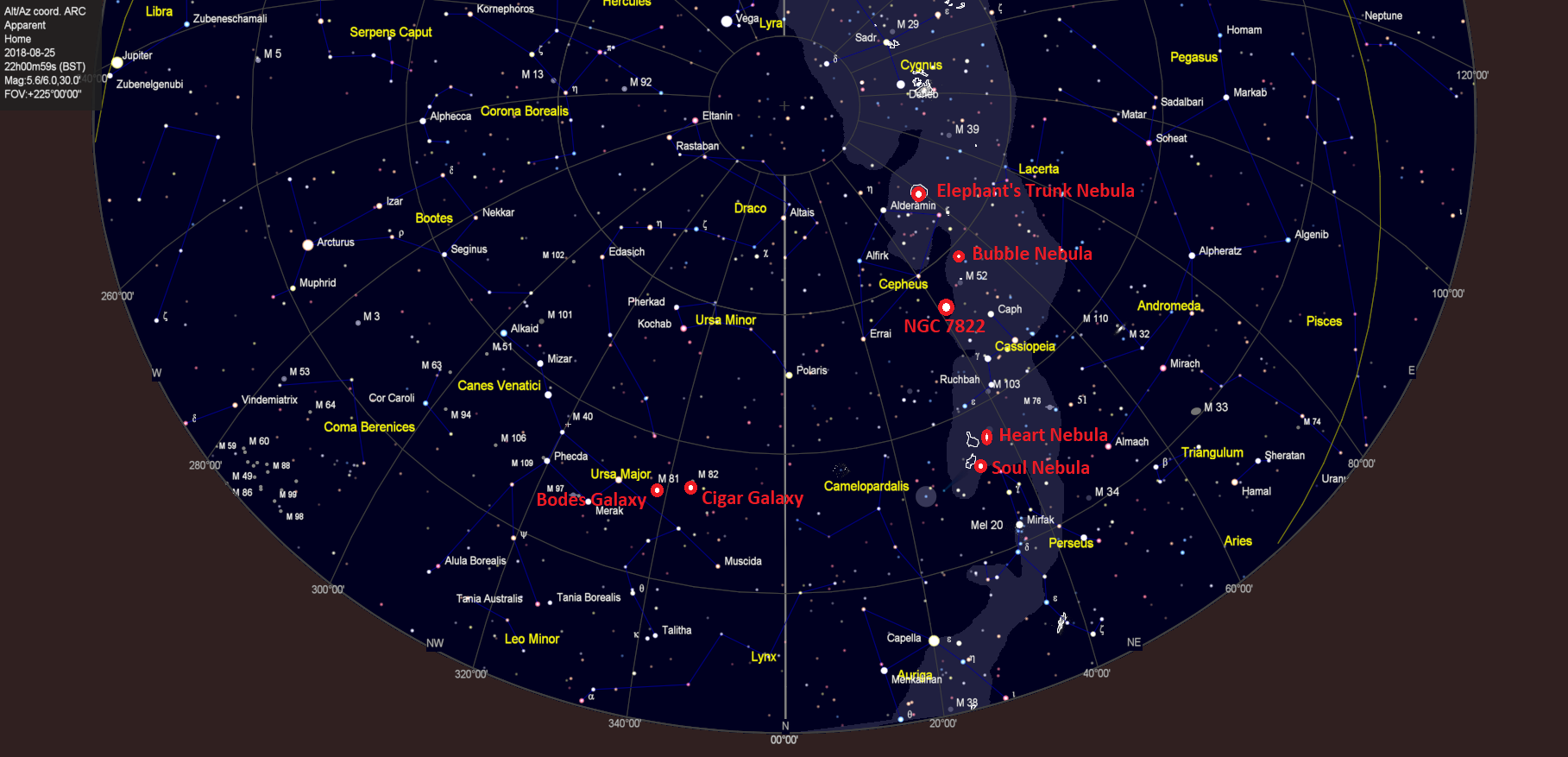
Having past the Autumn Equinox I’ve moved the observatory back to its main location on the patio looking south for the winter but not before a final look at the northern sky from the newly established Shed Observatory situated at the end of the garden.  After setting up The Shed in mid-May I have had a productive and very enjoyable time imaging and looking at the northern night sky properly for the first time.  My objective has been to learn more about this part of the sky and bag as many northern DSO classics as possible during the limited darkness available at this time of the year.  Furthermore, I set out to determine optimum imaging parameters for these objects in preparation for more extensive sessions at the same time next year.

Altogether I managed six targets with some good results, three of which have already been posted here: M81 Bodes & M82 Cigar galaxies, IC 1396 Elephant’s Trunk Nebula and IC 1805 the Heart Nebula. Whilst the new Shed Observatory provided a good view of much of the north sky, I did cut corners with the set-up and as a result guiding was not always at its best, sometimes with an impact on quality.  This has been a period of experimentation but now I know this location works, next time I’ll pay more attention to these matters.  In addition to the aforementioned objects I was also able to image three others, with mixed results.

I came across NGC 7822 soon after moving to the new Shed Observatory site whilst investigating the imaging possibilities from this location.  This complex emission nebula appears to be overlooked by many astrophotographers, though judging from the images that are available it can be quite a spectacular target, providing great promise in narrowband wavelengths when using the right equipment.  Whilst the main Ha image looked promising (below), sadly on this occasion the SHO & HOO images lack detail and colour; on reflection the focus looks a bit suspect too!

IMAGING DETAILS
Object NGC 7822
Constellation Cepheus
Distance 2,900 light-years
Size 100’   
Apparent Magnitude +18.3
 
Scope  William Optics GT81 + Focal Reducer FL 382mm  f4.72
Mount SW AZ-EQ6 GT + EQASCOM computer control
Guiding William Optics 50mm guide scope
  + Starlight Xpress Lodestar X2 guide camera & PHD2 control
Camera ZWO1600MM-Cool (mono)   CMOS sensor
  FOV 2.65o x 2.0o Resolution 2.05”/pix  Max. size 4,656 x 3,520 pix   
EFW ZWOx8 + ZWO LRGB & Ha OIII SII 7nm filters 
Capture & Processing Astro Photography Tool + PS2,  Deep Sky Stacker & Photoshop CS2, HLVG
Image Location              & Orientation Centre  RA 00:02:35     DEC 67:13:55                     

North Sky: Top Left = North  Top Right = East  

Exposures 20 x 180 sec Ha + 10×180 sec OIII & SII  (Total time: 120 minutes)   
  @ 300 Gain   50 Offset @ -20oC    
Calibration 5 x 300 sec Darks  20 x 1/4000 sec Bias  10 x Flats Ha-OIII-SII  @ ADU 25,000  
Location & Darkness Fairvale Observatory  South – Redhill – Surrey – UK        Typically Bortle 5
Date & Time 20th May 2018 @ +00.00h  
Weather Approx. <12oC   RH 70%

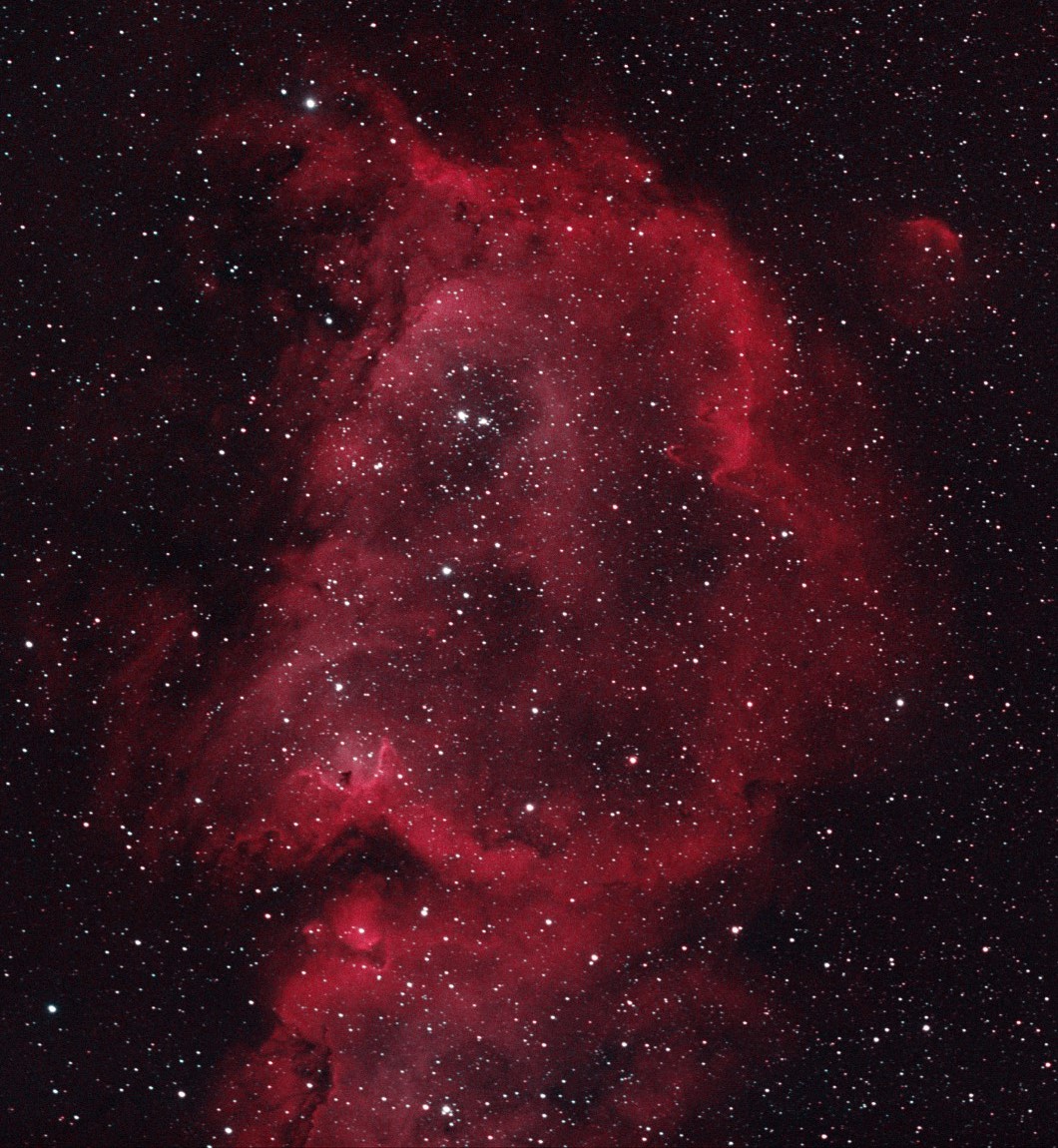
Once astronomical darkness was re-established in late July I soon returned to the northern sky thereafter.  After a gap of more than 2-months since my previous session in May, the north sky now provided other new opportunities, principal of which were the Heart Nebula and Soul Nebula.  Given their size and my field-of-view these objects need to be imaged separately and after a good result with the Heart Nebula, I was soon also able to tackle the nearby Soul Nebula.  However, this time the guiding was at first very poor and I decided to use the PHD2 Guiding Assistant to help correct the problem.  The new settings recommended by the Assistant made a big difference to the guiding but unfortunately I then overlooked that the consequence of running the process had changed the previous image framing of the object.  As a result of this the lower section of the nebula was no longer within the field-of-view and subsequently lost in the final image – oh well lesson learned for another day.

HaHOO crop (Large)

IMAGING DETAILS – Soul Nebula HaHOO (above) 
Object Soul Nebula IC 1848   (Westerhout-5)
Constellation Cassiopeia
Distance 6,500 light-years
Size 150’ x 75’  or 100 light-years
Apparent Magnitude +18.3
 
Scope  William Optics GT81 + Focal Reducer FL 382mm  f4.72
Mount SW AZ-EQ6 GT + EQASCOM computer control
Guiding William Optics 50mm guide scope
  + Starlight Xpress Lodestar X2 guide camera & PHD2 control
Camera ZWO1600MM-Cool (mono)   CMOS sensor
  FOV 2.65o x 2.0o Resolution 2.05”/pix  Max. size 4,656 x 3,520 pix   
EFW ZWOx8 + ZWO LRGB & Ha OIII SII 7nm filters 
Capture & Processing Astro Photography Tool + PS2,  Deep Sky Stacker & Photoshop CS2, HLVG
Image Location              & Orientation Centre  RA 02:52:25    DEC 60:01:35                     

Top  Left North  Top Right = East   Bottom Right = South   Bottom Left = West      

Exposures 20 x 300 sec Ha + 10×300 sec OIII  (Total time: 150 minutes)   
  @ 139 Gain   21  Offset @ -20oC    
Calibration 5 x 300 sec Darks  20 x 1/4000 sec Bias  10 x Flats Ha-OIII-SII  @ ADU 25,000  
Location & Darkness Fairvale Observatory – Redhill – Surrey – UK        Typically Bortle 5
Date & Time 2nd September 2018 @ +00.20h  
Weather Approx. 12oC   RH <=95%

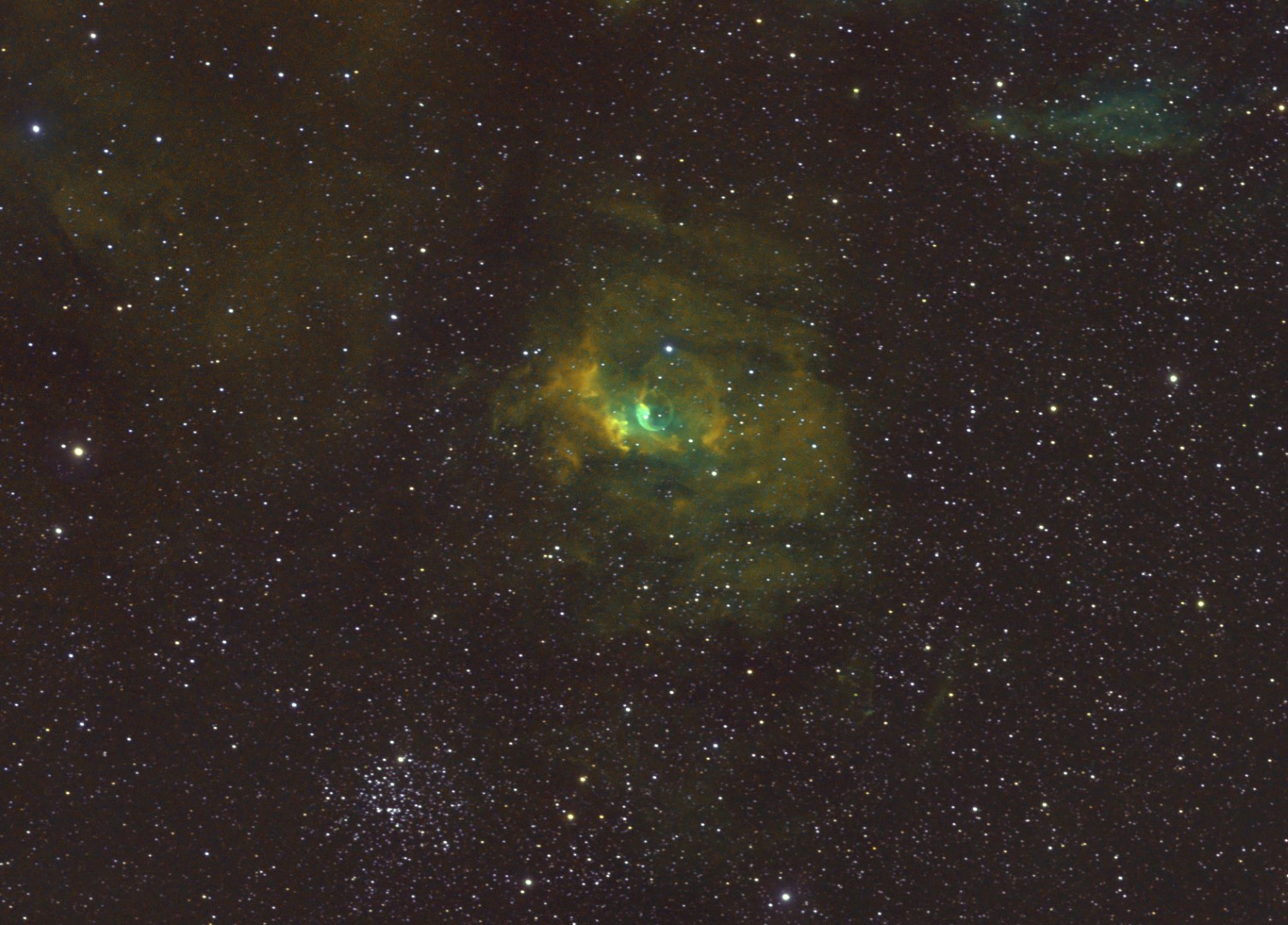
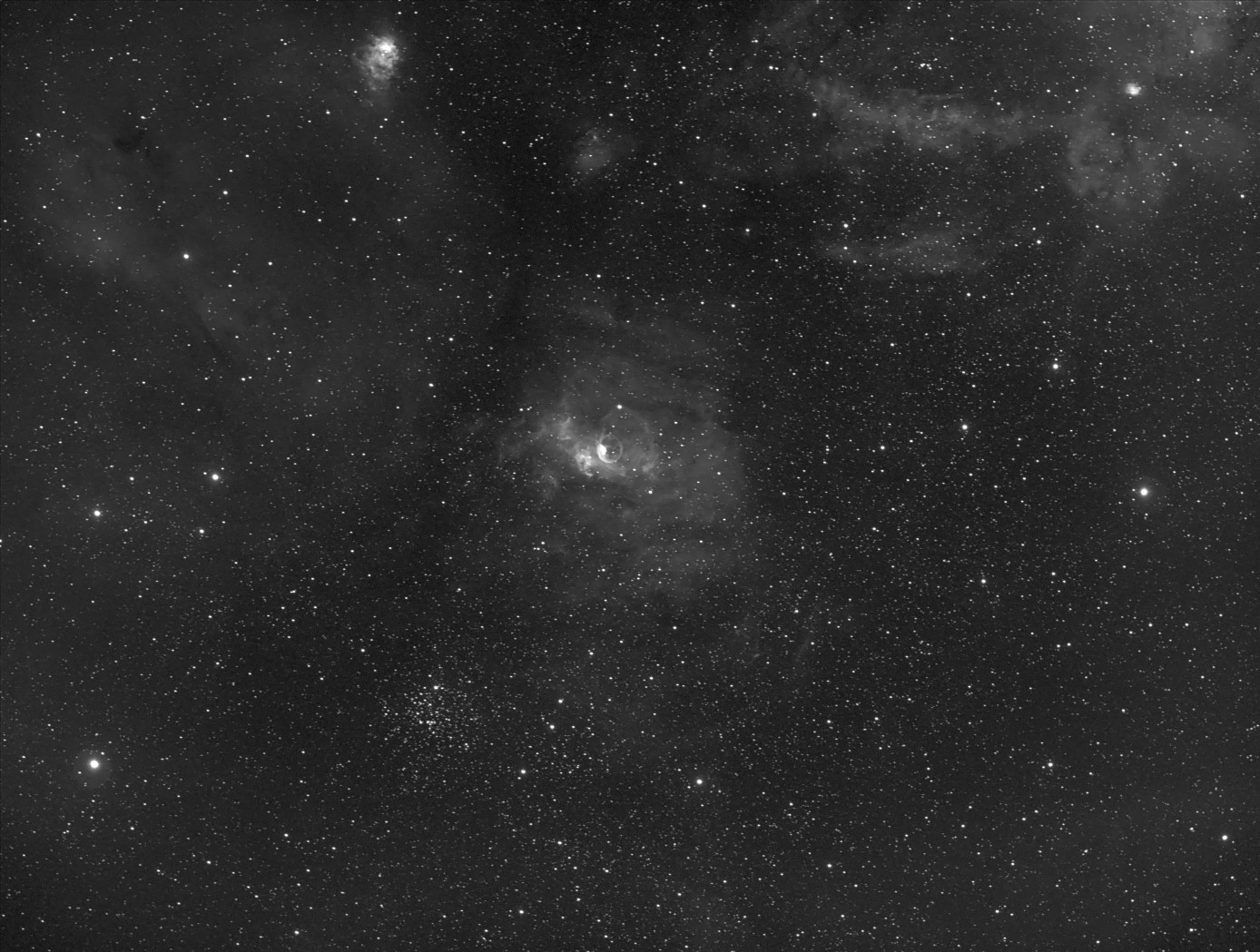
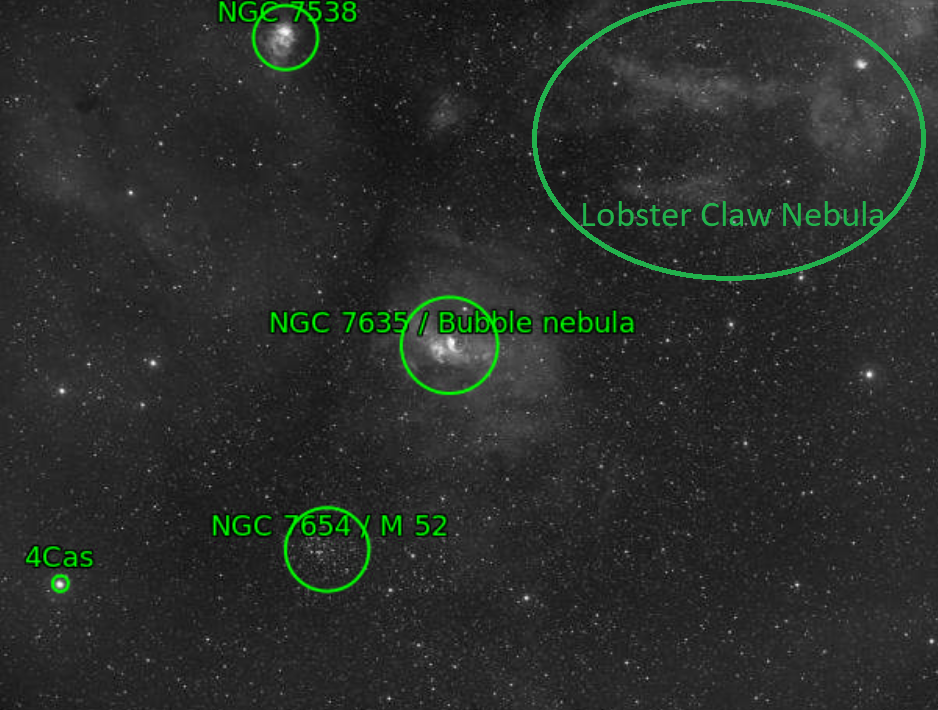
Finally I was surprised and pleased to discover that with the early evening darkness now available in September, I might be able to image the strange but beautiful Bubble Nebula NGC 7635.  Being very high in the sky at this time, the challenge was to track the object for as long as possible before at about 1.00 a.m. it disappears overhead behind the high garden hedge located immediately adjacent to the telescope location.  I managed, just about, and was very happy to see the ‘bubble’ in the middle of the resulting image. The enigmatic bubble is created by a stellar wind from a massive, hot central star (SAO 20575) which excites the nebula and causes it to glow.  Whilst the central Bubble Nebula is undoubtedly the star of the show, this region of the sky and resulting picture holds great promise to image other objects on another occasion, notably the open cluster M51 just below and to the left of the Bubble and the Lobster Claw Nebula SH2-157 in the top-right corner.

Ha2A (Large)


Claw2

IMAGING DETAILS: Bubble Nebula – Ha above, SHO top of page 
Object Bubble Nebula NGC 7635
Constellation Cassiopeia
Distance 7,100 light-years
Size 15’ x 8’  (Bubble 7 light-years)
Apparent Magnitude +10.0
 
Scope  William Optics GT81 + Focal Reducer FL 382mm  f4.72
Mount SW AZ-EQ6 GT + EQASCOM computer control
Guiding William Optics 50mm guide scope
  + Starlight Xpress Lodestar X2 guide camera & PHD2 control
Camera ZWO1600MM-Cool (mono)   CMOS sensor
  FOV 2.65o x 2.0o Resolution 2.05”/pix Max. size 4,656 x 3,520 pix   
EFW ZWOx8 + ZWO LRGB & Ha OIII SII 7nm filters 
Capture & Processing Astro Photography Tool + PS2,  Deep Sky Stacker & Photoshop CS2, HLVG
Image Location              & Orientation Centre  RA 23:21:27    DEC 61:06:52                     

Top = north  Right = East   Bottom = South  Left = West 

Exposures 15 x 300 sec Ha + 10×300 sec OIII & SII  (Total time: 175 minutes)   
  @ 139 Gain   21  Offset @ -20oC    
Calibration 5 x 300 sec Darks  20 x 1/4000 sec Bias  10 x Flats Ha-OIII-SII  @ ADU 25,000  
Location & Darkness Fairvale Observatory – Redhill – Surrey – UK        Typically Bortle 5
Date & Time 3rd September 2018 @ +21.45h  
Weather Approx. 15oC   RH >=70%

My time at the end of the garden this summer at the Shed Observatory has been a great success, made all the better by a prolonged period of warm weather.  I am confident that with more attention to the set-up, better guiding and longer integration times, next year will be even better and I’m already looking forwards to revisiting this year’s new horizons in the north sky in 2019.

North Sky summer Objects

North Sky Imaged Objects May to September 2018

Jumbo Joy

Picture saved with settings embedded.

After recently establishing Fairvale Observatory South AKA “The Shed” and dealt with some expected and unexpected problems, I was able to turn my attention to the object of my desire in this hitherto inaccessible part of the northern night sky.  With the summer solstice approaching I had originally planned on imaging this astrophotographers’ favourite later in the year but I couldn’t resist an early look.  A few nights after finishing Bodes galaxy from my new, northward looking location, I therefore swung the scope across the Meridian to the north east in order to obtain a few subs of this object just to see: (a) what it might look like with my equipment (b) bearing in mind the previous objective, to assess the best framing and (c) just for the fun of it, and was not disappointed!

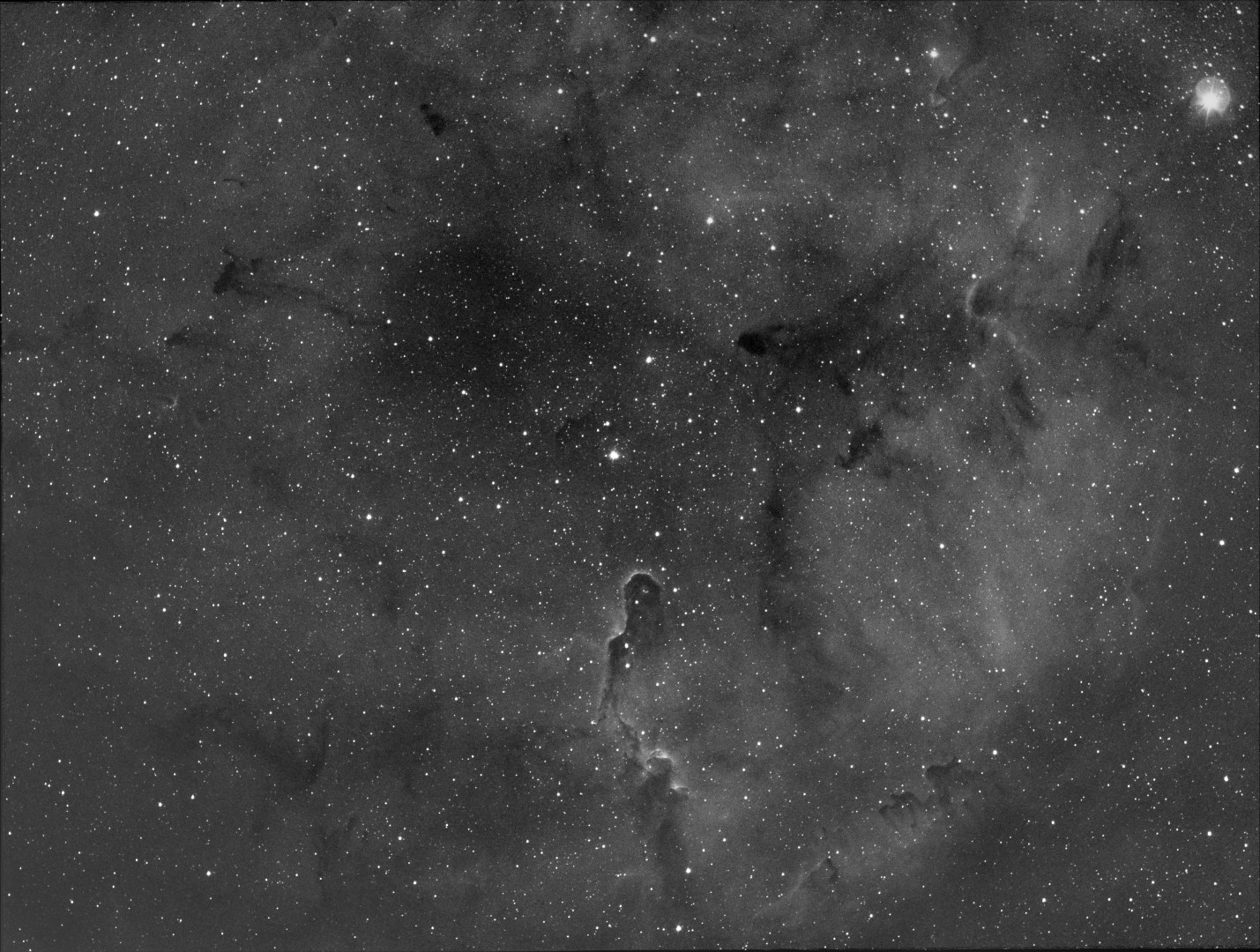
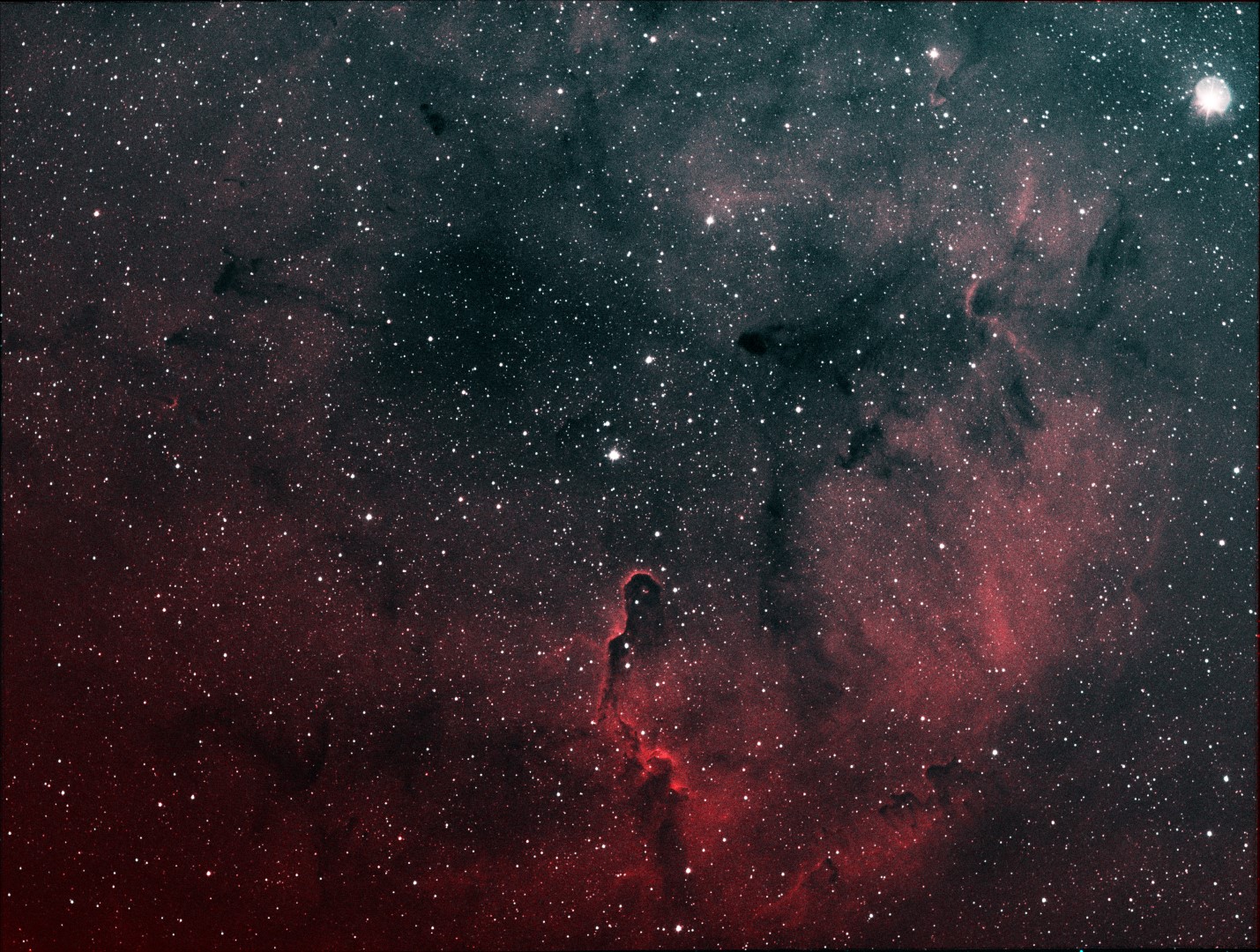
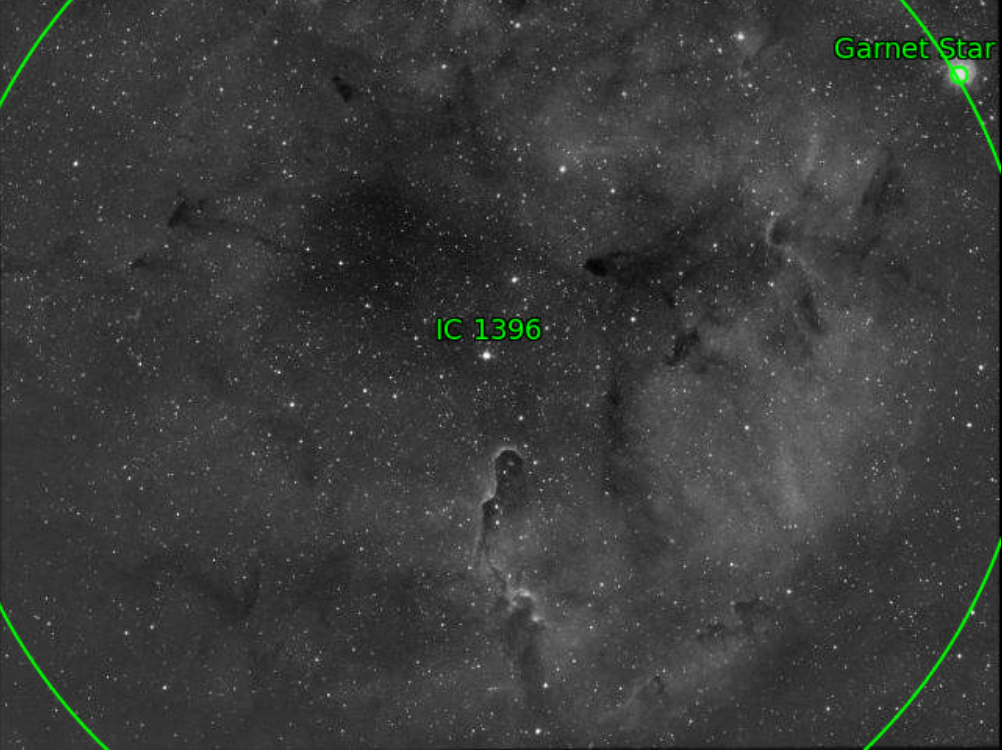
RGB XXX Final (Large)The aforesaid object of interest was the Elephant’s Trunk Nebula or IC 1396, a very large emission nebula, which in narrowband shows wonderful colour and detail (HaSHO above).  IC 1396 consists of glowing gas illuminated by an open star cluster, broken up by intervening lanes of dark interstellar dust clouds.  The ‘trunk’ itself, designated IC 1396A, is the long dark area protruding from the lower edge of the image, spectacularly illuminated from behind by a bright star forming region; the image has been rotated 180o from its natural position.  Top right on the edge is the red supergiant Mu Cephei or Herschel’s Garnet Star, one of the largest and brightest known stars in the Milky Way, which in the position of the Sun would extend out to Saturn’s orbit!
HHOO (Large)

The large IC 1396 nebula will not fit my field-of-view but with some judicious framing, using the Garnet Star as a marker and helped by a few previously taken test subs, I achieved a pleasing composition with the aforesaid trunk and nearby billowing dark clouds well placed (HaOIIIOIII bicolour image above).  Whilst I am pleased with my first attempt at the Elephant’s Trunk, the colour could be better and is too noisy – a consequence of too little integration time and high gain setting.  Having had success before using similar settings for Ha-type features like the Rosette Nebula, I was a little surprised by this outcome but it just goes to show that each object is different.  Notwithstanding, the Ha version is – I think – very promising (top of the page) but obviously there is too little OIII and SII in the composite wavelength images.

RGB XXX Final Crop (Medium)

I used to live and have worked all over Africa but this is a very different type of elephant to what I have met before (the “trunk” HaSHO above).  It forms an exciting imaging subject at this time of the year, made all the more rewarding being one of my first serious attempts to image the north sky.  I hope to return to this object in a couple of months when astronomical darkness has resumed but in the meantime the Jumbo of the night sky has been a real joy on my first encounter.

Elephant Location Crop

IMAGING DETAILS
Object Elephant’s Trunk Nebula   IC 1396   
Constellation Cepheus
Distance 2,400 light-years
Size 5o or “Trunk” only approx.. 45’   
Apparent Magnitude +3.5 to +5.7
 
Scope  William Optics GT81 + Focal Reducer FL 382mm  f4.72
Mount SW AZ-EQ6 GT + EQASCOM computer control
Guiding William Optics 50mm guide scope
  + Starlight Xpress Lodestar X2 guide camera & PHD2 control
Camera ZWO1600MM-Cool (mono)   CMOS sensor
  FOV 2.65o x 2.0o Resolution 2.05”/pix  Max. image size 4,656 x 3,520 pix   
EFW ZWOx8 + ZWO LRGB & Ha OIII SII 7nm filters 
Capture & Processing Astro Photography Tool + PS2,  Deep Sky Stacker & Photoshop CS2
Image Location Centre  RA 21:38:37    DEC 57:30:16  
Exposures 12 x 300 sec Ha + 6 x300 sec OIII & SII  (Total time: 120 minutes)   
  @ 300 Gain   50 Offset @ -20oC    
Calibration 5 x 300sec Darks  20 x 1/4000 sec Bias  10 x  Ha + OIII + SII  Flats @ ADU 25,000  
Location & Darkness Fairvale Observatory – Redhill – Surrey – UK        Typically Bortle 5
Date & Time 22nd May 2018  @ midnight