
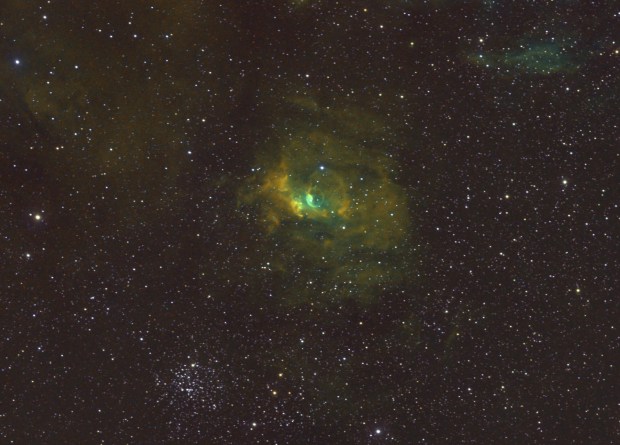
Having past the Autumn Equinox I’ve moved the observatory back to its main location on the patio looking south for the winter but not before a final look at the northern sky from the newly established Shed Observatory situated at the end of the garden. After setting up The Shed in mid-May I have had a productive and very enjoyable time imaging and looking at the northern night sky properly for the first time. My objective has been to learn more about this part of the sky and bag as many northern DSO classics as possible during the limited darkness available at this time of the year. Furthermore, I set out to determine optimum imaging parameters for these objects in preparation for more extensive sessions at the same time next year.
Altogether I managed six targets with some good results, three of which have already been posted here: M81 Bodes & M82 Cigar galaxies, IC 1396 Elephant’s Trunk Nebula and IC 1805 the Heart Nebula. Whilst the new Shed Observatory provided a good view of much of the north sky, I did cut corners with the set-up and as a result guiding was not always at its best, sometimes with an impact on quality. This has been a period of experimentation but now I know this location works, next time I’ll pay more attention to these matters. In addition to the aforementioned objects I was also able to image three others, with mixed results.
I came across NGC 7822 soon after moving to the new Shed Observatory site whilst investigating the imaging possibilities from this location. This complex emission nebula appears to be overlooked by many astrophotographers, though judging from the images that are available it can be quite a spectacular target, providing great promise in narrowband wavelengths when using the right equipment. Whilst the main Ha image looked promising (below), sadly on this occasion the SHO & HOO images lack detail and colour; on reflection the focus looks a bit suspect too!


| IMAGING DETAILS | |
| Object | NGC 7822 |
| Constellation | Cepheus |
| Distance | 2,900 light-years |
| Size | 100’ |
| Apparent Magnitude | +18.3 |
| Scope | William Optics GT81 + Focal Reducer FL 382mm f4.72 |
| Mount | SW AZ-EQ6 GT + EQASCOM computer control |
| Guiding | William Optics 50mm guide scope |
| + Starlight Xpress Lodestar X2 guide camera & PHD2 control | |
| Camera | ZWO1600MM-Cool (mono) CMOS sensor |
| FOV 2.65o x 2.0o Resolution 2.05”/pix Max. size 4,656 x 3,520 pix | |
| EFW | ZWOx8 + ZWO LRGB & Ha OIII SII 7nm filters |
| Capture & Processing | Astro Photography Tool + PS2, Deep Sky Stacker & Photoshop CS2, HLVG |
| Image Location & Orientation | Centre RA 00:02:35 DEC 67:13:55
North Sky: Top Left = North Top Right = East |
| Exposures | 20 x 180 sec Ha + 10×180 sec OIII & SII (Total time: 120 minutes) |
| @ 300 Gain 50 Offset @ -20oC | |
| Calibration | 5 x 300 sec Darks 20 x 1/4000 sec Bias 10 x Flats Ha-OIII-SII @ ADU 25,000 |
| Location & Darkness | Fairvale Observatory South – Redhill – Surrey – UK Typically Bortle 5 |
| Date & Time | 20th May 2018 @ +00.00h |
| Weather | Approx. <12oC RH 70% |
Once astronomical darkness was re-established in late July I soon returned to the northern sky thereafter. After a gap of more than 2-months since my previous session in May, the north sky now provided other new opportunities, principal of which were the Heart Nebula and Soul Nebula. Given their size and my field-of-view these objects need to be imaged separately and after a good result with the Heart Nebula, I was soon also able to tackle the nearby Soul Nebula. However, this time the guiding was at first very poor and I decided to use the PHD2 Guiding Assistant to help correct the problem. The new settings recommended by the Assistant made a big difference to the guiding but unfortunately I then overlooked that the consequence of running the process had changed the previous image framing of the object. As a result of this the lower section of the nebula was no longer within the field-of-view and subsequently lost in the final image – oh well lesson learned for another day.
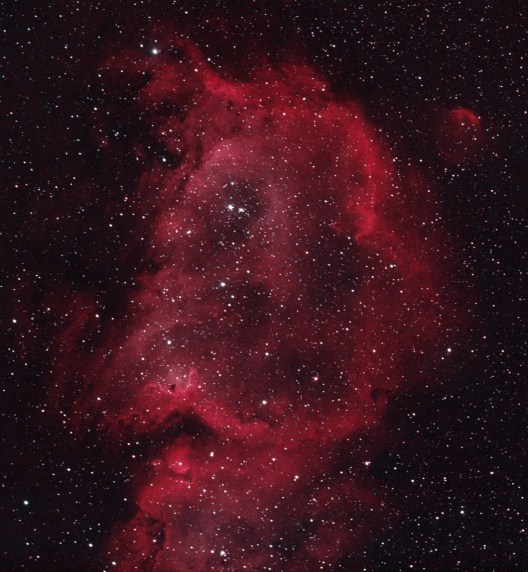
| IMAGING DETAILS – Soul Nebula HaHOO (above) | |
| Object | Soul Nebula IC 1848 (Westerhout-5) |
| Constellation | Cassiopeia |
| Distance | 6,500 light-years |
| Size | 150’ x 75’ or 100 light-years |
| Apparent Magnitude | +18.3 |
| Scope | William Optics GT81 + Focal Reducer FL 382mm f4.72 |
| Mount | SW AZ-EQ6 GT + EQASCOM computer control |
| Guiding | William Optics 50mm guide scope |
| + Starlight Xpress Lodestar X2 guide camera & PHD2 control | |
| Camera | ZWO1600MM-Cool (mono) CMOS sensor |
| FOV 2.65o x 2.0o Resolution 2.05”/pix Max. size 4,656 x 3,520 pix | |
| EFW | ZWOx8 + ZWO LRGB & Ha OIII SII 7nm filters |
| Capture & Processing | Astro Photography Tool + PS2, Deep Sky Stacker & Photoshop CS2, HLVG |
| Image Location & Orientation | Centre RA 02:52:25 DEC 60:01:35
Top Left North Top Right = East Bottom Right = South Bottom Left = West |
| Exposures | 20 x 300 sec Ha + 10×300 sec OIII (Total time: 150 minutes) |
| @ 139 Gain 21 Offset @ -20oC | |
| Calibration | 5 x 300 sec Darks 20 x 1/4000 sec Bias 10 x Flats Ha-OIII-SII @ ADU 25,000 |
| Location & Darkness | Fairvale Observatory – Redhill – Surrey – UK Typically Bortle 5 |
| Date & Time | 2nd September 2018 @ +00.20h |
| Weather | Approx. 12oC RH <=95% |
Finally I was surprised and pleased to discover that with the early evening darkness now available in September, I might be able to image the strange but beautiful Bubble Nebula NGC 7635. Being very high in the sky at this time, the challenge was to track the object for as long as possible before at about 1.00 a.m. it disappears overhead behind the high garden hedge located immediately adjacent to the telescope location. I managed, just about, and was very happy to see the ‘bubble’ in the middle of the resulting image. The enigmatic bubble is created by a stellar wind from a massive, hot central star (SAO 20575) which excites the nebula and causes it to glow. Whilst the central Bubble Nebula is undoubtedly the star of the show, this region of the sky and resulting picture holds great promise to image other objects on another occasion, notably the open cluster M51 just below and to the left of the Bubble and the Lobster Claw Nebula SH2-157 in the top-right corner.

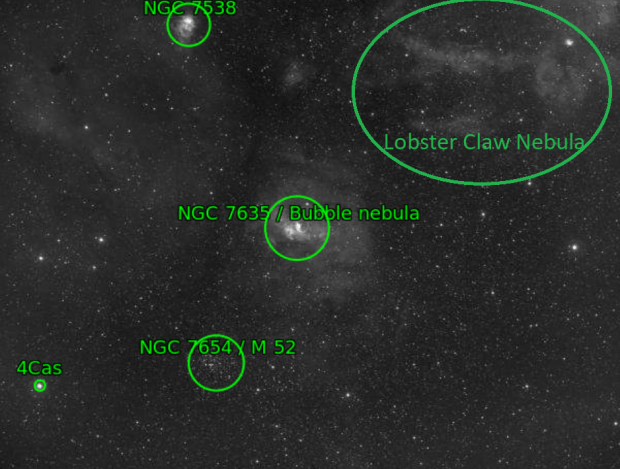
| IMAGING DETAILS: Bubble Nebula – Ha above, SHO top of page | |
| Object | Bubble Nebula NGC 7635 |
| Constellation | Cassiopeia |
| Distance | 7,100 light-years |
| Size | 15’ x 8’ (Bubble 7 light-years) |
| Apparent Magnitude | +10.0 |
| Scope | William Optics GT81 + Focal Reducer FL 382mm f4.72 |
| Mount | SW AZ-EQ6 GT + EQASCOM computer control |
| Guiding | William Optics 50mm guide scope |
| + Starlight Xpress Lodestar X2 guide camera & PHD2 control | |
| Camera | ZWO1600MM-Cool (mono) CMOS sensor |
| FOV 2.65o x 2.0o Resolution 2.05”/pix Max. size 4,656 x 3,520 pix | |
| EFW | ZWOx8 + ZWO LRGB & Ha OIII SII 7nm filters |
| Capture & Processing | Astro Photography Tool + PS2, Deep Sky Stacker & Photoshop CS2, HLVG |
| Image Location & Orientation | Centre RA 23:21:27 DEC 61:06:52
Top = north Right = East Bottom = South Left = West |
| Exposures | 15 x 300 sec Ha + 10×300 sec OIII & SII (Total time: 175 minutes) |
| @ 139 Gain 21 Offset @ -20oC | |
| Calibration | 5 x 300 sec Darks 20 x 1/4000 sec Bias 10 x Flats Ha-OIII-SII @ ADU 25,000 |
| Location & Darkness | Fairvale Observatory – Redhill – Surrey – UK Typically Bortle 5 |
| Date & Time | 3rd September 2018 @ +21.45h |
| Weather | Approx. 15oC RH >=70% |
My time at the end of the garden this summer at the Shed Observatory has been a great success, made all the better by a prolonged period of warm weather. I am confident that with more attention to the set-up, better guiding and longer integration times, next year will be even better and I’m already looking forwards to revisiting this year’s new horizons in the north sky in 2019.
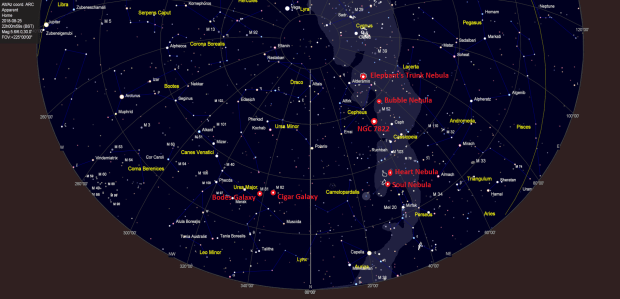
North Sky Imaged Objects May to September 2018
 WATCH THIS SPACE(MAN)