
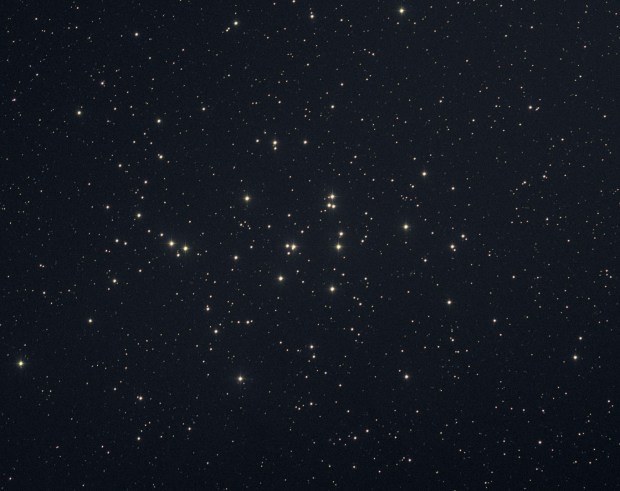
Identified by Ptolemy in the second century AD, the open star cluster was known in Greek and Roman mythology as Praesepe (The Manger). Soon after developing the so-called ‘Dutch Gadget’ for use in astronomy as a refractor in 1609, Galileo became the first person to properly observe through the telescope what is now known as The Beehive Cluster and thus detect some 40 stars. In 1769 Messier added the cluster to his growing catalogue as the 44th object and thus became M44. More than 400 years since Galileo’s first view, the Beehive Cluster AKA M44, Praesepe or more prosaically NGC 2632, is now known to consist of approximately 1,000 stars and forms one of the imaging targets at or about the time of the Spring Equinox each year.
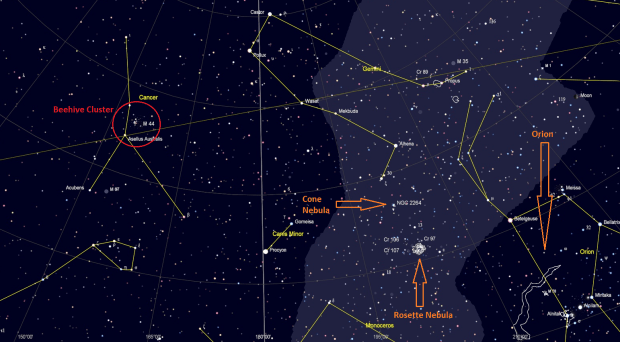
Located in our galaxy relatively nearby within the constellation Cancer, between 520 and 610 light-years away and 3-times the Moon’s diameter or 1.5o, The Beehive can be seen with the naked eye as a blur in dark skies and with a telescope becomes an excellent imaging target. Last imaged with the modded Canon 550D DSLR in 2015, the LRGB image obtained this time shows improvement but with only 20-minutes integration time lacks the colour seen in other examples, which however consist of more than 17 hours! Truth is that this was a brief experiment carried out between imaging two other objects on the same night and I’m encouraged that by increasing my time significantly I can eventually tease out better quality and the spectacular colours that make The Beehive such an attractive open cluster.
| IMAGING DETAILS | |
| Object | The Beehive Nebula (Praesepe, M44, NGC 2632) |
| Constellation | Cancer |
| Distance | 520 – 610 light-years |
| Size | 1.5o |
| Apparent Magnitude | +3.7 |
| Scope | William Optics GT81 + Focal Reducer FL 382mm f4.72 |
| Mount | SW AZ-EQ6 GT + EQASCOM computer control |
| Guiding | William Optics 50mm guide scope |
| + Starlight Xpress Lodestar X2 guide camera & PHD2 control | |
| Camera | ZWO1600MM-Cool (mono) CMOS sensor |
| FOV 2.65o x 2.0o Resolution 2.05”/pix Max. image size 4,656 x 3,520 pix | |
| EFW | ZWOx8 + ZWO LRGB & Ha OIII SII 7nm filters |
| Capture & Processing | Astro Photography Tool, Deep Sky Stacker & Photoshop CS2 |
| Exposures | 4×5 x 60 sec LRGB (Total time: 20 minutes) |
| @ 139 Gain 21 Offset @ -20oC | |
| Calibration | 5 x 300 sec Darks 20 x 1/4000 sec Bias 10 x Flats Ha, OIII & SII @ ADU 25,000 |
| Location & Darkness | Fairvale Observatory – Redhill – Surrey – UK Typically Bortle 5 |
| Date & Time | 11th February 2018 @ 21.30h approx. |
 WATCH THIS SPACE(MAN)