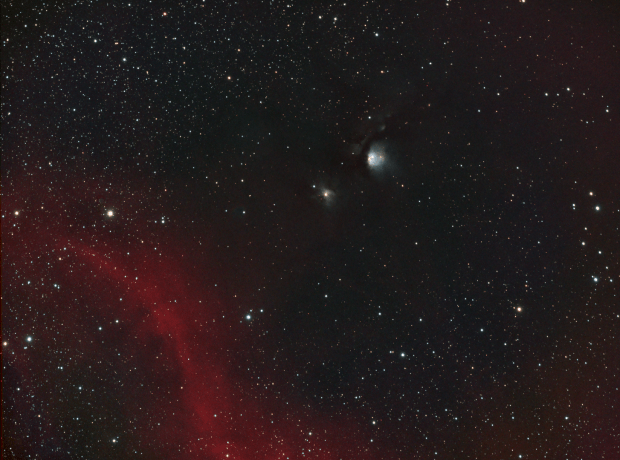
Hunting Orion

Combined +180 degrees 3+5min HaLRGB (Large)

In Greek mythology it is said that Zeus, the god of thunder, placed a giant huntsman amongst the stars as the constellation Orion.  Today it is one of the most recognizable of the 88 constellations in the night sky and certainly one of the most popular amongst astronomers.  Towards its extremities it is defined by the red supergiant star Betelgeuse at the top-left and the massive blue supergiant Rigel lower-right, divided in the centre by Orion’s so-called ‘belt’ formed by the line of bright stars from left-to-right: Alnitak, Alnilam and Mintaka.  These and the other stars that make up the constellation of Orion are of great interest to astronomers and also make an attractive widefield image with a standard camera.  But the more serious astrophotographer is mainly interested in the panoply of exciting DSOs that lie within and around Orion that I have therefore been pursuing myself since late January.

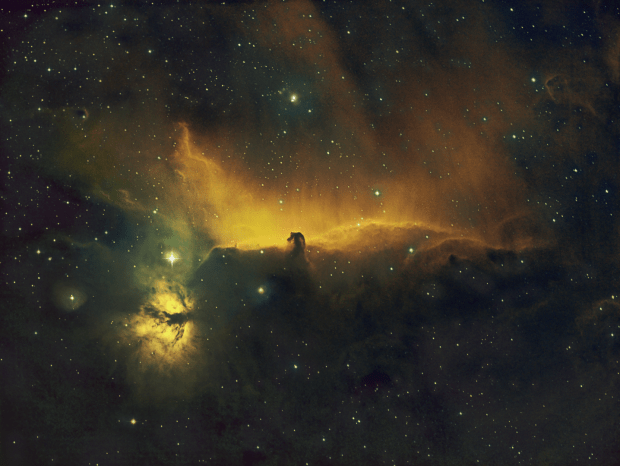
My quarry started with the Horsehead and Flame nebulae imaged in narrowband processed using the Hubble Palette technique in SHO to great effect.  Much to my surprise a spectacular period of warm weather and clear skies four weeks later then allowed me to capture the Great Orion Nebula over three nights in HaLRGB with an equally good result.  Such was the fine weather conditions that I was then able to continue over a further two nights – five consecutive nights of imaging in the UK in late February, unprecedented in my experience – with the objective now being the reflection nebula M78.

M78 is the brightest diffuse reflection nebula of a group that belongs to the Orion B molecular cloud complex but with an apparent size of 8 x 6 arc seconds it is a something of a challenging target with my equipment.  Notwithstanding, with the mono CMOS ZWO camera and the opportunity of obtaining increased integration times I considered it worth a try and was not disappointed with the outcome.

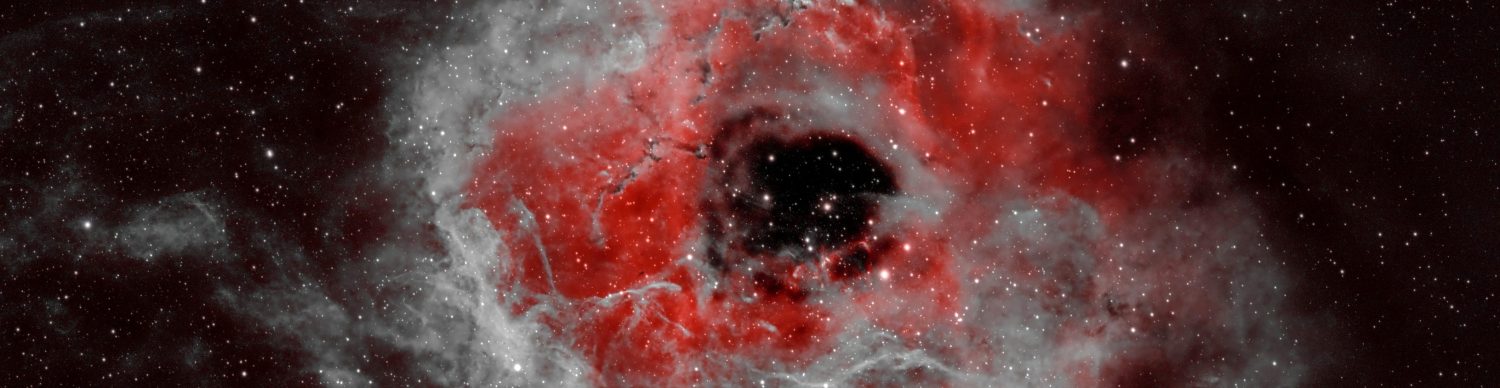
I generally like to present images in their natural orientation but this time I’ve chosen to rotate the it 90o anticlockwise, thus allowing the wider horizontal framing to better show M78 and the dramatic red Ha-light of nearby Barnard’s Loop together.   As with M42 previously, I first stacked and processed two exposure sets, short 60 second and long 300 second subs, before then combining them so as to tease out subtleties within the reflection nebula itself and provide greater control of the otherwise dominant Barnard’s Loop.  Despite my concerns about equipment and scale, I’m very pleased with the outcome of the main image (top-of-the-page), which beautifully shows off both the aforementioned objects to great effect and has even extracted some of the colour and detail of associated star clusters within and around the nebula.  Not surprisingly the cropped version of M78 itself starts to look a little noisy but is nonetheless interesting (below).
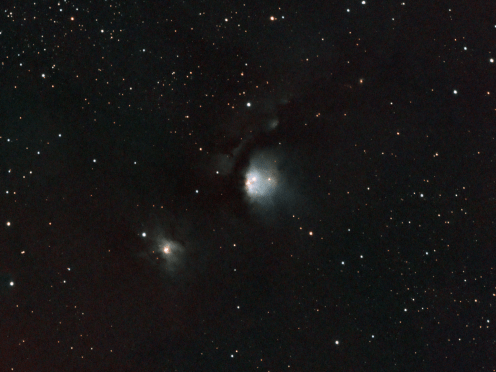
Combined crop 3+5min HaLRGB (Large)

After a very unpromising few months, the weather, Orion and my astroimaging took a surprising turn for the better from the end of January.  As a result of much longer integration times using plate solving over multiple sessions, combined with varied exposure times and more complex processing, I successfully managed to bag three classic deep sky objects of the Orion constellation – what’s not to like?

IMAGING DETAILS
Object M78 Orion reflection nebula
Constellation Orion
Distance 1,350 light-years
Size 8’ x 6’   
Apparent Magnitude +8.3
 
Scope  William Optics GT81 + Focal Reducer FL 382mm  f4.72
Mount SW AZ-EQ6 GT + EQASCOM computer control & Cartes du Ciel
Guiding William Optics 50mm guide scope
  + Starlight Xpress Lodestar X2 camera & PHD2 guiding
Camera ZWO1600MM-Cool mono  CMOS sensor
  FOV 2.65o x 2.0o Resolution 2.05”/pix  Max. image size 4,656 x 3,520 pix   
EFW ZWOx8 + ZWO LRGB & Ha OIII SII 7nm filters 
Capture & Processing Astro Photography Tool + PHD2 +  Deep Sky Stacker & Photoshop CS3
Image Location              & Orientation Centre  RA 05:47:37      DEC 00:20:59                     

Top Left = North  Bottom Left = East 

Exposures (A)    LRGB 8 x 180 sec  Ha 10 x 180sec       (Total time: 1hr 24 min.)

(B)    HaLRG 12 x 300 sec B 17 x300 sec      (Total time: 5hr 25 min.)   

  @ 139 Gain   21  Offset @ -20oC    
Calibration 10 x 180 sec & 5 x 300 sec Darks  20 x 1/4000 sec Bias  10 x  HaLRGB Flats               @ ADU 25,000
Location & Darkness Fairvale Observatory – Redhill – Surrey – UK        Typically Bortle 5-6
Date & Time 25th  26th 27th February  2019 @ +19.45h  
Weather Approx. 8oC   RH 60 to 80%                  🌙  ½ waning

Horseplay

SHO2 CompF (Large)

Who doesn’t like Orion and its constituent parts – M42/43, M78, the Witch’s Head, Barnard’s Loop etc.?  For many its annual appearance in the night sky is greatly anticipated and will form one of the main astrophotography highlights of the year as it passes across the sky between late November and February.  For me a basic afocal image of the Great Orion Nebula for the first time in 2013 marked something of an epiphany, as it demonstrated the power of long exposures in capturing the otherwise hidden beauty and excitement of Deep Sky Objects.

Since taking up astronomy and then astrophotography, I always return to at least one of Orion’s  objects each year, initially to see if I could just capture it on camera with my equipment and then to try and improve the image of each target.  It’s been a gradual process but I’m pleased to say I’ve usually managed to achieve such improvements over time, which has been both satisfying and often exciting – such is the nature of these objects.  Progress almost always resulted from one or more of four developments: new equipment, new software, new techniques and better processing.

Each step was usually small but occasionally a quantum change took place, such has been the case during the past two years: first with the change from DSLR to a CMOS mono camera and then, more recently, learning to plate solve.  I was reluctant to change to a traditional CCD mono camera which usually requires very long exposures that, in my opinion, is incompatible with British weather, light pollution and the frequent overhead passage of aircraft where I live between Gatwick and Heathrow airports – if one doesn’t get me the other will, or the low flying helicopters that pass over my observatory throughout the night from nearby Redhill aerodrome!

It was therefore very fortunate that at the same time I wanted to upgrade my camera from a DSLR, the new CMOS sensor technology had literally just arrived on the market.  With low read noise and shorter exposures, the ZWO1600MM-Cool mono camera I purchased has been a revolution for me, as well as the entire astroimaging community.  Furthermore, the use of narrowband imaging has added a completely new dimension to my astrophotography – apart from the ability to image when the Moon’s about each month and defy light pollution, narrow Ha-OIII-SII wavelengths reveal a whole new world that is both interesting and often dramatic in appearance.

Notwithstanding these developments, I was hitherto hampered by limited integration times of just over two hours (at most) either east or west of the Meridian, until in 2018 I finally mastered (probably that’s overstating my current prowess) plate solving, thereby making integration times literally infinite.  All I needed now was clear skies! Despite my enthusiasm for astrophotography, there have been times over recent months when I’ve questioned my choice of hobby and even maybe giving up.  Given sufficient funds it is possible to have the most incredible imaging set-up, capable of obtaining equally incredible images – subject to user ability – but if the sky remains cloudy it’s no more than a pile of expensive junk!

Having obtained a very decent LRGB image of the Pleiades on 17th November, armed with the ZWO1600 camera and my new plate solving skills, I decided to take on a project over the winter months.  My objective was to obtain one very good image based on a much longer integration time than I’ve previously achieved, acquired by imaging the same object over as many nights as possible during December and January. However, as Robert Burns once put it “The best laid schemes o’ Mice an’ Men, / Gang aft agley,” (translated – the best laid plans of mice and men often go awry).  Apart from one evening that fortuitously coincided with the lunar eclipse on 21st January, the skies here remained obscured by cloud from November 18th until January 27th (or 70-days!!!) and I thought my project was scuppered, that is until the other qualities required of astronomy came into play: patience and good luck.

Picture saved with settings embedded.

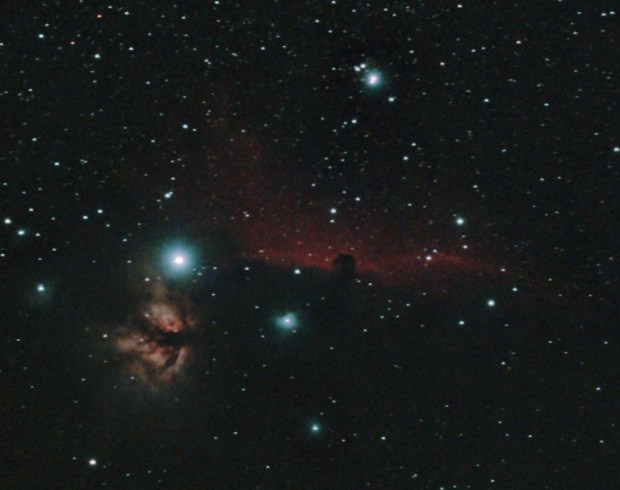
My first image of the Horsehead & Flame Nebulae, 23rd November 2014: William Optics GT81 +FF, Canon 700D (unmodded), SW AZ-EQ6 GT mount, 30 x 90 secs @ ISO1600 + full calibration

The Horsehead and Flame nebulae are traditionally imaged in LRGB colour, indeed my first and subsequent images of these objects have been mostly undertaken in this way (see image above).   However, inspired by a narrowband image of these objects I’d seen earlier last year, I too wanted to try and capture these nocturnal bedfellows in narrowband and process the subs using the Hubble Palette technique.  Given the aforementioned cloud problem, by the time late January had been reached Orion was already slipping over the western horizon for another year and I thought the project was dead before it could even start, at which point good luck played its part.  Starting on 27th January and for three out of the four evenings, the sky cleared and I eagerly launched into the long awaited project.

Unfortunately by now Orion crossed the Meridian about 9 p.m. and most imaging could only be undertaken on the west side, thus limiting each night’s subs again to 2½ hours or less.  But with three nights in the bag before inevitably the cloud returned on the 31st January, I had secured 106 x 5-minute Ha, OIII and SII subs or 6 hours 50 minutes of total integration time, at least three times what I had ever previously achieved.  The key was plate solving, as each night I could return to exactly the same part of the sky and continue imaging the same objects to the nearest pixel.  Having obtained and reviewed the data, it was now time to start processing.

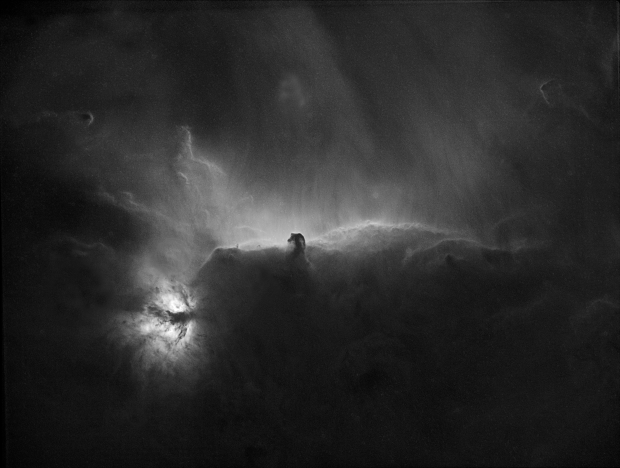
NGC 2024 Ha Starless2

Given the quality and quantity of data obtained I decided to take my time processing and, furthermore, try to use some new techniques to make the very best of the final image.  I was particularly keen to tame some of the brighter stars like the blue supergiant Alnitak located uncomfortably close to the Flame and at the same time bring out the interstellar dust that is present in the foreground below the Horsehead and across the lower right quadrant, which becomes evident in the starless processed Ha layer (see image above).  It took quite a while but in the end I am very pleased with the outcome, which I think shows all the benefits of longer data integration and the extra care taken processing.  The final SHO narrowband version of the Horsehead and Flame nebulae looks a real cracker, perhaps one of my best and has been worth all the patience and additional time taken to show these two objects and the adjacent region literally in a new light.

Needless to say, I’m already thinking about next year, cloud permitting!  I hope to return to the Horsehead and Flame for another playtime next winter, in order to acquire more subs with which to build further on the foundation achieved this year by a stroke of luck at the very end of Orion’s annual visit – can’t wait.

IMAGING DETAILS
Object (i)Horsehead Nebula (Barnard 33)  &  (ii)  Flame Nebula (NGC 2024)
Constellation Orion
Distance 1,500 light-years
Size (i)8” x 6”  &  (ii)  30’ x 30’
Apparent Magnitude +10.0
 
Scope  William Optics GT81 + Focal Reducer FL 382mm  f4.72
Mount SW AZ-EQ6 GT + EQ-ASCOM computer control
Guiding William Optics 50mm guide scope
  + Starlight Xpress Lodestar X2 guide camera & PHD2 control
Camera ZWO1600MM-Cool (mono)   CMOS sensor
  FOV 2.65o x 2.0o Resolution 2.05”/pix Max. image size 4,656 x 3,520 pix   
EFW ZWOx8 + ZWO LRGB & Ha OIII SII 7nm filters 
Capture & Processing Astro Photography Tool + PS2,  Deep Sky Stacker & Photoshop CS2, HLVG
Image Location              & Orientation Centre  RA 05:40:57    DEC -02:30:55                     

Top = North 

Exposures 40×300 sec Ha+34×300 sec OIII+32x300sec SII  (Total time: 6hr 50min )   
  @ 139 Gain   21  Offset @ -20oC    
Calibration 5×300 sec Darks  20×1/4000 sec Bias 10xFlats Ha-OIII-SII  @ ADU 25,000  
Location & Darkness Fairvale Observatory – Redhill – Surrey – UK     Typically Bortle 5-6
Date & Time 27th, 28th & 30th  January 2019 @ +21.30h  
Weather Approx. <=1oC   RH <=90%                🌙 ½ to ¼ waning