H.G. Wells knew a thing or two about the concept of time travel when he published his book The Time Machine in 1895. Since starting astrophotography in 2014, reflecting on the progress I have since made can also feel like a journey through time.
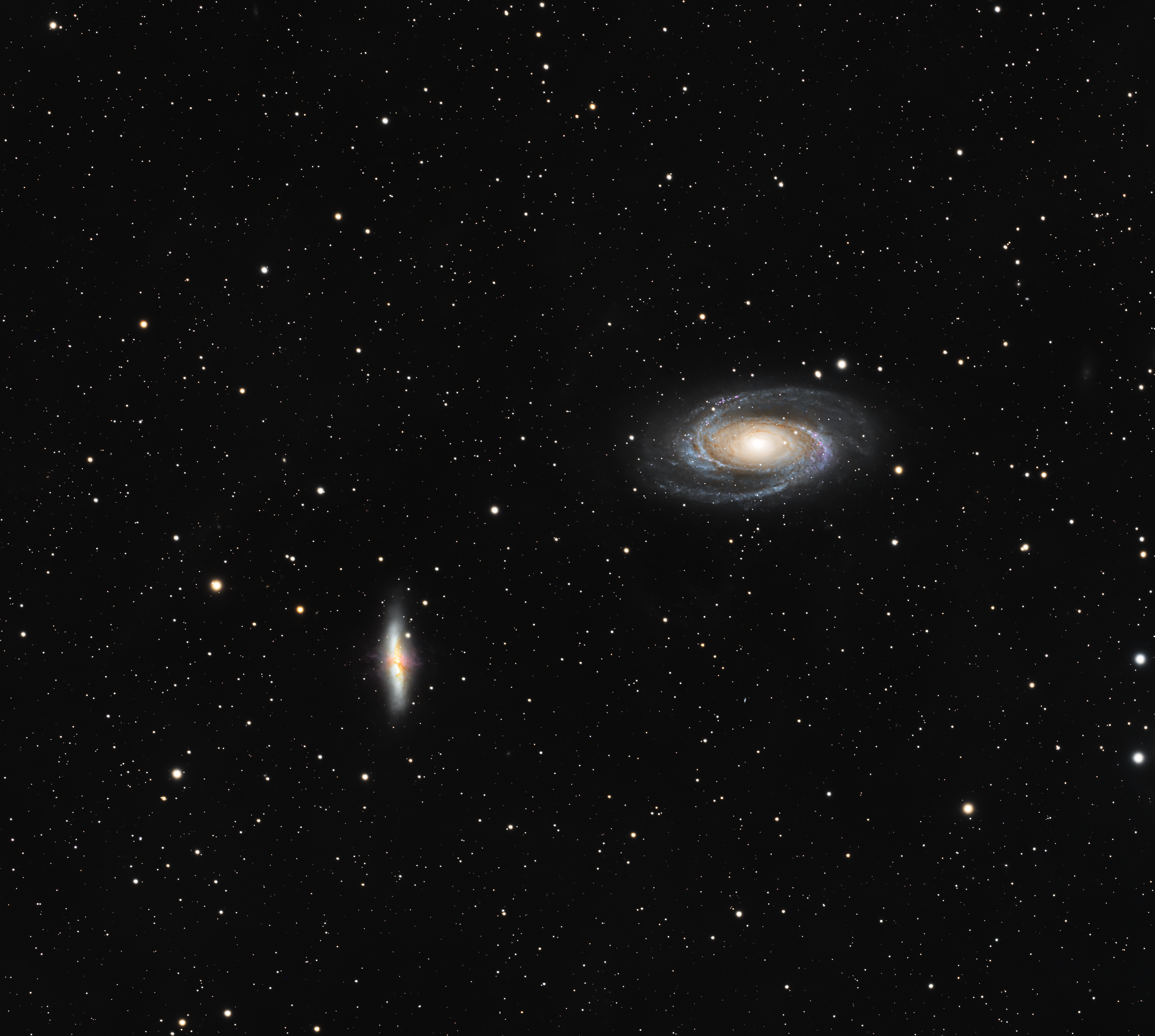
In May 2018, I managed to obtain my first image of the northern sky, which at my previous location in Surrey was completely obscured from view at my main imaging location. The result then obtained under a Bortle-6 night sky, was a modest 2hr 45m image of Messier 81 & 82 seen here. Notwithstanding, it was something of a breakthrough for me and I was – at the time – very pleased with the result. Nearly 8-years later, now located in the wonderful Bortle-4 dark skies of Somerset, I recently chose to image these two magnificent Messier objects once again.
M81 and M82 are two well-known galaxies in the northern sky, which being just 20o from Polaris are also circumpolar. Located in the constellation Ursa Major, they appear near each other in the sky and interact gravitationally. Both galaxies were discovered in 1774 by the German astronomer Johann Elert Bode and later included in the Messier Catalogue. Together, M81 and M82 form the central members of the M81 Group, a small cluster of galaxies located not far from our own Local Group.
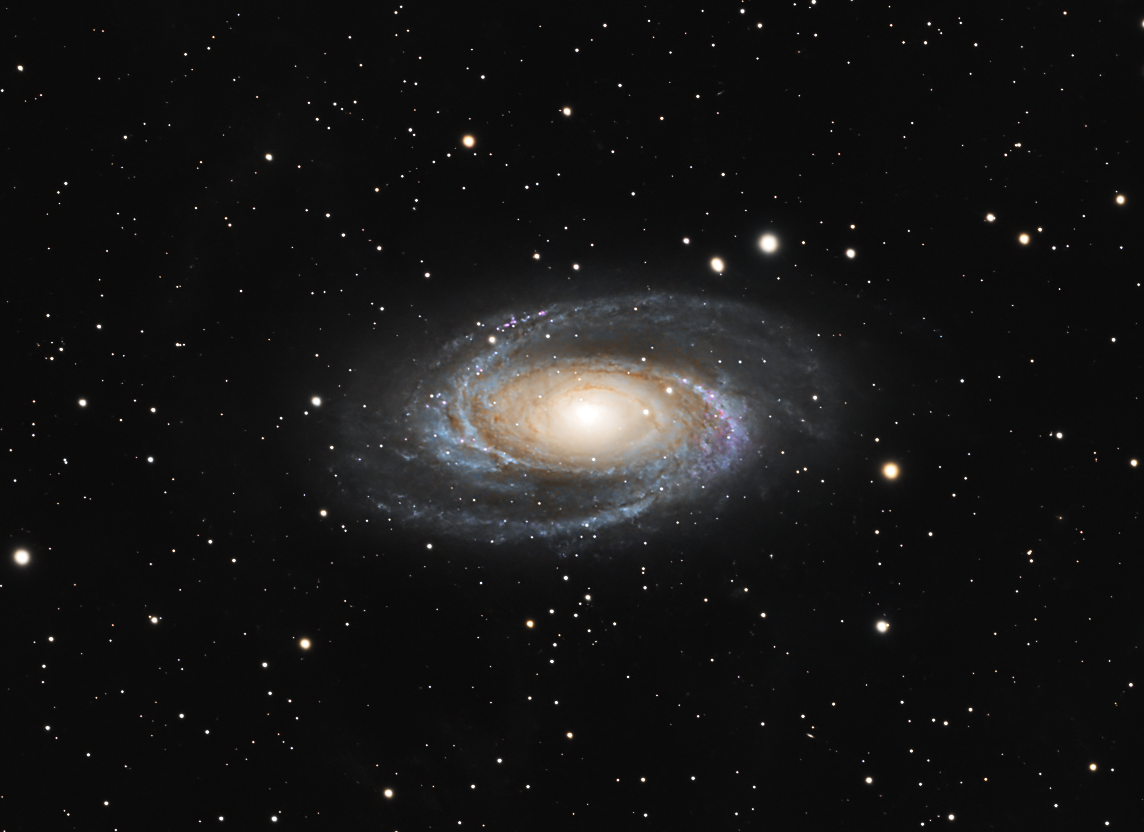
M81, also called Bode’s Galaxy (see above), is a spiral galaxy around 12 million light-years from Earth and one of the brightest galaxies visible from the Northern Hemisphere. The diameter is about 90,000 light-years, slightly smaller than the Milky Way, with a supermassive black hole at the centre. M82 or the Cigar Galaxy, is a starburst galaxy, thus forming new stars at an extremely high rate. This intense star formation is believed to have been triggered by the aforesaid gravitational interactions with M81. This activity creates powerful stellar winds and explosions from massive stars going supernova, that eject huge streams of gas and dust out of the galaxy to form dramatic red plumes that extend thousands of light-years above and below the galactic disk.
New equipment, software, greater processing experience and a dark sky location, have resulted in an exciting image that highlights the progress I have made on my astrophotography journey since 2018.
| IMAGING DETAILS | |
| Object | M81 AKA Bode’s Galaxy & M82 AKA Cigar Galaxy |
| Constellation | Ursa Major |
| Distance | 12 million light-years |
| Size | M81 26.9 x 14.1arcminutes (90.000 light-years) M82 11.2 x 4.3 arcminutes (37.000 light-years) |
| Apparent Magnitude | M81 +6.9 M82 +8.4 |
| Scope | William Optics GT81 + Focal Reducer FL 382mm f4.72 |
| Mount & Control | ZWO AM5 + ASIair |
| Guiding | William Optics 50mm guide scope |
| + ZWO 120MM Mini | |
| Camera | ZWO ASI294MM CMOS sensor |
| FOV 2.87o x 1.96o Resolution 2.50”/pix Max. image size 4,144 x 2,822 pix | |
| EFW | ZWOx8 EFW & 31mm LRGB filters |
| Capture & Processing | ASIair, Deep Sky Stacker & PixInsight v1.9.3 Lockhart |
| Image Location & Orientation | Centre = RA 09:55:12.64 DEC +69:20:55.1 Top Right = North |
| Exposures | L x 12 @ 600 sec & R x 12 + G x 9 + B x 8 @ 300 sec Total Integration Time: 4hr 25min |
| @ Gain 120 & 30 Offset 21 @ -15oC | |
| Calibration | 5 x 600 sec & 5 x 300 sec Darks & 10 x LRGB Flats & Dark Flats @ ADU 32,000 |
| Location & Darkness | Castle Farm Observatory, Wookey, Somerset – UK Typically Bortle 4 |
| Date & Time | 24th February 2026 @ +18.30h |
| Weather | Approx. ❤oC RH >=<60% 🌙 53% Moon |
 WATCH THIS SPACE(MAN)