Perspective is everything – in life and so it is, with astronomy. Hipparchus first pointed the way in 127 BC when he described the procession of the equinoxes and, as they say one thing led to another as, Nicolas Copernicus (1473-1543), Tycho Brahe (1546-1601), Galileo Galilei (1564-1642), Johannes Kepler (1571–1630), Johannes Hevelius (1611–1687), Giovanni Cassini (1625-1712), John Flamsteed (1646-1719) and others opened our eyes to the night sky and what lay beyond Earth. Notwithstanding, it was Edwin Hubble’s discovery of galaxies in 1924 that ultimately led to mankind’s recognition that there was much, much more, that we now take for granted to be the Universe. However, even to the experienced modern astronomer the scale, complexity and beauty of the Universe can be somewhat overwhelming, like when we consider that the observable Universe may consist of 2 trillion galaxies!
Since Hubble’s work we have become familiar with many types of galaxies, which the average person might describe as a colourful spinning firework-like disc, consisting of vast gravitationally bound systems of stars, stellar remnants, interstellar gas, dust and dark matter. This stereotypic impression arises because most galaxy images are viewed face-on or at an inclined angle, so that we can see the structures and processes that have created it. However, given the number of galaxies and therefore the many possible views, it is not surprising that some can only be seen edge-on from our perspective on Earth, the Needle Galaxy AKA NGC 4546 is one of these.
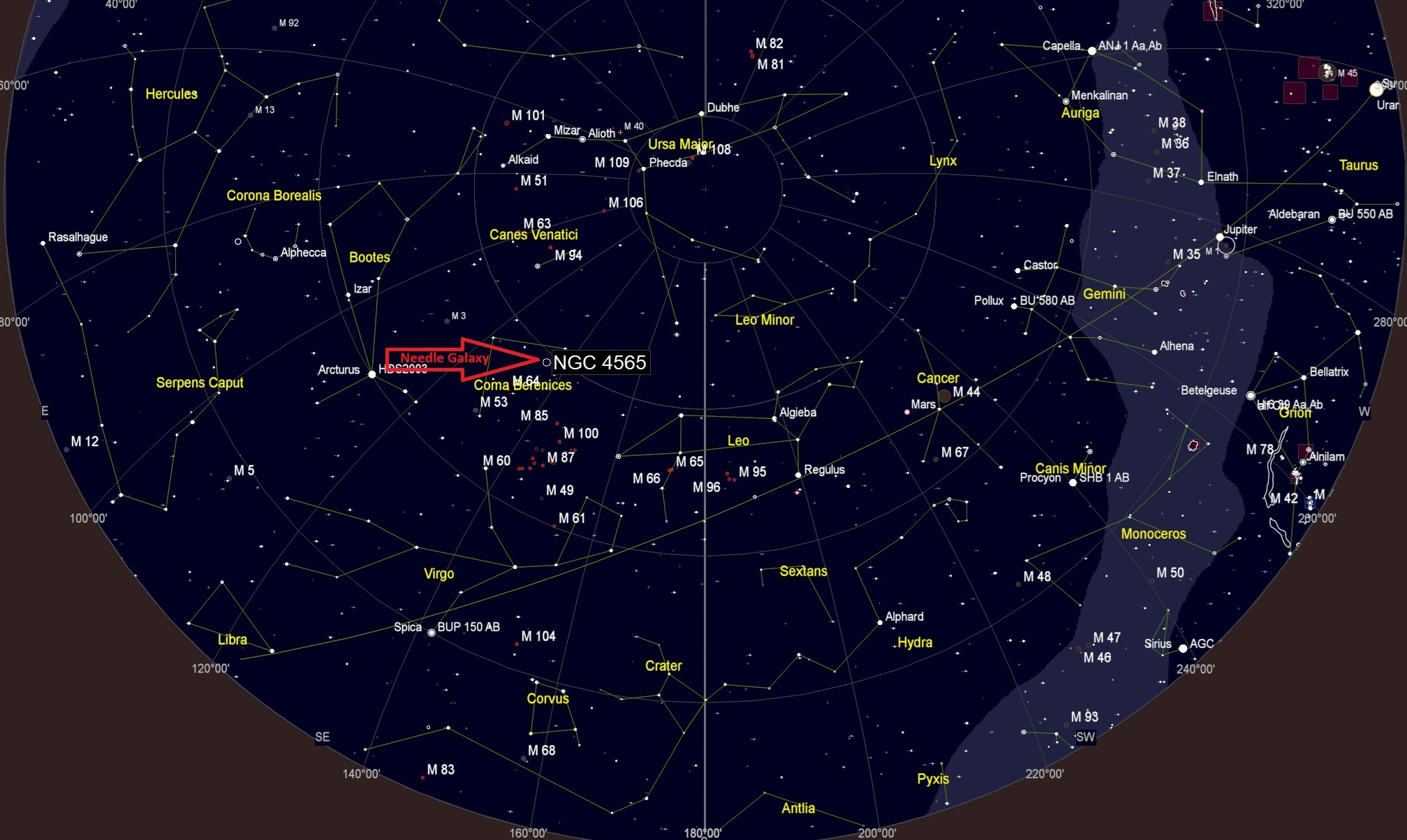
Thought to be a barred spiral galaxy, NGC 4546 is some 33% larger than the Milky Way. It has at least two satellite galaxies, about 240 globular clusters (Milky Way ~ 150) and is the brightest of the Coma 1 Group of galaxies. Seen through a telescope or when imaged the Needle Galaxy it appears like a thin streak drawn across the dark night sky but look closer and its magnificence is revealed, as in the image above.
Here ribbons of dust can be seen criss-crossing along the edge of the thin galactic disc, thereby blocking much of the from light behind. However, it is the bright central bulge that inevitably catches the eye but remains something of an enigma, as little can be seen from within. This excellent data set obtained using the MOANA 10” Newtonian telescope located in Texas’ dark skies, reveals such exquisite details that are provided by the less common edgewise perspective of this intriguing galaxy.
Footnote & credit: Following a knee replacement I’m currently unable to set-up and use my astronomy equipment, fortunately I havve been able to continue processing using this excellent public amateur data from the MOANA project located near Fort Davis, Texas https://erellaz.com/moana/. Many thanks to its creator Elleraz.
| IMAGING DETAILS | |
| Object | Needle Galaxy AKA NGC 4565 |
| Constellation | Coma Berenices |
| Distance | 40 million light-years |
| Size | 15.9 x 1.85 arc minutes |
| Apparent Magnitude | +10.4 |
| Scope | MOANA 10” f/4.5 Newtonian |
| Mount | Astro-Physics 1100GOTO |
| Guiding | Off axis guider + QHY 5L2M |
| Camera | ZWO1600MM Pro |
| FOV 45’ x 35’ Resolution 0.5915”/pix Image size 4,656 x 3,520 pix | |
| Filters | Baader 36mm RGB |
| Capture & Processing | NINA, Deep Sky Stacker & PixInsight v1.9-3 |
| Image Location & Orientation | Centre RA 12:36:08.12 DEC +25:55:59.31 Left = North |
| Exposures | R x 45, G x 47, B x 45 @ 300 sec Total Integration Time: 11hr 25 min |
| @ 90 Gain | |
| Calibration | 300 sec Dark & RGB Flats |
| Location & Darkness | Near Fort Davis, Texas, USA |
| Date | May 2023 |
 WATCH THIS SPACE(MAN)