
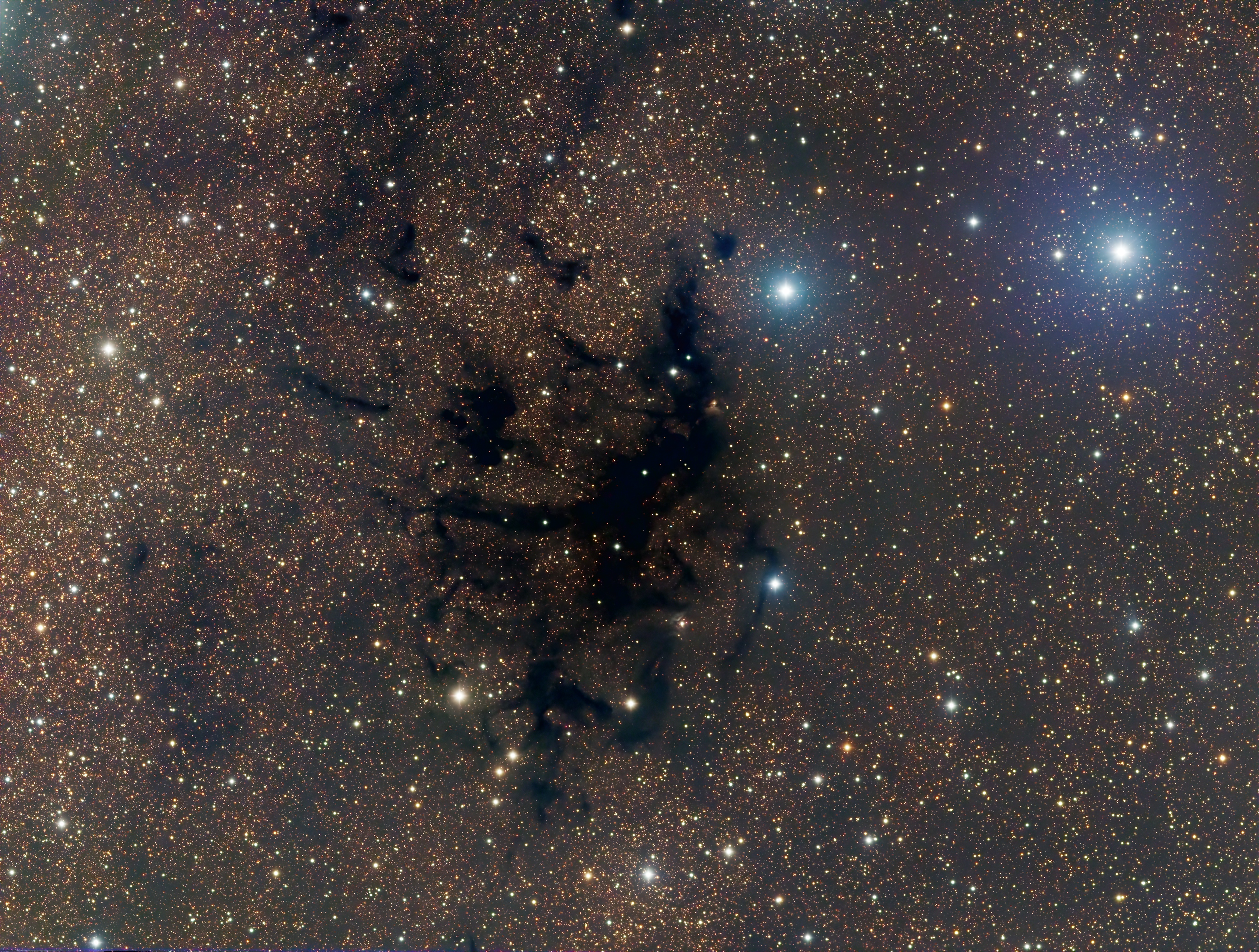
It might seem paradoxical but sometimes it is the absence of light that makes an astrophotography image interesting. Such a feature is the so-called Aquila Rift, a vast, dark interstellar cloud that spans the constellations of Aquila (Eagle), Serpens Cauda and eastern Ophiuchus. Towards the central section of the rift, about 600 million light-years from Earth, within the Aquila constellation and not far from the Summer Triangle’s Altair star, is Lynd’s Dark Nebula (LDN) 673.

Some 7-light years in size, this fragmented dark molecular cloud complex contrasts well against the colourful molecular clouds and stars of the Milky Way; the very dense dust of the dark nebulae scatters the blue light of the surrounding stars, producing a yellow-red bias. In places the density within the nebula that energetic outflows can be seen in the form of the red nebulosity of RNO 109 and Herbig-Haro object HH-32.
| IMAGING DETAILS | |
| Object | LDN 673 |
| Constellation | Aquila |
| Distance | 600 light-years |
| Size | 1o or approx. 7 light-years |
| Apparent Magnitude | Varies |
| Scope | Takahashi FSQ 106 FL 530mm f/5 + Moonlight Nightcrawler focuser |
| Mount | Paramount MyT |
| Guiding | Yes |
| Camera | QSI 683-WSG8 KAF-8300 full frame CCD sensor 5.4nm pixels |
| FOV 1.94o x 1.46o Resolution 2.1”/pix. Image array 3326 x 2,507 pix | |
| Processing | Deep Sky Stacker, PixInsight v1.8.9-2 |
| Image Location & Orientation | Centre – RA 19:20:50.72 DEC +11:15:16.20 |
| Exposures | L x35, R x23, G x18, B x22 x 600 secs @ -20C Total Integration Time: 16hr 20min |
| Calibration | Darks, Bias & Flats |
| Location & Darkness | Deep Sky West – amateur hosting facility near Rowe, New Mexico – USA SQM Typically >= 21.7 |
| Date & Time | Q4 2018 |
 WATCH THIS SPACE(MAN)