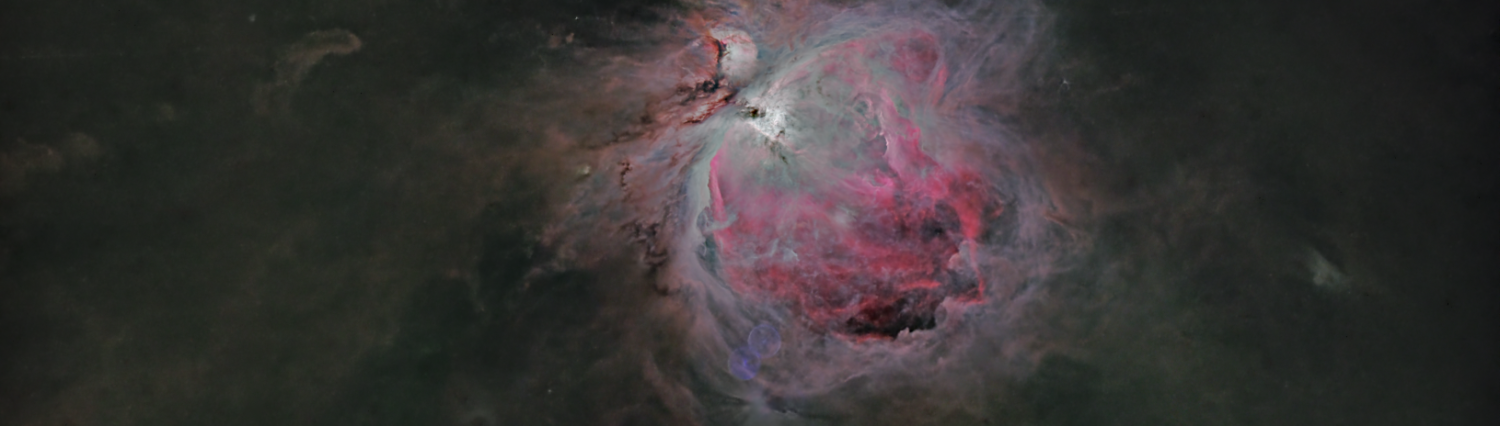
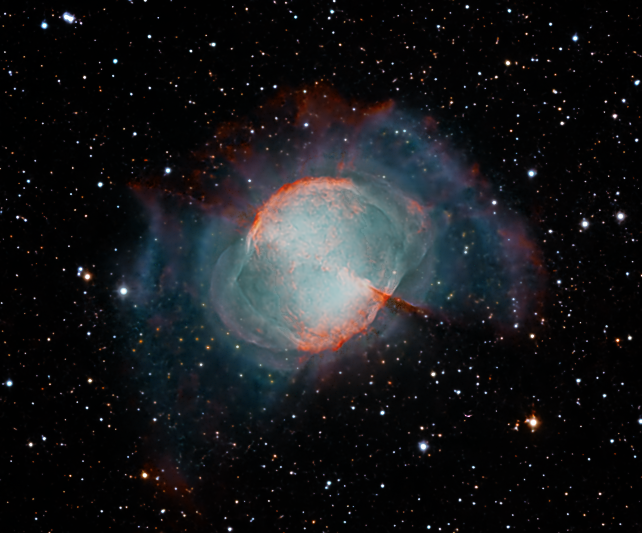
A popular object at this time of the year, the planetary nebula M27 consists of a glowing shell of ionized gas, which has been ejected from a red giant star in its late stage of its life to become a white dwarf. Like many planetary nebulae, the main inner shell exhibits numerous dark and light knots, of which red ionized hydrogen areas form two bright lobes that together make the shape of an apple- core / dumbbell, which are M27’s two nicknames. There also seems to be different bi-polar influences occuring, that have resulted in complex Ha (red) and OIII (blue) fans around the outer regions and a pulsar-like beam transecting the nebula (see cropped version at the top of the page).
Despite the good data quality and long integration time, the complicated nature of the planetary nebula made processing very difficult, in particular, teasing out the aforesaid but very faint outer fans. In this case it was necessary to carry out individual soft stretches of the Ha and OIII stacks before combining them into an HOO image, from which a starless colour image was created and then processed further to bring out the fans. Thereafter, Pixelmath was used to amalgamate this image with two other starless HOO and RGB versions that emphasized the main part of the nebula, before finally adding back RGB stars and finishing off.
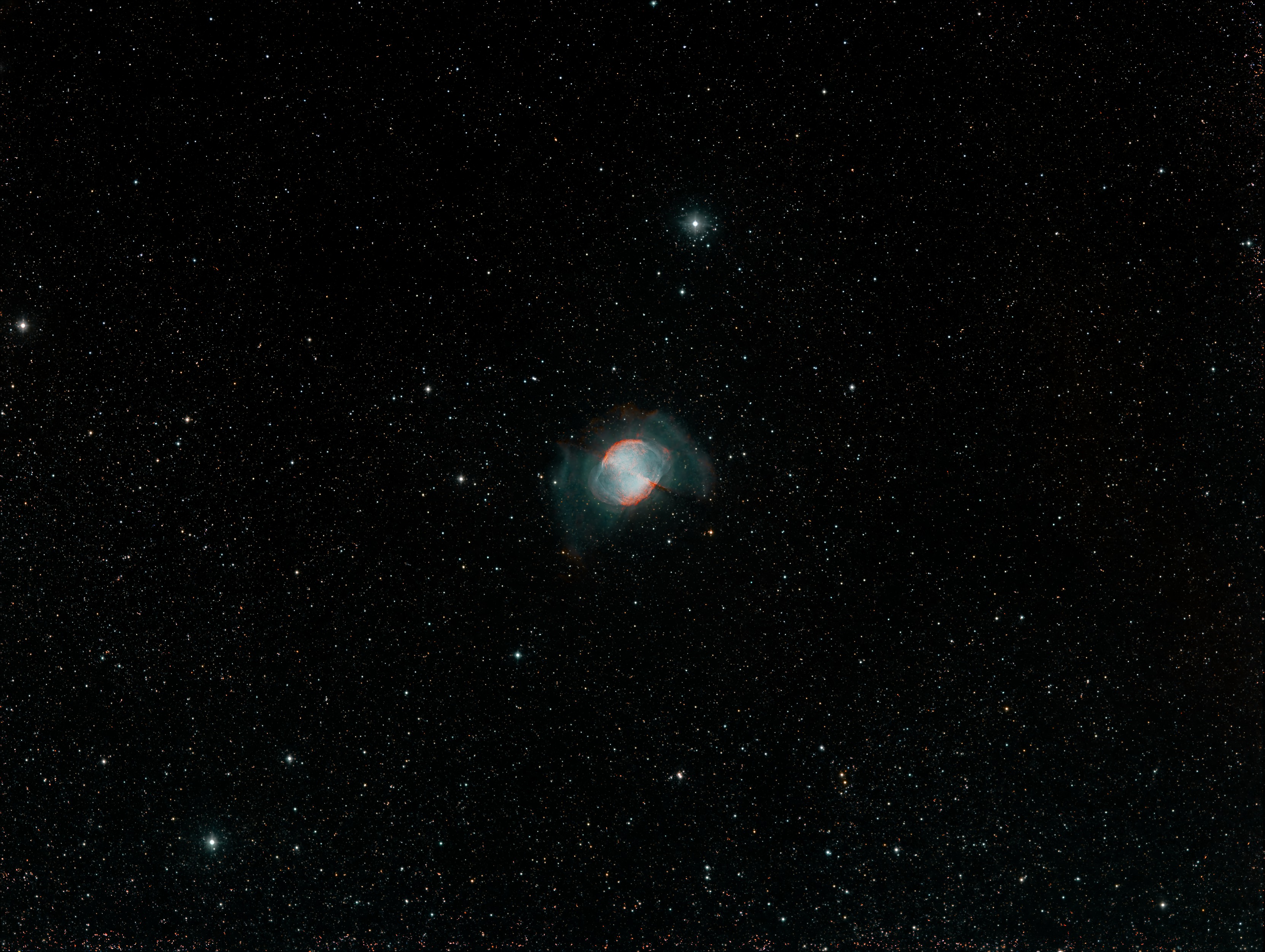
After considerable experimentation to obtain this result, I’m happy with the final image, which I hope shows off the said apple core / dumbbell and its outer fans to good effect (see above).
| IMAGING DETAILS | |
| Object | M27 AKA Dumbbell or Apple Core Nebula or NGC 6853 |
| Constellation | Vulpecula |
| Distance | 1,360 light-years |
| Size | 8.0 x 5.7 arc-minutes (core) 15 arc-minutes (total) or 5 light-years (actual) |
| Apparent Magnitude | +7.5 |
| Scope | Takahashi FSQ 106 FL 530mm f/5 + Moonlight Nightcrawler focuser |
| Mount | Paramount MyT |
| Guiding | Yes |
| Camera | QSI 683-WSG8 KAF-8300 full frame CCD sensor 5.4nm pixels |
| FOV 1.94o x 1.46o Resolution 2.1”/pix. Image array 3326 x 2,507 pix | |
| Processing | Deep Sky Stacker, PixInsight v1.8.9-1 |
| Image Location & Orientation | Centre – RA 19:59:35.363 DEC +22:42:54.383 Up = North Left = East |
| Exposures | Ha x28 & OIII x 35 x20min + R x12, G x22, B x14 x10min @ -20C Total Integration Time: 29hrs |
| Calibration | 24 x 20min & 30 x 10 min Darks x60 Bias & x20 Ha, OIII & RGB Flats |
| Location & Darkness | Deep Sky West – amateur hosting facility near Rowe, New Mexico – USA SQM Typically >= 21.7 |
| Date | Q2 2019 |


 WATCH THIS SPACE(MAN)