
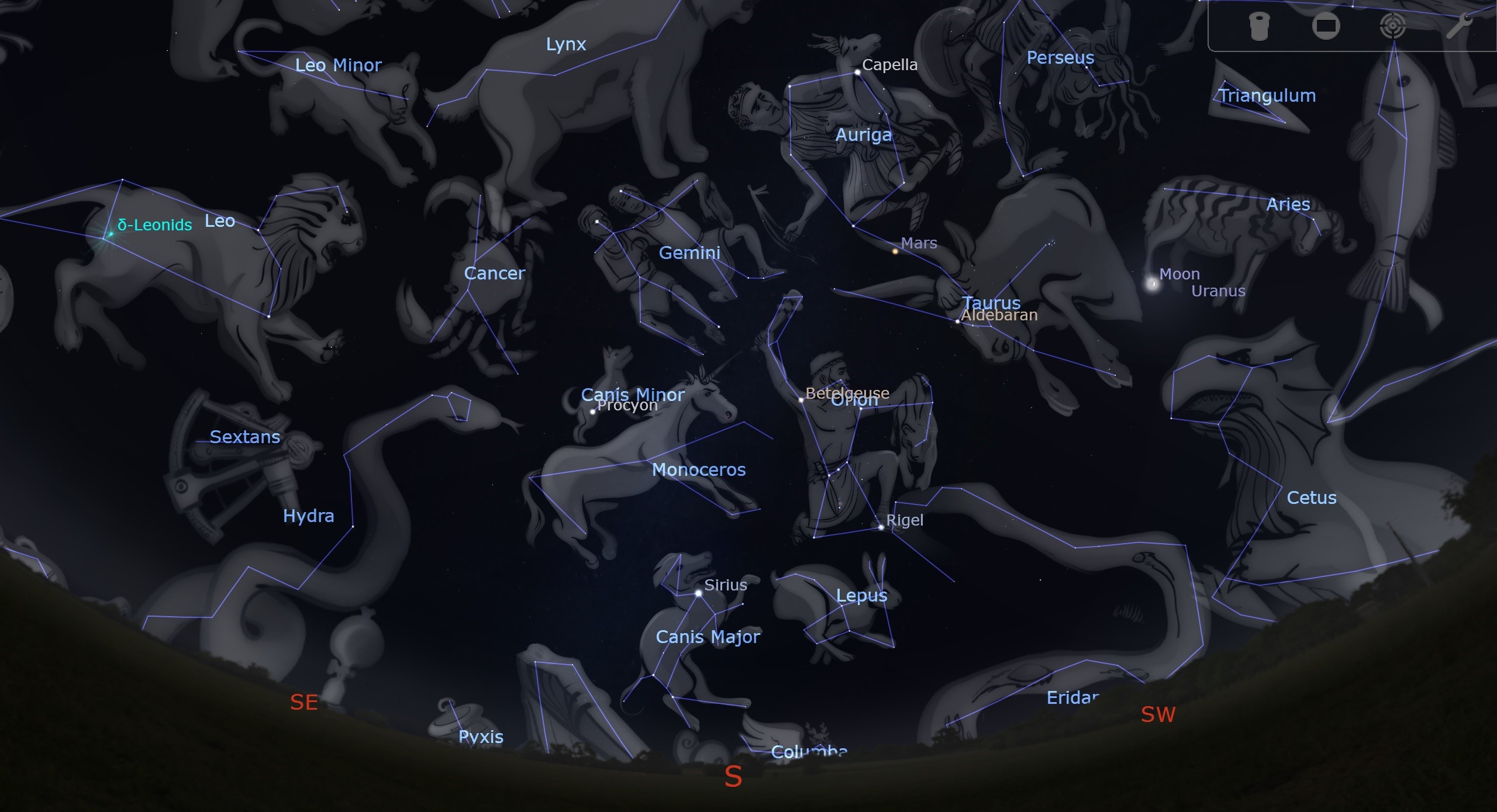
Constellation names mostly originated from ancient Middle Eastern, Greek, and Roman cultures, when they identified groups of stars and named them after their gods, goddesses, animals, and objects that were important to them. Other world-wide groups and throughout time – Native American, Asian, and African – have also made and named similar pictures from star groups based on their cultures and related beliefs. Given the number of stars observed when looking up into a clear dark sky, it is obviously helpful to ‘construct’ familiar patterns and adopt memorable names, which can then be used to identify areas of the sky in a way that can be easily identified by all. I have no problem with this long and well-established convention, which despite their antiquity works just as well in the modern world but I do have an issue with nicknames.
I’ve smiled at some of the nicknames given to popular, usually deep sky objects that have been well established by astronomers, but despite the possible use of describing their form, I am increasingly finding them a distraction when considering the merit of astrophotography images: Seagull Nebula, Running Man Nebula, Pelican Nebula etc. The problem is that they absolutely do look like the object they’re meant to depict but, like an earworm is to music, once seen they are difficult to view any other way.
With this partly in mind, for the first time in seven years I recently chose to image NGC 2174 again. I previously used the William Optics GT81 with a modded Canon 550D DSLR camera, which resulted in an image that wasn’t too bad, except it looked like a monkey! Given its nickname of the Monkey Head Nebula, this was to be expected but unfortunately, thereafter the picture of a monkey has remained with me ever since when I view NGC 2174 images. The challenge on this occasion was therefore to limit the monkey’s impact on the image, thereby showing the object for what it really is – an emission nebula.
Using the same OTA but with a mono CMOS camera and a good set of filters, the new data set obtained was much improved, and with better processing experience it was time to see the monkey (or not) in a new light. The first thing to do was present the image in an orientation that produces a more favourable perspective (less monkey like). Using a basic SHO palette in PixInsight the initial image was promising (see below) but with an alternative PixelMath dynamic SHO palette* and then processing with autocolor script, color saturation, Russell Croman’s XT-suites and other tweaks, I was pleased to see that the monkey was nowhere to be seen in the final image (see image at the top-of-the-page), or at least to my eye.
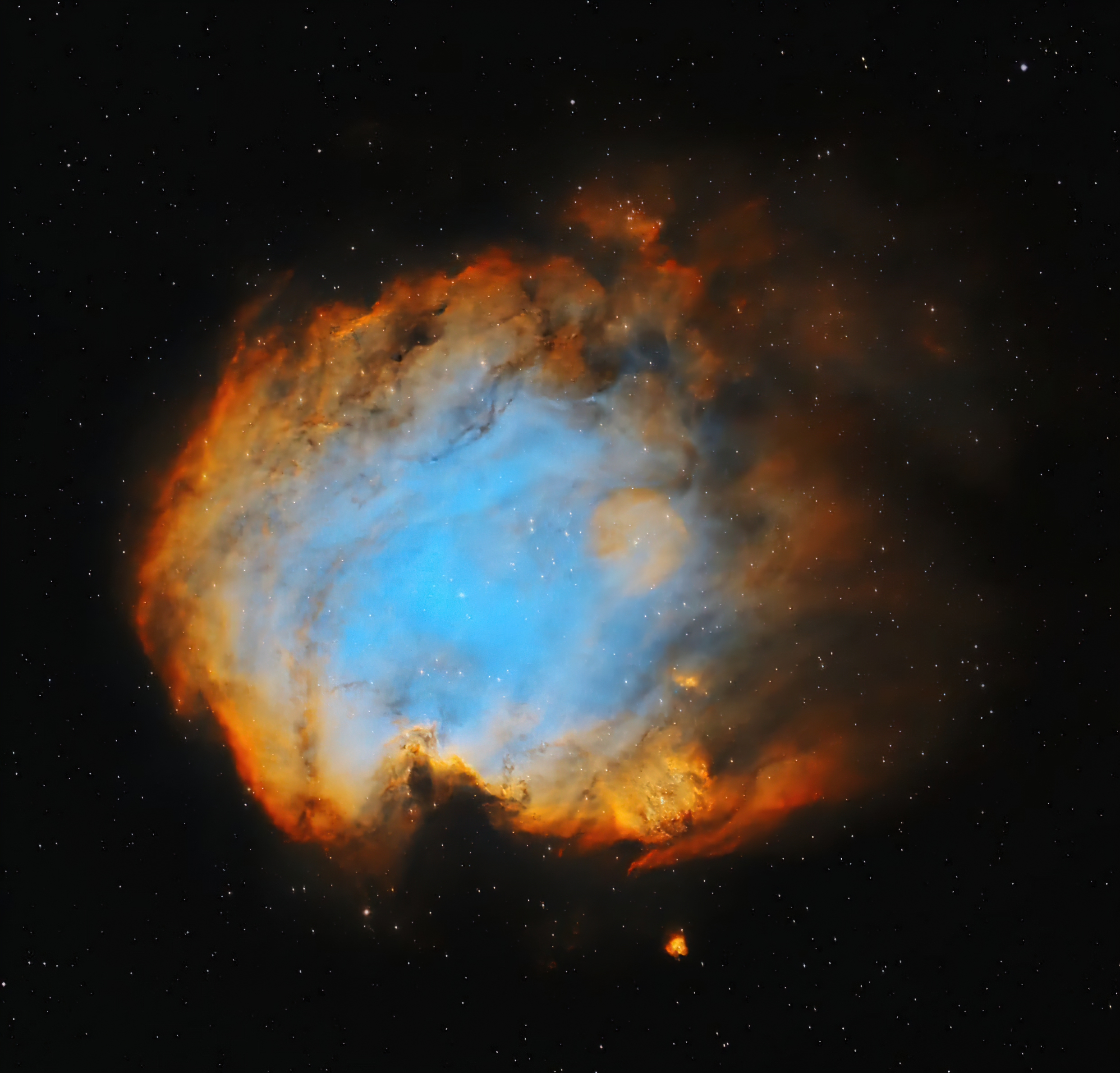
At last, it is now possible to look at NGC 2147 and see the inherent features of this interesting emission nebula, where new stars are being born at a rapid rate. Moreover, the inner details can now be clearly viewed within, thus also showing the associated open star cluster NGC 2175 and more. As a result of this monkey make-over, the NGC 2174 image now not only looks much better but critically, I no can longer see the ape! Now where’s that Seagull?
| IMAGING DETAILS | |
| Object | NGC 2174 |
| Constellation | Orion |
| Distance | 6,400 light-years |
| Size | 40 arc secs |
| Apparent Magnitude | +6.80 |
| Scope | William Optics GT81 + Focal Reducer FL 382 mm f4.72 |
| Mount | SW AZ-EQ6 GT + EQASCOM computer control & Cartes du Ciel |
| Guiding | William Optics 50mm guide scope |
| + Starlight Xpress Lodestar X2 camera & PHD2 guiding | |
| Camera | ZWO ASI294MM CMOS sensor |
| FOV 2.87o x 1.96o Resolution 2.50”/pix Max. image size 4,144 x 2,822 pix | |
| EFW | ZWOx8 EFW & 31mm Chroma HSO & LRGB filters |
| Capture & Processing | Astro Photography Tool + PHD2 + Deep Sky Stacker, PixInsight v1.8.9-1, Photoshop CS3 |
| Image Location & Orientation | Centre = RA 6:09:39.801 DEC +20:29:12.851 Right = North Up = East |
| *Image PI Processing: Dynamic Pixel Math | R = (O^~O)*S+~(O^~O)*H G = ((O*H)^~(O*H))*H+~((O*H)^~(O*H))*O B = O |
| Exposures | Ha 36 x 300 sec (3hr), OIII 30 x 300 sec (2hr 30m), SII 32 x 300 sec (2hr 40m) Total Integration Time: 8hr 10 min |
| @ 120 Gain 30 Offset @ -15oC | |
| Calibration | 5 x 300 sec Darks 15 x HSO Flats & Dark Flats @ ADU 32,000 |
| Location & Darkness | Fairvale Observatory – Redhill – Surrey – UK Typically Bortle 5-6 |
| Date & Time | 25th + 26th February + 2nd March 2023 @ +19.00h |
| Weather | Approx. < 3oC RH >=65% 🌙 +25 to +50% |
 WATCH THIS SPACE(MAN)