Dust Extractor

Nestled within the western area of the Perseus Molecular Cloud, some 1,100 light-years from Earth is the colourful NGC 1333 complex, one of the closest and most active stars forming regions of the night-sky.  I have long admired this exciting object but ruled it out for imaging as unsuitable for my equipment but eventually found its allure too compelling to avoid and just had to give it a try, with a surprisingly good result.
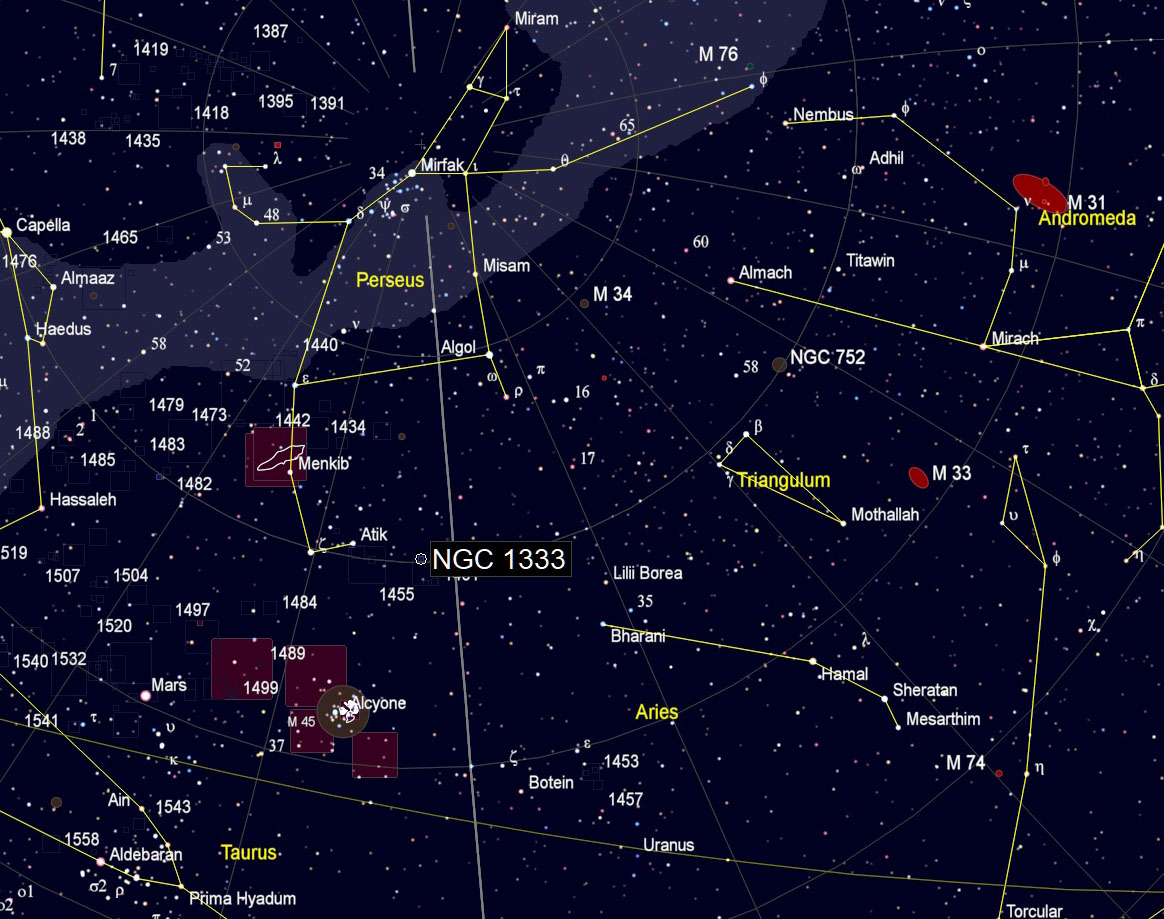
NGC 1333 shows details of dusty regions along with contrasting hints of red emissions from Herbig-Haro objects(1), jets and shocked glowing gases emanating from recently formed stars. In fact, the reflection nebula NGC 1333 contains hundreds of stars less than a million years old, mostly hidden from view by the prevailing dust.

Whilst NGC1333 is clearly the main act, numerous exciting objects abound throughout this complex region, including other reflection nebulae and Herbig-Haro stars, some of which which can be seen highlighted in the plate solving annotation above.  However, I’m most pleased that for the first time at this Bortle 5 / 6 area I’ve been able to capture the extensive interstellar dust and gases, which really brings the entire image to life – every cloud has a silver lining.  I am blown away by the outcome of this image, in the light of which I’ll need to reassess other hitherto neglected targets. 

  • (1) Wikipedia:  Herbig–Haro (HH) objects are bright patches of nebulosity associated with newborn stars. They are formed when narrow jets of partially ionised gas ejected by stars collide with nearby clouds of gas and dust at several hundred kilometres per second.

Final Word: as always, good quality data is the critical factor for all astrophotogaphy images but processing comes a close second in importance and is something I’m continually working on. This time I was able to use two new PixInsight features that were released shortly before Christmas and played an important role in completing the final image – thanks Santa.

Spectrophotometric Colour Calibration (SPCC) – based on results of the Gaia satellite’s work creating a three-dimensional map of our Galaxy, the Milky Way, SPCC usess the astrometric data (location) of all the stars and their related spectrometric data to accurately colour calibrate the image. This is an incredible piece of work that ensures that astrophotography objects, especially broadband wavelengths, can now be properly shown in their correct colours.

Blur XTerminator (BXT) – as astonishing as SPCC is, perhaps the real game changer is Russell Croman’s BXT, which literally does what it says on the tin, very, very well, and is causing something of a riot in the world of astrophotography. Like his other PixInsight tools NoiseXTerminator and StarXTerminator (also very popular), BXT is AI based with truly unbelievable results. The removal of blur, without damaging the image integrity at a pixel level, vastly improves the image quality – significantly improving the effective image resolution, which is like transforming your telescope to a more powerful, higher quality one!

 IMAGING DETAILS
ObjectNGC1333
ConstellationPerseus
Distance1,100 light-years
Size 6’ x 3’ 
Apparent Magnitude+5.6
  
Scope William Optics GT81 + Focal Reducer FL 382mm  f4.72
MountSW AZ-EQ6 GT + EQASCOM computer control & Cartes du Ciel
GuidingWilliam Optics 50mm guide scope
 + Starlight Xpress Lodestar X2 camera & PHD2 guiding
CameraZWO ASI294MM  CMOS sensor
 FOV 2.87o x 1.96o Resolution 2.50”/pix  Max. image size 4,144 x 2,822 pix   
EFWZWOx8 EFW & 31mm Chroma LRGB filters 
Capture & ProcessingAstro Photography Tool + PHD2 +  Deep Sky Stacker, PixInsight v1.8.8-7, Photoshop CS3, Topaz Denoise
Image Location              & OrientationCentre = RA 03:29:16.792      DEC +31:25:33.388                         Right = North  Top = East   
ExposuresL x50  R x41  G x43  B x43  x180 sec Total Integration Time: 8hr 51 min     
 @ 120 Gain   30 Offset @ -15oC    
Calibration10 x 180 sec Darks  + 15 x  LRGB Flats & Dark Flats         @ ADU 32,000
Location & DarknessFairvale Observatory – Redhill – Surrey – UK        Typically Bortle 5-6
Date & Time25th November + 15th & 16th December 2022  @ +18.30h  
WeatherApprox. < -1oC   RH >=85%                  🌙 -40% waning

2022 The Year In Pictures

At this time of the year, I produce an astrophotography calendar for members of my family, which consists of my better images from the year just ended.  In combination with the calendar, I also compile a video of the calendar images set to appropriate music, which we all watch together prior to seeing the actual calendar.  It’s a great way to present the images, which look really stunning on today’s large Smart TV’s and is also fun to watch with the family.

2022 CALENDAR

Last year’s new Chroma filters, a new ZWO ASI294MM camera, further processing improvements, dark sky data from a remote Takahashi 106 telescope in New Mexico, USA (indicated by an asterisk *) and the addition of a new widefield rig built around the excellent Samyang 135 lens, contributed to a successful astrophotography year in 2022.

The said calendar video can be viewed on YouTube by clicking HERE and below is a brief overview of each image.  More detailed background information and imaging details for those interested can be found in relevant blogs I posted on this website during the year.  The background music is the track Leaps and Bounds from Nils Petter Molvaer’s album Re-Vision.

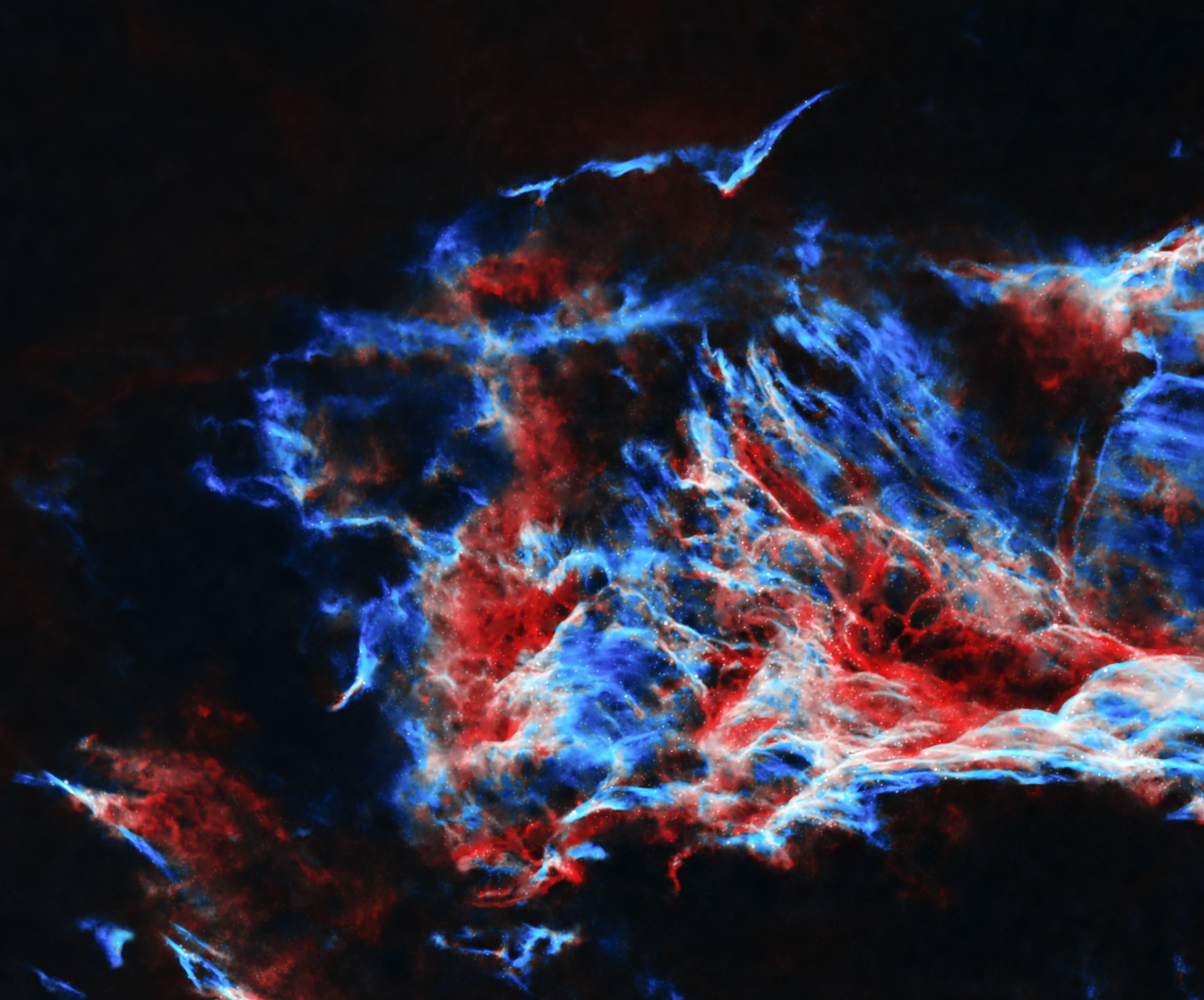
COVERPickering’s Triangle: A close-up, starless section of the Cygnus Loop SNR (Supernova Remnant).  
JANUARYM45 Pleiades Nebula: An open star cluster containing over 1,000 stars formed in the last 100 million years. Hot, blue stars are passing through an interstellar dust cloud, with the blue light from the brighter stars reflected off the interstellar dust.
FEBRUARY  Cone Nebula: Located 2,500 light-years from Earth, this rich star forming region is full of hydrogen gas, reflection, and dark nebulae.  With nearly 14-hours exposure time this narrowband image shows the Christmas Tree open star cluster, Cone Nebula, and the Fox Fur Nebula to good effect.  
MARCHBarnard-22: Close to the aforesaid Pleiades, lies the dark region of the Taurus Molecular Cloud (TMC), which at 430 light-years is the nearest star-forming region to Earth.  Consisting of hundreds of solar masses of primordial hydrogen and helium gas, as well as heavier elements, this vast area of dense stardust obscures almost all light from behind; Barnard-22 forms part of the TMC.      
APRILHelix Nebula*: This iconic planetary nebula in the Aquarius constellation was formed by a star near the end of its life shedding its outer layers, which is expelling the resulting gases into space.
      
MAYThor’s Helmet*:  An emission nebula, produced as a hot dying star, 20-times more massive than the Sun, emits a stream of particles expanding outwards, thus producing an interstellar bubble which here interacts with nearby molecular clouds and gives the nebula its form and glow.  
JUNELower’s Nebula: Located in the outer regions of the Orion constellation, between the Orion and Perseus arms of the Milky Way, the nebula mainly consists of ionized hydrogen, which is thought to be energised by a runaway star situated at its centre.  
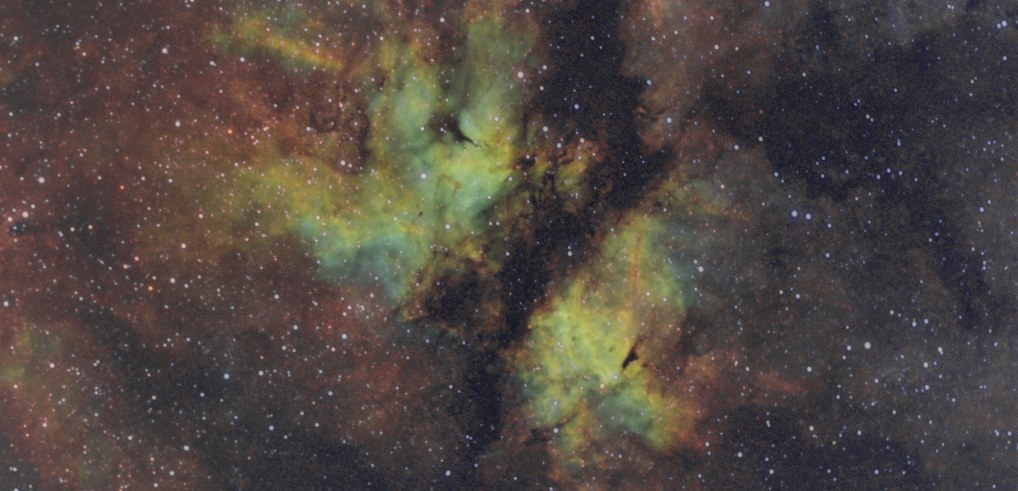
JULYSadr Region: This busy image uses a new widefield lens (8 x greater than my telescope’s field-of-view), framed to include some familiar objects across the very large Cygnus-X region, including the yellow-white supergiant Sadr star, Butterfly Nebula (top right) and the Crescent Nebula (centre).  
AUGUSTCygnus Loop / Western Veil Nebula: Located 1,500 light-years from Earth, this supernova is still expanding at 60 miles per second.  The debris cloud has been sculpted by shock waves from the star’s explosion, with the colours arising from ionized hydrogen (red) and oxygen (blue) gases.    
SEPTEMBERBodes & Cigar galaxies*: Located in the constellation of Ursas Major, Bodes spiral galaxy and the Cigar irregular galaxy are 11.8 million light-years distant. These galaxies have a gravitational lock on each other which has affected the shape and composition of each other.
OCTOBERClamshell, North America & Pelican Nebula:  The Cygnus constellation is rich in targets and by using the new widefield lens, it was possible to capture all three nebulae in one narrowband image.
 
NOVEMBERHorsehead & Flame Nebula: An old favourite located in the Orion constellation, here for the first time imagedin LRGB wavelengths to produce this colourful and exciting image. 
   
DECEMBERSpaghetti Nebula:  The beautiful complexity of this cosmic cataclysm is the product of a massive stellar explosion that took place some 40,000 years ago. Aptly named, the image concentrates on the southern lobe of this very large supernova remnant.  
 HAPPY NEW YEAR & CLEAR SKIES IN 2023