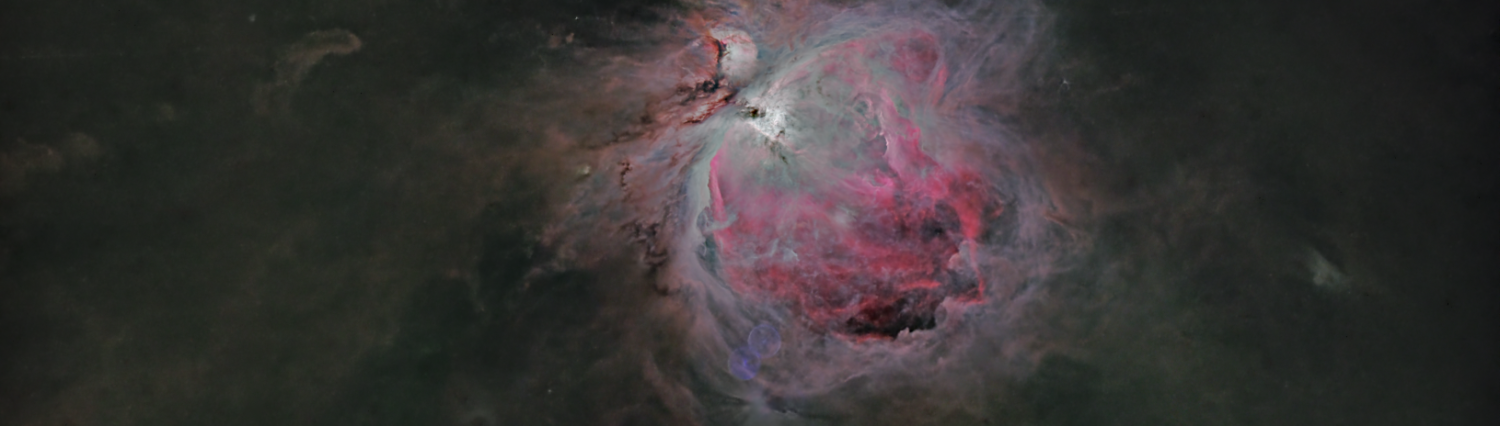
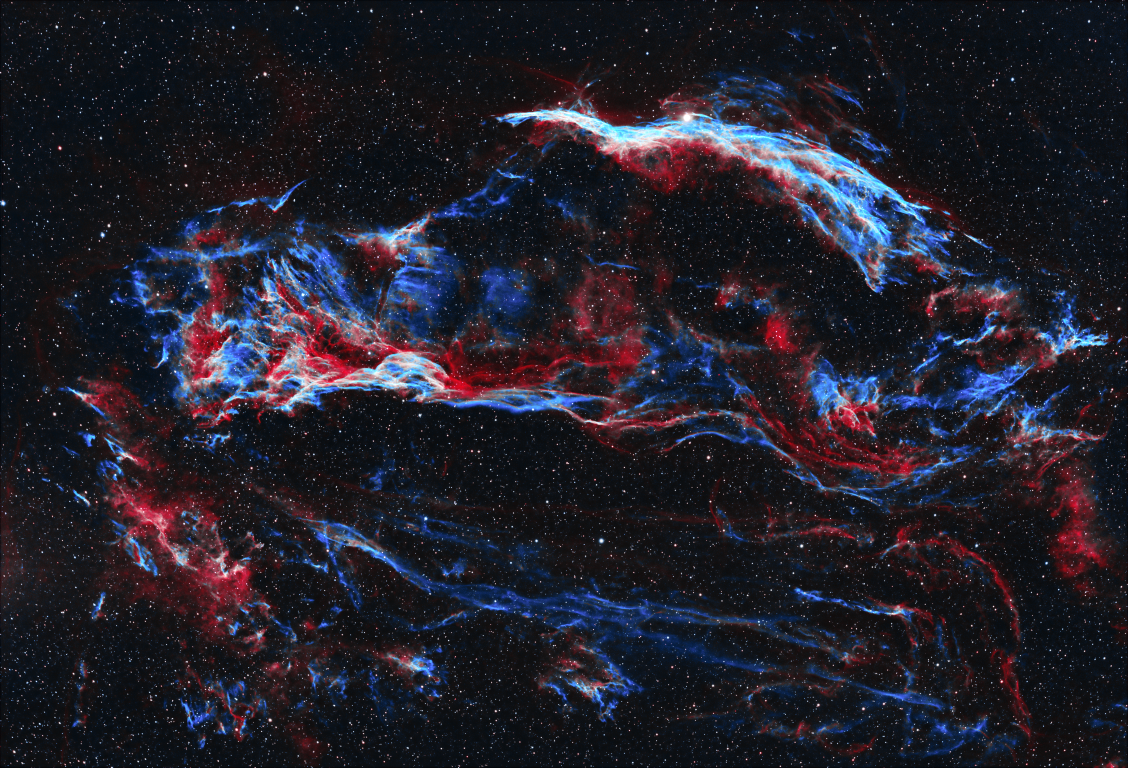
Following my routine summer break from astrophotography, I restarted in early August first using my new Samyang 135 + ZWO ASI1600MM-Cool rig, which immediately demonstrated its ability to produce excellent widefield images of very large objects, in this case the Cygnus Loop. However, also in late spring I had rejigged my William Optics GT81 telescope with the addition of a new ASI294MM camera, the successor to the ASI1600 which had been redeployed to the aforesaid Samyang rig. Having constructed, tested and briefly obtained First Light with this new combination, I then had to wait for the return of astronomical darkness and more suitable objects. Once again, I turned to the Cygnus Loop but this time concentrating on the western and central areas, generally known as the Western Veil and Pickering’s Triangle.
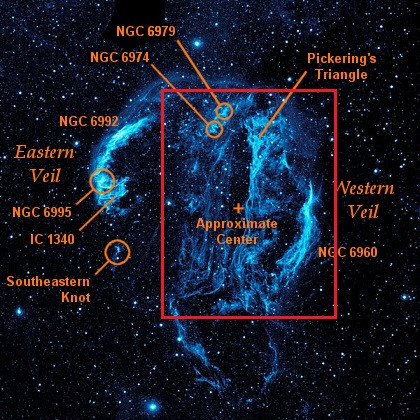
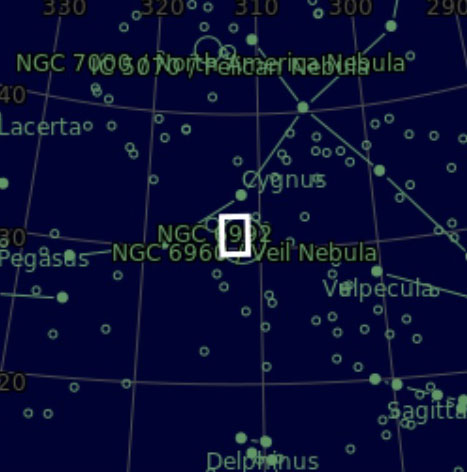
Approximate Image Location (Red Box)
Located 1,500 light-years from Earth within the plane of the Milky Way in the constellation of Cygnus, this large supernova remnant (SNR) occurred between 5,000 and 8,000 years ago. In its entirety the debris cloud has been sculpted by the shock wave from the star’s explosion, to form the Cygnus Loop object that we see today. The coloured light is created by the excitement of hydrogen (red) and oxygen(blue) gasses of the SNR, which is still expanding at about 100 km (60 miles) per second; image integration times for OIII & Ha wavelengths are in the ratio of 2:1 to enhance the weaker oxygen signal. More than twice the width of the full moon and spanning 35 light-years, this section of SNR only just fits into my field-of-view but with careful framing it works perfectly.
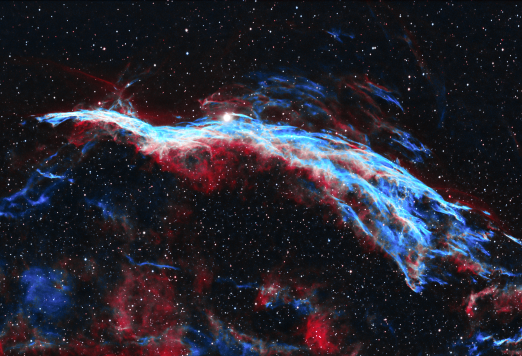
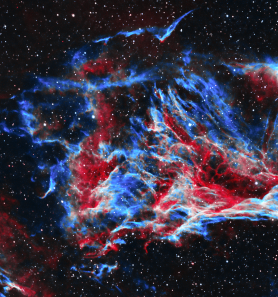
The resulting image successfully brings out the exquisite nature of this exciting SNR, in particular highlighting the abundant waveforms that run throughout the entirety of this dynamic object. Furthermore, the combination of the new ASI294MM camera and 3nm Chroma filters, has produced a vibrant red-blue colour palette that further enhances the said structures. Altogether this diaphanous delectation convincingly demonstrates the power and beauty of the Universe whilst, moreover, pointing to a new level for my astrophotography.
| IMAGING DETAILS | |
| Object | Cygnus Loop Section: Western Veil Nebula (NGC 6960), Pickering’s Triangle, NGC 6979 & 6974 |
| Constellation | Cygnus |
| Distance | 1,500 light-years |
| Size | ~2.9o total |
| Apparent Magnitude | +7.0 |
| Scope | William Optics GT81 + Focal Reducer FL 382mm f4.72 |
| Mount | SW AZ-EQ6 GT + EQASCOM computer control & Cartes du Ciel |
| Guiding | William Optics 50mm guide scope |
| + Starlight Xpress Lodestar X2 camera & PHD2 guiding | |
| Camera | ZWO ASI294MM CMOS sensor |
| FOV 2.87o x 1.96o Resolution 2.50”/pix Max. image size 4,144 x 2,822 pix | |
| EFW | ZWOx8 EFW & 31mm Chroma LRGB filters |
| Capture & Processing | Astro Photography Tool + PHD2 + Deep Sky Stacker, PixInsight v1.8.8-12, Photoshop CC v23.5.0 |
| Image Location & Orientation | Centre = RA 20:48:47.0 DEC +31:00:54.7 Left = North |
| Exposures | Ha 41 x 300 sec (3hr 25m), OIII 82 x 300 sec (6hr 50m) Total Integration Time: 10hr 15 min |
| @ 120 Gain 30 Offset @ -15oC | |
| Calibration | 5 x 300 sec Darks 15 x LRGB Flats & Dark Flats @ ADU 32,000 |
| Location & Darkness | Fairvale Observatory – Redhill – Surrey – UK Typically Bortle 5-6 |
| Date & Time | 27th + 29th + 30th + 31st August 2022 @ +21.00h |
| Weather | Approx. <18oC RH >=65% 🌙 0% New |
 WATCH THIS SPACE(MAN)
Pingback: Cygnus Hat-Trick | WATCH THIS SPACE(MAN)