A year after taking up astronomy as a hobby, at the behest of my elder daughter I started this blog in 2014. Describing the objective and content of the blog I adopted the strapline “A personal discovery of the Universe through astronomy and astrophotography”, which could also be described as a journey. In reality it’s been an adventure consisting of two threads: the knowledge and related science of astronomy and the challenge of astrophotography. As we on Earth pass through space whilst at the same time rotating 360o each year around the sun our view of the night sky changes month-by-month, inevitably returning to the same perspective each 365-days. Against this background I therefore often return to certain objects every few years hopefully armed with new astrophotography skills in pursuit of an even better image.
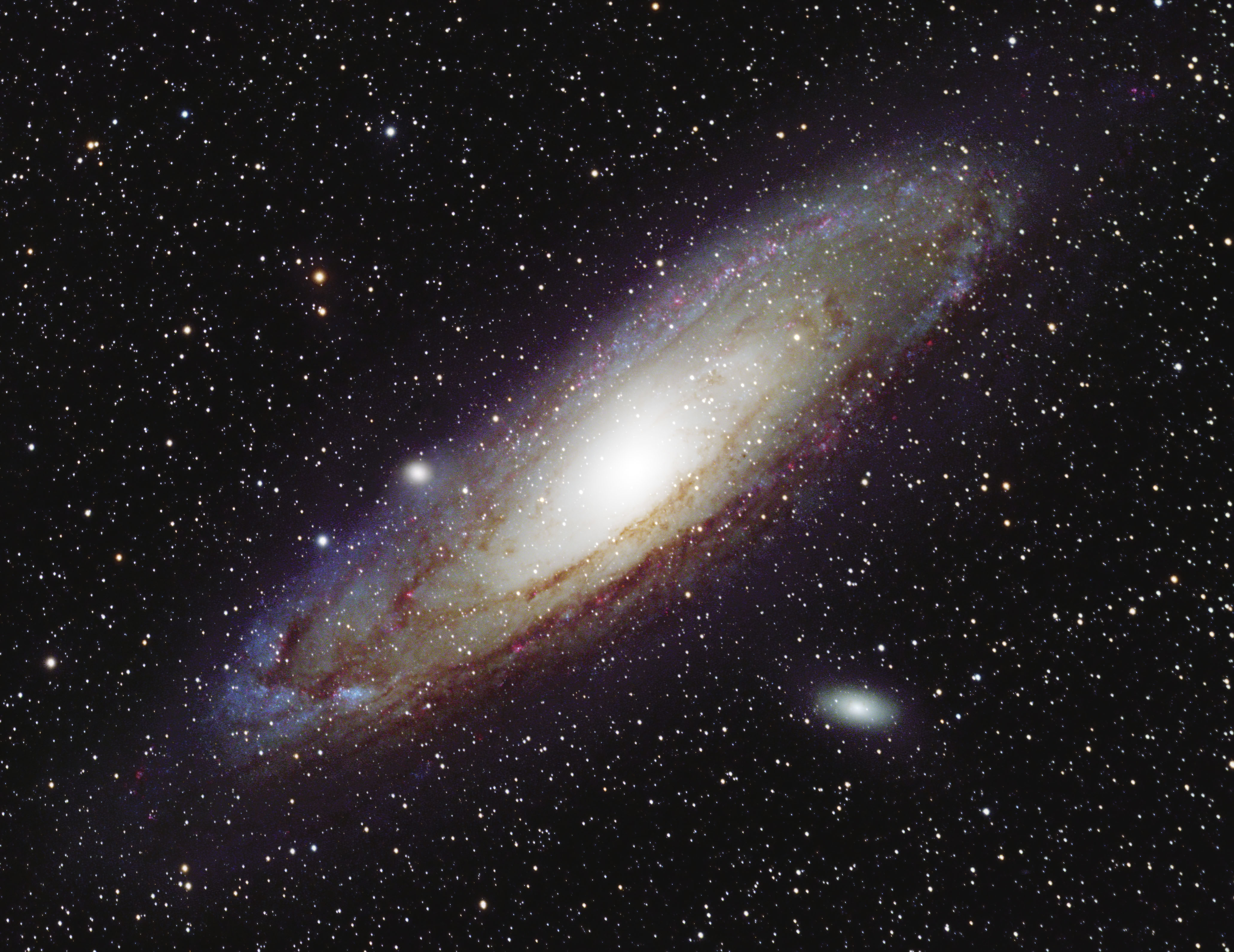
Following such a path I’ve already imaged M31 the Andromeda Galaxy on four separate occasions since 2015, each time enthralled by the majesty and beauty of this barred spiral galaxy. Notwithstanding, it was clear to me that there was significant scope for improvement of the previous images with both better data and processing. Since the last attempt in October 2019 a myriad of positive developments have taken place of which perhaps three stand out: multi-star guiding, the purchase of Chroma filters and in particular the use of PixInsight image for processing – all have been game changers, so much so that reprocessing that image now also looks good – see below.

However, whilst the said progress has already been transformative to my astrophotography during the past year, inevitabky it is imaging conditions that play the most critical role, especially in England. Fortunately during this autumn in both October and November for once the new moon coincided with clear skies, providing no less than six nights over which I was able to obtain almost 12-hours of some of perhaps my best ever data. Based on this I’ve been careful to apply my best new processing skills and am thankful that the final HaLRGB image has turned out very well. In particular, the dust lanes stand out against the bright core and surrounding blue intergalactic dust and gases, which are themselves punctuated by the bright red regions rich in Ha light.

In the blogs that accompanied previous Andromeda images I’ve often referred to the galaxy as a neighbour of the Milky Way but really we are part of the same family known as the Local Group. Some 10-million light years in diameter, more than 30 galaxies form two collections around the two largest galaxies of Andromeda and the Milky Way. Gravitational forces play the central role in controlling this group, especially Andromeda which is itself moving towards the Milky Way at about 70 miles per second and is destined to merge in about +/- 4 billion years; recent studies indicate that an outer halo of stars extending up to 2-billion light years from Andromeda may be in the influence of the galaxy, suggesting this event may already have started!
Thereby my personal journey of astrophotography is set to continue somewhat in parallel with that of Andromeda, which will I am sure lead to further hopefully even better images of this exciting deep sky object that is perfect for my equipment – after all we’re getting closer at the rate of 2,207,520,000 miles each year!
| IMAGING DETAILS | |
| Object | M31 the Andromeda Galaxy. |
| Constellation | Andromeda |
| Distance | 2.5 million light-years |
| Size | 3.2o x 1o or 220,000 light-years |
| Apparent Magnitude | +3.44 |
| Scope | William Optics GT81 + Focal Reducer FL 382mm f4.72 |
| Mount | SW AZ-EQ6 GT + EQASCOM computer control & Cartes du Ciel |
| Guiding | William Optics 50mm guide scope |
| + Starlight Xpress Lodestar X2 guide camera & PHD2 guiding | |
| Camera | ZWO1600M M-Cool mono CMOS sensor |
| FOV 2.65o x 2.0o Resolution 2.05”/pix Max. image size 4,656 x 3,520 pix | |
| EFW | ZWO x8 EFW + Chroma LRGB & Ha OIII SII 3nm filters |
| Capture & Processing | Astro Photography Tool , Deep Sky Stacker, PixInsight 1.8.8-8, Photoshop CS3 & Topaz AI Denoise |
| Image Location & Orientation | Original image centre RA 00:42:48 DEC 41:15:05 Final image rotated 180o i.e. Bottom = North + 5% crop |
| Exposures | L 71 x 60 sec R17 G 20 B 27 x 300 sec Ha 35 x 600 sec Total time: 11hr 46 minutes |
| @ 139 Gain 21 Offset @ -20oC | |
| Calibration | Darks 5 x 600 sec + 5 x 300 sec + 60 x 60 sec HaLRGB Flats & Dark Flats x15 each @ ADU 25,000 |
| Location & Darkness | Fairvale Observatory – Redhill – Surrey – UK Typically Bortle 5-6 |
| Date & Time | 1st 5th 6th 8th 9th October & 4th November 2021 @ +/-19.00h |
| Weather | Approx. 14o to 5oC RH >=65% to +85% 🌙 New Moon |

 WATCH THIS SPACE(MAN)