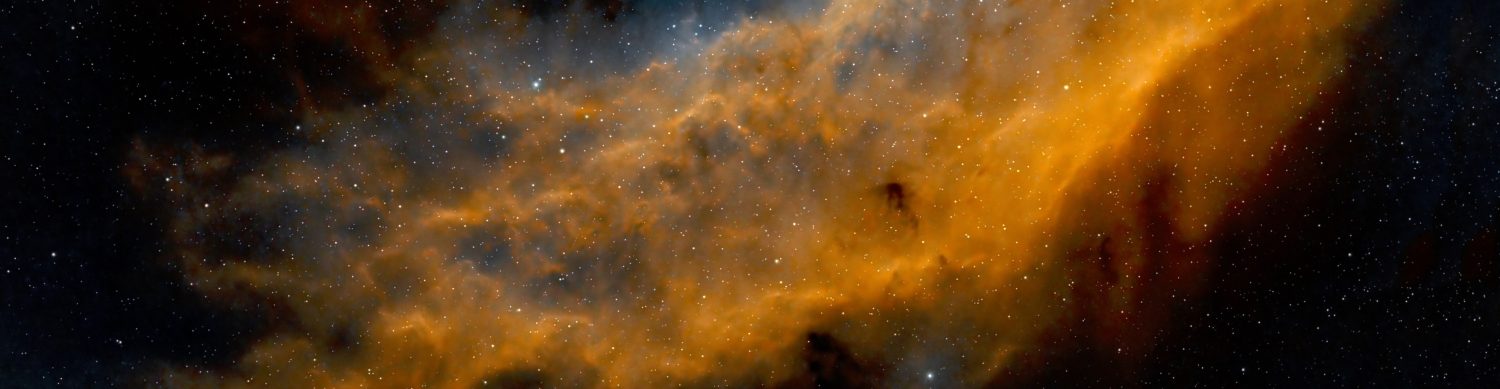
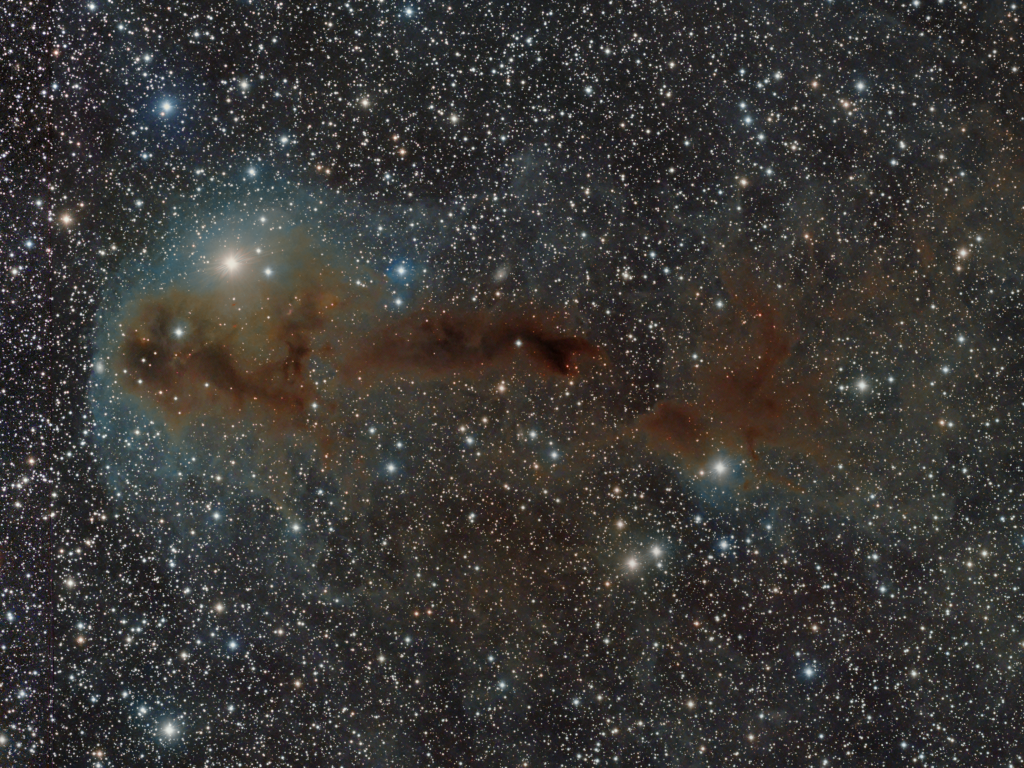
Somewhat tongue-in cheek, astrophotography is often referred to as something of a dark art and to be fair it sometimes seems that way, particularly when it comes to processing. My main interests in astrophotography are Deep Sky Objects such as emission nebulae, galaxies and planetary nebula but have long aspired to capture a more elusive category that abounds throughout the Universe – dark nebula.
Popular with astrophotographers, emission nebulae consist of vast clouds of ionised gases and regions of interstellar dust which reflect light from the said gases and or from stars and stellar nurseries that lie within – depending on their make-up the results are colourful in both broadband and narrowband wavelengths. Dark or absorption nebulae are also a type of interstellar cloud but are so dense they completely obscure and / or soak-up visible light emitted from objects behind or within, which as a result contrasts with general light flux of the Universe forming large dark regions. Because of their darkness they are usually faint, hard to see and moreover, difficult to image, especially from locations with light pollution.
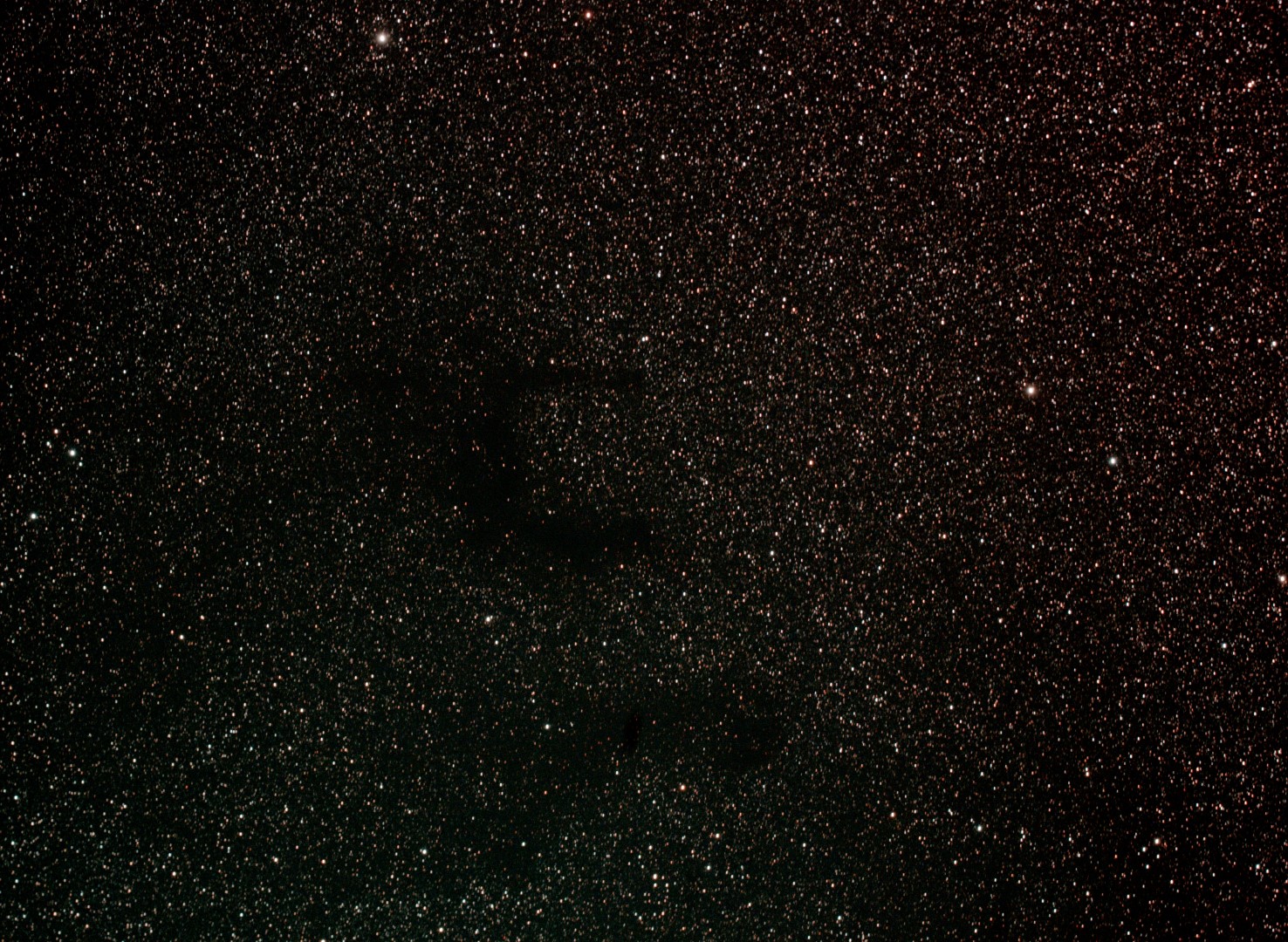
The Horsehead Nebula is a dark nebula that has formed a part of my previous images but I’ve only imaged an isolated dark nebula once before – Barnard 142-3, which for obvious reasons is also known as the E-nebula (see above & here). Larger more complex dark nebulae require much darker skies to image than prevail at Fairvale Observatory, such as in New Mexico, USA where the Deep Sky West observatory is located and on this occasion has produced my first ‘serious’ image of a stand-alone dark nebula.
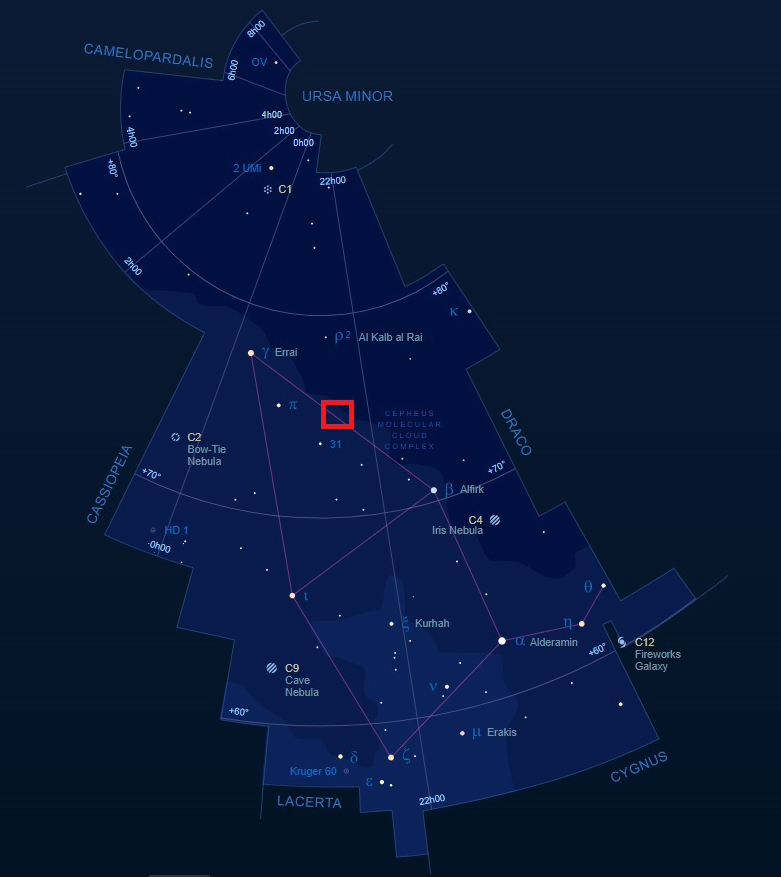
Lynds Dark Nebula (LDN) catalogue of dark nebulae was compiled by the eponymous Beverly T. Lynds in 1962 and is based on the study of red and blue photographic prints from the National Geographic-Palomar Observatory Sky Atlas. Situated in the north close to Polaris, the constellation of Cepheus has a number of dark nebulae, of which LDN 1250 is part of a huge complex of dark nebula surrounded by dust and scattered light from the stars of Cepheus.

Imaged here in LRGB the features come out well in all wavelengths, however, such are the subtleties of the dark nebula components I found processing difficult and required plenty of ‘dark art’ techniques. The final image at the top of the page shows to good effect the main dark nebula, togeher with widespread but less opaque nebulosity and star colours, as well as some distant galaxies lurking in the background that together has produced a satisfying and very interesting outcome.
| IMAGING DETAILS | |
| Object | LDN 1250 & 1251 |
| Constellation | Cepheus |
| Distance | 1,000 light years |
| Size | Main nebula approximately 1o ~ 17 light-years |
| Apparent Magnitude | – |
| Scope | Takahashi FSQ 106 FL 530mm f/5 + Moonlight Nightcrawler focuser |
| Mount | Paramount MyT |
| Guiding | Yes |
| Camera | QSI 683-WSG8 KAF-8300 full frame CCD sensor 5.4nm pixels |
| FOV 1.94o x 1.46o Resolution 2.1”/pix. Image array 3326 x 2,507 pix | |
| Processing | Deep Sky Stacker, PixInsight v1.8.8-7, Photoshop CS3, Topaz Denoise |
| Image Location & Orientation | Centre – RA 22:28:54.702 DEC +75:09:45.158 North = Up |
| Exposures | 23L + 18R + 16G + 17B x 900 secs @ -15C Total Integration Time: 18hr 30min |
| Calibration | 41 x 900 secs Darks x 50 Bias & x16 LRGB Flats |
| Location & Darkness | Deep Sky West – amateur hosting facility near Rowe, New Mexico – USA SQM Typically >= 21.7 |
| Date & Time | Q4 2020 |
 WATCH THIS SPACE(MAN)