Galactic Bloom


M63 HaLRGB FinalCropRotate3 (Large)-denoise-denoise

You don’t have to be an astronomer to appreciate Van Gogh’s wonderful evocation of the night sky in his 1889 painting Starry Night.  He knew a thing or two about sunflowers too and I’ve often stopped by the National Gallery in Trafalgar Square to take a peep at his famous painting of them.  However, it was still more than thirty years after completing these paintings that we first learned that such features as galaxies and the rest of the Universe even existed beyond our own Milky Way.  Since then our knowledge of the cosmos has expanded considerably and today provides no end of imaging opportunities for the astrophotographer, subject to clear skies!

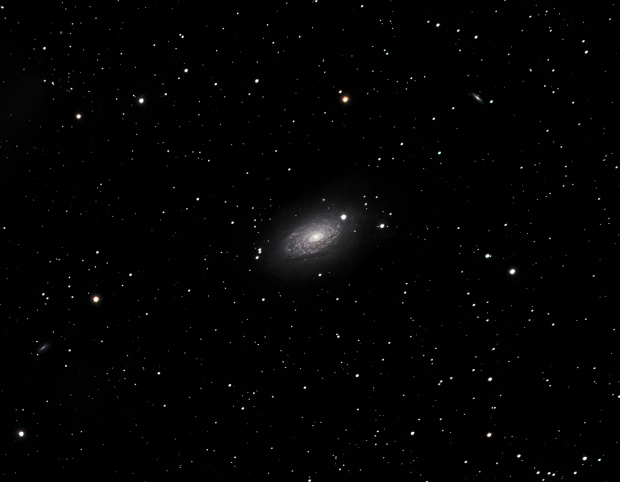
Having started the galaxy season with M106 and, given the excellent conditions that prevailed throughout much of Spring this year, I chose to return to the same area of the sky again to image M63, AKA the Sunflower Galaxy.  M63 has a spiral form but with no apparent central bar and in visible light lacks large scale spiral structure, although two-arm structures are noticeable in near infra-red.  Instead the dust lanes are extensively disrupted producing a patchy appearance and is thus classified as a flocculent galaxy – in this case looking something like a sunflower.

As previously discussed, most galaxies are a real challenge for my equipment but an earlier experiment indicated it might just be possible to image M63, the trick would be obtaining sufficient integration time.  Fortunately three clear nights approaching a new moon in April provided over 8-hours of good subs, which I’m pleased to say resulted in a decent final image after all.  The background sky is less busy than I would wish but there’s nice colour in the stars and also a few very small faint fuzzies on close inspection.  Notwithstanding,  M63 is clearly the star of the show (no pun intended) with the so-called flocculation clearly evident and numerous random dust lanes criss-crossing the entire galactic disc.

Although in 1924 Edwin Hubble’s recognition that galaxies, such as our own, existed outside the Milky Way, M63 was discovered by Pierre Méchain and catalogued by Charles Messier in 1779, long before Van Gogh’s paintings.  He might conceivably have known of its presence therefore but not what it was and would surely be inspired to see and know about the Sunflower Galaxy as we do today.

IMAGING DETAILS
Object M63, NGC 5055 AKA Sunflower Galaxy
Constellation Canes Venatici
Distance 29 million light-years
Size 12.6’ x 7.2’
Apparent Magnitude +9.3
 
Scope  William Optics GT81 + Focal Reducer FL 382mm  f4.72
Mount SW AZ-EQ6 GT + EQASCOM computer control & Cartes du Ciel
Guiding William Optics 50mm guide scope
  + Starlight Xpress Lodestar X2 camera & PHD2 guiding
Camera ZWO1600MM-Cool mono  CMOS sensor
  FOV 2.65o x 2.0o Resolution 2.05”/pix  Max. image size 4,656 x 3,520 pix   
EFW ZWOx8 + ZWO LRGB & Ha OIII SII 7nm filters 
Capture & Processing Astro Photography Tool + PHD2 +  Deep Sky Stacker & Photoshop CS3
Image Location              & Orientation Centre  RA 13h 15m 49.47”      DEC +42o 01’ 45.62”                     

Top = North approx..     

Exposures 30 x L  17 x R  18 x G  23 x B  12 x Ha x 300 sec

Total Time:  8hr 20 min    

  @ 139 Gain   21  Offset @ -20oC    
Calibration 5 x 300 sec Ha + 10 X 300’ RGB  Darks,  20 x 1/4000 sec Bias  10 x  HaRGB Flats               @ ADU 25,000
Location & Darkness Fairvale Observatory – Redhill – Surrey – UK        Typically Bortle 5-6
Date & Time 14th 15th & 16th April 2020  @ +22.00h  
Weather Approx. <=8oC   RH 60 – 70%                  🌙 40% waning

Return of the Lion


Leo LRGB RotateX denoise2 (Medium)

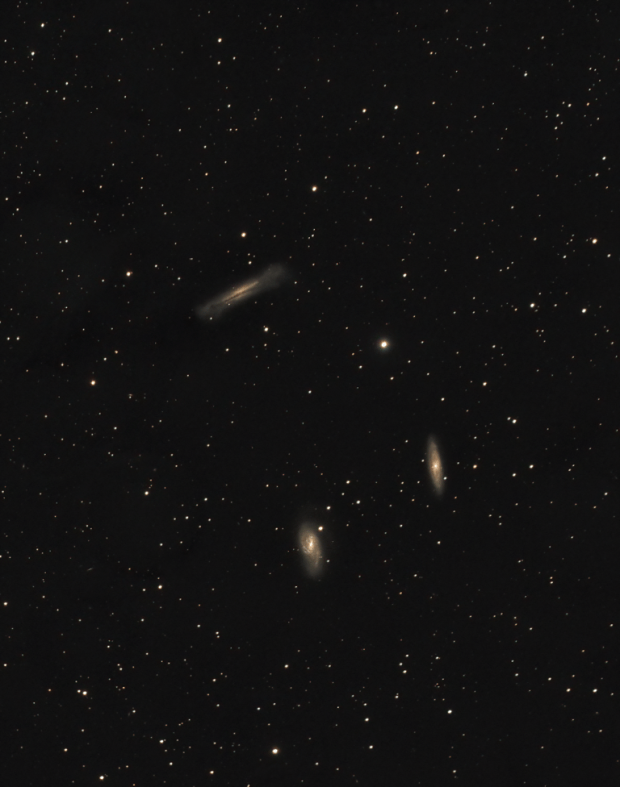
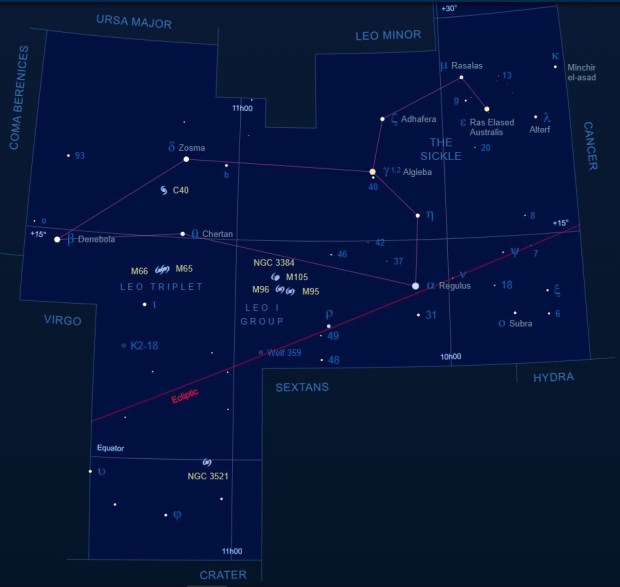
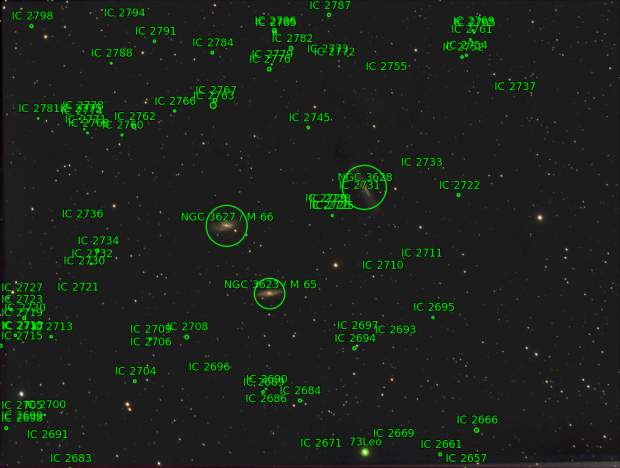
The period between March and May provides an excellent opportunity to see and image objects in and around the constellation of Leo.  Located close to the ecliptic, this area of the sky is packed with galaxies and can therefore be seen from most parts of the northern and southern hemispheres.  Located to the east of the Leo 1 Group is perhaps the best known of these M65, M66 and NGC 3628, also known as the Leo Triplet.

Leo Constellation

I last imaged this attractive group of galaxies shortly after changing to a CMOS mono camera in March 2017.  Unfortunately on that occasion it was only a test with just 45 minutes integration time at 300-gain, so a more serious attempt to image these three beauties was obviously long overdue.  On this occasion imaging over three nights during late March and then finally again in April produced well over 7-hours of integration time.

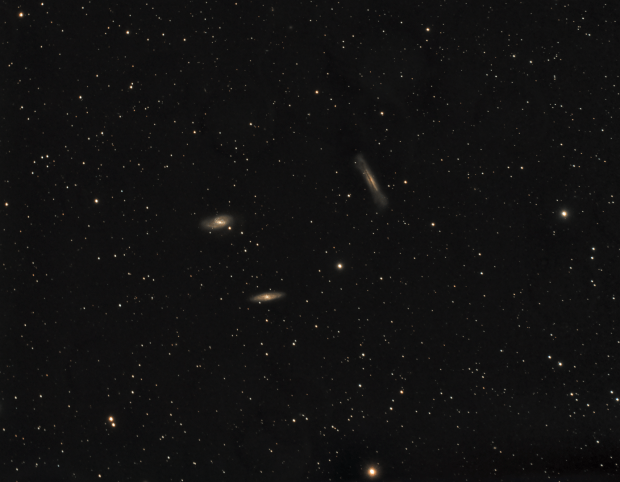
Whilst the earlier test image showed promise, each of these objects is small and certainly push my equipment it to the limit.  However, the benefit of much longer time and imaging at unity settings is self-evident.  I’m very pleased with the final LRGB image, which shows good detail and colour for all three galaxies.  Furthermore, the advantage of a wider view using the William Optics GT81 and ZWO ASI1600MM-Cool camera combination, has also captured numerous other colorful stars and even smaller galaxies, thereby providing a more interesting background for the main show – the Leo Triplet (see below).

Leo LRGB Final (Large)

4184511

Each of the galaxies that make up the Leo Triplet is tilted at different angles relative to the view from Earth, thereby producing a variety of form and perspective in the image (cropped & adjusted to accurate orientation @ top-of-the-page).  In addition, various distortions of the galactic discs and other effects demonstrate that the three galaxies in the M66 Group have all been affected by gravitational interactions with each other.  Seen edge-on, the unbarred spiral galaxy NGC 3628 clearly shows a broad band of dust stretching along its outer edge, thus obscuring young stars within the galaxy’s spiral arms.  NGC 3628 seems to be the most affected by the said intergalactic forces which, moreover, has drawn out a tidal tail from the eastern side of the galaxy spanning some 300,000 light years; unfortunately the aforesaid tail is very faint and does not often appear in images – something for another day and a larger telescope!

IMAGING DETAILS
Objects The Leo Triplet or M66 Group: M65, M66, NGC 628                                                  AKA the Hamburger or Sarah’s Galaxy
Constellation Leo
Distance 35 million light-years
Size M65 = 8.71’ x 2.45’   M66 = 9.1’ x 4.2’   NGC 3628 = 15.0’ x 3.6’
Apparent Magnitude M65 +10.3    M66 +9.97    NGC 3628  +9.4
 
Scope  William Optics GT81 + Focal Reducer FL 382mm  f4.72
Mount SW AZ-EQ6 GT + EQASCOM computer control & Cartes du Ciel
Guiding William Optics 50mm guide scope
  + Starlight Xpress Lodestar X2 camera & PHD2 guiding
Camera ZWO1600MM-Cool mono  CMOS sensor
  FOV 2.65o x 2.0o Resolution 2.05”/pix  Max. image size 4,656 x 3,520 pix   
EFW ZWOx8 + ZWO LRGB & Ha OIII SII 7nm filters 
Capture & Processing Astro Photography Tool + PHD2 +  Deep Sky Stacker & Photoshop CS3
Image Location              & Orientation Original Subs:  Centre  RA 11h 19’ 44.95”      DEC +13o 19’ 06.48”                       

Main Image Top = East  + Cropped Image Top = North     

Exposures 180 sec x 42 L Ha,  x37 RGB  = 153subs

Total Integration Time 7hr 39min   

  @ 139 Gain   21  Offset @ -20oC    
Calibration 10 x 180 sec Darks  20 x 1/4000 sec Bias  10 x  LRGB Flats

@ ADU 25,000

Location & Darkness Fairvale Observatory – Redhill – Surrey – UK        Typically Bortle 5-6
Date & Time x4 nights: 18th + 29th + 31st March + 26th April 2020  @ +21.00h  
Weather Approx. 2 – 8oC   RH 60 -75%              🌙 19 – 43% waxing