
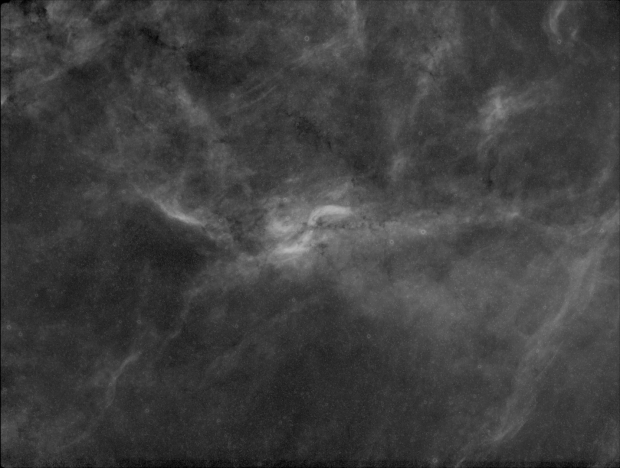
In a quest to find and image new targets, my curiosity was recently drawn towards a more obscure catalogue of HII emission nebula, in particular DWB 111, AKA Simeis 57 or The Propellor Nebula. The object was first catalogued in the early 1950s by the Crimean Astronomical Observatory at Simeiz, Ukraine as number 57 of a total of 306 HII regions! Then in 1969 H.R. Dickel, H. Wendker and J. H. Bieritz (DWB) developed a catalogue of 193 HII optically visible HII objects in the Cygnus-X region of the Cygnus constellation, which included DWB 111; strictly speaking The Propellor consists of DWB 111 & 119 with other close-by features DWB 107,108, 118, 125 & 126.
Whatever the nomenclature, suitable catalogues that can be used with Cartes du Ciel for the purpose of locating DWB 111 were difficult to unearth but I eventually found and installed the necessary data. Shortly thereafter on 5th September, for the first time I successfully directed my telescope to this hitherto unseen and to some extent neglected part of the night sky. Wow!
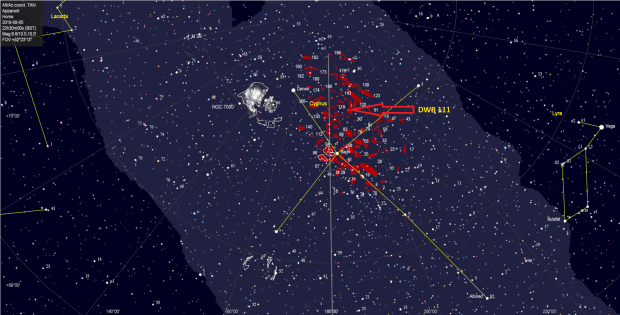
The target is located between Vega and Deneb, which at this time of the year tracks northwest directly above Fairvale Observatory and means the imaging opportunity is confined to just about 2 hours before disappearing behind the roof of my house! As an HII region and with limited time, I therefore concentrated on imaging the Ha wavelength, with only a few SII and OIII subs, which are both weak in nature. The aptly named Propellor Nebula lit up my initial test exposure at the centre of the screen and was obviously going to make an excellent object with more subs. However, with a total Ha-integration time over two nights of some 110 minutes of Ha data, it was the details seen in surrounding region that took my breath away once processed (see top-of-page).
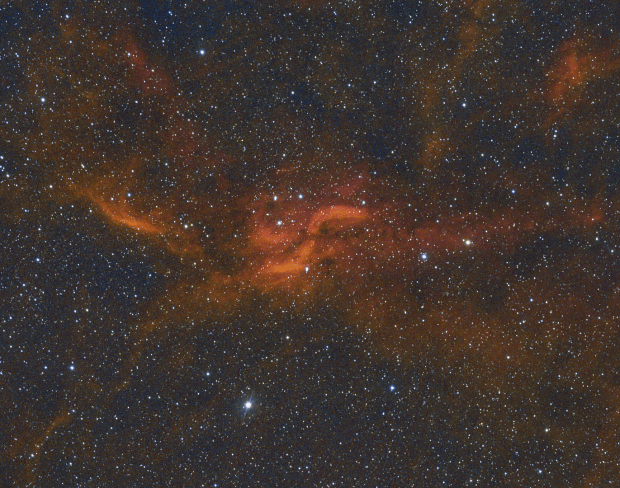
With a 2.65o x 2.0o field-of-view, my equipment provides a good view of The Propellor Nebula but stretching the Ha image stack revealed the aforementioned wider area, which is absolutely full of HII features that obviously continue well beyond the image. Pointing to unseen forces, numerous filament-like threads produce fascinating structures that run throughout the nebulosity, which makes for a truly exciting image. With limited OIII and SII subs, colours were difficult to tease out using the HST palette but, nonetheless, the SHO (below) and HSO (bottom-of-page) images are also pleasing and hold much promise when additional integration time can eventually be obtained in the future.
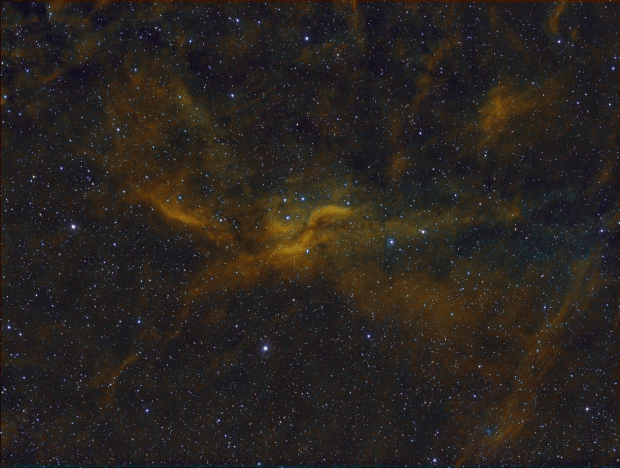
Unfortunately it seems that little is known about DWB 111, including its distance from earth and it is therefore difficult to estimate that actual size of the aforesaid view. Notwithstanding, it is clearly very extensive with exquisite details that seem to represent something of the very elusive fabric of reality that is space itself and it is therefore difficult to understand why DWB 111 and this exciting region of the night sky is not given more attention by astronomers. Rich pickings abound and I hope to return one day to do this exciting area greater justice.
| IMAGING DETAILS | |
| Object | DWB 111, Simeis 57 AKA The Propellor Nebula |
| Constellation | Cygnus |
| Distance | ? |
| Size | <=25’ |
| Apparent Magnitude | ? |
| Scope | William Optics GT81 + Focal Reducer FL 382mm f4.72 |
| Mount | SW AZ-EQ6 GT + EQASCOM computer control & Cartes du Ciel |
| Guiding | William Optics 50mm guide scope |
| + Starlight Xpress Lodestar X2 camera & PHD2 guiding | |
| Camera | ZWO1600MM-Cool mono CMOS sensor |
| FOV 2.65o x 2.0o Resolution 2.05”/pix Max. image size 4,656 x 3,520 pix | |
| EFW | ZWOx8 + ZWO LRGB & Ha OIII SII 7nm filters |
| Capture & Processing | Astro Photography Tool + PHD2 + Deep Sky Stacker & Photoshop CS3 |
| Image Location & Orientation | Centre RA 20:16:78 DEC 43:23:33
Top = North |
| Exposures | 22 x 300 sec Ha, 8 x 300 sec OIII & SII (Total time: 3hr 10 minutes) |
| @ 139 Gain 21 Offset @ -20oC | |
| Calibration | 5 x 300 sec Ha, OIII & SII Darks, 20 x 1/4000 sec Bias 10 x Ha, OIII & SII Flats @ ADU 25,000 |
| Location & Darkness | Fairvale Observatory – Redhill – Surrey – UK Typically Bortle 5-6 |
| Date & Time | 5th & 7th September @ +22.30h |
| Weather | Approx. 16oC RH <=75% 🌙 ¼ waxing |
 WATCH THIS SPACE(MAN)