Once again this year between April and August I moved to the so-called Fairvale Observatory South, AKA the “Shed Observatory” situated at the end of the garden, in order to provide imaging opportunities of the northern sky, which is otherwise completely blocked from view by my house from the north position. It’s not perfect but I was able to tease out some new classic objects, as well as revisit others seen from here for the first time last year. Despite having a view of Polaris from this location, I’d previously battled with guiding on circumpolar tracking objects and this year decided to grasp the nettle and address the problem.
Given prior success with the PHD Drift Align technique for polar alignment without a view of Polaris, as from Fairvale Observatory North, this time I decided to try the alternative PHD Polar Drift Alignment (PDA) method, which is based on direct visual alignment with Polaris. However, although quite straight forward, after a number of attempts I still failed to achieve a decent result using this approach. By this time astronomical darkness had ceased for more than eight weeks over the summer solstice period and I took a break from astronomy to ponder a solution.
Developed by an enthusiast in the UK, Sharpcap is a fully working, free image capture software. However, for the sum of £10 the Pro-version contains a number of useful additional features, including a polar alignment routine that is highly recommended by numerous users on the Stargazers Lounge Forum – after spending my £10 I can see why. There are similarities with PHD’s PDA method but Sharpcap is even easier to use and, more importantly, very soon I achieved a reasonable polar alignment from the Shed Observatory for the first time!
Perhaps the surprising theme of 2019 has been the discovery of various classic objects that could, despite previous expectations to the contrary, be seen for imaging from Fairvale Observatory, albeit with some difficulties at times: M101 Pinwheel Galaxy & M51 Whirlpool Galaxy. Now this summer this theme was about to continue, with the first cab off the rank being NGC 7380, AKA the Wizzard Nebula in the Constellation of Cepheus.
The Wizzard is an attractive emission nebula that forms a popular narrowband object for astrophotographers, frankly I was astonished to find it was within my sight from the Shed Observatory but not for long. With astronomical darkness lasting only 3-hours at the beginning of August, starting at about 23.30h there was no more 2-hours for imaging before the target disappeared behind my +15ft hedge
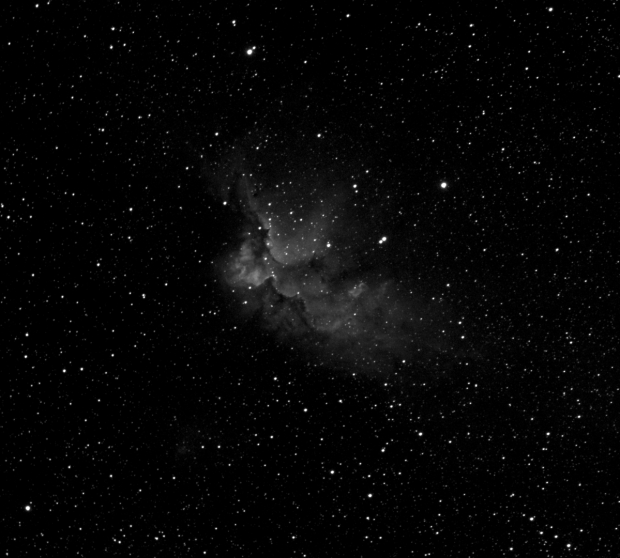
Notwithstanding, I was keen to see how this relatively small object (25 arc minutes) would look with my equipment. As so often, the stronger Ha-wavelength produced a half reasonable result (see above) with only 45-minutes (15×3 minutes) integration time but with only about 30-minutes (10×3 minutes) each, incorporating the weaker OIII and SII wavelengths only produced rather noisy and washed out HST images (below left SHO, right HOO). However, I would be confident that with longer integration times, on another day from a better location, my equipment could probably do justice to the Wizzard.


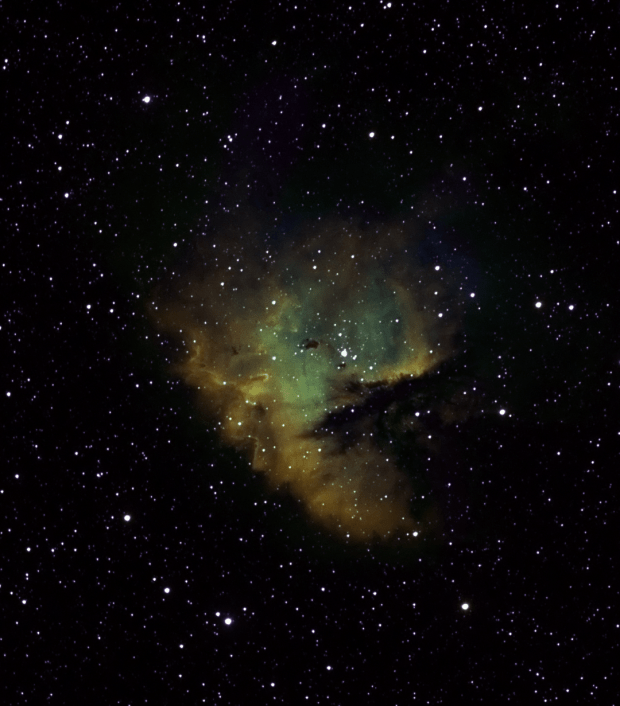
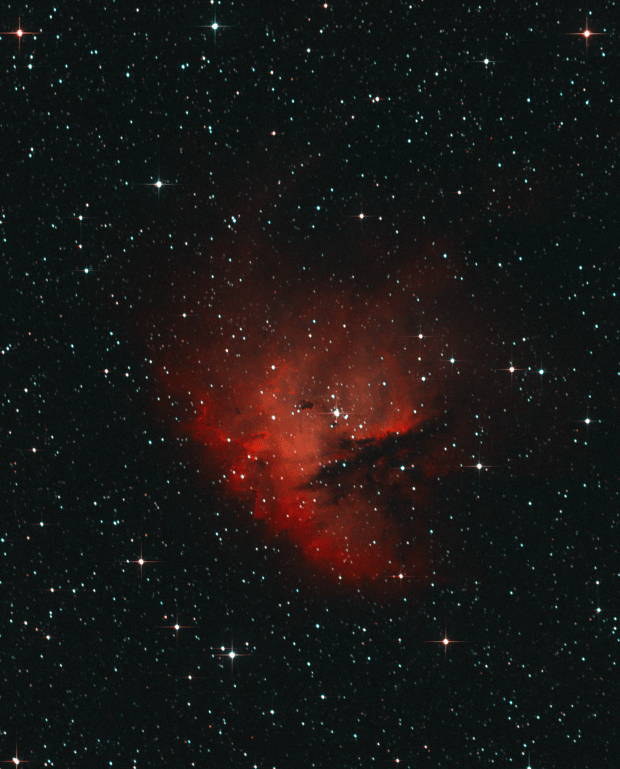
As the Cygnus constellation then came into view three weeks later, I discovered another favourite object NGC 281 AKA the Pacman Nebula. By now astronomical darkness had improved slightly, thus providing a 50% increase of integration time of nearly 3-hours! Though still somewhat limited in time, Pacman is however a little larger than the Wizzard (35 v 25 arc minutes), slightly brighter, with overall stronger narrowband, thus altogether providing a better imaging prospect. The resulting HST images of Pacman therefore did not disappoint in SHO (top-of-the-page) and HaOO (below).
Whilst imaging from the Shed Observatory has resulted in a number of imaging firsts and proved a lot of fun over the last two summers, I’m now of the opinion that I to further improve my field-of-view and imaging times looking north I need to move away from the Shed and into the garden, as was originally planned; the +15ft hedges adjacent to the Shed location frequently curtails sight lines and a move slightly north could add up to 2-hours imaging time – we shall see. Furthermore, the discovery of Sharpcap and its Polar Alignment function is certainly a game changer, that I hope to put to good use again next year when I move into the garden for the summer.
| IMAGING DETAILS | |
| Object | NGC 281 AKA Pacman Nebula |
| Constellation | Cassiopeia |
| Distance | 9,500 light-years |
| Size | 35 arc minutes |
| Apparent Magnitude | +7.4 |
| Scope | William Optics GT81 + Focal Reducer FL 382mm f4.72 |
| Mount | SW AZ-EQ6 GT + EQASCOM computer control & Cartes du Ciel |
| Guiding | William Optics 50mm guide scope |
| + Starlight Xpress Lodestar X2 camera & PHD2 guiding | |
| Camera | ZWO1600MM-Cool mono CMOS sensor |
| FOV 2.65o x 2.0o Resolution 2.05”/pix Max. image size 4,656 x 3,520 pix | |
| EFW | ZWOx8 + ZWO LRGB & Ha OIII SII 7nm filters |
| Capture & Processing | Astro Photography Tool + PHD2 + Deep Sky Stacker & Photoshop CS3 |
| Image Location & Orientation | Centre RA 00:55:00 DEC 56:40:29
Right = North |
| Exposures | Ha 15 x 300 sec OIII & SII 10×300 sec (Total time: 2hr 55 minutes) |
| @ 139 Gain 21 Offset @ -20oC | |
| Calibration | 5×300 sec Darks 20 x 1/4000 sec Bias 10 x Ha, OIII & SII Flats @ ADU 25,000 |
| Location & Darkness | Fairvale Observatory – Redhill – Surrey – UK Typically Bortle 5-6 |
| Date & Time | 26th August 2019 @ +22.15h |
| Weather | Approx. 19oC RH 70% 🌙 Crescent waning |
 WATCH THIS SPACE(MAN)