Being galaxy season it was appropriate that the BAA spring meeting this year on 27th April was all about – galaxies. This was my first BAA meeting and I’m pleased to say it was well attended and very worthwhile, I especially enjoyed the following presentations:
- Prof. Richard Ellis: The Quest for “Cosmic Dawn”;
- Prof. Chris Impey: Einstein’s Monsters: Black Holes at the Heart of Galaxies;
- Stewart Moore: Galaxies: A Brief History of Discovery, and
- Owen Brazell: Observing Galaxy Clusters.
It seems incredible that just 100-years ago the prevailing view was that Universe consisted entirely of the Milky Way, though that was soon about to change. Whilst Immanuel Kant had proposed the possibility of galaxies outside our own as long ago as 1755, it was not until Edwin Hubble’s work at the Mount Wilson Observatory, California that the existence of other worlds, in the form of galaxies, was proven and accepted during the period between 1924 and 1929.
Following Copernicus’s controversial theory in 1543 that the Earth orbited the Sun, the evidence this time that there was much, much more beyond the Milky Way was equally profound in its implications, if not more so. However, I was surprised to learn that it was Vesto Slipher and not Hubble who discovered the redshift of galaxies that was fundamental to understanding that galaxies existed outside the Milky Way that were moving away from us – it would seem to me that he deserves much greater credit as well as Hubble for this work. The current estimate is that there are some 100 to 200 billion galaxies in the observable universe but new research now estimates that the total number is likely to be at least ten times greater! Either way there are many other worlds out there.
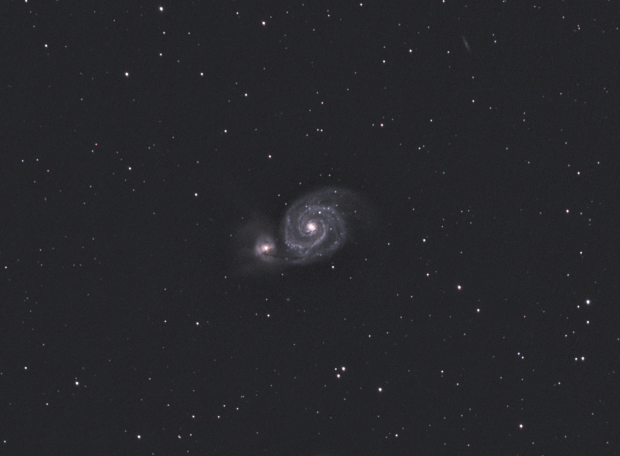
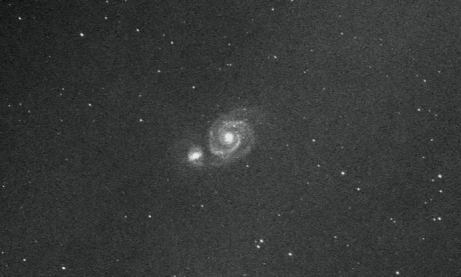
After recently learning that I could after all see and image a few larger galaxies from Fairvale Observatory in-and-around the Ursa Major constellation, it was to my great delight when I then discovered that one of them was M51 AKA the Whirlpool Galaxy. I’ve seen many images of this wonderful object and was frustrated that it seemed to be completely out of sight from here but thankfully that is not the case. Armed with this knowledge, following an imaging session of M101 at the end of March, I therefore went on and immediately grabbed a single Luminance test sub of M51 (below) before it disappeared behind the roof of my house, (a) because I could, and (b) to see how it looked with my equipment. The answer was that it was almost certainly a viable target for another night when more time was available.
While located just above the star Alkaid in Ursa Major, M51 is now included within the nearby constellation Canes Venatici; created by Johannes Hevelius in the 17th Century, M51 was previously in Ursa Major. One of the more famous grand-design spiral galaxies i.e. with prominent well-defined spiral arms, the Whirlpool Galaxy forms a striking image as it interacts and distorts the dwarf galaxy NGC 5195 located at the tail of its outer second arm. The exquisite structure of M51 is further enhanced by large star-forming regions along the spirals, which are picked out by the associated hydrogen alpha gases.
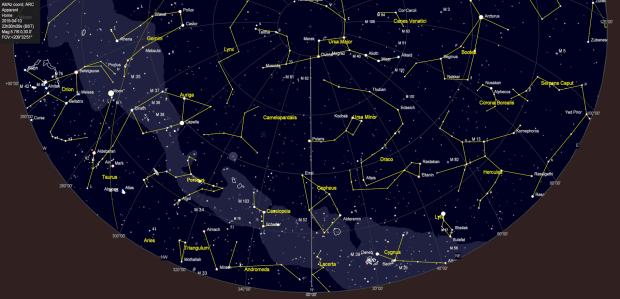
Timing is everything: M51 is in a tricky position seen from Fairvale Observatory, obscured for much of the time at the north viewing location by the house and from the south location by a 20ft hedge – in between there’s a maximum window of no more than 2.5 hours for imaging!
The smaller dimensions of the M51 galaxy would normally place it at the limit of my equipment for imaging but is helped by its aforementioned clear-cut features, strong colours, favourable apparent magnitude and its location towards the zenith immediately above my observatory. This has long been in my top-10 ‘must-do’ imaging list but hitherto was thought to be out of view. Unlike M101, which lies below Alkaid i.e. south, being further north the imaging time of M51 from Fairvale Observatory North is even shorter before it too retreats behind the rooftop. However, this year I decided to move early to the summer location at the bottom of the garden – Fairvale Observatory South – where it was possible to gain a slightly longer view, though still only just over two hours before it disappears for the night, this time behind the adjacent 20-foot hedge!
It’s clear that the final LRGB image would be greatly enhanced with further integration time and the addition of Ha-wavelength but for now I’m content that at last I’ve managed to capture this spectacular object on camera. Skies permitting I hope to return to the Whirlpool and its companion NGC 5195 as soon as possible.
| IMAGING DETAILS | |
| Object | M51 The Whirlpool Galaxy & NGC 5951 |
| Constellation | Canes Venatici |
| Distance | 23 million light-years |
| Size | 11.2’ x 6.9’ or 43,000 light-years (M51 only) |
| Apparent Magnitude | +8.4 |
| Scope | William Optics GT81 + Focal Reducer FL 382mm f4.72 |
| Mount | SW AZ-EQ6 GT + EQASCOM computer control & Cartes du Ciel |
| Guiding | William Optics 50mm guide scope |
| + Starlight Xpress Lodestar X2 camera & PHD2 guiding | |
| Camera | ZWO1600MM-Cool mono CMOS sensor |
| FOV 2.65o x 2.0o Resolution 2.05”/pix Max. image size 4,656 x 3,520 pix | |
| EFW | ZWO x8 ZWO LRGB & Ha OIII SII 7nm filters |
| Capture & Processing | Astro Photography Tool + PHD2 + Deep Sky Stacker & Photoshop CS3 |
| Image Location & Orientation | Centre RA 13:30:03 DEC 47:11:43
Top = South Bottom = North |
| Exposures | (A) L 18 x 180 sec RG 9×180 sec B 10 x 180 (Total time: 2hr 18 minutes) |
| @ 139 Gain 21 Offset @ -20oC | |
| Calibration | 10 x 180 sec Darks 20 x 1/4000 sec Bias 10 x HaLRGB Flats @ ADU 25,000 |
| Location & Darkness | Fairvale Observatory – Redhill – Surrey – UK Typically Bortle 5-6 |
| Date & Time | 10th April 2019 @ +22.00h |
| Weather | Approx. 6oC RH 60% 🌙 ¼ waxing |
 WATCH THIS SPACE(MAN)