In Greek mythology it is said that Zeus, the god of thunder, placed a giant huntsman amongst the stars as the constellation Orion. Today it is one of the most recognizable of the 88 constellations in the night sky and certainly one of the most popular amongst astronomers. Towards its extremities it is defined by the red supergiant star Betelgeuse at the top-left and the massive blue supergiant Rigel lower-right, divided in the centre by Orion’s so-called ‘belt’ formed by the line of bright stars from left-to-right: Alnitak, Alnilam and Mintaka. These and the other stars that make up the constellation of Orion are of great interest to astronomers and also make an attractive widefield image with a standard camera. But the more serious astrophotographer is mainly interested in the panoply of exciting DSOs that lie within and around Orion that I have therefore been pursuing myself since late January.


My quarry started with the Horsehead and Flame nebulae imaged in narrowband processed using the Hubble Palette technique in SHO to great effect. Much to my surprise a spectacular period of warm weather and clear skies four weeks later then allowed me to capture the Great Orion Nebula over three nights in HaLRGB with an equally good result. Such was the fine weather conditions that I was then able to continue over a further two nights – five consecutive nights of imaging in the UK in late February, unprecedented in my experience – with the objective now being the reflection nebula M78.
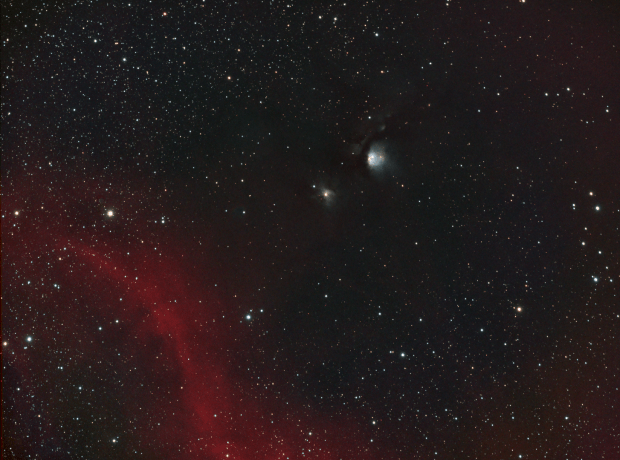
M78 is the brightest diffuse reflection nebula of a group that belongs to the Orion B molecular cloud complex but with an apparent size of 8 x 6 arc seconds it is a something of a challenging target with my equipment. Notwithstanding, with the mono CMOS ZWO camera and the opportunity of obtaining increased integration times I considered it worth a try and was not disappointed with the outcome.
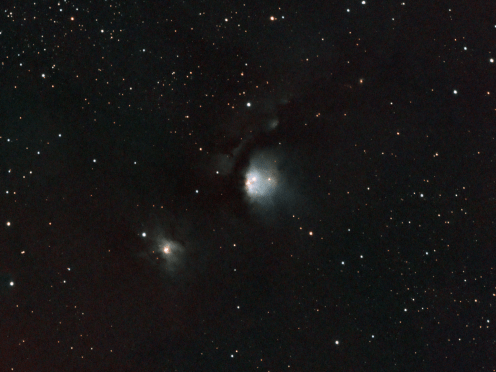
I generally like to present images in their natural orientation but this time I’ve chosen to rotate the it 90o anticlockwise, thus allowing the wider horizontal framing to better show M78 and the dramatic red Ha-light of nearby Barnard’s Loop together. As with M42 previously, I first stacked and processed two exposure sets, short 60 second and long 300 second subs, before then combining them so as to tease out subtleties within the reflection nebula itself and provide greater control of the otherwise dominant Barnard’s Loop. Despite my concerns about equipment and scale, I’m very pleased with the outcome of the main image (top-of-the-page), which beautifully shows off both the aforementioned objects to great effect and has even extracted some of the colour and detail of associated star clusters within and around the nebula. Not surprisingly the cropped version of M78 itself starts to look a little noisy but is nonetheless interesting (below).
After a very unpromising few months, the weather, Orion and my astroimaging took a surprising turn for the better from the end of January. As a result of much longer integration times using plate solving over multiple sessions, combined with varied exposure times and more complex processing, I successfully managed to bag three classic deep sky objects of the Orion constellation – what’s not to like?
| IMAGING DETAILS | |
| Object | M78 Orion reflection nebula |
| Constellation | Orion |
| Distance | 1,350 light-years |
| Size | 8’ x 6’ |
| Apparent Magnitude | +8.3 |
| Scope | William Optics GT81 + Focal Reducer FL 382mm f4.72 |
| Mount | SW AZ-EQ6 GT + EQASCOM computer control & Cartes du Ciel |
| Guiding | William Optics 50mm guide scope |
| + Starlight Xpress Lodestar X2 camera & PHD2 guiding | |
| Camera | ZWO1600MM-Cool mono CMOS sensor |
| FOV 2.65o x 2.0o Resolution 2.05”/pix Max. image size 4,656 x 3,520 pix | |
| EFW | ZWOx8 + ZWO LRGB & Ha OIII SII 7nm filters |
| Capture & Processing | Astro Photography Tool + PHD2 + Deep Sky Stacker & Photoshop CS3 |
| Image Location & Orientation | Centre RA 05:47:37 DEC 00:20:59
Top Left = North Bottom Left = East |
| Exposures | (A) LRGB 8 x 180 sec Ha 10 x 180sec (Total time: 1hr 24 min.)
(B) HaLRG 12 x 300 sec B 17 x300 sec (Total time: 5hr 25 min.) |
| @ 139 Gain 21 Offset @ -20oC | |
| Calibration | 10 x 180 sec & 5 x 300 sec Darks 20 x 1/4000 sec Bias 10 x HaLRGB Flats @ ADU 25,000 |
| Location & Darkness | Fairvale Observatory – Redhill – Surrey – UK Typically Bortle 5-6 |
| Date & Time | 25th 26th 27th February 2019 @ +19.45h |
| Weather | Approx. 8oC RH 60 to 80% 🌙 ½ waning |
 WATCH THIS SPACE(MAN)