As outlined in my last post Horseplay, it seemed like plans for imaging over the winter were going to be completely scuppered this year, with weeks of cloud cover from mid-November through to late January. I was therefore very grateful for three clear nights at the end of January that finally enabled me to carry out my principal winter imaging project of the Horsehead and Flame nebulae in narrowband. Notwithstanding, given the preceding bad weather and the onset of galaxy season, I reckoned that this was likely to be the end of my imaging for a while, which could not have been further from the truth as more than two months of good night skies (on-and-off) then followed.
Although by late February Orion is crossing the Meridian early in the evening, darkness is still prevalent at the same time and with the aforementioned good conditions it’s been a bonus to catch more of Orion’s objects before they finally disappear for the year. I’ve successfully imaged some parts of Orion before with the ZWO1600MM-Cool camera but for various reasons they’ve mostly been short integration times in narrowband. It was therefore obvious that given this unexpected opportunity, on this occasion I should attempt to image everyone’s astrophotography favourite – M42 the Orion Nebula in LRGB.
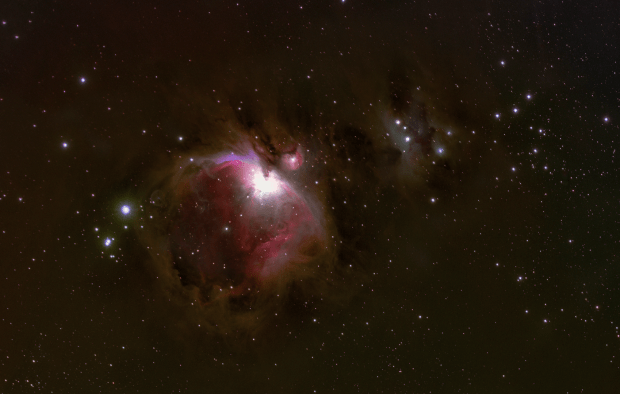
At some 1,500 light years distance, M42 is the closest large star forming nebula to Earth and always holds great promise when imaging. I’d previously obtained some good images of the Orion Nebula with a modded-DSLR camera and more recently a few narrowband images in 2017 showed the promise of using the new ZWO CMOS mono camera. Now with unusually good weather I wanted to try and achieve an image that really showed off M42 and its neighbours M43 and the Running Man Nebula (SH-279) in all their glory, paying particular attention to the more difficult inner structures and associated Ha nebulosity. In order to achieve this I first imaged in HaLRGB at 180 sec exposures with Unity settings for 5½ hours and then at shorter 60 sec exposures for 1 hour over three consecutive nights.


With much longer integration times than before, careful processing and manipulation to bring the long and short exposure images together, I’m very happy with the final result, which I believe achieves most of the aforementioned objectives. Internal structure and colour is shown to good effect but I’m especially pleased with the addition of the Ha data, which dramatically enhances those areas where present together with interstellar dust within and around the main objects; I’m already planning to add more Ha data next year to further intensify the aforesaid impact.
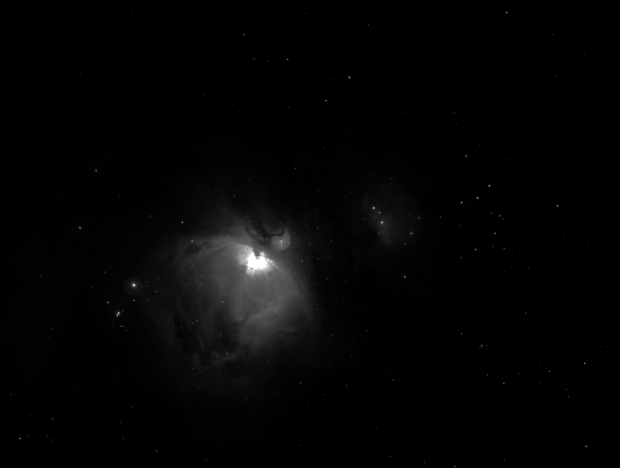
M42 Ha data
Obtaining such results at this late stage of February was completely unexpected and, I thought, would effectively mark the eleventh hour this year for Orion and the rich collection of other DSOs that are found across the winter sky. But no, there was much more to come – watch this space!
| IMAGING DETAILS | |
| Object | M42 Orion Nebula + M43 & Running Man Nebula (SH2-279) etc. |
| Constellation | Orion |
| Distance | 1,500 light-years |
| Size | 65’ x 60’ or 24 light-years (M42 only) |
| Apparent Magnitude | +4.0 |
| Scope | William Optics GT81 + 0.80 x Focal Reducer FL 382mm f4.72 |
| Mount | SW AZ-EQ6 GT + EQASCOM computer control & Cartes du Ciel |
| Guiding | William Optics 50mm guide scope |
| + Starlight Xpress Lodestar X2 camera & PHD2 guiding | |
| Camera | ZWO1600MM-Cool mono CMOS sensor |
| FOV 2.65o x 2.0o Resolution 2.05”/pix Max. image size 4,656 x 3,520 pix | |
| EFW | ZWOx8 + ZWO LRGB & Ha OIII SII 7nm filters |
| Capture & Processing | Astro Photography Tool + PHD2 + Deep Sky Stacker & Photoshop CS3 |
| Image Location & Orientation | Centre RA 05:35:09 DEC -05:08:31
Top Right = North Top = North East Bottom Left = South Bottom = South West |
| Exposures | (A) L 20 x 180 sec R 24×180 sec G 25 x 180 B 24 x 180sec Ha 17 x 180sec (Total time: 5hr 30 minutes)
(B) 12 x 60 sec HaLRGB (Total time: 1hr) |
| @ 139 Gain 21 Offset @ -20oC | |
| Calibration | 10 x 180 sec & 15 x 60 sec Darks 20 x 1/4000 sec Bias 10 x HaLRGB Flats @ ADU 25,000 |
| Location & Darkness | Fairvale Observatory – Redhill – Surrey – UK Typically Bortle 5-6 |
| Date & Time | 23rd 24th 25th February August 2019 @ +19.40h |
| Weather | Approx. 7oC RH <=75% 🌙 ¾ to ½ waning |
 WATCH THIS SPACE(MAN)