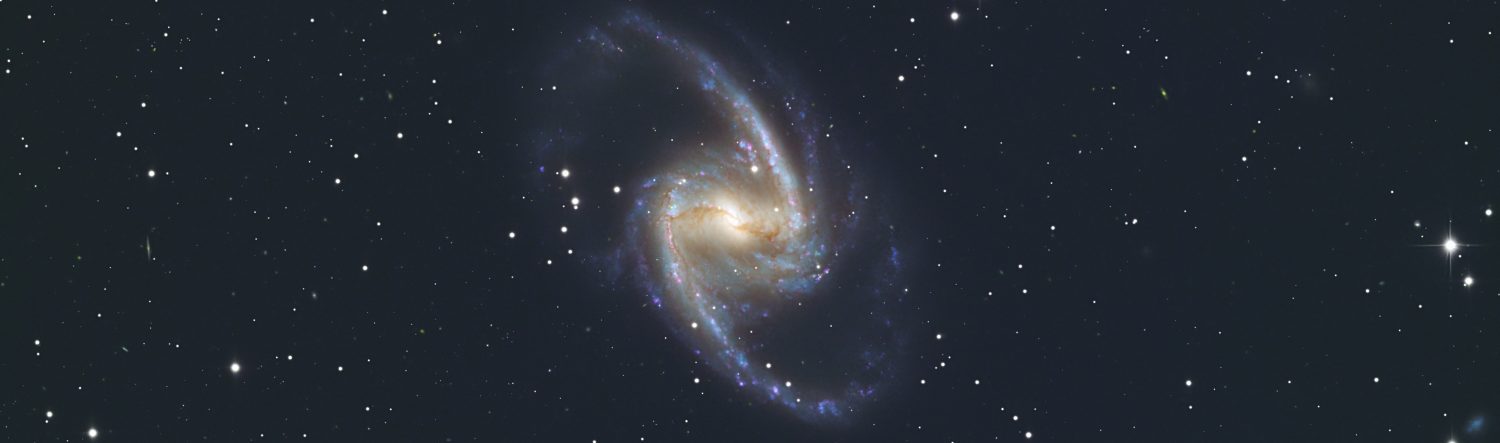
Apart from the simple enjoyment of travel, it often opens the potential for new opportunities and experiences that more profoundly broadens one’s horizons; I’ve travelled extensively during my life which has been enriched accordingly. Earlier this month I visited astrophotographer Oliver (Olly) Penrice at his Les Granges Observatory in the Hautes-Alps region of Provence in France, with the objectives of imaging with a more favourable dark sky and to learn from Olly’s experience.
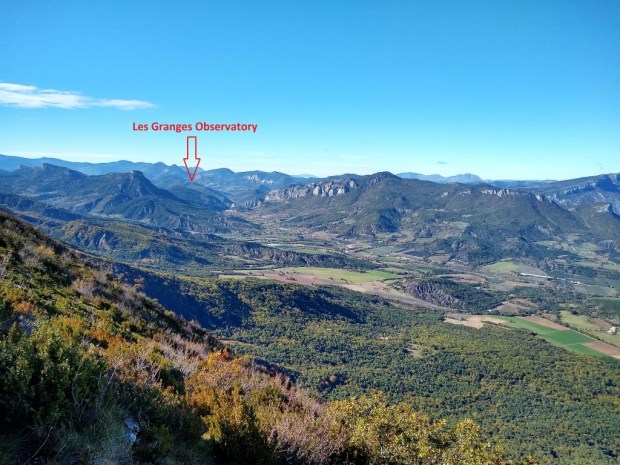
Situated deep in the mountains and very much off the beaten track, Les Granges is in the small (28 people) hamlet of Ètoile-Saint-Cyrice, some way from Peter Mayle’s better known Provence but nonetheless itself interesting and beautiful, with some wonderful geology to boot; after all my wife and I are also geologists.
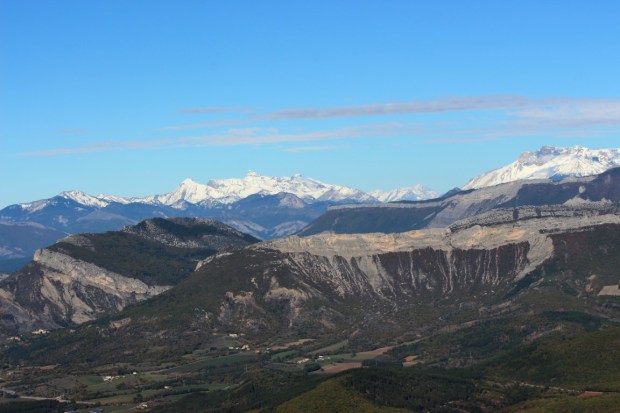
Area immediately north east of Etoile-Saint-Cyrice
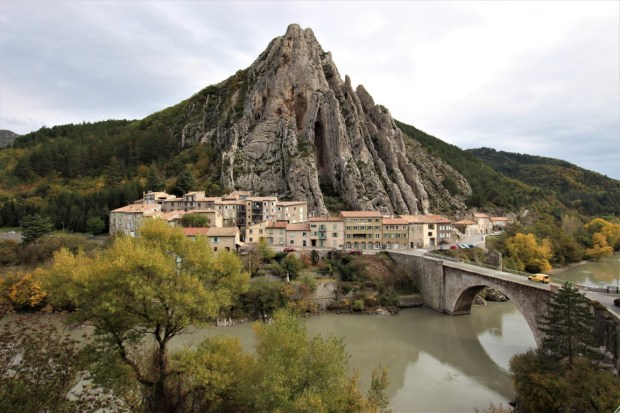
Spectacular monocline rock folding at Sisteron
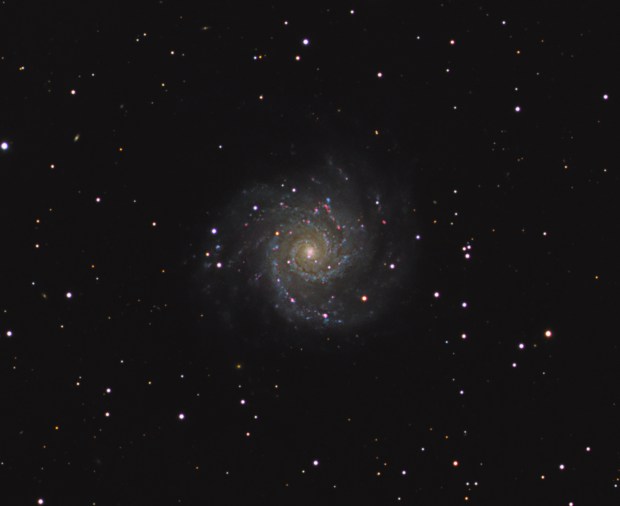
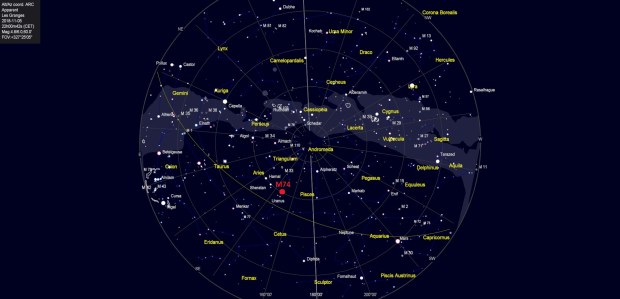
Subject to time and conditions, I particularly wanted to image a target that could not be achieved at home, either because it cannot be seen from my location or is beyond the capabilities of my equipment. Before leaving for France I therefore researched the projected night sky at Les Granges and developed a short list of potential targets, number one of which was a spiral galaxy. At the moment my equipment struggles with these faint fuzzies and I’ve long wished to bag a good image of a ‘proper’ galaxy. With galaxy season still a few months off the choice was limited but it soon became clear that M74, the Phantom Galaxy would provide such a target: it is not commonly imaged, is somewhat faint and difficult to see but is a classic, face-on spiral galaxy – just right for Guy Fawkes Night on November 5th too!
Olly’s imaging equipment consists of a Takahashi FSQ106Ns rig and a more suitable TEC 140 f/7 refractor, which when matched with an Atik 460 CCD camera was just the job for the proposed task. Outstanding night skies at the Les Granges Observatory are commonplace, with SQM values in excess of 22 but it was raining when we arrived and the outlook seemed less than perfect. Notwithstanding, the next two nights were clear in the early evening and so on the first night we managed to obtain 3-hours of RGB subs, followed by nearly 2.5 hours of Ha and Luminance data the following evening. Whilst imaging we also spent time observing, in these conditions Andromeda Galaxy was clearly visible with the naked eye but using the 14″ Meade LX200 which Olly inherited from the late Alan Longstaff other objects such as M27 and M33 came to life in the eyepiece.
Does what it says on the tin – entrance to Les Granges observatory
Sadly the rain returned thereafter and this turned out to be the only window of opportunity for the rest of the week! Thankfully Olly has a vast wealth of data that included some of M74, from which we were able to bolster our meagre data from the first two evenings of imaging the same object.
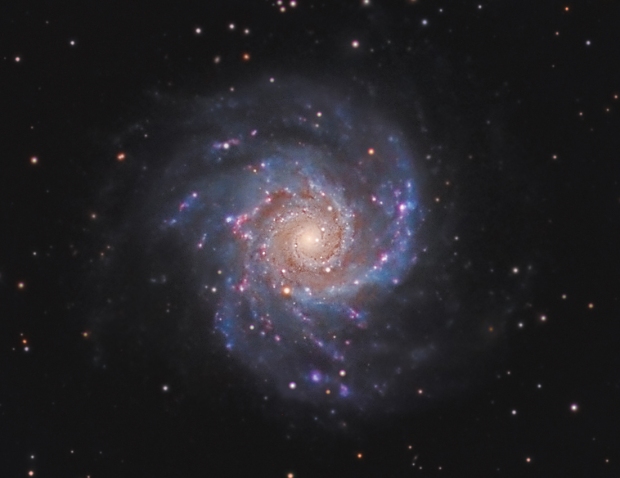
Since returning home I’ve worked on the recently acquired data again and am pleased with the resulting image, shown at the top of the page. In particular, the addition of Ha-wavelength light has brought the galaxy to life where it highlights areas of star formation located within the spiral arms, in the form of distinctive areas of magenta coloured red spots – a characteristic sign of such activity within galaxies. Olly also produced an alternative image by combining data from the aforesaid recent image with additional data previously taken with an ODK 14 inch scope. This resulted in a total integration time of some 17-hours and produced a stunning image of M74 that I’m pleased to say I played a small part in (see below).
It was disappointing that much of the time at Les Granges was spoilt by poor weather but I was able to use some of that time on processing techniques with Olly and just enjoying the wonderful ambiance that comes from being in such a location. I hope to return again some time in order to enjoy the beauty of the area and the night sky that can be seen – when it’s not cloudy. In the meantime, I’m more than pleased to catch some photons from another world of another world, which has resulted in stunning images of a spiral galaxy – at last.
| IMAGING DETAILS | |
| Object | M74 Phantom Galaxy |
| Constellation | Pisces |
| Distance | 30-million light-years |
| Size | 10.5’ x 9.50’ |
| Apparent Magnitude | +10.0 |
| Scope | TEC 140 FL 980 mm f7.00 (+ADK 14”) |
| Mount | Mesu 200 |
| Guiding | PHD2 |
| Camera | Atik 460 CCD Pixels 4.50 ɥm |
| FOV 43.80’ x 35.04’ Resolution 0.96”/ pixel | |
| Capture & Processing | Atik software capture, Astroart pre-processing, PixInsight and Photoshop CS3 post processing |
| Image Location | RA 01:36:41 DEC 15:47:01 |
| Exposures | 6 x 600sec RGB + 5×900 sec L & Ha = 320 minutes @ -20oC |
| Location & Darkness | Ètolie-Saint-Cyrice, Hautes-Alps Provence, France SQM <=21.50 – 22.00 |
| Date & Time | 2nd & 3rd November 2018 @ +20.30h |
| Weather | <=8oC RH% high |
 WATCH THIS SPACE(MAN)