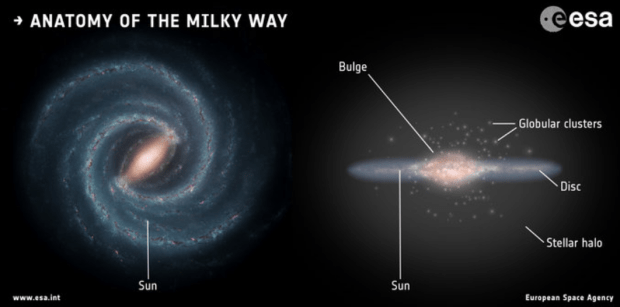
Of all the things I’ve discovered since taking up astronomy, perhaps it is the presence and nature of globular clusters that has most surprised me. Bound closely together by gravity, these massive spherical collections of stars orbit the galactic core perpendicular to its plane. In the case of the Milky Way there are 150 globular clusters but they can be much larger in other galaxies, such as M87 which has some 13,000; clusters of clusters have also now been discovered in the Universe! Typically each cluster might contain a few thousand or tens of thousands of stars, although in some cases they can be much larger. Omega Centauri is the largest globular cluster in the Milky Way, being 150 light-years in diameter it contains 10 million stars; though clearly visible from Earth it can only be viewed from the Southern Hemisphere, which we unfortunately did not see when in New Zealand earlier this year.
Despite all the advances being made in cosmology, the origin of globular clusters still seems to remain quite uncertain. Characteristically the stars are all very old, typically in the region of 8 to 12-billion years and are of low metallicity i.e. they contain a low proportion of elements other than hydrogen and helium. At least some, such as Alpha Centauri, are thought to have condensed from dwarf galaxies and such a process may currently be taking place within the large Magellanic Cloud – which we did see in New Zealand! In other cases it is thought that the clusters have probably originated independently and were subsequently captured by the relevant galaxies. However, their very old age – sometimes nearly as old as the universe itself – origin and relationship to galaxies remains intriguing. For these and many other reasons I personally find globular clusters fascinating, probably more than any other astronomical feature, amazing as they too may be.
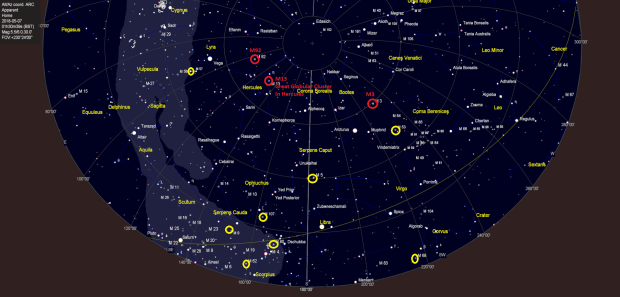
Globular Clusters May 2018: M3, M13 & M92 (red circles) + Others (yellow circles)
From time-to-time I’ve tried imaging various globular clusters but have not been satisfied with the outcome. Now using guiding, plate solving and the high-resolution ZWO1600MM-Cool camera, it was time to give it another try this spring, when some of the best clusters are present in the northern night sky.
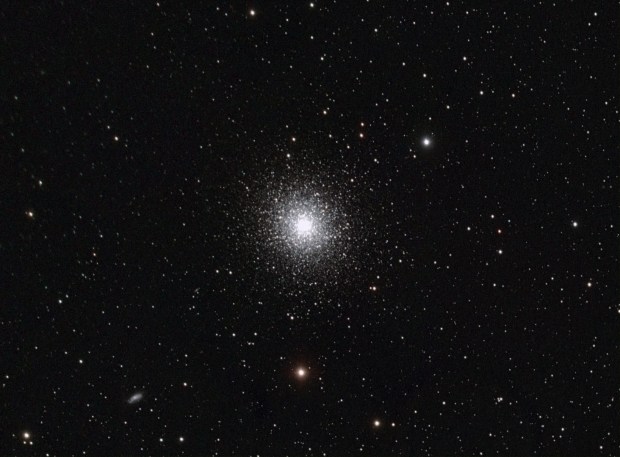
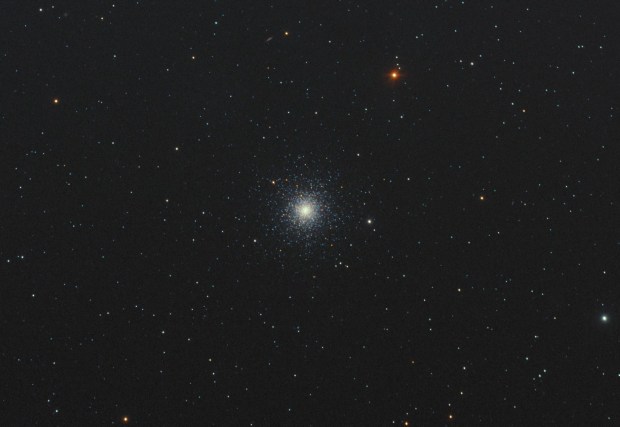
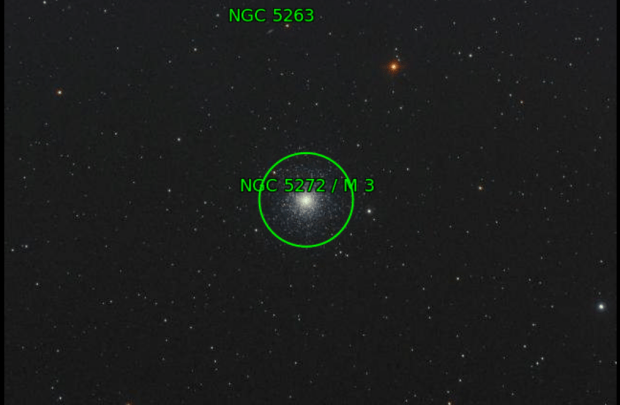
First up was M3 (Final image above), the very first Messier Object to be discovered by Charles Messier himself in 1764. Consisting of 500,000 stars, between 8 and 11-billion years old and spanning some 220 light-years, M3 is one of the largest and brightest (absolute) globular clusters associated with the Milky Way – about 300,000 times brighter than our Sun. It is noteworthy that the cluster contains some 274 variable stars, the highest number of any clusters, as well as a relatively high number of ‘blue stragglers’ – young main-sequence stars that appear to bluer and more luminous than the other stars in the cluster and are thought to be formed through stellar interaction of the older stars.
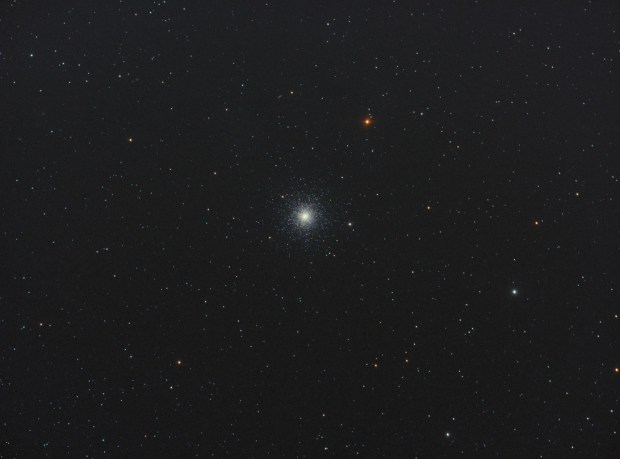
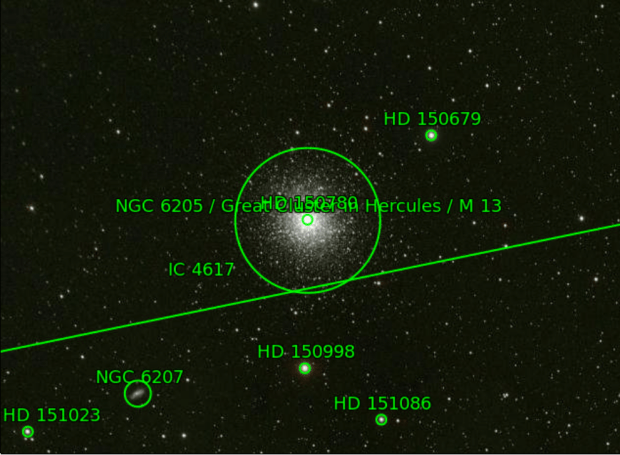
With these attributes it is not surprising that M3 is considered a popular target in astrophotography (cropped image above), likely surpassed however by M13 AKA the Great Globular Cluster in Hercules (cropped image top-of-the-page), which conveniently follows M3 in the same area of the sky about 3-hours later (together with nearby the globular cluster M92). And so having bagged M3 it was time to turn the telescope and camera towards M13 (Main image below). Discovered by the eponymous Edmond Hailey in 1716 (he of Hailey’s Comet), seen from Earth M13 is slightly brighter than M3 with a wide range of star colours that certainly makes for an exciting image. At 11.65 billion years old, M13 has been around almost three times as long as the planet Earth.
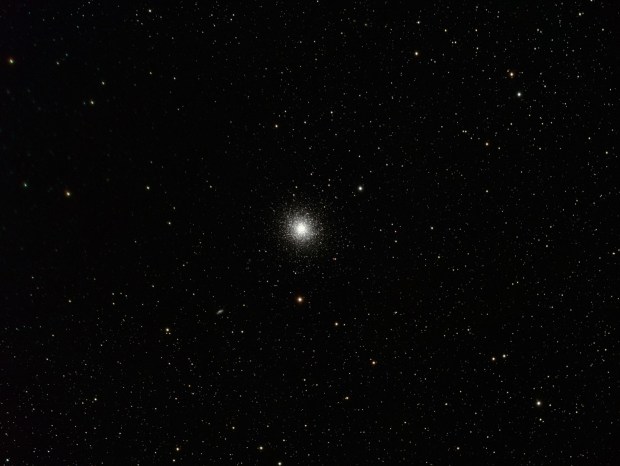
Since starting astrophotography I like to try my hand at imaging a globular cluster at least once each year but hitherto with disappointing results. This time I’m pleased with the outcome, especially M13 which is surely one of the most magnificent objects in our night sky; as a bonus there are also a few galaxies in the background of both the M3 and M13 images too. It is therefore fortunate that for those of us in the higher latitudes of the northern hemisphere the Great Globular Cluster in Hercules can be seen all-year round, though is at its highest and therefore best position between May and September – thereby inaccessible for the Kiwis who are instead compensated by Alpha Centauri! I expect to be back again next year to marvel at these amazing and enigmatic objects, if not before.
| IMAGING DETAILS | |
| Object | M3 (NGC 5272) |
| Constellation | Canes Venatici |
| Distance | 33.9 million light-years |
| Size | 18.0’ or 220 light-years |
| Apparent Magnitude | +6.2 |
| Scope | William Optics GT81 + Focal Reducer FL 382mm f4.72 |
| Mount | SW AZ-EQ6 GT + EQASCOM computer control |
| Guiding | William Optics 50mm guide scope |
| + Starlight Xpress Lodestar X2 guide camera & PHD2 control | |
| Camera | ZWO1600MM-Cool (mono) CMOS sensor |
| FOV 2.65o x 2.0o Resolution 2.05”/pix Max. image size 4,656 x 3,520 pix | |
| EFW | ZWO x 8 + ZWO LRGB & Ha- OIII-SII 7nm filters |
| Capture & Processing | Astro Photography Tool + PS2, Deep Sky Stacker & Photoshop CS2 |
| Image Location | Centre RA 13:42:23 DEC 28:22:50 |
| Exposures | 24 x 180 sec L + 10×180 sec RGB (Total time: 162 minutes) |
| Unity @ 139 Gain 21 Offset @ -20oC | |
| Calibration | 10 x 180sec Darks 20 x 1/4000 sec Bias 10 x Flats LRGB @ ADU 25,000 |
| Location & Darkness | Fairvale Observatory – Redhill – Surrey – UK Typically Bortle 5 |
| Date & Time | 5th + 6th May 2018 @ +23.00h |
| IMAGING DETAILS | |
| Object | M13 (NGC 6205) |
| Constellation | Hercules |
| Distance | >=20,000 light-years |
| Size | 20’ or 150 light-years |
| Apparent Magnitude | +5.8 |
| Scope | William Optics GT81 + Focal Reducer FL 382mm f4.72 |
| Mount | SW AZ-EQ6 GT + EQASCOM computer control |
| Guiding | William Optics 50mm guide scope |
| + Starlight Xpress Lodestar X2 guide camera & PHD2 control | |
| Camera | ZWO1600MM-Cool (mono) CMOS sensor |
| FOV 2.65o x 2.0o Resolution 2.05”/pix Max. image size 4,656 x 3,520 pix | |
| EFW | ZWOx8 + ZWO LRGB & Ha OIII SII 7nm filters |
| Capture & Processing | Astro Photography Tool + PS2, Deep Sky Stacker & Photoshop CS2 |
| Image Location | Centre RA 12:39:59 DEC -11:37:20 |
| Exposures | 20 x 180 sec L + 15×180 sec RGB (Total time: 195 minutes) |
| @ Unity 139 Gain 21 Offset @ -20oC USB 40 | |
| Calibration | 10 x 180sec Darks 20 x 1/4000 sec Bias 10 x Flats LRGB @ ADU 25,000 |
| Location & Darkness | Fairvale Observatory – Redhill – Surrey – UK Typically Bortle 5 |
| Date & Time | 6th + 7th + 9th May 2018 @ +00.30h |
 WATCH THIS SPACE(MAN)
Pingback: Two’s Company | WATCH THIS SPACE(MAN)
Pingback: Photon Factory | WATCH THIS SPACE(MAN)