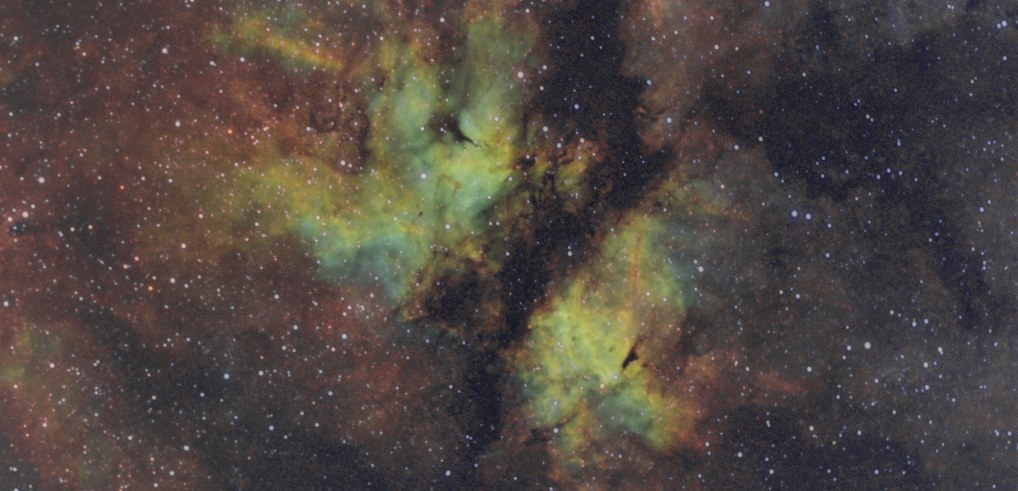
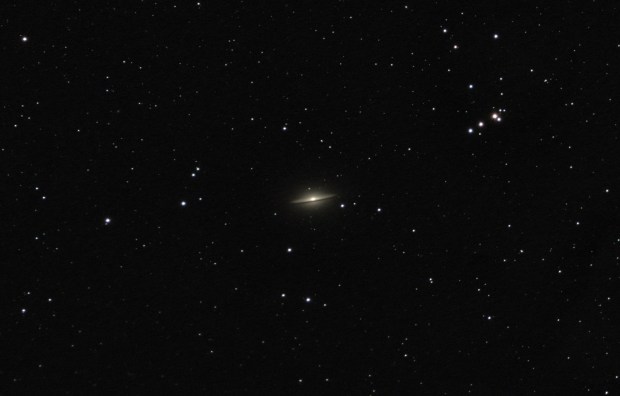
I always had a general interest in astronomy but was eventually sparked into action after viewing Saturn through the Thompson 26 inch refractor at Herstmonceaux observatory in 2014. The beauty of the planet and its unique rings is captivating and like many others it remains my favourite planet to this day. One year on and looking further afield at Joan Genebriera’s Tacande Observatory on the island of La Palma, I discovered what is now one of my very favourite Deep Sky Objects – M104 or the Sombrero Galaxy; until recently I used the resulting picture obtained whilst at La Palma as the main banner image for this website. Though perhaps not as spectacular as the Orion Nebula or certain spiral galaxies, the sombrero-like galaxy (with a passing resemblance of a flying saucer too), is beguiling in its own unique way and ever since then I’ve been eager to return to The Hat and image it myself from home.
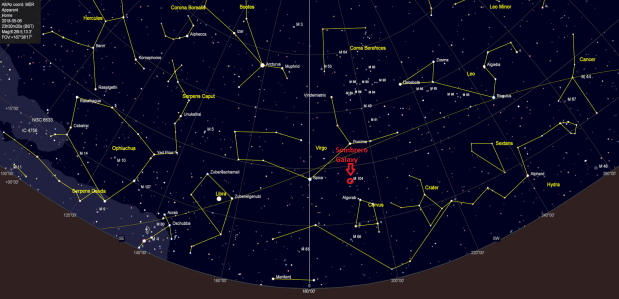
However, imaging the Sombrero from the UK and especially at my location just south of London is quite another matter to La Palma. Aside from light pollution, being at 51o north compared to 28o in La Palma, M104 is considerably lower in the sky when viewed from Fairvale Observatory in Redhill; at the time of imaging in early May it was about 26o above the southern horizon. Furthermore, my sight lines are obscured on three sides by 15-foot hedges and directly south by two 45-foot conifers – see below SE to SW view of M104 imaging track at Fairvale Observatory.
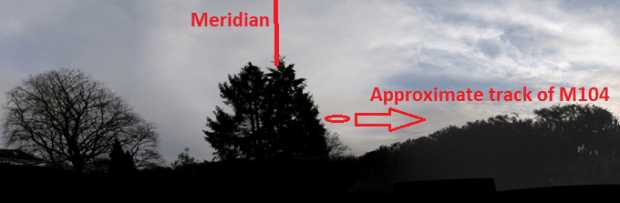
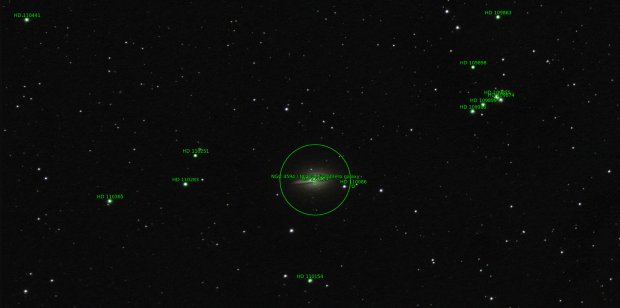
As a result, only after it emerges from behind the western edge of the aforesaid conifers can M104 (just) be imaged, as it moves along the top of the hedge for just over an hour before disappearing from view once again. Of course this is far from ideal but with my enthusiasm for the Sombrero, a high-resolution ZWO1600M-Cool camera and newly acquired ability to plate solve, I gave it a try over three consecutive nights.
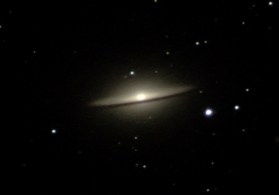
An unbarred spiral galaxy, the hallmark of M104 is its bright bulbous centre encircled by dark dust lanes, which when viewed from Earth tilted at just 6-degrees above the equatorial plane creates the appearance of a sombrero hat (see cropped image above). With the much higher resolution of the Hubble telescope some 2,000 globular clusters have been identified with M104, ten-times that of the Milky Way. In 1912 the galaxy was found to be moving away from Earth at 700 miles per second, providing an early indication that the Universe was in fact expanding in all directions.
All-in-all the Sombrero galaxy is a fascinating and unusual object, though small and all-in-all a challenging imaging target, especially seen from Fairvale Observatory. Notwithstanding, at last I am very pleased to obtain my own exciting image of the Sombrero – chapeau!
| IMAGING DETAILS | |
| Object | Sombrero Galaxy M104 |
| Constellation | Virgo |
| Distance | 29 million light-years |
| Size | 9’ x 4’ or 50,000 light-years |
| Apparent Magnitude | +8.0 |
| Scope | William Optics GT81 + Focal Reducer FL 382mm f4.72 |
| Mount | SW AZ-EQ6 GT + EQASCOM computer control |
| Guiding | William Optics 50mm guide scope |
| + Starlight Xpress Lodestar X2 guide camera & PHD2 control | |
| Camera | ZWO1600MM-Cool (mono) CMOS sensor |
| FOV 2.65o x 2.0o Resolution 2.05”/pix Max. image size 4,656 x 3,520 pix | |
| EFW | ZWOx8 + ZWO LRGB & Ha OIII SII 7nm filters |
| Capture & Processing | Astro Photography Tool + PS2, Deep Sky Stacker & Photoshop CS2 |
| Image Position | Centre RA 12:39:59 DEC -11:37:20 |
| Exposures | 25 x 180 sec L + 3x5x180 sec RGB (Total time: 120 minutes) |
| @ 139 Gain 21 Offset @ -20oC | |
| Calibration | 10 x 180sec Darks 20 x 1/4000 sec Bias 10 x Flats LRGB @ ADU 25,000 |
| Location & Darkness | Fairvale Observatory – Redhill – Surrey – UK Typically Bortle 5 |
| Date & Time | 5h + 6th + 7th May 2018 @ 23.30h approx. |
 WATCH THIS SPACE(MAN)