
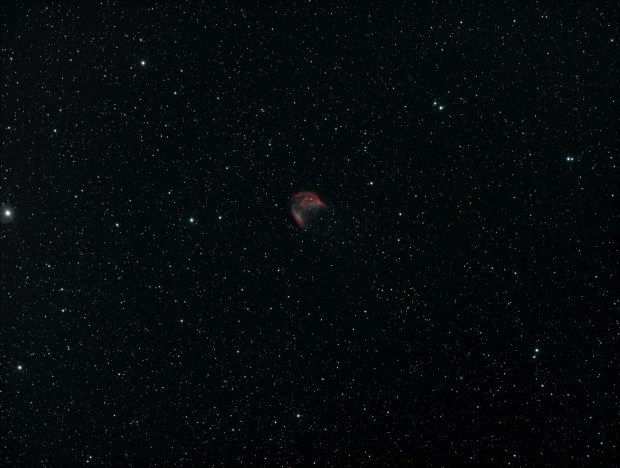
As the winter arm of the Milky Way proceeds inexorably towards the west, I’ve been seeking new objects and was pleasantly surprised to recently discover a small but nonetheless interesting planetary nebula located just to the east of the galactic plane between Canis Minor and Gemini. Consisting of large filaments of glowing ionized gas, the feature goes by the popular name of the Medusa Nebula, after the Greek mythological gorgon figure which has hair of writhing snakes!

Statue of Medusa
Also known as Abell 21 (discovered by George Abell in 1955), Medusa is an ancient planetary nebula some 1,500 light-years away, officially situated within the constellation Gemini. Like its dramatic mythological namesake, the planetary nebula represents the final stages of a low mass star such as our sun in the process of transforming from a red giant to hot a white dwarf star, in the process shedding its outer layers which are illuminated by ultraviolet radiation from the hot star within which powers its glow.

At 4-light years across the Medusa Nebula is a small though reasonable size but with an apparent magnitude of some +15.99 is very faint and is therefore difficult to image. Nonetheless, Ha and OIII gases are prevalent and as something of an experiment I chose to try and image this object at narrowband wavelenghts.
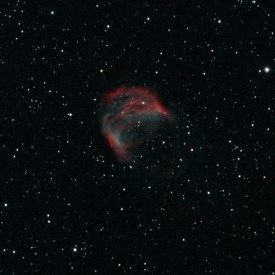
Considering the aforesaid problems I am quite pleased with the outcome (top of page), indeed I was surprised to see I had captured anything. However, given its challenging low brightness and a total integration time of only 75-minutes, the final image was always going to be lacking in detail and noisy (cropped image immediately above). Notwithstanding, now I know of its presence I will surely be returning to The Medusa Nebula on another occasion to improve the integration time and perhaps use a larger telescope to grab those photons which prove elusive to my current equipment set-up.


| IMAGING DETAILS | |
| Object | The Medusa Nebula (Abell 21 / Sharpless 2-274) |
| Constellation | Gemini |
| Distance | 1,500 light-years |
| Size | Approx. 12’ x 9’ |
| Apparent Magnitude | +15.99 |
| Scope | William Optics GT81 + Focal Reducer FL 382mm f4.72 |
| Mount | SW AZ-EQ6 GT + EQASCOM computer control |
| Guiding | William Optics 50mm guide scope |
| + Starlight Xpress Lodestar X2 guide camera & PHD2 control | |
| Camera | ZWO1600MM-Cool (mono) CMOS sensor |
| FOV 2.65o x 2.0o Resolution 2.05”/pix Max. image size 4,656 x 3,520 pix | |
| EFW | ZWOx8 + ZWO LRGB & Ha OIII SII 7nm filters |
| Capture & Processing | Astro Photography Tool, Deep Sky Stacker & Photoshop CS2 |
| Exposures | 10 x 300 sec Ha, 5 x 300 sec OIII (Total time: 75 minutes) |
| @ 139 Gain 21 Offset @ -20oC | |
| Calibration | 5 x 300 sec Darks 20 x 1/4000 sec Bias 10 x Flats Ha, OIII & SII @ ADU 25,000 |
| Location & Darkness | Fairvale Observatory – Redhill – Surrey – UK Typically Bortle 5 |
| Date & Time | 11th February 2018 @ 23.00h approx. |
 WATCH THIS SPACE(MAN)
Pingback: Nice But Dim | WATCH THIS SPACE(MAN)
Pingback: Discover the Mysterious Medusa Nebula (Abell 21) – Henry Carpenter