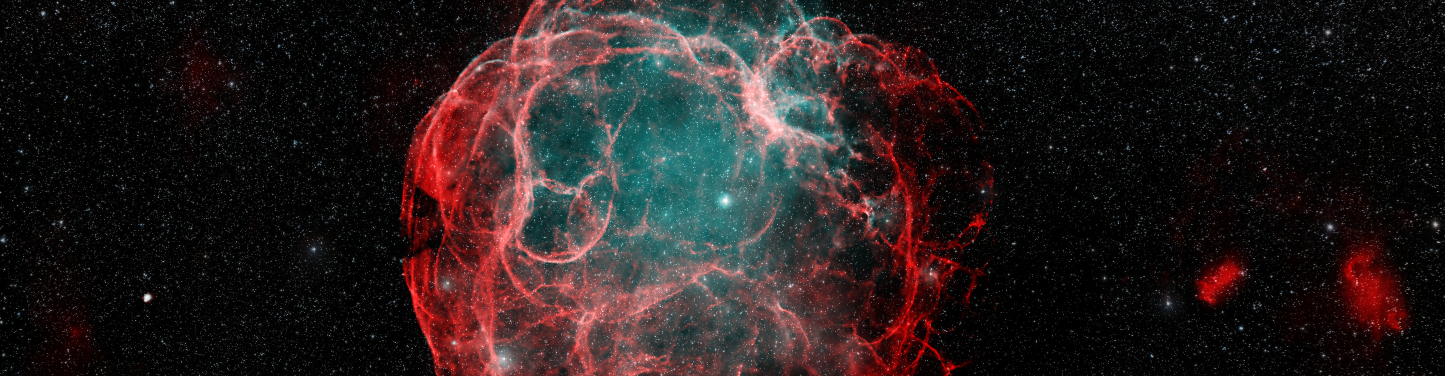

After the fun of December and January provided by the wide choice of exciting DSO objects, February affords a worthy finale to the winter season, in particular within the constellation Monoceros. After successfully imaging the Rosette Nebula on 9th February, a few days later I was able to move on to another nearby HII-region in the Milky Way, with equally good results. Surprisingly it’s been just over 3-years since I last imaged the same part of the sky just before Christmas 2014, on that occasion with an unmodded Cannon 700D DSLR. Now armed with the more capable ZWO1600MM-Cool camera and narrowband filters, the potential for raising the bar was good and the results did not disappoint.
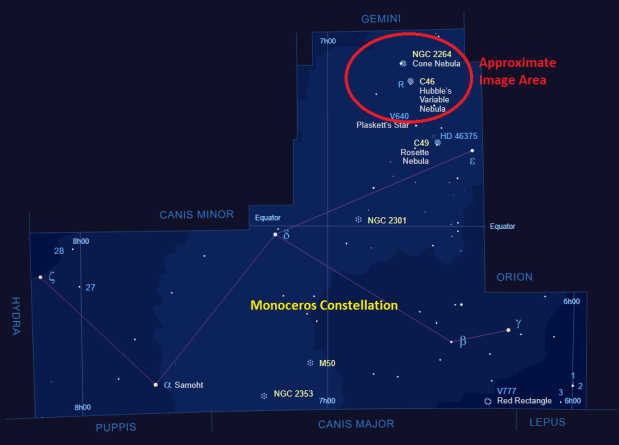
Of foremost interest this time was NGC 2264, which officially describes the Cone Nebula and Christmas Tree Cluster but also includes the Snowflake Cluster and Fox Fur Nebula, all set within a large HII-region. Individually each object is towards the limit of my equipment’s resolution but taken all together makes for an interesting combination when encompassed inside the 2.65o x 2.00o field-of-view. Like the Rosette I chose to image in narrowband, with a total integration time of 90 minutes; again using 300 second subs at Unity gain proved to be very effective – I suspect that only more subs rather than longer exposures would lead to a better outcome but that will have to wait until I’ve sorted how to plate solve, watch this space!
I’ve recently been experimenting in Photoshop using star masks and related sharpening and contrast enhancement methods, which for the first time I applied when processing these images to great effect. Being an HII-region the overall image area is dominated by Ha-light and the processed Ha-subs resulted in a very exciting image at this wavelength, with many subtleties revealed throughout (see below). On the other hand OIII and especially SII wavelengths are much less prevalent, from which it would seem that a higher ratio of those subs would be required to better tease out detail at those wavelengths. Notwithstanding, the resulting Ha-OIII-OIII Bi-Colour image has turned out well (top of the page), with all the aforementioned objects showing clearly.
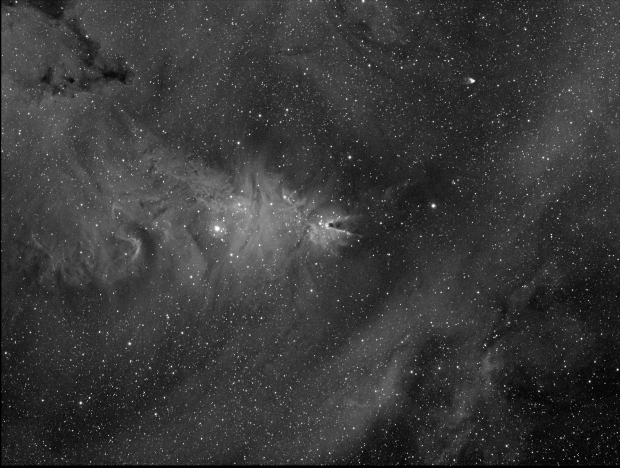
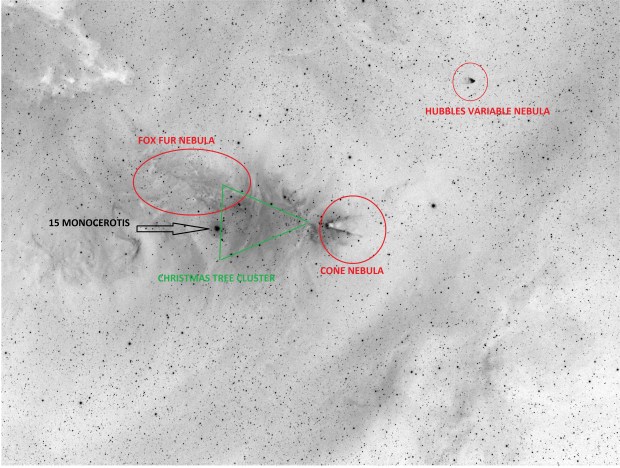
The signature object of this image is probably the Cone Nebula. New stars are forming within a cone shaped dark molecular cloud, itself sculpted by strong stellar winds. However, I consider the Fox Fur Nebula (Sharpless-273) to be the bigger imaging challenge, which I’m therefore pleased to say is starting to show well in these images. The name derives from the rich, fur-like texture of the nebula which is also shaped by stellar winds; reckon The Fox & Cone would make a good pub name! Below: Cone Nebula & Christmas Tree Cluster Ha-OIII-OIII before colour mapping.
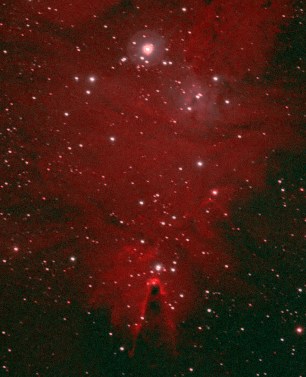
But there’s more. A series of stars form an inverted outline shape of the so-called Christmas Tree Cluster above the Cone Nebula (see image above), with the conspicuously bright 15 Monocerotis at its base made of a massive variable star system. And finally, somewhat off piste, lurking in the top right corner of the main image is NGC 2261 or Hubble’s Variable Nebula. Discovered by Edwin Hubble in 1949, the nebula is illuminated by the unseen R Monocerotis star and forms a small but distinct bright triangular area.
All-in-all this is a great part of the February sky for imaging. There’s still more to discover and I won’t leave it as long as 3-years before going back again, with the objectives of increasing integration time and possible addition of RGB subs to enhance the colour potential.
| IMAGING DETAILS | |
| Object | Fox & Cone Nebulae NGC 2264 + Hubble’s Variable Nebula NGC 2261 |
| Constellation | Monoceros |
| Distance | 2,700 light-years |
| Size | Approx. 54’ x 37’ |
| Apparent Magnitude | +3.9 |
| Scope | William Optics GT81 + Focal Reducer FL 382mm f4.72 |
| Mount | SW AZ-EQ6 GT + EQASCOM computer control |
| Guiding | William Optics 50mm guide scope |
| + Starlight Xpress Lodestar X2 guide camera & PHD2 control | |
| Camera | ZWO1600MM-Cool (mono) CMOS sensor |
| FOV 2.65o x 2.0o Resolution 2.05”/pix Max. image size 4,656 x 3,520 pix | |
| EFW | ZWOx8 + ZWO LRGB & Ha OIII SII 7nm filters |
| Capture & Processing | Astro Photography Tool, Deep Sky Stacker & Photoshop CS2 |
| Exposures | 12 x 300 sec Ha, 6 x 300 sec OIII (Total time: 90 minutes) |
| @ 139 Gain 21 Offset @ -20oC | |
| Calibration | 5 x 300 sec Darks 20 x 1/4000 sec Bias 10 x Flats Ha, OIII & SII @ ADU 25,000 |
| Location & Darkness | Fairvale Observatory – Redhill – Surrey – UK Typically Bortle 5 |
| Date & Time | 11th February 2018 @ 21.00h |
 WATCH THIS SPACE(MAN)