I continue to be very impressed and pleased with the William Optics GT81 triplet refractor and ZWO1600MM-Cool camera combination, which has unleashed an exciting new era in my astrophotography. Still less than one year since acquiring the camera I continue to learn about its features, as well as master the increasing complexity of using a mono camera and filters; I am particularly pleased I waited last year for the release of the larger ZWO x8 EFW and matching 31mm filters. Armed with this new set-up I’m working through my list of favourite targets that were previously imaged with a modded-Canon 550D DSLR, the difference is often nothing less than quite spectacular revealing previously unseen details and colours.


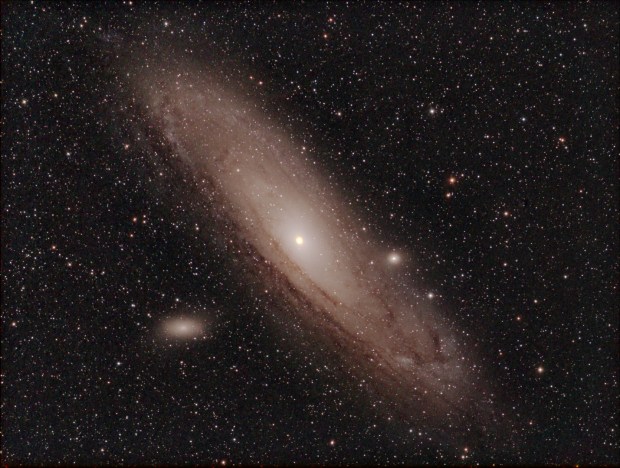
As the autumn equinox approached and the skies darkened again and imaging opportunities have thankfully greatly improved, subject to clear skies of course! Whilst the scope-camera combo is excellent for larger DSO targets and especially nebulae, it is unable to tackle most of the galaxies which are usually small and require greater power than this provides. However, there are a few exceptions, most significant of which arrives here towards the end of August if you are prepared to stay up very late. It is our nearest neighbour M31, the Andromeda galaxy and smaller friends. I think I’ve been quite successful imaging M31 before with a DSLR but now it was time to get to grips with the new camera and LRGB!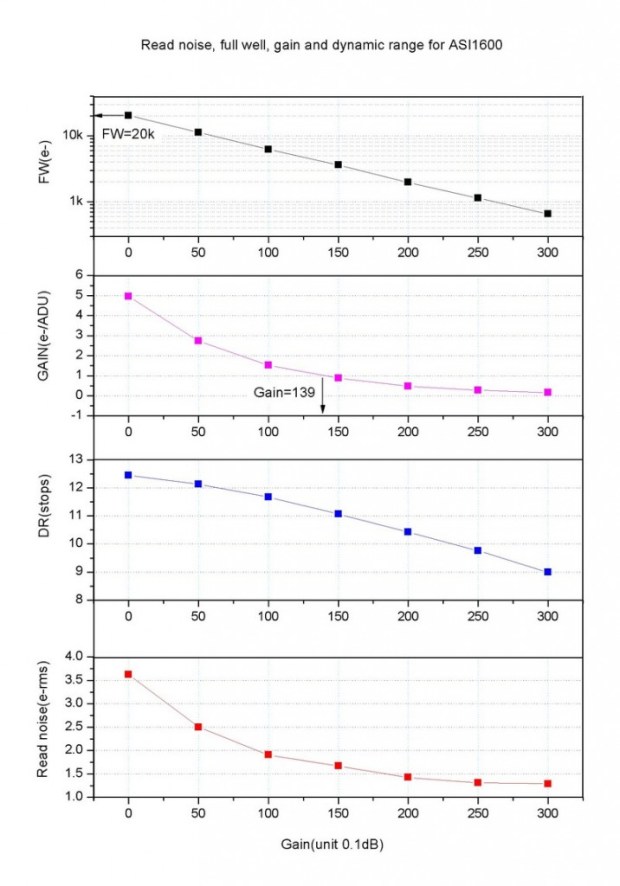
I’m new to the issue of Gain, Offset and ADU and am still experimenting with these settings on the ZWO1600. As the camera performs quite differently to a more conventional CCD sensor, it’s fair to say that most other users, even those with CCD experience, are also on this learning curve. After little more than a year since this revolutionary CMOS-based camera was introduced in the UK, only now are users starting to agree on suitable operating parameters. Unity at 139 and has become the safe Gain setting but many have obtained some exciting results using either high gain and very short exposures or low gain and long exposures. Given its size, apparent magnitude and high contrast core, it was clear that Andromeda was going to pose some new problems with the ZWO camera.
|
GAIN |
OFFSET |
ADU |
| 0 | 10 | 400 |
| 75 | 12 | 550 |
| 139 | 21 | 850 |
| 200 | 30 | 1690 |
| 300 | 50 | 2650 |
Current popular guidance on ZWO1600MM-Cool settings
In view of the galaxy’s characteristics the obvious adjustment would be to reduce Gain but I continued to use my standard setting of 300 and Offset 10; the offset should be higher but for some reason I was initially successful with this level and have also conveniently stored a good set of matching calibration subs too. My initial impression afterwards was that the subs were overcooked, blown-out in the centre and lacking detail in the spiral. Enquires on the SGL Forum seemed to confirm that I needed to turn down the Gain for the core whilst seeking a target ADU count of about 500 to 600. Shortly afterwards I therefore imaged M31 again but this time using two different settings for the core and the spiral: Gain-O Offset-3 + Gain-100 and Offset-17 respectively.
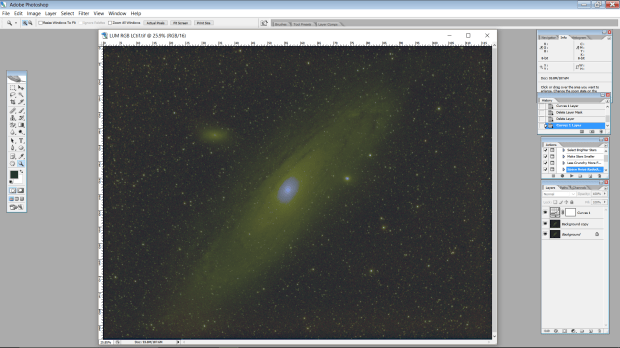
The ‘disc of green mud’ during processing! Clearly lower Gain and Offset settings combined with shorter 30 second exposure was not working.
Despite these changes initial processing of the subs obtained from the second imaging session resulted in an even worse outcome, with the galaxy now looking more like a disc of green mud! As a result I returned to the original subs and with care and perseverance teased a decent image of Andromeda (top of page) – patience and care is everything with astrophotography, if at first you don’t succeed try and try again.
| IMAGING DETAILS | |
| Object | M31 Andromeda Galaxy + M32 & M110 |
| Constellation | Andromeda |
| Distance | 2.5 million light-years |
| Size | Approx. 3.17o x 1.0o or 220,000 light years |
| Apparent Magnitude | +3.44 |
| Scope | William Optics GT81 + Focal Reducer FL 382mm f4.72 |
| Mount | SW AZ-EQ6 GT + EQASCOM computer control |
| Guiding | William Optics 50mm guide scope |
| + Starlight Xpress Lodestar X2 guide camera & PHD2 control | |
| Camera | ZWO1600MM-Cool (mono) CMOS sensor |
| FOV 2.65o x 2.0o Resolution 2.05”/pix Max. image size 4,656 x 3,520 pix | |
| EFW | ZWOx8 + ZWO LRGB & Ha OIII SII 7nm filters |
| Capture & Processing | Astro Photography Tool, Deep Sky Stacker & Photoshop CS2 |
| Exposures | 60 sec 40 x L + 20 x RGB (Total integration time: 100 minutes) |
| @ Gain 300 Offset 10 @ -20oC | |
| Calibration | 5 x 60 sec Darks + 10 x 1/4000 sec Bias + 10 x LRGB Flats |
| Location & Darkness | Fairvale Observatory – Redhill – Surrey – UK Typically Bortle 5 |
| Date & Time | 28th August 2017 @ 00.00h |
 WATCH THIS SPACE(MAN)