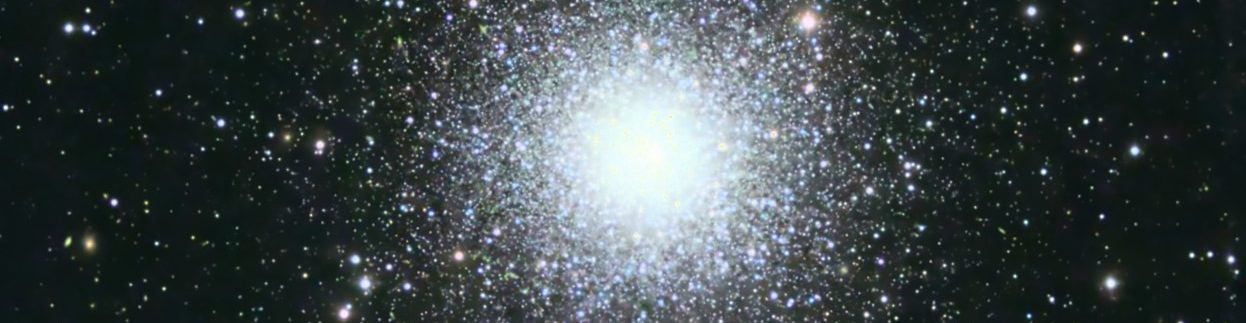

Eastern Veil Nebula NGC 6992 & NGC 6995 in SHO narrowband*
The East traditionally evokes connotations of the exotic and a promise of excitement. This year the late Summer delivered plenty such opportunity for astrophotography combined with long, warm and clear nights, making for a productive and very enjoyable time. Furthermore, this being the first year I’ve owned the mono ZWO1600MM-Cool camera, I’m mostly revisiting objects previously imaged with a modded DSLR and as a result am discovering details of hidden interest and beauty within the new images; on this occasion the object of my desire was the Eastern Veil Nebula in the Cygnus constellation.
Desperate to start re-imaging suitable targets with the ZWO camera, I briefly flirted with the Eastern Veil on the morning of the summer solstice this year. But with limited darkness of any sort and coming just before dawn, imaging time was very limited. I was still pleased with the result which bode well for longer, darker night conditions with the potential for extended imaging time. In June I was only able to capture 18 minutes of Ha and 9 minutes each of OII and SII wavelengths, compared this time with a whopping 30 minutes for each! OK it’s still quite short and for a standard CCD camera might only amount to one or two subs but given the unique sensitivity of the ZWO1600 operating at -20oC – itself a game changer in so many ways – the additional integration time achieved resulted in much more detailed and dramatic images than before.

Eastern Veil Nebula in Ha-OIII BiColour*
For the moment I’m very pleased with the outcome but it’s obvious that greater imaging time holds the prospect of even better images – although such improvements are likely to be less dramatic and more incremental in nature. Due to practical limitations at this site I’m limited to about 2-hours dedicated imaging time each side of the Meridian and will only be able to increase the integration time beyond this barrier by using plate solving, thus enabling meridian flips during a session or cumulative imaging of the same object over different nights. With plenty to learn and enjoy with the ZWO1600 camera, plus Orion already reappearing over the eastern horizon – my personal favourite, this is unlikely to occur before next year. In the meantime, the Eastern Veil points towards a very promising future – Watch This Space!
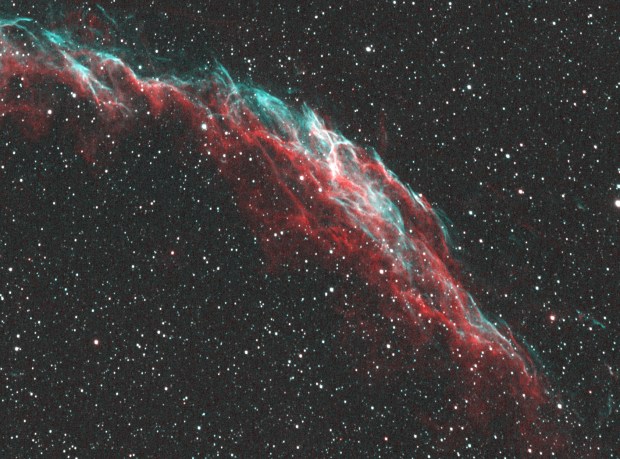 The Eastern Veil Nebula detail in Ha-OIII BiColour*
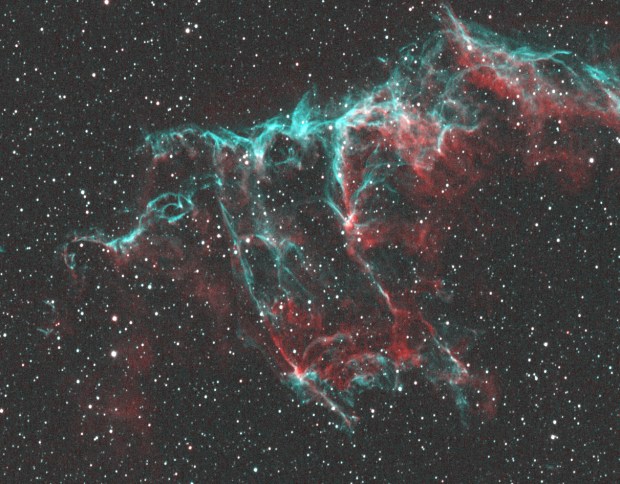
The Bat Nebula IC 1340 detail in Ha-OIII Bicolour*
| IMAGING DETAILS* | |
| Object | Eastern Veil Nebula AKA Caldwell 33 NGC 6995, NGC 6992 & IC1340 |
| Constellation | Cygnus |
| Distance | 1,470 light-years |
| Size | Approx. 80’ vs Total Veil Nebula 3o |
| Apparent Magnitude | +7.0 |
| Scope | William Optics GT81 + Focal Reducer FL 382mm f4.72 |
| Mount | SW AZ-EQ6 GT + EQASCOM computer control |
| Guiding | William Optics 50mm guide scope |
| + Starlight Xpress Lodestar X2 guide camera & PHD2 control | |
| Camera | ZWO1600MM-Cool (mono) CMOS sensor |
| FOV 2.65o x 2.0o Resolution 2.05″/pix Max. image size 4,656 x 3,520 pix | |
| EFW | ZWOx8 & ZWO LRGB Ha OIII SII 7nm filters |
| Capture & Processing | Astro Photography Tool, Deep Sky Stacker & Photoshop CS2 |
| Exposures | 10 x 180 sec Ha, OIII & SII (Total time: 90 minutes) |
| @ 300 Gain 10 Offset @ -20oC | |
| Calibration | 5 x 180 sec Darks 10 x 1/4000 sec Bias 10 x Flats Ha, OIII & SII |
| Location | Fairvale Observatory – Redhill – Surrey – UK |
| Date & Time | 19th August 2017 @ 22.38h |
 WATCH THIS SPACE(MAN)